31/05/02
Last day of the month and several updates done to the World Cup soccer info above. This event starts tonight so be on the look out for feeds and coverage on various channels and let me know where you see it. The list is getting a bit big so I will shift it to its own page soon. Theres a unusual channel running on Pas 8 Taiwanese mux that screens wrestling around the clock including the more well known WWF content. Its called Z Channel and could become quite popular if it stays there. I have done some checking and on Sunday nights Taiwan time they supposedly show major WWF events so look for that if the channel is still there FTA.WWF Smackdown was seen last night at 10 pm hk
Sorry the pics from B1, 12483 V won't go up until tommorow once I have had the chance to convert them. There may be some World Cup feed pics to go up also and the page is needing a trim.
Z channel link http://www.zchannel.com.tw/
Z channel program link http://www.zchannel.com.tw/ver3/v3program.html (try using one of the webtranslator sites)
Super TV link http://www.supertv.com.tw/index.asp
From my Emails & ICQ
From Glenn Gibson
To all the wrestling fans out there.(I'm not but I know a few of you are).
A new C-band channel has been added to the Taiwanese Mux today on Pas 8. (3860H, sr28000,fec 5/6, apid 911, vpid 910). The channel is called Z Channel and it seems to be mostly made up of both Chinese/Japanese shows but mainly a lot of Japanese Wrestling. Today there was quite a few bouts with men and also women. (The women are actually tougher than the guys!). Anyway if you can put up with the constant "I'm horny - Call me now" type adds in between bouts, I suggest you should check it out.
Their website is http://www.zchannel.com.tw/ . I'm sure there must be a program guide in there somewhere but I haven't searched for it yet. ;o)
Cheers
Glenn
From Rambod
Univision is $$$$$ is now encrypted.
Panamsat 2, 169E "Feeds" 4165V Sr 27687 Fec 7/8...For some reason i cant get
them. Maybe Sr change.
Fifa election on Pas 2 Adhoc 1. Also on Dubia sports.
Iran vs Q8 on asiasat 2. IRIB3. Tehran time 11:00 pm.
From the Dish
TDRS 5 174.3W The occasional feeds have left 3763 H and 4000 H.
TDRS 5 174.3W 3727 H The test cards have left .
TDRS 5 174.3W 3808 H "TV Sur" has left .
Intelsat 701 180E 4086 L New SR for the mux is : 12041.
Intelsat 701 180E 10975 H "Loft Story" has started , Mediaguard, SID 2004, PIDs 163/92.
PAS 2 169E 3901 H "Univision is now encrypted".
PAS 2 169E 12480 H "Ihug" has left .( Can anyone confirm this??? or do I have to set up the 90cm on the weekend and try and find Pas 2?)
PAS 2 169E 12474 H "Occasional feeds"?, Sr 6620, Fec 3/4. (this Australia beam?? or have they changed it? can someone check it for feeds?) as this was reported by the same person that report the above
PAS 8 166E 3740 H "MTV China" is Fta still.
PAS 8 166E 4136 V "Net 25" has started Fta, Sr 2344, Fec 3/4, PIDs 308/256. (quite weak this one)
PAS 8 166E 3860 H "Super TV and Z Channel" have started, Fta, PIDs 470/471 and 910/911.
PAS 8 166E 12450 H "Televisa Veracruz" has started on , enc., Sr 4687, Fec 7/8, PIDs 308/256.
Optus B1 160E 12483 V "TV 3, TV 4, Prime TV, Fox 8, TV 1, TVNZ TV One TVNZ TV 2" have started, Irdeto 1, Encrypted, PIDs 512/650-519/657.
Optus B1 160E 12734 V A Saturn TV mux details, Irdeto 1, SR 22500, Fec 3/4,PIDs 512/650-519/657, line-up: Sky Movies, The Living Channel, Sky MovieMax,Hallmark Channel Asia, E! Entertainment TV, Rugby Channel, Sundance Channel New Zealand and The Soccer Channel.
Agila 2 146E 3733 H "Net 25" has left , moved to PAS 8.
Palapa C2 113E 4080 H "Quick Channel has again replaced RAI International 1" Fta on ,,PIDs 512/650.
Palapa C2 113E 4053 H "Bali TV" has started, Fta, Sr 5632, Fec 3/4, PIDs 308/256. (Those settings look like feed settings? can anyone confirm this is there? and if so provide a screenshot?)
ST 1 88E 3632 V The MMBN mux is encrypted in Nagravision, in addition to Viaccess.
LMI 1 75E 12618 V New PIDs for the test card on : 102/103.
PAS 10 68.5E 3797 V "The God Channel" has started, Fta, Sr 3003, Fec 2/3,PIDs 4194/4195.
Intelsat 804 64E 3669 R "TV Africa West and TV Africa South" are now encrypted.
NEWS
Set-top piracy court battle renewed
From http://media.guardian.co.uk/broadcast/story/0,7493,724663,00.html
NDS, the Rupert Murdoch-owned company accused of helping hackers pirate set-top box access cards, will today renew its court battle with Canal Plus over a £700m damages claim.
The News International subsidiary has asked a San Francisco court to throw out claims by Canal Plus, a division of Vivendi Universal, that it illegally supplied codes to crack the cards to DR7.com, a website used by software pirates.
In its court filing NDS launched a scathing attack on the legitimacy of the Canal Plus claim, saying the company "designed its complaint to lay the blame for its financial woes publicly on NDS".
"While examining the truth of those allegations and the dubious connection between them and Canal Plus's ineptitude must wait another day, the time is now ripe to test the legal adequacy of Canal Plus's claims," it said.
The court hearing, which could ultimately see News International pay out up to £2.4bn in damages under US law, is the latest round in a saga that led from laboratories in Israel to hackers in California to car boot sales and markets across Europe.
It has also implicated the upper echelons of News International management, including Mr Murdoch's sons, Lachlan and James, who sit on the NDS board, and was cited as a factor in the downfall of ITV Digital.
Canal Plus claims it has evidence that NDS hackers in Israel deliberately cracked the code to the cards before arranging for Chris Tarnovsky, a west coast NDS employee, to post the codes on DR7.com.
A second witness, Giles Kaehlin, claims Mr Tarnovsky did so on instructions from his NDS superiors, according to court documents.
The former ITV Digital chief executive, Stuart Prebble, blamed some of its ills on a huge piracy problem, which he said lost it an estimated £100m.
ITV Digital's access cards used the Canal Plus technology and were soon widely pirated, allowing viewers to watch movies, sport and other channels without paying. SkyDigital, which uses the NDS system, has no such problems with piracy.
Last month Canal Plus began the process of replacing its 12m cards across Europe but said it was concerned that, unless the case succeeds, the new cards could also fall victim to hacking.
Hallmark Readies Australia Relaunch
From Enews Sky report
The Hallmark Channel will re-launch in Australia effective June 1,
when it will unveil a major celebrity driven program
initiative featuring event nights, theme weeks and new
program start times. The re-launch is designed to provide
the Hallmark Channel with a distinct Australian identity
and a more viewer friendly schedule.
Ten Sports to take soccer to cinema theatres
From indiantelevision.com
Ten Sports is taking the novel route to increasing awareness about the channel in the interiors of the country.
The channel that has secured exclusive rights to telecast the soccer World Cup matches live in India will show certain matches live in select theatres across the country. Says Ten Sports Mumbai marketing head Mohit Mehra, the exercise will supplement the current awareness campaign that has been unleashed in most territories the channel considers its key markets. These include Kolkata, Chennai, Bangalore, Cochin, Coimbatore, Mumbai and Delhi. Apart from hoardings in most citiies, Ten Sports has launched road shows in these cities to create hype around the channel, hoping to cash in on the soccer fever in the country.
It has pressed into service vans decorated with the Ten Sports logo and fitted with television screens which display small demos about the channel and promote the World Cup, since 15 May. The idea, says Mehra, is to hook the cable operator through the common viewer into creating a demand for the product.
Ten Sports has also bought spots on cable television in some areas as well as on AIR FM and private radio stations in Bangalore, Mehra says. The channel has signed on advertisers that include Akai, Coca Cola, Hyundai, Kodak, Onida and Prudential ICICI Mutual Fund. "
World Cup telecast fracas
From http://timesofindia.indiatimes.com/articleshow.asp?art_id=11509961
MUMBAI: The World Cup could be your’s for a steal. With the failure of talks between two of the city’s biggest multi-service providers and Ten Sports (which has the TV rights for the soccer fiesta starting from Friday), cable industry sources say widespread stealing of signals will ensure that the viewer does not miss out on Beckham’s benders and Ronaldo’s dream runs.
Several operators said on Thursday that they would illegally hook up with genuine feeds just before the opening ceremony and shut off after the matches are over each day. Regional head of Ten Sports Alok Govil, however, says it has taken “enough precaution’’ to stub out mischief.
Among the city’s three leading multiservice providers (MSOs), two—Hathway and InCable—seem resolved not to sign the contract under the channel’s current demands.
However, most Siticable operators have signed. Two smaller players, Rajesh Cable and Seven Star, also have signed up. Seven Star’s pockets of influence are Santa Cruz, Juhu, and Vile Parle up to Goregaon. Rajesh has some grip on Ghatkopar.
Siticable dominates Ghatkopar, Powai, Matunga, Dharavi, Sion, Mulund and and Dadar. InCable is spread all over, as is Hathway, with its strong presence in south Mumbai, Malad, Chembur and Thane.
While Ten Sports is believed to have climbed down from its initial demand of Rs 15 per consumer per month to Rs 10, it is asking MSOs to declare the same subscriber base as they do with ESPN/Star Sports.
Hinduja’s InCable, for instance, has been asked to declare 2 lakh connections, while Hathway, of which WinCable is a part, has been asked to declare close to 1.5 lakh homes, says an insider. But InCable is not willing to declare more than 50,000-60,000 subscribers at the moment, he said.
?The ball is in their court.We cannot go back to the consumer again and again asking for more,’’ says Rajiv Vyas, president of InCableNet. Operators feel Ten Sports will climb down at the last moment for the sake of reach and advertisers.
However, the channel says that if MSOs don’t bend, it may go directly to the operators. “We have tried our level best. Mumbai has 2.5 million connections.We are not even getting 15 per cent of that,’’ says Mr Govil.
The channel is unlikely to sell rights to Doordarshan. B4U has bought delayed rights for the opening and closing ceremonies, the semis and the final.
Firms asked to give pricing of FTA channels
From http://timesofindia.indiatimes.com/articleshow.asp?art_id=11514547
NEW DELHI: The government has asked broadcasters and cable representatives to come out with a pricing structure for subscribers, regarding free-to-air (FTA) channels.
Broadcasters plan to suggest a price of Rs 50 per month per household for FTA channels. However, Multiple Service Operators (MSOs) said this should be Rs 100 a month. This is part of putting conditional access system (CAS) in place.
While the CAS debate continues, some broadcasters are looking at direct to home (DTH) television service as a complementary service to CAS. Many players are negotiating with the government to relax DTH regulations for smooth implementation of this business.
Zee Telefilms did not rule out foray into DTH. ‘‘We are very closely looking at DTH service,’’ said a senior company official. Star has already expressed interest to enter into the DTH platform.
Even though a DTH project entails an investment of around $400 million, broadcasters are considering it to get a direct access to the end-consumer, bypassing cable operators.
Industry watchers said government should not lose grip in mandating CAS, but maintained that DTH policy should be relaxed to create a competitive environment with CAS.
Broadcasters said government’s intention behind CAS was good, but it didn’t solve the problem of under-declaration of subscribers (not giving the exact numbers) from cable operators. This under-declaration happen in metros due to alleged political and underworld influence, they added.
?‘It is difficult to monitor CAS since signals can be stolen from analog boxes easily, reaching end-consumers through an alternative pipe,’’ alleged one broadcaster. While CAS service may begin with analog boxes, DTH need digital boxes.
Sources said the equity regulation is making DTH a non-starter. The government has put in a restriction that no broadcasting or cable network company shall own more than 20 per cent equity as a DTH licensee.
Hollywood Movies Playing On Your Cable TV Soon
From http://www.financialexpress.com/fe_full_story.php?content_id=10056
Mumbai: In a major breakthrough, movies from major Hollywood studios will be available for cable TV viewing for the first time in the country.
Indo Overseas Films, who are importers of English movies in India, have joined hands with Mumbai-based Live Satellite Media to form Diskovery Movie Club to distribute English films to cable operators across the country for screening on their networks.
The company has procured 7-year cable TV rights to 900 English movies and plans to increase it to 2,000 by December-end.
?We have cable TV rights to movies from MGM, Warner Brothers and Universal, besides other independent producers. Cable operators can now officially show them on their networks,” said Ashish Choudhary, one of the promoters of Live Satellite Media.
Major Hollywood studios like 20th Century Fox and Paramount, however, are yet to part with cable TV rights.
Cable operators have been showing pirated videos, though there has been a drastic reduction in such instances after the seven big Hollywood studios got together to combat piracy.
?The major studios are reluctant to part with their cable TV rights. We have 150 movie rights for cable TV from independent producers. But no major titles are available for purchase,” said Ultra managing director Sushil Agarwal.
Diskovery Movie Club will get a royalty for supplying official software in terms of VCDs/VHS tapes to run on their local cable channel. The royalty charges have different slabs, depending on the size of the cable network.
For operators who have up to 2,000 points, the fee will be Rs 8 per subscriber a month. The charge for those who have connectivity between 2,000 to 5,000, the fee is Rs 7 per point, while those who have above 5,000 points will have to pay Rs 6 per subscriber.
The minimum charge for cable networks having less than 200 points has been fixed at Rs 2,000 per month.
The company is targeting 1,000 headends across the country in the first year of operations. “We will be offering two movies a day. There will be adult movie content, too,” said Mr Choudhary.
The software includes fast action movies, thrillers, comedies and children’s classics. DMC also offers to cable operators popular serials, adventure shows, wildlife videos, cookery shows, documentaries, exercise videos and cartoons. It has acquired rights to animation classics from Paris-based BKN International. The cable operators will be allowed to run local ads on their channel as a source of revenue.
30/05/02
Some interesting activity on B1 for those in NZ that noticed it yesterday, B1, 12483 V and 12734 V both muxes were FTA and those mystery S03 etc labled freqs are no longer a mystery. See the from the dish section for the details. What was interesting for me was to see Australian pay tv channel Fox8 and Tv1. Gee what a lot of adverts! No wonder people try and hack it. Anyway it all encrypted again 3pm NZ but you can see the pictures down below. These services are there to link to Telstras cable headend in Christchurch.
From my Emails & ICQ
From "Siam Global"
Subject: mcm
MAY WE ADD TO YOUR ADVICE FOR MR JONED ON THE SITE TODAY ?
WE CANNOT RECEIVE KU BAND FROM (ANY) PAS SATS IN BANGKOK EVEN ON 12 FT DISH SO DOUBT HE COULD FROM MALAYSIA. CHEAP KU/C COROTORS WITH L/R &V/H MADE IN TAIWAN ARE AVAILABLE NOWADAYS, SO HE COULD GET ONE OF THESE FOR AROUND $150 WITH THE 2 LNB'S REQUIRED BUT HIS RECEIVER WILL NEED SKEW CONTROL.TO OPERATE IT . HE WILL HAVE NO PROBLEM RECEIVING MCM IN MALAYSIA. (IN FACT THE KU LNB IS MORE EXPENSIVE THAN THE COROTOR !) SIAMGLOBAL BKK
From Bassett
Could some bright bastard out there tell me why I can no longer watch Now
TV,, Asiasat 3s 3760 H 26000 7/8.. Yesterday it played away no trouble,
today, stuff all.. I can get it to load , on differant receivers. Loads on
Nokia in about 20 secounds, But will it lock and play.. Will it buggery,
Theres bags of signal, Last week I had it playing on a 2 mitre solid dish ,,
I don,t really want to watch it, It just pisses me off that I can't. And
Don't tell be that you live 5 Ks from the GPO and your getting it on a 90cm
That I don't need to hear..
From Ren
B1, 12734V Screenshots


The Living Channel, Sky Movie Max, Hallmark


E!, Sundance, Sky Movies


The Rugby Channel, Worldcup Soccer Channel
(Craigs comment, Good work excellent Nokia screenshots, tommorow I hope to have time to put up the shots I did off 12483V)
From Peter Berrett
He notes the French tennis Open is on I701 RFO and Tele Nouvelle Caledonie
From Elena
Hi Craig,
well, just been looking through ur website... great!
in the secction of world cup, I got some info that might interest u
4026V, 22000, 3/4
169's both MUCH TV and Era News channels will be covering all 64 live soccer matches(unless they dissapear)
http://worldcup.eracom.com/tvtime-01.asp the schedule, it's in chinese... as well as the commentadors speaking in mandarin... oh it's in taiwanese time as well. sadly i can't watch it... i got the info from a popular taiwanese TVRO site.
From the Dish
PAS 8 166E 3860 H "Z" ? Sr 28000 Fec 5/6
PAS 8 166E 3740 H "MTV China" is now encrypted.
PAS 8 166E 12410 H "Venus-Eye" New SID is : 101.
Optus B1 12483 V Sr 22500 Fec 3/4, all Irdeto and Encrypted
"S03" vpid 512 apid 650 pcr 135 sid 3 pmt 258 "Tv3" 544x576 192k J/S
"S04" vpid 513 apid 651 pcr 139 sid 4 pmt 259 "Tv4" 544x576 192k J/S
"S05" vpid 514 apid 652 pcr 140 sid 5 pmt 260 "Prime" 544x576 192k J/S
"s17" vpid 517 apid 655 pcr 143 sid 17 pmt 264 "Australian Tv1" 544x576 192k J/S
"s65" vpid 518 apid 656 txt 576 pcr 144 sid 65 pmt 267 "Tvnz Tv1" 720x576 192k J/S
"s70" vpid 519 apid 657 txt 577 pcr 145 sid 70 pmt 268 "Tvnz Tv2" 720x576 192k J/S
"s71" vpid 515 apid 653 pcr 141 sid 71 pmt 261 "Fox8" 544x576 192k J/S
"s72" vpid 516 apid 654 pcr 142 sid 72 pmt 262 "Saturn Choose" 544x576 192k J/S
"code" apid 654 pcr 142 sid 81 pmt 271 "audio" unknown
Optus B1 12734 V Sr 22500 Fec 3/4, all Irdeto and Encrypted
"s11" vpid 513 apid 651 pcr 129 sid 11 pmt 256 "The Living Channel" 544x576 192k J/S
"s12" vpid 514 apid 652 pcr 131 sid 12 pmt 258 "Sky Movie Max" 544x576 192k J/S
"s14" vpid 515 apid 653 pcr 131 sid 14 pmt 259 "Hallmark" 544x586 192k J/S
"s15" vpid 516 apid 654 pcr 132 sid 15 pmt 259 "E!" 544x576 192k J/S
"s16" vpid 518 apid 655 pcr 134 sid 16 pmt 260 "Sundance" 544x576 192k J/S
"s23" vpid 512 apid 650 pcr 128 sid 23 pmt 264 "Sky Movies" 544x576 192k J/S
"s25" vpid 517 apid 655 pcr 133 sid 25 pmt 268 "Rugby Channel" 544x576 192k J/S
"s97" vpid 519 apid 657 pcr 135 sid 97 pmt 272 "WC Soccer Channel" 544x576 192k J/S
"t80" 655 pcr 133 sid 80 pmt 271 "radio" unknown
ST 1 88E 3632 VAll channels in the MMBN mux are now encrypted in Viaccess 1,except BBC World, CTV and FTV Entertainment.
For those Greek TV Fans without Tarbs http://www.lyngsat.com/livetv/Greece.shtml
NEWS
BBC forces viewers to record its new sitcom
From http://www.telegraph.co.uk
The BBC was accused yesterday of Orwellian tactics after digital video machines in thousands of homes were switched on remotely to record Caroline Aherne's new sitcom Dossa and Joe. The move was described as the equivalent of junk mail.
Many of the 50,000 households that own TiVo machines awoke on Friday to discover that the 30-minute programme had been downloaded on to their recorders without having asked for it.
It is the first time a broadcaster has used the new technology to try to boost audiences for a show.
TiVo's selling point is its ability to "remember" to tape viewers' favourite programmes and similar shows, based on a list of preferences. However the BBC sent Dossa and Joe to all the machines regardless of preference.
Almost 1,000 messages have been posted on a web forum for TiVo users, many complaining that such "foul-mouthed rubbish" had been imposed on them.
Some were unhappy that they missed the start of the Ten O'Clock News last Thursday because the machine was still recording Dossa and Joe on BBC2. Others accused the BBC of breaching the 9pm watershed because children could watch the programme the next day.
TiVo is one of a new generation of digital video machines that record programmes on hard disk rather than tape. The BBC was able to send the episode because the machines are linked by telephone to a central database.
The BBC has high hopes for Dossa and Joe, about a retired Australian couple and starring the former Neighbours actress Anne Charleston. But the comedy, Aherne's first series since The Royle Family, has attracted fewer than 1.5 million viewers.
Granville Williams, of the Campaign for Press and Broadcasting Freedom, said: "This is an unwanted and unrequested intrusion into people's lives.
"Consumers were told that TiVo would give them greater control, yet exactly the opposite has happened here. Someone has decided, 'This is what you want to watch.' "
(Craigs comment, is this the digital tv equivalent of email spamming?)
Europe Online SkyBooster DSL Satellite Surfing Up to 768 Kbps Now Available Across Europe
From satnewsdaily
Europe Online Investments S.A. has announced that its EOL SkyBooster DSL-like satellite surfing service, with speeds of up to 768 Kbps, is now available Europe wide for 3.9 cents per minute. The EOL SkyBooster service is compatible, with the newly released Europe Online version 1.6 Multimedia Software (see accompanying Press Release) for use with all DVB-PCI cards manufactured and distributed by Hauppauge, TechnoTrend and Technisat.
With the new EOL SkyBooster service, users can profit from the advantages of DSL-like surfing via satellite. Heavy web pages load within an instant and multimedia applications (Flash, Video) run seamlessly and smoothly. “SkyBooster is the ideal "satellite" alternative for DSL-like surfing, exclusively for EOL users, particularly in areas without terrestrial DSL coverage,” declared Candace Johnson, Europe Online Investments’ President.
.urope Online’s special introductory offer includes 10 hours of surfing at up to 768 Kbps for only 24,90 Euros per month. Heavy surfers can go for the 20 hours at 39.90 Euros per month option. Surfing after their monthly allowance costs only 3.9 Cents a minute. The EOL SkyBooster also comes with an automatic time-out so that users do not need to worry about keeping time and saving money while they are satellite surfing.”
?The entire offer with fast surfing, fast downloading offline, great music with MTV live, wonderful films with EOL's video on demand, interactive games, free-to-air digital television and an Elert email notification creates a digital, interactive broadband world par excellence,” concluded Candace Johnson.
Strategy Analytics: Asia-Pacific Set-Top Box Sales Reach $1.1bn
From satnewsdaily.com
Sales of digital TV set-top boxes will soar by 54% to $1.1bn this year in the Asia-Pacific region, according to the latest research from Strategy Analytics. The report also predicts that China will become the largest market in 2005, overtaking the current leader, Japan.
These findings are presented in research published recently by Strategy Analytics within its strategic advisory service, Broadband Device Strategies.
This year's market is being driven by demand for new satellite services in Japan and South Korea. Two million digital satellite set-top boxes will be sold in Japan this year, and a further 400,000 in South Korea.
Because of the fragmentation of the regional cable TV industry, satellite set-top boxes continue to dominate the market, accounting for 85% of sales in 2001. However, the report predicts that this will change as the cable market matures. By 2008, cable is expected to be the dominant platform, accounting for 58% of annual shipments.
"China remains the unknown factor," says Peter King, Director of the Strategy Analytics Broadband Device Strategies service. "If aggressive plans to upgrade China's 100 million cable homes are implemented, the Asia-Pacific market will undergo a fundamental shift over the coming years."
The report offers a cautious outlook for digital terrestrial television (DTTV). Standards and rollout plans have still to be finalized in many markets, and about the feasibility of developing successful DTTV business models.
Strategy Analytics, Inc., a global research and consulting firm, provides timely insights and strategic business solutions, to technology companies operating at the convergence of information, communications and entertainment.
Ten Sports announces new CATV distribution agreements taking C&S penetration to 18 million TV homes
From indiantelevision.com
The major bugbear for new sports broadcaster the Bukhatir-promoted Ten Sports has been the lack of penetration in cable and satellite TV homes in India. That seems to be slowly becoming less of a sore point going by the announcement made this evening by Taj Television (the parent company of Ten Sports) chief executive Chris McDonald.
McDonald said in a press release issued late this evening that large MSOs such as RPG Netcom in Kolkata, Asianet in Kerala and Hathway in Bangalore and Chennai, have all begun airing Ten Sports as of today "With these systems signing on, the national networks of Hathway, Win Cable and Siticable are showing Ten Sports except for a few isolated pockets, which are expected to sign up in the next 24 hours," the press release stated.
McDonald added that the distribution tieups with these MSOs means that Ten Sports penetration across India now stands at 18 million homes, and is expected to go up further in the next two days, as the 2002 FIFA World Cup fever increases in intensity.
(Craigs comment, it's been interesting following this new startup 10 Sports channel in just a couple of months they have gone from 0 to 18 million viewers, I wonder how they will go once the World Cup finishes)
B4U, DD ink deal on FIFA World Cup telecast
From indiantelevision.com
B4U Networks and Doordarshan thrashed out an agreement today that clears the way for the deferred telecast on DD of four matches and a daily highlights capsule.
B4U's chief distribution officer Debashish Dey said this evening the contract had been signed and delivered. Queried as to the placement cost rate that had been thrashed out, Dey would only say that it was much, much lower that the Rs 250,000 per half hour that DD had reportedly sought.
The telecast schedule is as follows:
Opening ceremony and opening match - 31 May, 11:30 pm onwards .
First Semi-Final - 25 June, 11 pm onwards.
Second Semi-Final - 26 June, 11 pm.
Final and closing ceremony - 30 June, 11 pm.
One-hour daily capsules - 11 pm.
On Fridays the daily capsule will be telecast after the weekend feature film.
Queried as to what B4U hoped to get out of the deal, Dey said: This is a very big brand equity exercise for B4U.
Broadcasters Want Basic Tier Charge For Free Channels Capped At Rs 45
From http://www.financialexpress.com/fe_full_story.php?content_id=9972
Mumbai: Broadcasters have suggested to the government that the basic tier package of free-to-air channels should cost the subscriber not more than Rs 25 to Rs 45 a month.
The multi-system operators (MSOs), on the other hand, want a much higher price of Rs 150, citing the investments required to run operations. The meeting, which was chaired by joint secretary of information and broadcasting Mr Rakesh Mohan on Tuesday, had representatives from broadcasters and cable operators to get feedback on how the conditional access system can be implemented.
Said INCablenet president Rajiv Vyas, “The government wanted to take inputs on pricing for the basic tier from all the stakeholders of the value chain, based on the break-up of costs. We indicated a break-even cost of Rs 150.”
A higher price for basic tier, broadcasters felt, would thwart the basic purpose of keeping prices for cable TV viewing more affordable. Besides the basic service, consumers would have to bear the expense of the pay channels they wanted to watch. “The whole exercise is to make consumers pay less. The purpose of CAS will get defeated if the basic tier alone is so costly,” a representative who attended the meeting said.
As per the current data, there are 38 million cable TV homes. Broadcasters are paid for just 5-6 million homes. The average price for the service is Rs 100 in the country. “If we do a calculation taking these factors into consideration, the price for the basic tier should be much lower than what is currently prevailing,” the representative added.
Analysts said it is in the interests of pay-TV broadcasters to suggest a low basic tier package of free-to-air channels. A lower basic subscription rate would obviously provide room for viewers to subscribe to a greater number of pay channels. Star India chief executive officer Peter Mukerjea said consumers were paying for artifically high prices because of under-declaration of subscriber base by cable operators. “We have told the ministry that we would reduce the price for the Star bouquet in return for actual declaration of subscribers by cable operators,” he added.
Mr Mohan said a second meeting would take place after a week.
29/05/02
Testing continues on B1, 12706V Sky has moved National Geographic and Discovery channel there. 18 "services" are listed on this transponder but not with proper names WCTL-1-8 Discovery and Nat geo are named corectly and have an EPG. The Living channel and Worldcup soccer channels have been added.
Has anyone found a feed of the French Open Tennis?
From my Emails & ICQ
From Mohammad joned
Subject: Polarity Problem
I live in Kuala Lumpur, I can do scanning digital tv channel which used the H/V polarity easily. Unfortunately, I fail to obtain digital satellite tv channel those used L/R polarity. Craig, what can I do in order to solve this problem?
Feel keen to watch channel MCM via satellite INTELSAT604 at 66 east.
(Craigs comment, first try Pas 8 12366H Sr 27500 Fec 3/4 see if you can pick that up it has MCM Asia FTA, now to the problem you can insert a Dialetric plate into the feed you use to get circular polarization, its not a great option the best option is a proper circular feed or else replace your feed with one that does H+V+RHC+LHC this can be an expensive option)
From Bill Richards 28/05/02
0952 UTC
Pas2 4045V "Reuters Singapore Feed" Sr 4285, Fec 3/4, Vpid 4194 Apid 4195 SID1
Regards
Bill
From the Dish
PAS 2 169E 4165 V All test cards are now encrypted.
PAS 2 169E 12490 V "Ocassional Feeds" Sr 4224, Fec 1/2, NE Asian beam.
PAS 2 169E 12363 V "Occasional feeds" , Sr 6620, Fec 3/4, NE Asian beam.
PAS 8 166E 3860 H "TTV, CTV and CTS" have started Fta, APIDs 410/411-430/431.
PAS 8 166E 3860 H "Super TV" has left .
PAS 8 166E 12366 H "TV 5 Asie has replaced Les Amis de TV" Fta on, PIDs 257/258.A Les Amis de TV test card has started on SID 4, PIDs 1025/1026, clear.
Optus B1 160E 12544 V "The Living Channel" Vpid 512 Apid 650 Sid 1022 PMT 260 NDS Encrypted
Optus B1 160E 12608 V "WorldCup Channel" Vpid 512 Apid 650 Sid 1039 PMT 262 NDS Encrypted
Palapa C2 113E 4080 H "RAI International 1" has started Fta , PIDs 512/650.
Palapa C2 113E 4080 H "FTV" has left again, replaced by a test card.
Asiasat 2 100.5E 3773 H "Reuters TV" is now mainly Fta.
Asiasat 2 100.5E 3799 H "APTN Asia" is Fta again.
Thaicom 3 78.5E 3520 H "Al-Manar TV" has started , Fta, SID 36, PIDs 523/651.
LMI 1 75E 12618 V "TBC test card" has started Fta, Sr 6624, Fec 7/8,PIDs 101/102, north beam.
PAS 10 68.5E 3836 H "SIS Digital" is now encrypted.
PAS 10 68.5E 4064 H "EWTN Catholic Radio and EWTN Radio Catolica" have started Fta on, APID 1622.
Intelsat 804 64E 3669 R New PIDs for all channels in the TV Africa mux: 512/650-515/680.
Intelsat 904 60E 4183 R "Occasional feeds" on , Sr 6110, Fec 3/4.
NEWS
Rural Net tenders spelt out
From http://www.stuff.co.nz/inl/index/0,1008,1216974a28,FF.html
Commerce Minister Paul Swain told the country's major telcos that if they wanted a slice of the regional high-speed Net tenders the government is about to let, they must form relationships with local community groups in the regions targeted.
He spelt out the tender process for regional broadband tenders at a packed meeting of telecommunications companies and community groups in Wellington, addressed also by Deputy Prime Minister Jim Anderton.
Mr Swain says that vendor consortiums may have to be formed to meet the requirements of the tenders, and is adamant that successful bids will involve partnerships with local communities.
"That is absolutely fundamental and critical to this issue," he says.
The government expects to meet its target of high-speed Internet supporting regional broadband to majority of regional users by the end of 2003 with virtually all the rest getting services by November 2004.
Mr Swain says there will be between 10 and 20 regional tenders to potential providers.
The "tens of millions of dollars", which speculation points to being $30-$40 million, announced on budget day for regional broadband, will involve tenders for regional groupings of schools, and would aim to give them broadband speeds of around 512 kilobits per second.
The cost would be met by the Economic Development Ministry and the Education Ministry and would be sufficient to fund services likely to extend to between 75 and 85 per cent of rural communities.
The first tender will be a request for information which will place a high priority on the bidder's plans to reach out beyond schools to business, government, and individual customers in each region.
Mr Swain says the government is aiming for "whole-of-community" delivery and the winners in a tendering process that will involve requests for proposals, probably in August or September, would be likely to provide coverage that would bring broadband to all but about 10 per cent of the country.
To cover the remaining 10 per cent, local communities, through trusts and other vehicles, would have to come up with funding, he says.
Consultancy Amos Aked Swift has been appointed project manager for the initiative.
Indian Govt looking at basic tier price of Rs 90 post-CAS
From indiantelevision.com
The Indian government would ideally like to keep the price of the basic tier of free-to-air (FTA) channels, once the conditional access system (CAS) is implemented, below Rs. 100. This is in contrast to the figures that have been touted in the industry that ranges between Rs 125 and Rs 150.
"Ideally we are looking at pricing the basic tier of FTA channels at around Rs 90," a senior information and broadcasting ministry official told indiantelevision.com.
However, the government official also added that if, after a meeting with cable operators, slated to take place soon, the operators say they would be comfortable with Rs 100 we'd "come to a compromise as the government is quite flexible about the whole idea. "
The official also added that "the government is not looking at controlling channels - specially the FTA channels. "
Explaining the rationale behind the clause in the Cable TV (Networks) Regulation Amendment Bill, 2002 passed by Lok Sabha (Lower House of Parliament), which empowers the government to decide on the FTA package, the official explained that if a certain area in a city is dominated by for example South Indians, then having Punjabi or Bengali channels as part of the FTA basic tier in the area would not be feasible.
Still, media analysts insist that certain clauses in the Bill, yet to be okayed by the Rajya Sabha (Upper House), are aimed at giving government a control over what Indian cable and satellite subscribers can watch or not.
‘Cable industry told to come up with an equitable pricing mechanism for FTA basic tier
From indiantelevision.com
Information and broadcasting minister Sushma Swaraj set the ball rolling again today on the conditional access issue following her trip to Cannes.
Swaraj convened a meeting in the morning chaired by Rakesh Mohan, joint secretary I&B, which had a representation from broadcasters as well as the cable industry.
According to a senior government official, The government has instructed the cable industry to come up with an equitable pricing formula for the basic tier of free to air channels within a week.
One significant feature of the meeting was the heavy representation of the Star India team at the proceedings. CEO Peter Mukerjea, COO Sameer Nair, distribution head Tony D'Silva and CFO Shankar Narayanan were in attendance.
Industry sources say that the Star team later went into a separate meeting with Mohan. There was no independent confirmation of this though.
Conditional access not practical yet’
From http://economictimes.indiatimes.com/articleshow.asp?art_id=11204093
HONG KONG: In its first comprehensive statement on the divergent views over the introduction of conditional access in the country, leading broadcaster STAR has said it is not theoretically against the concept but maintains its introduction at the moment was fraught with practical impossibilities and could slow down the rapidly-growing television business.
Seated in the eighth floor conference room of Harbour Front, STAR’s Hong Kong headquarters overlooking the scenic Victoria Harbour, the Asian Broadcasting Network’s James Murdoch was tense on the sensitive conditional-access issue; but when pressed, he minced no words on his company’s stand.
Till last-mile cable operators continued to under-declare their real subscriber-base, conditional access would remain an impractical solution, he said.
On the Cable Network (Amendment) Bill passed by the Lok Sabha making CAS mandatory, Mr Murdoch said the I&B Ministry had been “visionary” but questioned the necessity of any legislation on the subject. “Let the market decide,” he said.
?It is a good concept, but not a well-thought-out plan,” said STAR’s COO Bruce Churchill. Denying any dissonance between STAR’s international stance in favour of conditional access and its opposition to the mandatory introduction of CAS in India, Mr Murdoch said his company was not against conditional access.
In fact, STAR’s sister-concern NDS was the leading provider of de-encryption and software technology for CAS’ set-top boxes. However, the debate in India had not yet accounted for the practical realities — the piracy factor and who and how would the technology upgradation be funded.
?It’s not just about placing set-top boxes. Head-ends in the cable network have to be upgraded, billing systems worked out and smart cards provided. Who pays for all this technology?” he questioned. The roll-out involving the import and supply of as many as 38 million set-top boxes had also not been seriously considered, he added.
?What sense does it make for STAR to invest in the technological upgradation of the last-mile if the cable operator decides to defect to an alternative platform the next day?” added Mr Churchill. If ultimately the consumer pays for all this, CAS turns out to be a much more expensive proposition, insist STAR’s executives.
B4U, DD all set to ink deal on FIFA World Cup telecast
From indiantelevision.com
With just three days left for the kick-off the 2002 FIFA World Cup in Japan and Korea, indications are that B4U Networks and Doordarshan are on the verge of signing a deal which will allow for the deferred telecast on DD of four matches and a daily highlights capsule.
The sticking point thus far on the negotiations has reportedly been that DD was quoting Rs 250,000 per half hour as placement cost, a figure B4U was attempting to mark down. According to industry sources, the two sides likely to sign the papers tomorrow.
The developments came even as Ten (Taj Entertainment Network) Sports, which holds the rights for India, finally made it official today that it had sold the terrestrial telecast rights to LMB Holdings (promoter of B4U Networks).
Pavithran said that after making its presence felt in all the main southern language channels (Tamil, Telugu, Kannada), Balaji was next looking to enter Malayalam language programming on the Sun Network's Surya channel.
The terrestrial rights allow for transmission of four games only. These are the opening game, two semifinals and the finals on a six-hour delayed telecast. They also include a daily highlights package, also on a six-hour delayed basis, an Ten Sports release said. There was no mention however, of the telecast of the opening and closing ceremonies, which was earlier mentioned as being part of the package.
As for Ten Sports, even as the clock counts down to the 31 May kick-off, there is still no clear indication of how many people will finally get to watch the sporting world's (not for India though) biggest mega event.
Financial daily Economic Times' website reported that in Delhi both the Star-controlled Wincable and the Hindujas’ InCableNet, which together reach 65 per cent of cable & satellite homes in the capital, have signed up with Ten Sports while the Zee-controlled MSO Siticable had not. In Mumbai however, where the Star-controlled Hathway Cable and Datacom and InCableNet cover nearly 75 per cent of the city there is no word as yet of any deal. In the other three metros of Kolkata, Chennai and Bangalore (all of which have one MSO dominating) there is reportedly still no accord in place either. In Kolkata it is RPG Netcom, in Bangalore Hathway and in Chennai Sumangali Cable Vision that rule the roost.
It is difficult to tell whether this is an article of faith or not considering how close at hand the tournament is, but the feeling in the industry seems to be that come 31 May, some agreement will be reached.
No Shining Star On The DTH Horizon Yet
http://www.financialexpress.com/fe_full_story.php?content_id=9896
New Delhi: Although the government is talking of relaxing direct-to-home (DTH) television norms only if it’s a service for the masses, participating companies are likely to find it tough to meet the government condition, particularly in terms of a higher reach.
Being perceived as an elitist service in India with an estimated reach of approximately 3 million cable homes when it is launched, the government has indicated that it may explore granting concessions to participating companies only if there’s an assurance that the viewership base for DTH is around 15 million DTH homes. But a senior Star official told eFE that it’s tough for DTH to have a reach of 15 million homes. According to him, if the DTH viewership base reaches around 10 million to 12 million homes in the next 10 years or so, it would be considered successful. This is clearly against the government expectation of 15 million DTH homes in the immediate future.
Star’s views on this are significant because it is among the few broadcasters to have shown interest in launching a DTH service. The first DTH application has come from Space Television and Star has admitted that it is close to Space Television, without specifying how. On whether Star is planning to pick up a stake in Space Television, chairman and CEO James Murdoch refused to comment.
However, on the other condition put up by the government—lower monthly tariff for DTH subscribers—Star may make an effort. A Star official said that the monthly subscriber charges for DTH may be brought down to the level of current cable TV pricing. So, as against monthly charges of Rs 1,000, Star is now talking in the range of Rs 400-500.
The government wants the price of the receiver and the DTH dish to be reduced drastically also. On that, Star has no concrete plans yet. As per estimates, the DTH dish and receiver are priced at around Rs 8,000, excluding the installation charges. Broadcasters are required to assure the government with data that the price of these receivers and dishes would come down considerably, before it grants concessions.
Space Television, the only DTH applicant, has asked for concessions in the area of revenue-sharing with the government and reduction of custom duty on set-top boxes. This is in contrast to the earlier scenario when potential players in DTH were demanding removal of the 20 per cent sectoral cap for broadcasters and permission for higher foreign direct investment.
As per the DTH norms, the applicant company is required to pay an entry fee of Rs 10 crore in the beginning. In addition, 10 per cent per year of the revenue collected by the platform owner is payable to the government as annual fee. The licencee is also required to execute a bank guarantee of Rs 40 crore valid for the duration of the 10-year licence. Also, the total foreign investment in the DTH platform cannot exceed 49 per cent, in which the share of FDI would be limited to 20 per cent. As of now, reducing the monthly charges for DTH service is the only area which seems feasible to a potential player such as Star. In a scenario where the government wants DTH to be a service for the masses to grant concessions, things may have to wait for a while.
CAS: Is it for the viewer or cable operator?
From http://www.business-standard.com/today/corp20.asp?Menu=2
A bill to make it mandatory to access pay channels through an addressable system has some parties swearing by the viewers’ benefits, while some beg to differ.
Consumer rights groups are concerned that the conditional access system (CAS) may lead to the viewers paying more for less number of channels, while the cable operators vouch for it selling it as a ‘viewer-friendly’ move.
Once the Cable Television Network (Regulation) Amendment Bill, passed by Lok Sabha recently, becomes an Act, viewers will require a set-top-box (STB) to watch any pay channel.
Consumer groups are worried that the proposed legislation gives ‘sweeping powers’ to the government to decide the number of free-to-air channels as also where they should be shown.
In the present scenario, a consumer gets over 80 channels, including pay channels, and pays a fixed monthly charge to the cable operator ranging from Rs 100 to Rs 250.
Once the STBs are installed, many niche channels will be affected, at least initially, as their revenues will come down, says Nawal Ahuja of Exchange for Media, a media research and solution provider organisation.
This does not mean the big channels offering bouquets are safe. The revenues of the big channels depend on advertising. The advertisers depend on the reach of the channel to decide on giving advertisements.
?This reach determines the TRP ratings, which in turn depend largely on the cable TV operators’ declarations on each channel’s viewership,” says Ahuja.
That is where for a long time the cable operators and broadcasters had tussles on, with the latter accusing the former of ‘underdeclaration’ of viewership.
&#ter CAS, we will not have the broadcasters’ bluff on underdeclaration, and won’t be treated like thieves,” says Vikki Choudhry, managing director of Home Cable, the largest independent cable operators in New Delhi.
?Therefore, we are very happy with the CAS, as it allows the viewers to select the channels they want to watch,” he adds.
But Indian Broadcasting Foundation (IBF) says it may result in ‘exploitation of consumers in terms of prices of services charged by cable operators due to monopolies on ground’.
A parliamentary committee, examining the Convergence Bill, should look into the matter so that the consumer truely benefits, says the IBF.
Meanwhile, consumer bodies say TV viewers will end up paying more, in addition to the initial investment on STBs, which is expected to cost between Rs 2,000 and Rs 5,000.
Added to it, they will be burdened to update the system hardware, each time technology advances, like in case direct-to-home (DTH) TV is introduced, when he will be asked to buy dish antennas, says Ahuja.
With DTH being debated strongly, STBs will just be a stop-gap, at least for the upmarket consumers.
Government sources say the cost of STBs could be borne by either the broadcasters or cable guys. But that does not seem like a good idea.
28/05/02
Livechat 9pm NZ and 8.30pm Syd time onwards in the chatroom tonight. It seems every news item today seems to be about Broadband internet seems a popular subject at the moment.
French Tennis Open feeds anyone spotted them yet?? They used Asiasat 2 last time.
Is anyone still checking Jcsat 2a? They are supposed to have signals up there in June.
From my Emails & ICQ
From "D"
Tarbs - new stuff
5 new chans this week inc 2 english. Cars and fashion.
New transponder coming.
From the Dish
Lyngsat still on a break, but look for new Tarbs service Pas 10 and Pas 8?
NEWS
NZ Govt to outline broadband
From http://www.stuff.co.nz/inl/index/0,1008,1215783a28,FF.html
The Government will give details of its "multi-million" dollar regional broadband initiative announced in the budget to more than 100 representatives of telecommunications carriers and equipment suppliers, regional authorities, and other interested parties in Wellington today.
Details of the tender process and time-frames for the 15 to 20 regional broadband projects will be outlined by Deputy Prime Minister Jim Anderton and Commerce Minister Paul Swain. The company managing the project will be announced.
The tender process is eagerly awaited by the telecommunications vendor community.
It is expected that all the major telecommunications companies in New Zealand will be pitching for business.
The Government is making access to broadband a key plank of its regional development strategy for the country.
(Craigs comment, Should be interesting everyone after a share of the governments money I wonder what Ihug will come up with they were pushing their ULTRA service as being the solution for rural areas. The real solution would be a proper 2 way satellite service. The 803 satellite mentioned yesterday is no solution it could only offer the same as what Ihugs curent setup via Panamsat does. To uplink to 803 would probably require a 2.4M-9M size dish to send data back!)
Extra satellites join broadband war
From http://australianit.news.com.au/articles/0,7204,4397167%5E15318%5E%5Enbv%5E15306,00.html
SATELLITE telecommunications providers are upping the ante on Telstra's bush services, promising better internet and communications for people living in remote areas.
Two new satellites - the Optus C1 and the New Skies Networks NSS-6 - will be launched in the next six months, offering direct-to-home services.
The C1 satellite, which Optus is sharing with the Department of Defence, has already signed a number of internet and media contracts, while the NSS-6 is aimed at media companies and better business communications.
The commissioning of the satellites came as the government approved a second Special Digital Data Service (SDDS) satellite internet provider to compete with Telstra in providing broadband internet to the bush.
Melbourne-based ISP Hotkey will be able to offer its satellite internet customers an industry-funded 50 per cent rebate on satellite service installation.
Hotkey, which already has 60 satellite internet customers in rural areas, charges $650 for an average set-up, delivering speeds up to 1Mbps.
Telstra was previously the only SDDS-certified provider.
The dominant carrier - which sold its satellite assets into a joint venture with Dutch telco KPN in 2000 - has also moved to reassert its satellite credentials, signing an airtime deal with handheld player Iridium.
On the wholesale side, it will be a busy few months for Australia's telcos.
C1 will be launched by Arianespace at the European Space Centre in Kourou, French Guiana, in December, while New Skies' NSS-6 will leave Kourou in November.
It will be the first satellite launch for Optus in nine years, and the first ever for New Skies. Most of New Skies' parent company News Skies Satellites' network comes from privatised Intelsat interests and the 1999 acquisition of Australia's AAPT Sat-tel.
Much of the Optus satellite capacity was inherited from the old Aussat.
Both companies say their satellites will be well-placed for direct-to-home services, including broadcast and broadband internet connections.
"Optus can't offer global coverage, but we can," New Skies chief executive Maureen Murphy said. "We will compete directly with C1 in the broadcast market."
New Skies already provides a multi-country, 30-site voice and data WAN for the Federal Government, as well as a range of commercial services, particularly in remote locations.
Optus satellite general manager Bob Murray dismissed the challenge, saying 800,000 satellite dishes were pointed at Optus' 150-degree location, making C1 the obvious choice, and Foxtel had already committed to using C1.
"The customers are closely locked into that location," he said. "C1 is ideally suited for direct-to-home in Australia because you don't get any blockages. We don't feel threatened, but we are not complacent because NSS-6 is a large satellite with substantial capacity."
Optus has also revealed a broadband internet deal with the Northern Territory and NSW education departments, allowing schools to receive fast internet and broadcast services on the same dish.
"We see a huge vista of opportunity with broadband," Mr Murray said. "It has applications in healthcare, and we are pursuing that market."
Rules to force digital TV off the air
From http://www.smh.com.au/articles/2002/05/27/1022243315419.html
Australia's only separate digital television channels - the ABC's youth channels, Fly and ABC Kids - will have to be taken off air next year so the organisation can broadcast its required 20 hours of high definition television a week.
The ABC's director of technology, Colin Knowles, told a Senate estimates committee yesterday it was "near impossible to run high definition [television] at the same time as running multichannels".
"There's just not enough space in the spectrum," Mr Knowles said.
The ABC's claim was later backed by SBS, which has plans to launch its first digital channel - a 12-hour world news channel - in June.
SBS's managing director, Nigel Milan, said the multicultural public broadcaster would follow the launch of the news channel with a second data channel in July, which would contain an electronic program guide and material from its Web site.
But Mr Milan said because of the amount of spectrum required by HDTV, which provides cinema-quality pictures, SBS would not be able to run one or possibly both of its digital channels while HDTV was broadcast.
The requirements to show HDTV were imposed by the Government 18 months ago, as a way of encouraging consumers to take up digital technology - something few are doing.
HDTV sets are expensive, costing up to $15,000 each.
The Government gave the commercial networks and public broadcasters extra spectrum to broadcast HDTV, on the proviso they put to air 20 hours a week from next January 1.
They also gave the public broadcasters the extra right to use part of this spectrum for limited types of so-called "multichannelling".
The ABC is using this spectrum for its extra youth channels. It now says these will have to be pulled off air while HDTV is broadcast, giving consumers even less incentive to try digital television.
A spokesman for the Communications Minister, Senator Richard Alston, said yesterday that the additional spectrum given to the pubic broadcasters could "cope".
He said the Government had relaxed its 20-hour a week requirement to allow broadcasters to meet it over a period of 12 months.
The ABC and SBS said the Government had not formally told them of this new rule, and that even with less onerous conditions digital channels would still have to be switched off when HDTV was broadcast.
Space junk a growing peril in Earth's backyard
From http://straitstimes.asia1.com.sg/cybernews/story/0,1870,121786,00.html?
Debris has been piling up in orbit since Sputnik was launched , and presents an increasing risk of collision in space
SPACE may seem empty, beautiful and boundless but in the immediate neighbourhood of planet Earth, it is quickly resembling an ugly scrapyard.
Scientists are dismayed at the debris that is piling up in orbit less than 45 years after Man launched the first satellite, Sputnik.
'There are more than 100,000 objects in orbit, of which only 600 to 700 are operational satellites,' says Mr Walter Flury, the European Space Agency's coordinator on space debris.
'There are no international laws about the debris problem and you cannot clean it up. It's that simple.'
The rubbish includes tiny fragments from exploded boosters, lens covers that have dropped off satellite cameras, enormous fuel tanks, Soviet-era nuclear-powered satellites as well as drifting nuts, bolts, screwdrivers and wrenches dropped accidentally by spacewalking astronauts.
The risk of collision with this rubbish is statistically remote, but it is increasing as more countries join the space powers, and any impact can be catastrophic.
In about 4,000 rocket launches, there has been only one documented case of a serious incident.
That happened in 1996 when a French spy satellite, Cerise, was whacked at about 50,000 kmh by a reeling fragment left from an exploded Ariane rocket.
Experts say they fret most over the smaller items, some of which can be impossible to track by radar and telescope from Earth.
The website space.com reports that the National Aeronautics and Space Administration had a major scare last November, when a Russian spy satellite, Cosmos 2367 - which had been lofted in December 1999 - broke up into more than 300 pieces, 40 per cent of which were thrown into orbits that crossed the path of the International Space Station.
In June 1983, the windscreen of the US space shuttle Challenger had to be replaced after it was chipped by a fleck of paint, measuring 0.3mm, that impacted at 4 km per second.
The worst debris clouds are in two main areas - in low Earth orbit (LEO), which is at an altitude of between 800 and 1,500 km above Earth, and in geostationary orbit, about 35,000 km away.
That is a problem. These are precisely the areas earmarked for the global navigation and telecommunications satellites that are the force behind the digital revolution.
Once the rubbish is up there, it tends to stay there. Something in geostationary orbit can be there for hundreds of years. Rubbish in LEO is gently plucked by gravity and contact with air molecules on the fringes of the atmosphere and sometimes comes down after only a few years, burning up harmlessly on its descent.
No international treaty addresses the rubbish problem, although the United Nations next year may adopt a set of technical guidelines which spacefaring nations will be encouraged to adopt.
The likely recommendations are that satellite operators ensure that their satellites have enough fuel to send them out of harm's way when their operational life is over.
Those in geostationary orbit would be dispatched to a 'graveyard' way out in space, while those in LEO would be sent on a final, suicide mission, plunging into the atmosphere in a fireball. --AFP
Net speeding to rural areas?
From http://www.modbee.com/local/story/2935492p-3777418c.html
WASHINGTON -- Lowell Junkins, the director of economic development for Lee County, Iowa, would like to see a more modern economy take root in his area, but says his work has been hindered by a dearth of high-speed Internet access.
"It's absolutely critical that we be able to provide the kind of technology that's demanded by the new-tech companies, and we presently do not have that kind of technology available to us," he said.
Lee County and areas like it could get up to $2 billion to help connect to the information superhighway under a provision of the farm bill recently signed by President Bush.
"Whereas rural areas needed electricity to move them into the 20th century, they need broadband to bring them into the 21st century," said Sen. Tom Harkin, D-Iowa, chairman of the Senate Agriculture Committee.
Huge investment expected
Broadband uses cable or satellite signals to zap data back and forth at speeds 2,000 times faster than a normal telephone line. It also can carry high-quality digital video signals.
And it can wipe out the geographic isolation that hampers economic development in rural America.
The farm bill provides $100 million in low-interest loans and loan guarantees over the next six years to encourage private providers, cities, counties -- anyone with an interest -- to invest in broadband in rural areas. The loans are expected to generate as much as $2 billion in investment.
Broadband access in rural areas has lagged because the scarcity of potential subscribers doesn't justify the high cost of laying cable or building satellite towers.
According to a 2000 report by the Commerce Department, less than 5 percent of towns with fewer than 10,000 people had broadband access. The rate of access for populations above 250,000 was 65 percent.
A report last December by the National Exchange Carrier Association, a nonprofit entity created by the Federal Communications Commission, estimated it would cost about $10.9 billion to wire all of rural America.
Rep. Tom Udall, D-N.M., who represents rural towns and impoverished Indian reservations in northern New Mexico, said the new federal program follows the model of the New Deal-era Rural Electrification Administration, which brought electric power to rural areas.
"I view us being hooked up to the Internet and the broadband service as just a crucial piece of infrastructure," he said.
"Without it, areas of our country are going to fall behind, especially the rural areas."
(Craigs comment, ok so the items American it applys to Aus /NZ as well though rural areas are the ones missing out on broadband)
27/05/02
A couple of very interesting items about NZ and the governments broadband plans for schools. The Item though about NSS 803 I think is misleading. I am sure its not a 2 way satellite in the way we think of modern 2 way satellite. E.g a 45cm dish that transmits and receives. I would expect any 2 way system setup may use a 60cm dish for recieve but the uplink dish would be much larger. I will have to check this out. If the NZ government read my December predictions they would of seen me predict that in June this year they would launch their own satellite, gosh that dosn't leave them many days until launch does it ! It does seem the obvious solution for them to launch a "lite sat" with real 2 way 45cm dish type access.
Thomas Baxter is now helping out with creating the advanced satellite pages, this saves me a lot of time that I can put towards adding other content to the site. I am not to hot with HTML and webdesign. So once Bacco has the page done I will put up the B1 page as an example and get some feedback from readers as to the look of it and the info it contains.
Soccer World Cup, Pas 2 MUCH TV???? can someone check their site seems to indicate they are carrying the World Cup games. So that would be another FTA source via Pas 2.
From my Emails & ICQ
In my postal mail today the following from SKY
This just came in the mail from Sky
Dear MR X
Mindful of our commitment to provide you with top quality sports coverage we have experienced increased costs over the last 12 months. Regretfully we must now pass on a portion of these costs over the last 12 months. Regretfully we must now pass on a portion of these costs to you in order to maintain the high standard of service you enjoy and expect from Sky.
So, as of your July statement there will be an increase in the weekly charg for the Sky Sport package of $1.15 per week. The new monthly charge for the services you receive will be $51.60 (previously $46.61).
In order to keep the price increase to a minimum from July 1st MGM will become part of a new multichannel Movie package to which we have added Turner Classic Movies (TCM). This new 4 channel movie package has over 200 movies every month from Blockbuster premieres on Sky Movies and Sky MovieMax to Classic's on MGM and TCM. And because you already subscribe to the sports package you can add the movies package for only $16.63 per month ( a saving of $2.00 per month on the usual movie package price).
Now, grab a comfortable chair, because over the coming months SKY has the very best in sport and entertainment from New Zealand and around the world coming directly to you.
Rugby fans are in for a huge season with Sky bringing you exclusively live coverage of the Tri-Nations, The Bledisloe Cup and Air New Zealand NPC. Rugby League supporters can follow the Warriors right down to the wire on SKY1 , plus there's all the top Golf and exciting Tennis and Cricket action and so much more on all Sky's channels.
As always at SKY wee are dedicated to providing the very best in television now and in the future, and we hope you continue to enjoy all our great entertainment.
Yours Sincerrely
Veni Morisa
Billing Services Manager
P.S as you pay by Direct Debit your monthly debit will automatically reflect the increase without need for you to do anything.
(Craigs comment, Someone get me a shovel for this Crap Sky just dumped on its customers. Words fail me have I got this right they are taking MGM from the service I get and increasing the price by $5 a month! The person in my household you has paid for the service signed a contract for 12 months of this package which included MGM at $46.61. I don't think its legal at all for them to change the rules, no doubt you will hear more on this tommorow. How about this line "plus there's all the top Golf and exciting Tennis and Cricket action and so much more on all Sky's channels". Hilarious cricket action ?? its mid winter! they didn't show NZ tour of Sharjah, Or NZ tour to Pakistan, and they won't show NZ in the West-Indies either, this is false advertising. You will hear more about this tommorow)
From Steve McClark
Hi all,
I have noticed a new signal on Pas8 on 4136V.
However, the SR is too small for my receiver to lock
on it.
I've checked Lyngsat but nothing is listed, however,
satcodx has it listed with a SR of 2344 and a channel
name of Net-25.
Can anyone confirm this also? There's definitely a signal there.
From David Furrows, Gold Coast, Australia
The best coverage in the world is on French TV. For those of us in Australia we can watch almost all of it, even with legal "Le Bouquet Francais" subscriptions ($32 per month) let alone pirate Canal Satellite cards.
Basically, New Caledonia's "Tele Nouvelle Caledonie" (formerly RFO 1) will show almost all of the 64 matches live using feed from France's TF1 network. Concurrent matches are passed on to LCI (also on the LBF subscription) or Eurosport (which requires a New Caledonian Canal Satellite subscription).
In Australia, Channel Nine is showing 16 games using British BBC commentary and the other matches are on SBS. All matches are live, except the 6 matches which are played concurrently which will be shown with a 2 hour delay.
I presume that people can watch this Channel Nine / SBS coverage via Imparja satellite.
Regards,
David
(Craigs comment, anyone else have World Cup football information? please supply and I will add it up the top of the page)
From Chris Pickstock 26/05/02
Thought you might be interested to know that Mediasat on B3 had Rugby on in the early hours of the morning. It was the Heinekin Cup final, Leicester Tigers v Munster (I think they're German). It started 11.30 pm my time, 2 am NZ. It was also on Star Sports, Asiasat 3.
Chris P
From Bill Richards 25/05/02
Pas 2
0805 UTC
3810 H Sr 13240 Fec 3/4
Vpid 2160 Apid 2120 SID21 "Belleville-MCPC 2 CH2" (No Video/Audio)
Vpid 2260 Apid 2220 SID22 "Globosat-MCPC 2 CH2" (No Video/Audio)
0810 UTC
3796 V Sr 5632 Fec 2/3
Vpid 308 Apid 256 SID1 "Sky News 2 World Cup Test Card"
Regards
Bill
From Glenn Gibson
More changes to the Taiwanese Mux on Pas 8. Super Tv now gone.
Mux for TV Channels look like this. (I presume Radio channels are the same)
Pas 8 3860 H, Sr 28000, Fec 5/6
Ttv 410v 411a
Ctv 420 421
Cts 430 431
Ftv 440 441
Test 460 461
Set TV 480 481
Tzu Chi 490 491
Power Tv 500 501
Regards
Glenn
From ME 25/05/02
B1, 12410 V NRl , "Bulldogs vs Eagles".Sr is 6980 Fec 3/4 vpid 308 apid 256
From the Dish
Lyngsats on a break
Pas 8 166E 4136 V "Net 25" , Sr 2344 Fec 3/4
NEWS
Dutch satellite operator plans to offer broadband Net in NZ
From http://www.stuff.co.nz/inl/index/0,1008,1213378a1896,FF.html
Dutch satellite operator New Skies Satellites says it will be able to offer low-cost two-way broadband Internet anywhere in New Zealand from August, following the repositioning over the Pacific of one of its satellites, NSS803.
Maureen Murphy, chief executive of the company's Sydney subsidiary, New Skies Networks, says the company will open an office in New Zealand soon and is looking for someone to head it up. "We see New Zealand as a very progressive country in terms of its broadband thinking."
New Skies is keen to be involved in the Government's $30 million plan to roll-out high-speed Internet to New Zealand schools – announced in the budget – and Ms Murphy will meet Prime Minister Helen Clark when Ms Clark visits Sydney on a trade mission this week. "We believe we are in a good position to provide potential solutions for the broadband roll-out."
Ms Murphy says the NSS803 satellite will act as a "hot bird" for New Zealand, meaning it will have a high-power beam targeting the country.
The advantage is this reduces the size – and hence the cost – of antennae needed to relay data to and from the satellite, and the cost of installing antennae.
Antennae linking to NSS803 could measure only 60cm to 90cm, she says.
Connections would typically range between 64 kilobits per second and 5Mbits/sec, but organisations which wanted a transponder to themselves could get 45Mbit/sec.
Ms Murphy says the satellite will let New Skies expand its business in New Zealand with a "range of prospective customers".
NSS803 is in orbit over the Atlantic, but is about to be moved following its replacement by another New Skies satellite, NSS-7. It will be repositioned in orbit above the Pacific so as to be able to connect direct to the United States west coast and is also suitable for beaming US TV channels to New Zealand and carrying pay-TV content.
Ms Murphy says satellite is the only technology capable of supporting nationwide broadband and suggests the New Zealand Government could spend the $30 million it has earmarked for the broadband roll-out subsidising satellite receivers or the local manufacture of terminal equipment.
Ms Murphy says one aspect of the Government's school broadband roll-out that concerns her is the plan for 20 regional tenders.
She warns this could lead to disparity, region by region, if different technologies such as microwave, satellite and high-speed landline DSL technologies were used in different regions – particularly over time, if the technologies developed at different speeds.
As a satellite vendor, Ms Murphy "naturally sees the advantages of a nationwide approach" but says there may be issues of equity in a regional strategy.
The New Zealand Government could draw lessons from South Korea, she says, which has put its entire educational curriculum online.
New York and Amsterdam-listed New Skies already operates a global chain of five satellites, including NSS703, from which TVNZ leases capacity. TVNZ doubled the capacity it obtains from New Skies in March.
The company is valued on the New York Stock Exchange at US$682 million (NZ$1.5 billion).
Israel firm looking for NZ partners
From http://www.stuff.co.nz/inl/index/0,1008,1213375a1896,FF.html
Gilat Satellite Networks, an Israel-based, Nasdaq-listed satellite operator, is looking for business partners in New Zealand.
Oded Sheshinski, Gilat's Melbourne-based regional manager, says Gilat has been co-operating with New Zealand companies, offering its expertise in satellite-based telecommunications.
He is interested in the regional tenders for broadband announced in the Budget.
"New Zealand is an ideal place to adopt the satellite-based solutions for voice, data and broadband in rural areas," he says.
"No other technology will be ready to roll out within weeks, reaching every single user."
Mr Sheshinski says Gilat would sell equipment and support services to telecommunications and service providers.
He says its service operates under any C band, Ku band satellite, using very small antennae.
Gilat, founded in 1987, operates very small aperture terminal (VSAT) satellite technology which can be used to transmit and receive broadband Internet, voice, fax and data.
In 2001, Gilat claims on its website to have achieved its goal of becoming the world's top wholesale provider of VSAT equipment and services, last year winning orders with Internet service providers and telecommunications operators and users in Europe, Brazil, India and the Philippines.
A VSAT network has three components: a central hub or master earth station; the satellite; and a virtually unlimited number of remote earth stations that can be located across a country or a continent.
The remote stations send and receive content to the hub via the satellite.
Gilat has several big-name customers, including the US Postal service for business networking, while Telkom South Africa is among a number of telecomms operators around the world that use it for telephony.
Telco Cable & Wireless uses it for broadband Internet Protocol in Australia.
A week ago, Gilat reported a first-quarter loss of US$13 million (NZ$29.5 million). It has a market capitalisation of $42 billion.
Attention to broadband gets welcome nod
From http://www.stuff.co.nz/inl/index/0,1008,1213369a1896,FF.html
Maurice Williamson, National party spokesman on tertiary education, IT, and research, science and technology, says the budget rhetoric is a step in the right direction.
"The problem is the detail and timeframe."
He says it's great to see the Government giving attention to broadband for education and business in provinces and regions.
But the money being put up is trivial, says Mr Williamson, when what has to be done is considered. "I'd like to know the number that is going to be put into this."
How tendering and contracts will be managed is another matter, he says. He thinks there is bound to be litigation and the whole process must be very open.
Governments in the knowledge economy age have to be a catalyst to get things up and moving, he says, but must step away once things are running.
Mr Williamson supports the money being put into research, science and technology, and education. But he says it needs to be upfront rather than over a long time which diminishes the effects.
In real terms the increase in education funding is not that big considering the size of the budget surplus, he says. Student numbers are increasing and he says that is not really taken into account by the budget. "We are over-represented in the legal accounting area and need to have more scientists and engineers."
Without access to Treasury tables he is unable to say how much he would have put into these areas.
Executive director of the Information Technology Association Jim O'Neill supports the broadband roll-out. National broadband won't be commercially viable for some time, he says, so this is a good way to accelerate development. He was pleased to see the budget focus on economic development, and says if innovation and ICT is progressed, his members will benefit, so he is quite happy.
Ernie Newman, chief executive of the Telecommunications Users Association, calls the regional broadband initiative "quite visionary". He is pleased the tenders will be contestable, leaving the way open for all delivery mechanisms. "It's a real boost for the whole concept of enabling communication through high-speed networks."
The budget moves over broadband in rural areas are excellent, according to Chris France, executive director of the Schools Trustees Association.
This been an issue for education for some time as the Internet has developed, he says.
He sees no reason why a school at the back of the West Coast should have less access to material than a school in Karori or Fendalton.
How the Government manages the process is the real issue now, he says.
He thinks another issue is how teachers will be trained to manage the new access, because it is unlikely that remote centres will have access to good training.
AsiaSat Says No Contracts Yet For New Satellite; Increases Investment in SpeedCast
From satnewsasia
AsiaSat 4: Launch reset to September.
Asia Satellite Telecommunications Company Ltd (AsiaSat) has not secured a single contract for its latest satellite, AsiaSat 4, due to the economic downturn and a delay in its launch.
Media reports said AsiaSat blamed sluggish market conditions for the failure to secure clients so far. Chief Executive Peter Jackson said, however, “this is not unusual.” He said the company has first to meet the launch position and then sign the contracts. The launch of AsiaSat 4 has been rescheduled from May to September because of manufacturing delays.
AsiaSat also announced it has made additional investments in SpeedCast, a broadband enabler of satellite-based services in the Asia-Pacific.
AsiaSat has invested US$4 million in SpeedCast by way of cash and transponder capacity of US$2.5 million and US$1.5 million respectively. This new investment has raised AsiaSat's stake in SpeedCast from 36.5% to 45.3%.
AsiaSat Chief Executive Officer Peter Jackson said his company’s further investment in SpeedCast reflects its confidence in this joint venture. “Since its inception in 1999, SpeedCast has been developing as planned and adapting to the changing broadband market. We believe in the long-term growth potential of SpeedCast in view of the growing demand for broadband multimedia and Internet services in the region,” he said.
SpeedCast's three principal services include broadband Internet access, multimedia content delivery and corporate broadcast services such as data package delivery and Internet streaming. SpeedCast also offers on-line multimedia services that are delivered via AsiaSat 3S, AsiaSat's third Asian satellite.
Based in Hong Kong, SpeedCast was founded in September 1999 by AsiaSat and Tech System Ltd. AsiaSat is Asia's leading provider of satellite services to both the broadcast and telecommunications markets. AsiaSat serves telecommunications customers for public telephone networks, private VSAT networks and high speed Internet and multimedia services.
Optus expert argues for Foxtel deal
From http://australianit.news.com.au/articles/0,7204,4380501%5E15319%5E%5Enbv%5E15306,00.html
AUSTRALIA'S current pay television industry set up was unstable with Optus unlikely to remain in pay TV if its proposed deal with Foxtel did not go ahead, an Optus regulatory expert warned today.
Massachusetts Institute of Technology's Professor Jerry Hausmann said his submissions on the Optus-Foxtel deal pointed towards a more stable and competitive pay TV industry in Australia.
Professor Hausmann has written an economic affidavit to the Australian Competition and Consumer Commission (ACCC) backing the content sharing deal, which he said was needed to ensure Optus stayed in pay TV.
He said the current industry set up could not survive as Foxtel was outcompeting Optus in a head to head pay TV battle in the same geographic areas.
If approved the deal, which operates from November 1 until 2010, gives Optus rights to carry all of Foxtel's channels. Optus is already carrying some Foxtel content.
Professor Hausmann said Optus was currently losing market share to Foxtel.
However, that could change under the proposed deal, which would give the Singapore Telecommunications Ltd-owned operator "must have channels" to better bundle pay TV content with telephony products, he said.
"I think this deal will lead to Optus being a stronger competitor," Professor Hausmann said.
"(But currently) there's a real question if Optus will continue, now they're owned by SingTel, in providing competition to Telstra."
Foxtel is 50 per cent owned by Telstra, with the other half owned by Kerry Packer's Publishing & Broadcasting Ltd and Rupert Murdoch's News Corp. The ACCC has already raised concerns the Optus-Foxtel deal had potentially far-reaching effects on pay TV, telephone competition and on the whole broadband development.
Professor Hausmann said in his view, the ACCC would look at whether there was "substantial lessening of competition" from the proposed content deal, particularly in four relevant markets.
In those four markets - telephony, broadband, mobiles and free-to-air (FTA) - overall the deal would have a largely pro-competition effect, he said.
Professor Hausmann said in Australia FTA channels had a much stronger position than FTA channels in the US, where pay TV had higher household penetration - around 78 per cent compared to Australia's 22 per cent.
He hoped the ACCC would not give in to demands of some industry participants in terms of access prices or cheap product prices.
"I happen to believe in markets, not government running the show," Professor Hausmann said.
Professor Hausmann said the content sharing deal would also help Foxtel.
Murdoch for debate over conditional access
From http://www.business-standard.com/today/corp10.asp?Menu=2
James R Murdoch, chairman and chief executive officer, Star Group, has urged for a proper debate on the merits and demerits of the conditional access system (CAS) for the satellite television industry before introducing it in India.
Fielding questions on the new cable amendment bill that mandates all pay TV channels to be received through a set-top box in the country, Murdoch said that CAS will not solve the problem of under-declaration of satellite TV subscription homes by the cable operators in India.
Though it is a well-intentioned bill, it could also slow down the growth of the industry, he added.
?Though the CAS technology is important for transparency, the Indian cable industry is still not ready for it,” he told reporters at the Star Group office in Hong Kong.
For CAS to be successful in India, the cable industry must first adopt best practices, he felt. “CAS is not a magic bullet that will solve the problems of the cable operators and broadcasters,” he said.
On why he did not see CAS solving India’s cable TV industry woes, he said the last mile connectivity to TV is still with the small cable operator who does not have the financial muscle to invest in upgrading his cable systems or the capacity to invest in good quality set-top boxes.
,heap set-top boxes are easy to hack into and one can feed more than one household through one box in such cases. So the under-reporting problem does not get solved,” he said.
CAS is a massive exercise in upgrading the cable operation system, therefore it is important to get it right.
However, he clarified that it would be incorrect to say that he is against conditional access per day.
?Star is a major manufacturer of set-top boxes through a joint venture company NDS. But the timing of the introduction of conditional access system in India should be left to the market forces,” he added.
Murdoch also expressed surprise over the “dissonance” among broadcasters in response to the Cable Amendments Bill as it affects the industry as a whole.
Interestingly, the cable amendment bill that mandates conditional access system for the Indian cable and satellite industry has already been cleared by the Lok Sabha. It is likely to be introduced in the Rajya Sabha in the next Parliament session.
CAS Picture Is Still Unclear To Broadcasters
From http://www.financialexpress.com/fe_full_story.php?content_id=9791
Mumbai: 𠇊n addressable system will lead to niche and better programming as audiences can be segmented and segregated. Unless we have such a system, we will be in a situation where general entertainment channels offer similar fare and look almost alike,” says SET India chief executive officer Kunal Dasgupta.
Broadcasters have another complaint: that cable operators pay for only one-fifth of their subscriber base.
?We are not paid for our total connections. While our bouquet of channels is priced at Rs 40.50 a month per subscriber, the effective rate is as low as Rs 7-8. The under-declaration by cable operators is a grave problem,” says Star India chief executive officer Peter Mukerjea.
So why are pay-TV broadcasters opposing the introduction of conditional access system (CAS)?
Their common refrain is that nobody is prepared yet for the CAS. They also fear that the CAS may involve a disruption of service.
Says Mr Dasgupta, “The distribution of set top boxes even in the metros will take time to implement. There are other practical problems like cost and availability of the boxes.”
Broadcasters are also wary of a more serious and direct problem: the bundling of channels is likely to face strong resistance; there will be a drop in reach; it will affect advertising revenue.
?It is a tricky situation. Broadcasters are not sure what products they should bundle together and what price it will be acceptable for subscribers,” says Vikram Sakhuja, managing director, Fulcrum - South Asia.
Business models will have to change. Broadcasters will have to take a tough call between pay revenues and reach.
Earlier, striking the right balance was not needed as they had access to both advertising and pay revenues. That will be in conflict. Some of the pay channels will have to move to free-to-air. “We haven’t done the calculations yet. But we will have to strategise,” admits Mr Mukerjea.
Broadcasters are a confused lot. Take SABe TV, for instance. The channel was planning to go pay but will be adopting a ‘wait-and-watch’ policy. “We realise staying free-to-air is not the solution. The future is in pay. But it is difficult to move to one side, till things under CAS become clearer,” says Sri Adhikari Brothers Television Network vice-chairman and managing director Markand Adhikari.
Certain decisions can hurt. Sony, which has paid a whopping $255 to acquire the cricket World Cup telecast rights, was planning to push the bundle and increase subscription revenues in a major way. Gaining substantial mileage from a bundling strategy, analysts say, may be tough. But on the positive side, Sony has an opportunity to charge more during the World Cup if CAS is in place. However, nobody can point out what the overall impact will be.
The scenario can get complex. Says Mr Sakhuja, “Advertising rates will be linked to the availability of channels in homes. The stronger content channels will get richer. Smaller channels can get hit drastically.”
Channels will have to build bigger and exclusive properties. This will be a trend particularly in sports channels where subscribers can switch off after the live event is over.
,onsumers will end up paying more. If a broadcaster has an exclusive product, the fee can shoot up,” says Mr Mukerjea.
The short term solution, Mr Mukerjea says, is not the CAS. The fundamental problem is under-declaration. Prices under the current system would have fallen if operators declared the exact subscribers they are servicing. The CAS will not guarantee the right declaration as the software for billing will be at the multi-system operator end and can be fudged.
Some analysts say broadcasters should have set up a service company which would have encoded all the channels and handled the subscriber management system.
?It is a headend-in-the-sky concept. Broadcasters should have insisted on such a system as it would have ensured transparency. But it may be too late now as the onus has shifted to the cable operators,” said the head of a MSO.
Not many, however, feel that such a system can work in India as neither the broadcasters nor the MSOs are united.
TEN Sports ties up with top advertisers
From http://www.hindustantimes.com/nonfram/270502/detECO05.asp
The FIFA World Cup soccer bonanza seems to be working well for the newly launched Dubai-based Taj Entertainment Network (TEN Sports).
The company is expected to gain in terms of viewership. The Abdul Rehman Bukhatir-promoted channel is certain to garner good revenue for the world's largest televised event.
Peter Hutton, vice-president (programming) of the company said, "We have got all the advertising sown up. We are available in 15 million homes in India. This event is going to be a huge penetration driver.
The channel has already signed with five Indian companies for advertising campaigns during the event. Apart from these Indian corporate houses, multinationals also have signed agreements with the channel.
Hutton said, "Some major advertisers which have signed up include Coke, Carrier, Hyundai, UB (Kingfisher), DSP Merrill Lynch, Mastercard, ICICI, Onida, Akai, TVS, Maxwell, Pepsi and Hero Honda."
According to analysts, it makes sense to buy the telecast rights not only for prestige, but also for the fact that it can act as a complementary device as the channel holds the right for the cricketing events in Sharjah, Sri Lanka and Bangladesh.
TEN now holds the rights package which includes all 64 matches, the opening and closing ceremonies and highlights.
T S I C H A N N E L N E W S - Number 21/2002 26 May 2002 -
A weekly roundup of global TV news sponsored by TELE-satellite International
Editor: Branislav Pekic
Edited Apsattv.com Edition
A S I A
AUSTRALIA
SPORTS TV RIGHTS ROW
A row has broken out in Australia over sports broadcasting rights, according to a report in The Australian. The catalyst for the row is the final of the Super 12 rugby, shown live on Foxtel. On May 25, the final took place between the ACT Brumbies and the Canterbury Crusaders, in Christchurch. The Seven Network has the replay rights to the Super 12 games played in Australia. News Limited (a part-owner of Foxtel) helped to set up the three nation rugby competition. The commercial TV stations now want the Super 12 to be available on "free-to-air" (FTA) television. The pay-TV groups and the FTA groups are fighting over which sports they can broadcast.
AUSTAR ENDORSES PROGRAMME SHARING AGREEMENT
Austar United Communications has endorsed the proposed programme sharing agreement between its fellow Australian pay-TV providers Foxtel and Optus. In a submission to the Australian Competition and Consumer Commission (ACCC) Austar said the deal "will not lead to a substantial lessening of the competition in any relevant market." The document also criticised opponents of the accord that was announced in February for calling it a merger, saying that it did not have an anti-competitive impact on the market for pay-TV content, or telephony. Terrestrials Ten and Seven have been strong opponents of the Foxtel/ Optus axis, although print media company Fairfax has also voiced its opposition, along with rural subscription TV operators. The latter is the ACCC's main concern about the agreement that will see Foxtel and Optus share channels, and dominant telco Telstra, 50 per cent owners of Foxtel, offering the platform as part of a bundled offering similar to that of Optus. Austar CEO, the author of the submission, said critics of the accord do not understand how pay-TV channels are sourced. "Of the 41 different video channels provided by Austar, Foxtel controls only nine, or 22 per cent. This hardly equates to Austar 'controlling' Austar programming," he said.
BANGLADESH
GOVERNMENT LIFTS SATELLITE TV BAN
The government on May 20 lifted its surprise ban on 11 out of 13 satellite channels in less than 24 hours of clamping it. The government banned the broadcast of 13 satellite channels on May 19 for their “adverse impact of alien culture on religious and social values”. The Ministry of Information has decided to give permission of broadcast to all but two channels - MTV and Channel V. Earlier, the ministry decided on suspending broadcast of 13 satellite channels, both pay and free-to-air ones. The channels were HBO, Star Movies, Star World, MTV, Channel V, MGM, Hallmark, AXN, RAI TV, PTP, TVE and SNTV. The official communiqué said the government reconsidered its earlier decision after reviewing the pleas by the satellite channel distributors. Cable operators said four channels - TV6, TV4, MCM and Fashion TV - were banned by the previous government in 2000.
PAKISTAN
NEWS CHANNEL TO LAUNCH IN JULY
Pakistan Television will be introducing a new channel from 1 July and it will be exclusively for news and current affairs. This was stated by the federal minister for information and media development, Nisar Memon, who said that religious programmes would also be aired on this channel.
SOUTH KOREA
DISNEY CHANNEL ON CABLE AND SATELLITE
ABC Cable Networks Group on May 20 announced plans to launch its Disney Channel Asia service in Korea on June 1. Korea Digital Satellite Broadcasting will carry Disney Channel's Asia service under its Skylife brand name. The Korean Broadcasting Commission granted Disney Channel approval as a foreign re-transmission channel early this year. Negotiations between KDB and Disney began in the middle of 2001 and culminated in an agreement recently. KDB projects Skylife will reach 500,000 Korean households by December 2002. Disney Channel Asia is now available in five countries around the region: Korea, Malaysia, Singapore, Brunei and the Philippines. It was launched in January 2000 and is a multi-language feed with both dubbing and subtitling in Mandarin, and a main feed in English. The Korean feed will be broadcast in English with Korean subtitles.
THAILAND
UBC TO MEET SUBSCRIBER TARGET
Pay-TV operator United Broadcasting Corp (UBC) is set to meet its target of adding 60,000 subscribers by the end of the year after revealing new customer sign ups in the first quarter of 2002 were four times greater than the same period in 2001. A report by the Bangkok-based arm of Merrill Lynch, Phatra Securities, detailed that UBC had gained 6,439 subscribers in the first quarter 2002, compared to 1,524 in the first three months of 2001. It meant that the platform ended the period to March 31 with 413,028 subscribers, compared to 406,589 at the start of the year and compares to the March 31, 2001 total of 382,480. The report follows the announcement by the company that it lost $673,000 for the same quarter, massively lower than the $12 million loss recorded 12 months earlier. UBC said churn rates fell from a January high of 1.3 per cent, to 1.2 in February and 0.8 in March with the yearly average projected to be one per cent.
A F R I C A
ZIMBABWE
TRANSNET TO LAUNCH DIGITAL SATELLITE SERVICE
A Zimbabwean group plans to develop a $600 million digital satellite broadcasting company project that will beam programmes across Africa and other parts of the world. The company, Trans Africa Satellite Network (TransNet), plans to establish a multi-channel satellite broadcasting station in Harare. TransNet is a subsidiary of Zimbabwean electronics firm Mukonitronics. A company spokeswoman said the project had the potential to earn Zimbabwe more than $2 billion annually in subscriptions by the fifth year and create at least 14,000 new jobs. TransNet is one of several local firms which have applied for licences to operate satellite television stations in Zimbabwe, where at present only state-run Zimbabwe Broadcasting Corporation beams radio and TV programmes nationally.
26/05/02
Sunday no update
25/05/02
You will see above "World Cup Soccer" please contribute if you see any feed or programmng via reguler channels
Asiasat 3 page updated new links added to homepages and program links
Tarbs has 3 new Italian channels on Pas 8, not sure of the freq or where these are sourced from either Thaicom 3 or maybe they have started using Pas 10?
channel 56: SICILIA INTERNATIONAL (ITALIAN)
channel 57: NAPOLI INTERNATIONAL (ITALIAN)
channel 58: 24 ORE (ITALIAN)
Websites
http://www.siciliainternational.it/
http://www.napolinternational.com/
http://www.ilsole24ore.com/
Video link
http://www.24oretv.ilsole24ore.com/hp.htm
From my Emails & ICQ
From Chris Pickstock
4.30 pm SA time
B1, 12430 V, Sr 6110. Prematch interviews at the moment. It is Penrith Panthers. Dont know who they are playing.
Also on B1, 12410 V Sr 6110 earlier this afternoon there were pictures from a rugby ground somewhere. Could be for another match, or it might have been a switch in frequency to 12430. Had an id of VUA 9Mhz
Chris
(Craigs comment could of been a news feed for the Super 12 Rugby final tonight?)
From ?
today 25/5, 11h45
"Rai international" on Palapa instead of quick channel.
(very poor sound quality)
(Craigs comment, I suppose this is on 4080 H? Sr 28125 Fec 3/4, a lot of testing going on here)
From ME
2PM Syd
B1 12420 V Sr 6110 fec 3/4 "AFL"
From the Dish
Lyngsats on a break
NEWS
DD to telecast four FIFA World Cup matches deferred live; highlights of others
From indiantelevision.com
Following yesterday's announcement made by B4U Networks that it had secured the terrestrial telecast rights for the FIFA soccer World Cup from Taj Sports, the promoter company of sports channel Ten Sports, there has been a clarification issued.
Peter Hutton, V-P Programming, Ten Sports, said today: "It would be incorrect to say that B4U has the terrestrial rights to the World Cup. Our discussions with them are limited to the airtime sales of highlights being shown after 11 pm on Doordarshan and there is no deal as yet with Doordarshan to show such highlights."
When contacted Debashish Dey, chief distribution officer, B4U, stated that "we have acquired the rights for a six-hour deferred terrestrial telecast on Doordarshan of four matches and the opening and closing ceremonies." The matches that will be shown in their entirety are the opening match, the two semi-finals and the finals. For the other 60 matches that will be played during the tournament, one-hour highlight capsules would be aired at 11 pm, Dey said. "In all probability we will be buying 11-12 pm slots on DD and telecasting the highlights," he added.
DD not to beam World Cup soccer live
From http://timesofindia.indiatimes.com/Articleshow.asp?art_id=10892168
NEW DELHI: World Cup soccer will not be beamed live to over 50 million television homes in India. The premier soccer tournament in the world kicks off on May 31 in Japan and Korea.
Completely denying media reports which suggested that Doordarshan will show the matches live, Peter Hutton, Vice President Programming, TEN Sports told Times News Network: "There will be no live telecast of any World Cup game on Doordarshan."
TEN Sports is a Dubai-based channel promoted by Abdul Rahman Bukhatir that has the broadcasting rights for World Cup soccer in India.
TEN Sports' Hutton denied that the company has sold off terrestrial broadcasting rights to UK-based LMB Holdings, the holding company for B4U Networks, another satellite TV network.
"Terrestrial rights for the World Cup in India have not been granted to B4U or LMB holdings, nor has there been any discussion of B4U screening games live, either on Doordarshan, or in cinemas," Hutton said.
He said TEN has given a proposal to Doordarshan for airing highlights of World Cup matches, apart from opening and closing ceremonies and two semi-finals and the final games — all with a six-hour time lag.
As per the proposal, all the highlights - that would be either of half-hour or one-hour duration would be screened after 11 pm on DD 1, the company said.
He acknowledged that TEN Sports is in the process of signing up with cable operators across the country. "I am confident that TEN Sports would be available in over 20 million cable households before the World Cup kicks off," Hutton said.
Soccer lovers are, naturally, disturbed by these developments as large section of the 70-million television homes are going to miss live action from the soccer field. Several multi service operators such as Star TV-backed Hathway and Zee group-promoted Siticable are yet to include the channel as a part of their bouquet. However, some pockets in Mumbai and Delhi - mostly controlled by independent cable operators - have already switched on the channel.
Aastha beams first ever live satellite telecast of 'Ram Katha' from Mauritius
From indiantelevision.com
It was in January 2001 that faith channel Aastha set a landmark of sorts with the live telecast from Allahabad of the 45-day religious mega-event - the Maha Kumbh Mela. There is no comparison in terms of scale but Aastha is currently broadcasting the "Ram Katha" by Sant Morari Bapu live from Mauritius.
Scheduled as a nine day telecast from 18 May, the "katha" (religious discourse in a story format) is being held at Hindu House, Port Louis, Mauritius. The venue of the "katha" has been established with the objective of propagation of Hindu Dharma, says the channel. This broadcast, says an official release, is particularly significant because it is for the first time that any "katha" will be telecast live on a satellite television channel.
An official release states that the show will be viewed by people in 156 countries across the world - in Asia, Africa, Europe and Australia. The telecast will also provide glimpses of Mauritian life, culture and the natural beauty of the island state.
Over 1,000 devotees, mainly from the UK, USA, Europe, East and South Africa and India, are expected to be present for the "katha".
Mauritius was chosen as a venue because nearly 54 per cent of the 1.2 million citizens in the country are of Indian origin, the release says.
(Craigs comment, this channel is via Thaicom 3 global beam)
24/05/02
The service on B1, 12706V have all encrypted (no surprise) channels are labled WCTL 1-8
I just got the latest Skywatch magazine, Sky are launching a new channel on "8" "The Living channel" which looks to be a clone of the lifestyle channel but made up of NZ and Australian programming. People are asking for channels like NASA TV but this is what Sky comes up with Low rating cheap filler like this and E!. I skimmed the program listings and it appears to be an 8 hour block of programs repeated so much for a new "channel"
I also see they have an advert for the Lewis vs Tyson PPV which is $39.95 NZ.
Rumour, Foxtel to go Irdeto 2 in November, New cards to be issued
FACT , Jedi on Pas 8 KU to go Irdeto 2 in June, New cards already issued last week
From my Emails & ICQ
From A.Reader
I am visiting the Philippines during the world cup in June 2002 and I was wondering if you had any ideas which channel I can view the football (soccer) world cup matches "Live" in that country. I already know there's one channel that has a 30 minute highlights program for the day's matches but I need one with full coverage..or at least some matches..
Awaiting your reply and thanks for your time and help..
Many thanks,
[email protected]
(Craigs comment, I think ESPN has the rights up there, but your problem will more likely be World Cup Football overload I doubt you will be able to switch to any channel without hearing it mentioned. Any local bar or club will no doubt have every game on at some stage of the day. In the Philipines there is a PAY TV service called DREAM, it probbaly has it.)
From the Dish
Lyngsats on a break, please send me any updates that you notice so I can share them here.
NEWS
Prasar Bharati still to tie up deal with WSG Nimbus for telecast of ICC Cricket tourneys
From indiantelevision.com
Pubcaster Prasar Bharati's board these days is seized with matters mostly related to telecast rights. If it is not football, then it must be cricket. A recent meeting of the board just did that - discuss the issue relating to the terrestrial rights of the ICC-organised cricket matches.
"Even the board meeting slated for early next month will discuss the cricket telecast issue as DD cannot simply afford to ignore the cricket matches in a cricket-crazy nation like ours," a senior Prasar Bharati official told indiantelevision.com on Thursday.
The telecast rights of the ICC-organised cricket matches for the next six years is held by World Sports Nimbus combine, a joint venture between World Sports and Mumbai-based Nimbus Communications, which sold the satellite rights for the India region to Sony Entertainment Television India for a reported sum of $255 million.
Admitting that DD, despite being the national broadcaster, is slowly getting edged out of the sports telecast scene in India in recent times, the official said: "Private channels can push through some decisions fast, but being remote-controlled by the government still, Prasar Bharati Corporation cannot take quick decisions where huge amounts of money are involved. We have to take into consideration not only economic factors, but political ones too."
DD has been in negotiations with World Sport Nimbus for the sale of terrestrial rights of the cricket matches, including the next two World Cups. But talks reportedly broke down as DD's offer did not find much favour with World Sport Nimbus negotiators, which included the joint venture's co-chairman and managing director of Nimbus Communication Harish Thawani.
When contacted, Thawani refused to either confirm or deny the report other than to say: "We do not discuss commercial negotiations that are in progress."
DD to telecast World Cup
From http://www.hindustantimes.com/nonfram/240502/detspo20.asp
It seems that World Cup football will finally be available to Indian viewers on Doordarshan. Following the face-off between Ten Sports and Doordarshan regarding the terrestrial telecast of the matches, B4U Television Network stepped in and bought the terrestrial rights from Ten Sports at an undisclosed amount.
Confirming the deal, Debashish Dey, chief distribution officer, B4U Television Networks said, "it is our commitment to show quality content to the Indian viewers. We plan to show all the 64 matches including the opening and closing ceremonies," he added.
The company has, however, no option but to show it on Doodarshan since there is no other terrestrial network in the country. As a result, with a week to go for the start of the event, B4U is open to options regarding its deal with Doordarshan. It has already sent a proposal to Doordarshan which DD is likely to consider on Friday.
The company is planning to re-sell the rights to DD. If this option fails then the company is also willing to share revenue with DD or show the matches by just buying airtime chunks from the state broadcaster and selling the advertising spots on its own. Ten Sports officials were available for comment, meanwhile DD Dy Dir. Gen. K Kunhikrishnan confirmed that they had received a prposal and were examining it.
While Ten Sports had earlier bagged the rights for the Indian territory, the channel's plans to show the matches got snagged in its distribution problems. As a satellite pay channel available only through cable in Indian households, its reach was limited. With a limited viewership its clout with the advertisers too suffered. The negotiations with Doordarshan had failed even after the two parties had considered delayed telecast of only the opening, closing, semi-finals and final matches on a defferred telecast.
B4U picks up terrestrial telecast rights of FIFA World Cup from Taj Sports
From indiantelevision.com
Here's yet another twist to the convoluted tale of national broadcaster Doordarshan's bid to arrange World Cup soccer telecast. DD now has to deal with a new entrant on the scene - B4U Networks Ltd - which has secured the terrestrial telecast rights of the matches from Dubai-based Taj Sports, which promotes new kid on the block broadcaster Ten Sports.
While refusing to divulge the financial terms of the purchase of rights from Ten Sports, B4U chief distribution officer Debashish Dey said that come what may, the Indian public would get to see all the World Cup matches. And that too on DD.
Said he: "We have picked up the terrestrial rights for World Cup soccer and B4U is committed to the Indian masses. We cannot allow the soccer loving public to miss out on such a high quality sporting extravaganza, which happens only once every four years. "
Dey revealed there were three possibilities as far as the arrangement with DD regarding telecast was concerned: "We could sell the rights to DD, we could reach a revenue sharing deal; or if both fail to fructify, we will buy time slots on DD and show the matches."
Dey added that a major initiative that B4U was organising would be in the football-crazy Kolkata metro, where they were planning to show key matches in ten to 15 cinema halls in prominent locations of the city.
Queried as to whether the six-hour delay in telecast that Taj Sports has stipulated would prove a disadvantage as far as marketing the event was concerned, Dey said because Japan was four hours ahead of India timewise, the match timings would in fact be a boon for B4U.
In the capital meanwhile, a senior official of Prasar Bharati, told indiantelevision.com: "We have received intimation from B4U that for the terrestrial rights (of the soccer matches) we now have to negotiate with it instead of Ten Sports."
Pointing out that DD officials are looking into this new twist of events, the Prasar Bharati official added, "The soccer matches telecast saga is getting more curious by the day even as pressure is mounting on Prasar Bharati to resolve the telecast issue as soon as possible."
Though the official was not sure as to why Ten Sports, which had been negotiating with DD till recently, had brought in B4U in the ongoing talks, it was indicated that it may be because of the equations B4U's chief executive Ravi Gupta had with the pubcaster.
Not only does B4U have a working relationship with DD (B4U used to supply DD with movies till last year under an agreement since then expired and still has some programmes running on one of the DD channels), Gupta is the former head of National Film Development Corporation (NFDC), a unit under the information and broadcasting ministry which funds and markets Indian movies.
B4U's entry notwithstanding, if DD does manage to conclude some deal for the telecast of the soccer matches, it will have to be on a six-hour deferred basis.
B4U taking charge of the responsibility to air the matches will probably make irrelevant moves by Indian political heavyweights like Das Munshi, closely associated with the All India Indian Football Federation (AIFF), who have been lobbying hard with Ten Sports and even FIFA itself so that some soccer matches can be telecast live on Doordarshan's terrestrial network.
Political sources said there is still the possibility that public interest litigation (PIL) may be filed to curb Ten Sports' exclusivity on the telecast rights of the soccer matches. In India, this is an oft-used method to get temporary stay on proceedings. It may be recalled that when Kaun Banega Crorepati on Star Plus was ruling the airwaves, competition had various legal cases filed against the programme in different courts of the country on the basis that the game show "encouraged gambling."
That most of the cases got thrown out of the courts is another matter, but, in the short term, the Star Network had to undergo some inconvenience.
New weekend business show on CNBC India
From indiantelevision.com
Business channel CNBC India is launching yet another weekend business show, Global Market Wrap from 25 May.
The 30-minute show aims to focus on key developments in the international world of finance and markets. CNBC markets editor Udayan Mukherjee will bring viewers a comprehensive round up of the US, European and Asian markets on a weekly basis.
The new show is based on CNBC's belief that in today's scenario, economies, markets and businesses are linked more closely than ever. The show will feature popular market barometers like the NASDAQ and the Dow Jones indices, the key trends in the US and the European stock markets to the latest updates on the global currencies, commodities and oil prices. There will be live analysis from US and Asian market experts and also an update on key issues such as the Enron crisis, the HP-Compaq deal and the Microsoft case, featuring captains of the US Industry. The wrap will also include key corporate developments from the US.
The show will be telecast at 8 pm on Saturdays with repeats at 10:30 am on Sunday.
23/05/02
Lots of acitivity lately so I need to update the satellites pages, I will do that later tonight. Talking of activity a lot of action on B1 12706 V Sr 22500 Fec 3/4 (NZ Beam) this is TelstraClear (Saturn) yesterday. You will see below a lot of screenshots of services that are fta there.The EPG lists Test 3, Test 4 etc finishing later with Test 5. The WCTL channels at time went encrypted. The pictures on Prime and some of the TV1/2 were not to hot either possibly they were off-air signals. Of interest is the Saturn Mosaic Why have their own mosaic with just a few channels (channel numberd same as Sky) ? could they be planning their own small sat service? I note the mosaic changes after a while it shows the following services in the mosaic screen..
01 TV1
02 TV2
03 TV3
04 TV4
06 Prime TV
13 ESPN
31 J2 (Juice music)
41 Cartoon Network
51 National Geographic
55 BBC World
56 CNN
57 CNBC
Mux changed from Irdeto to NDS around 5.30pm Wednesday 21/05/02, all services FTA
12706-1 Sid 65534 PMT 4352
WCTL 1 Vpid 512 Apid 650 PCR 148 Sid 1701 PMT 256 "Tv1"
WCTL 2 Vpid 513 Apid 651 PCR 149 Sid 1702 PMT 257 "Tv2"
12706-3 Vpid 514 Apid 652 PCR 150 Sid 1703 PMT 258 "Mosaic Saturn?"
12706-4 Vpid 515 Apid 653 PCR 151 Sid 1704 PMT 259 "Prime"
12706-5 Vpid 516 Apid 654 PCR 152 Sid 1705 PMT 260 "Saturn Weather"
12706-6 Vpid 517 Apid 655 PCR 153 Sid 1706 PMT 261 "Saturn Weather dif audio"
12706-7 Vpid 518 Apid 656 PCR 154 Sid 1707 PMT 262 "Tv1"
12706-8 Vpid 591 Apid 657 PCR 155 Sid 1708 PMT 263 "Tv2"
From my Emails & ICQ
From Bill Richards 22/05/02
0910 UTC
Pas 2 4045 V Sr 6110, Fec 3/4
Vpid 1460 Apid 1420 SID14 Mediasat Test Card
Vpid 2160 Apid 2122 SID24 Mediasat Test Card

0920 UTC
Pas 2 3915 V Sr 6110, Fec 3/4 Vpid 4096 Apid 4097 SID1 "Monash Hospital Sydney Feed via Mediasat DSNG"

0935 UTC
Pas 2 3795 V Sr 5632, Fec 2/3 Vpid 308 Apid 256 SID1 "Sky Sport Feed Soccer News"

Pas 2 3888 V Sr 6620, Fec 2/3 Vpid 33 apid 200 sid 21 "TVE soccer feed"

Pas 2 3941 V Sr 6510, Fec 2/3 Vpid 33 Apid 34 SID1 "Herbalife Feed"

From Bill Richards 23/05/02
Pas 2 3777 V Sr 6620, Fec 3/4 Vpid 1110 Apid 1211 SID1 "Occ Asian News Feed"

From Me
Screenshots taken 22/05/02 Optus B1 12706 V Sr 22500 Fec 3/4


TVNZ TV1 (Wclt 1), TVNZ TV2 (Wclt 2), Prime TV


Saturn Weather, Saturn Weather dif audio, Saturn Mosaic???


TVNZ TV1, TVNZ TV2
From the Dish
PAS 2 169E 3915 V Occasional feeds on , SR 6110, FEC 3/4.
PAS 2 169E 3777 V Occasional feeds on , SR 6620, FEC 3/4.
Asiasat 3 105.5E 3713 H "MSTV Travel Channel" has started , MPG 4:2:2!, SID 2, PIDs 750/751.
Asiasat 2 100.5E 3799 H "APTN Asia" is encrypted again.(They should get a clue this ones on and off all the time depending on content)
Asiasat 2 100.5E 3660 V "Voice of Islamic Rep. of Iran" has started, Fta, SID 15, APID 2434.
Yamal 102 90E 3591 R "STS (+7h)"is now encrypted.
Yamal 102 90E 3576 L "Kanal Melodia" has started, Fta, APID 257.
ST 1 88E 3632 V All channels in the MMBN mux on are now Fta.
Intelsat 704 66E 3805 R "British Telecom mux with Sky News and occasional feeds" has left .
NEWS
Satellite phones get a cautious greeting
From http://www.thewest.com.au/20020523/news/state/tw-news-state-home-sto57519.html
THE national launch of three new satellite and phone services to the bush by Telstra Country Wide in Carnarvon was described yesterday as a push to win rural support for the sale of the next tranche of Telstra shares.
The new items include a hand- held satellite phone at access and call rates comparable with a standard mobile.
The other items are a cordless phone with a range of 10km and a two-way broadband internet and phone service using satellite transmission and land lines.
Group managing director Doug Campbell said the new services were a way of Telstra "putting rubber on the road" to improve service to rural customers.
But pastoralist Sandy McTaggart, of Mt Narryer station 280km south-east of Carnarvon, said it was clearly a move to win support in the bush for the sale, which after the Telstra 2 sale depended on certain improvements to telecommunications in the bush.
Mr McTaggart welcomed the competition to the existing Vodaphone satellite service. The call charges and access were cheaper than for his Vodaphone unit and with the competition, prices would probably fall further.
Chris D'Arcy, of Lyndon station, 300km north-east of Carnarvon, said the satellite mobile phones were a great idea and part of a continuing process of improvement since the 1980s when Royal Flying Doctor Service radios were the only service.
Incoming National Farmers Federation president Peter Corish said he thought Telstra still had quite a way to go to meet the improvement targets for the next Telstra share sale. But repair times and extension of services had improved greatly in the past 18 months.
The launch came as the Federal Government began attacking Labor plans for the future of Telstra - even before the plans have been unveiled fully.
Labor is expected to release a discussion paper today on Australia's telecommunications sector and its regulatory regime.
It is understood the paper will include a proposal for Telstra which includes selling off its mobile and pay TV businesses to allow a future Labor government to buy back its core network.
Opposition treasury spokesman Bob McMullan said most of the Telstra shareholders were concerned about the collapse in the Telstra share price under its current leadership.
The paper's release comes as speculation continues about the Government's plan to sell off its 50.1 per cent share in the telco.
AsiaSat Makes a Further Investment in SpeedCast
From satnewsdaily
Asia Satellite Telecommunications Company Limited (AsiaSat) announced today it has a further investment in SpeedCast, a leading broadband enabler of satellite-based services in the Asia Pacific region.
Under this funding arrangement, AsiaSat has made a further US$4 million capital contribution to SpeedCast by way of cash and transponder capacity of US$2.5 million and US$1.5 million respectively, and as a result raising AsiaSat's stake in SpeedCast from 36.5% to 45.3%.
"Our further investment in SpeedCast reflects our confidence in this joint venture. Since its inception in 1999, SpeedCast has been developing as planned and adapting to the changing broadband market. We believe in the long-term growth potential of SpeedCast in view of the growing demand for broadband multimedia and Internet services in the region," said Peter Jackson, Chief Executive Officer of AsiaSat.
SpeedCast's three principal services include broadband Internet access, multimedia content delivery and corporate broadcast services such as data package delivery and Internet streaming. In addition, SpeedCast offers on-line multimedia services such as NetTV and BizTV which deliver business video content to ISP networks or end-user PCs across the Asia Pacific region. These services are delivered via AsiaSat 3S, AsiaSat's third pan-Asian satellite serving over two-thirds of the world's population.
SpeedCast, based in Hong Kong, was founded in September 1999 by AsiaSat and Tech System Limited (TSL). In March and July 2000, Telecom Venture Group Limited (TVG) and Yahoo! Inc. respectively, were invited by the founding partners to participate as shareholders.
AsiaSat is Asia's leading provider of high-quality satellite services to both the broadcast and telecommunications markets. AsiaSat serves telecommunications customers for public telephone networks, private VSAT networks and high speed Internet and multimedia services.
DirecTV Gets $1 Million in Signal Theft Case
DirecTV said it obtained a $1 million judgment against an Indiana man who allegedly was one of several individuals accused of trafficking illegal signal theft devices following a series of raids last year.
Li Sang, of Westfield, Ind., agreed to the judgment last month in a California federal district court.He has forfeited more than $660,000 in funds seized in a raid last year, along with other assets, including the value of the equity in his home, DirecTV said.
Sang, who operated a business known as Smart Card Solutions, was among several defendants who were targets of a series of civil seizures and impoundment orders in California, Texas and Florida that recovered an estimated $4.6million in contraband.
Two other defendants from the case settled with DirecTV for more than $1.1 million, the company said. The defendants, including Sang, advertised and sold signal theft devices on the Internet and provided software programs for illegally modifying DirecTV access cards.
"You couldn't find a case that better illustrates the old maxim 'crime doesn't pay' than this one," said Larry Rissler, vice president of DirecTV's office of signal integrity. "This man lost his house and now has a healthy dent in his bank account as a result of his illegal activities."
Howzatt! Sports channels are being bowled out
From http://www.business-standard.com/iceworld/icew68.htm
India’s sports channels are tuning in to declining ad revenues and fewer viewers, reports Shuchi Bansal
Don’t say you weren’t warned. If you’re a cricket buff, you may have to shell out Rs 500 to watch the 54 Cricket World Cup 2003 matches on your television set. No, this is not a fallout of the conditional access system. Sony Entertainment Television has to recover the whopping Rs 1,837.5 crore ($ 375 million) it has sunk into acquiring satellite and terrestrial telecast rights for the World Cup matches, including three ICC Champions’ Trophies and three Under-19 Cricket World Cups.
At Sony’s Mumbai headquarters, executives say that the price is not unreasonable. “After all, we will further invest in marketing and packaging the event and the cost has to be recovered,” says one executive.
Sony may have learned a lesson or two from UK-based digital terrestrial channel ITV Digital, which went bust recently. The channel forked out an awesome $330 million to acquire the Nationwide League Soccer rights, pushing it over a financial precipice, according to a recent BBC report.
India’s four major sports channels too could profit from the ITV Digital experience. Behind the glitzy sporting events, all of them are staring at declining advertising revenues and, stunningly, even viewership.
According to television advertising monitoring agency CurrentOpinion & Future Trends (COFT), total advertising on sports channels in India (including Star Sports, ESPN, SET Max and Doordarshan) plunged from Rs 305 crore in 1999 to Rs 199 crore in 2001 (see table).
To be sure, 1999 was the year of the Cricket World Cup, during which ad spends were high. But in 2001, Doordarshan beamed at least two domestic cricket match series — India versus UK and India versus Zimbabwe. ESPN-Star Sports, too, had a busy international cricket calendar. Neither translated into major gains for either channel.
Ad spends on telecasts of tennis matches too have tumbled over the years. In 1999, advertisers spent Rs 3.1 crore on Wimbledon. In 2001, the figure nearly halved to Rs 1.6 crore. Three years ago, the US Open generated Rs 1 crore worth of advertising. The figure for last year: not more than Rs 70 lakh.
Not everyone agrees that sports channels are in dire straits. Ravi Kiran, general manager at advertising agency Leo Burnett’s media buying arm Starcom, pooh-poohs the numbers. He believes that the ad revenue downturn at sports channels, especially during cricket matches, is directly proportionate to the downturn in the ad industry. “Interest in cricket is back and so are the advertisers,” he says. Two of his clients, Heinz and Fiat, have already bought spots for cricket events. Toyota may soon join their ranks, he says.
But Gopinath Menon, media director at the Delhi-based TBWA-Anthem, begs to differ. He says advertisers are backing only one-day cricket matches, simply because their viewership numbers swells to five times the number of those who watch test matches on the telly.
Television Audience Measurement (TAM) numbers support Menon’s point. Sports channels’ share of the total audience fell by almost 27 per cent in 2001. The gainers, on the other hand, were regional language, news and even general entertainment channels.
Menon also thinks that other programming genres on TV such as game shows in 2000 and news in 2001 also emerged as strong contenders for the advertiser’s rupee. According to COFT, in 1999 soft drinks company Pepsi spent Rs 35 crore on sports channels in India. Last year, it cut spending to Rs 10 crore.
In an earlier interview with Business Standard, a senior Pepsi executive said that advertising on cricket matches was getting to be an expensive proposition. “It means forking out at least Rs 70 lakh a match,” he said.
To lighten the financial burden, Pepsi shared its rights to the title sponsorship of the India-England series in December 2001 with Hero Honda, saving 60 per cent of the total cost. Even rival Coca-Cola is understood to have spent only Rs 14 crore on sports channels, down from Rs 20 crore in 1999 (see table). Coca Cola India’s marketing head Shripad Nadkarni was unavailable for comment.
Declining ad spends on sports TV channels partly explain why Buddha Films, which entered into a commercial airtime marketing contract with Doordarshan for domestic cricket matches, walked out of the deal mid-way.
Company officials couldn’t be contacted for comments, but the company is said to have lost a sizzling Rs 100 crore in the deal and the state-owned broadcaster encashed its bank guarantee of Rs 67.57 crore. It also explains why Sony is thinking of asking the public to pay for seeing some of the cricket matches it will telecast.
Indeed, the ad revenues of channels have dipped or remained stagnant. Example: according to COFT figures, the total earnings of ESPN-Star Sports have remained stagnant at Rs 110 crore during the last two years. ESPN-Star Sports managing director Manu Sawhney did not respond to e-mailed questions and phone calls seeking his comments.
Siddharth Ray, who formed a sports consortium for Doordarshan led by his company Stracon, rightly argues that telecast rights to sports events are fragmented among several channels (see chart), leading to splintering of ad revenues. Both Doordarshan and ESPN-Star Sports seem to be losing out on big cricket events. The two lost out to Sony for the Cricket World Cup rights. If ESPN-Star Sports does not bid aggressively for the rights to telecast the five-nation (Zimbabwe, England, Australia, New Zealand and South Africa) cricket matches, there may be little cricket on the channel.
Ray believes that the name of the sports channel game is now consolidation. He claims that Stracon was in a stronger negotiating position and struck favourable deals with advertisers as it controlled rights to major cricket and tennis events for Doordarshan.
Nor does it he lp that sports channels have been paying obscene sums of money to buy the rights to popular events. For instance, Doordarshan paid Rs 252 crore to acquire the rights to all domestic cricket events till 2004. The Sony story is already well documented. And guess what CSI, the international sports management and marketing company, is demanding for the rights to the five-nation cricket match series? Approximately $ 1.5 billion.
Sony CEO Kunal Dasgupta admits that the cost of acquiring the right to telecast major sports events has shot through the roof and shows no signs of dipping. Warns Peter Hutton, vice president (programming & events) at the Dubai-based Ten Sports: “Sports federations hike television rights’ fees year after year. Channels in their attempt to keep pace with that may collapse. “An executive at IMG, the sports marketing company, says telecast rights are at least 3.5 times more expensive than they were two years ago. “Unless the prices are rationalised, there may be no buyers left,” he adds.
A former Doordarshan official also contends that international sports channels have done little to promote a sport other than cricket in the last seven or eight years that they have been in India. “Their fortunes are linked to cricket and crores have been spent on marketing the already popular game,” he says, adding: “The strategy to chase cricket-led revenues rather than to build another game can only lead to short-term gains.” That is one of the reasons for the plight sports channels find themselves in.
Clearly, India’s sports channels clearly could do with a dose of realism - unless they want to go the ITV Digital way, of course.
major events are split among channels
Sony Entertainment Television: World Cup and ICC KO rights till 2007 (including 2003, 2007 World Cups)
Doordarshan: All domestic cricket matches in India including major cricket series till end 2004
Ten Sports: World Cup Soccer, Manchester United TV, Sharjah Cricket, Champions Trophy (hockey)
ESPN-Star Sports: Bangladesh cricket, New Zealand cricket, English Premier League Football, US Tour (golf)
overseas glut
India’s sports channels may be in a bit of a spot, but the air waves overseas are choc-a-bloc with even more sports channels. Says Peter Hutton, vice president (programming & events) at the Dubai-based Ten Sports: “In terms of the trend among sports broadcasters worldwide, the firms that own the rights to major events are creating their own channels.”
For instance, Manchester United has created its own channel, MUTV. Spain’s Real Madrid has launched Real Madrid TV and the New York Yankees baseball club in the US has started Yankees TV.
In fact Ten Sports, launched by Abdul Rehman Bukhatir should be seen as an extension of the same principle. The channel’s owners also own the Sharjah and Morocco cricket events and the channel is built around the four live triangular cricket events a year that these venues will stage. “Controlling your own key content gives the channel long term security,” says Hutton.
Day-long cable strike today (India)
KOLKATA: The city will have to do without its quota of serials and news updates.
There will be day-long cable blackout in the city on Thursday, starting from 10 am. While RPG Netcom and Siticable have said they are not party to the strike, operators, on the other hand, said they will not allow telecast of signals through their network.
According to Tarak Saha, spokesman for the Joint Action Committee of Cable Operators, they are resorting to the strike in protest.
?We are protesting against the policy of pay channels wherein they package all their channels in one bundle to the cable operator. Two, we want the government to take care of our business security aspect,” he said.
Saha added that his committee would meet consumers and explain their stand. “If need be,we will even write to the information and broadcasting ministry and the state government highlighting the problems faced by us,” he added.
Meanwhile, a spokesperson for Siticable said that they were not consulted by the cable operators about the strike.
“Transmission will continue from our head-ends. It will be left entirely to the discretion of the operators whether they want to carry the transmission or not.”
?Our cable signals will be kept alive and made available to the cable operators. It is then upto the individual cable operator to decide whether or not to carry the signals to the individual households,” a spokesman for RPG Netcom said.
As things stand, the final loser seems to be the consumers, who will not get to see anything, despite paying the charges for the day.
With World Cup around the corner -- Ten Sports yet to put its distribution in place
From http://www.thehindubusinessline.com/businessline/stories/2002052302020600.htm
WITH less than 10 days to go for the FIFA World Cup, Ten Sports — the channel that holds the telecast rights — as yet to put its distribution in place.
The channel is still in negotiations with the big multi-service operators (MSOs) across the country. Though the channel claims that it has already tied up with operators such as InCable, Spectranet, Siticable, Catvision, Ortel and some others for certain markets, top cable industry officials said that many parts of the country are still uncovered.
For instance, deals with MSOs who operate in the metros of Mumbai, Calcutta and Chennai such as Hathaway Cable, RPG (in which Hathaway has a stake), Sumangali Cable Vision (promoted by Sun Network) have not yet been struck. However, Ten Sports officials are confident that the distribution would be in place before the World Cup starts.
A cable operator told Business Line, "There are several different issues that are delaying the tie-ups. The subscription rate of Rs 15 for the channel is steep considering the fact that Ten Sports has rights to very few games."
Other than World Cup football, cricket matches in Sharjah, Morocco and Sri Lanka and WWF boxing, the channel does not have an impressive line-up.
Another factor is that Modi Entertainment Network (MEN) which distributes the channel through a sister concern, HMA Udyog Ltd, has been trying to bundle its other channels such as Hallmark, DD Sports and FTV. "The bundling is creating trouble as all the operators are not unanimous in the choice of channels and accepting the entire bouquet," said a top official from the cable industry.
Industry analysts believe that it is crucial for Ten Sports to increase its presence especially in the football crazy states of West Bengal, Kerala and Goa. "If the channel is not available in these states, it could be quite disastrous for the channel," said an observer.
"The advertisers are targeting football fans and if the channel does not reach them, then Ten Sports could loose ad revenues as well," said a senior media planner.
Ten Sports, meanwhile, claims that it has already tied up with advertisers such as Coca-Cola, Akai, Hyundai, Kodak, Onida, Prudential ICICI Mutual Fund.
Sheikh holds key to living room soccer
From http://timesofindia.indiatimes.com/articleshow.asp?art_id=13701368
Mumbai: It’s just a week to World Cup soccer, but nearly 85 per cent of Indian viewers could miss the action.
Ten Sports, owned by Sharjah’s cricket promoter Sheikh Abdul Rahman Bukhatir, has the exclusive cable, terrestrial and satellite telecast rights for all 64 matches in India. But it doesn’t have the reach. The channel is pulled in by only ten million of India’s 40 million homes wired with cable and satellite. Doordarshan’s terrestrial signal, on the other hand, reaches 70 million homes.
Ten Sports is currently trying to strike a deal with Doordarshan to buy slots on the national network by paying a telecast fee in return for free air time. But DD has yet not given it the green signal. Said DD’s deputy director general Unni Krishnan, “We are in the process of negotiation for the four matches under the sponsorship category. Discussions are on with Ten Sports, and we might have an answer by Thursday.’’
If it comes through, DD will offer the viewer a six-hour deferred telecast of four matches—the inauguration, two semi-finals and the final, and highlights of the daily matches. In Mumbai, Ten Sports is still to work out a deal with the two major multiple service operators that run the cables into viewers’ homes— Hathaway and In Cable. The two have access to 80 per cent of Mumbai’s cable homes, apart from a dominant presence in ten other cities.
Ten Sports’ presence In Mumbai: Western and northern suburbs of Mumbai, including Bandra, Juhu, Goregaon, parts of Borivali and Chembur, Ghatkopar and Thane.
In North India: Delhi, Kanpur, Lucknow, Varanasi, Ludhiana, Indore and Jaipur In the West: Mumbai, Pune, Ahmedabad, Surat, Baroda and Nagpur.
In South: Chennai, Bangalore, Hyderabad, Cochin, Coimbatore, Madurai, Vishakhapatnam, Vijayawada
In the East: Kolkata, Patna
(Craigs comment dosn't look good for Dordashan viewers, there should be others like RCTI covering the gamse and of course the ocassional feed)
22/05/02
State of Origin tonight, normally a feed of this on Mediasat. B3
Can anyone who is watching Telefutura on Pas 2 confirm it is this service? maybe compare programing listed at the univision.com website. TV Horarios is where they have the program guide links.
"satelliteman" in NZ if you read this please email me!
From my Emails & ICQ
From Bill Richards
0840 Utc
Pas2 4165V Sr 27687 Fec 7/8
Vpid1160 Apid1120 SID11
Vpid1260 Apid1220 SID12
Vpid1360 Apid1320 SID13
Vpid1460 Apid1420 SID14
Vpid1560 Apid1520 SID15
Vpid1660 Apid1620 SID16
All Channels carry same Test Card
Channels Labled MCPC 1-CH. 1 to 6
Regards
Bill
(Craigs comment, this was checked lastnight during the chatroom a big strong signal there, but they had made changes and nothing was visable FTA)
From Bill Richards (Followup post)
This was taken from one of there PIDS !!
00: 47 40 10 17 00 40 f0 4f 00 0a f5 00 00 f0 1e 40 G@[email protected].......@
10: 10 57 6f 72 6c 64 20 43 75 70 20 50 41 53 20 31 .World Cup PAS 1
20: 30 0f 04 53 41 50 53 5f 04 53 41 50 53 f0 24 00 0..SAPS_.SAPS.$.
30: c9 00 01 f0 1e 43 0b 00 39 18 00 00 00 21 02 60 .....C..9....!.`
40: 40 14 41 0f 00 1f 01 00 20 01 00 21 01 00 22 01 @.A..... ..!..".
50: 00 23 01 42 17 fc 1d 40 f0 93 00 01 e1 00 00 f0 .#.B...@........
60: 1d 40 0f 44 65 66 61 75 6c 74 20 4e 65 74 77 6f [email protected] Netwo
70: 72 6b 0f 04 53 41 50 53 5f 04 53 41 50 53 f0 69 rk..SAPS_.SAPS.i
80: 00 01 00 01 f0 24 43 0b 00 41 20 00 00 00 21 02 .....$C..A ...!.
90: 76 90 15 41 15 00 01 80 00 0b 01 00 0c 01 00 0d v..A............
a0: 01 00 0e 01 00 0f 01 00 10 01 00 65 00 01 f0 15 ...........e....
b0: 43 0b 00 41 31 00 00 00 21 01 32 40 C..A1...!.2@
00: 47 40 10 18 31 13 41 06 00 15 01 00 16 01 00 c9 [email protected].........
10: 00 01 f0 1e 43 0b 00 37 75 00 00 00 01 02 60 40 ....C..7u.....`@
20: 14 41 0f 00 1f 01 00 20 01 00 21 01 00 22 01 00 .A..... ..!.."..
30: 23 01 25 f3 e4 65 40 f0 69 00 02 d1 00 00 f0 17 #.%[email protected].......
40: 40 09 57 6f 72 6c 64 20 43 75 70 0f 04 53 41 50 @.World Cup..SAP
50: 53 5f 04 53 41 50 53 f0 45 00 01 00 01 f0 24 43 S_.SAPS.E.....$C
60: 0b 00 41 65 00 00 00 21 02 76 90 15 41 15 00 01 ..Ae...!.v..A...
70: 80 00 0b 01 00 0c 01 00 0d 01 00 0e 01 00 0f 01 ................
80: 00 10 01 00 65 00 01 f0 15 43 0b 00 38 08 00 00 ....e....C..8...
90: 00 21 01 32 40 13 41 06 00 15 01 00 16 01 e0 f3 [email protected].........
a0: c4 ab 40 f0 89 00 03 cb 00 00 f0 13 40 05 53 70 ..@[email protected]
b0: 61 72 65 0f 04 53 41 50 53 5f 04 53 are..SAPS_.S
00: 47 00 10 19 41 50 53 f0 69 00 01 00 01 f0 24 43 G...APS.i.....$C
10: 0b 00 42 00 00 00 00 01 02 76 90 15 41 15 00 01 ..B......v..A...
20: 80 00 0b 01 00 0c 01 00 0d 01 00 0e 01 00 0f 01 ................
30: 00 10 01 00 65 00 01 f0 15 43 0b 00 42 00 00 00 ....e....C..B...
40: 00 01 01 32 40 13 41 06 00 15 01 00 16 01 00 c9 [email protected].........
50: 00 01 f0 1e 43 0b 00 42 00 00 00 00 01 02 60 40 ....C..B......`@
60: 14 41 0f 00 1f 01 00 20 01 00 21 01 00 22 01 00 .A..... ..!.."..
70: 23 01 cf 2e b0 7e ff ff ff ff ff ff ff ff ff ff #....~..........
80: ff ff ff ff ff ff ff ff ff ff ff ff ff ff ff ff ................
90: ff ff ff ff ff ff ff ff ff ff ff ff ff ff ff ff ................
a0: ff ff ff ff ff ff ff ff ff ff ff ff ff ff ff ff ................
b0: ff ff ff ff ff ff ff ff ff ff ff ff ............
(Craigs comment, there you go the Nokia does it again, its the mux for the Worldcup soccer feeds!)
From Siam Global
21 May 2002 : We have been monitoring Channel 6 ...formerly the Super Channel on LMI .for Apsatters. This channel from Madagascar is extremely professional and is on air from midday to mignight Madagascar time. It's programming consists of a mixture of US and French films, documentaries, news broadcasts and music videos. The analogue PAL signal quality and strength here in Bangkok (as seen using a 12 ft dish) is excellent and as good as local terrestrial tv. While writing we would point out that the same applies for the 3 Israeli channels on the same satellite.
SIAMGLOBAL, Bangkok
From the Dish
PAS 2 169E 4165 V "Six test cards" have started Fta, Sr 27687, Fec 7/8, PIDs 1160/1120-1660/1620.
Agila 2 146E 3853 H "ESC 1" is still/back on , Fta, Sr 3200, Fec 3/4, PIDs 4144/4145.
Palapa C2 113E 4080 H "Ar-Rahman TV" has replaced Swara, Fta, PIDs 515/653.
ST 1 88E 3632 V "CTS and Rainbow Channel 1" are Fta at the moment.(Rainbow is the lame Adult channel)
LMI 1 75E 3863 V "Canal 6 and Antananarivo 100.4 FM" are back on , PAL, 5.80 and 6.80 MHz.
Intelsat 704 66E 3805 R "BBC World" has left .
NEWS
Two Boeing-Built Satellites Enter Service
From satnewsdaily
Two popular communications satellite models have been delivered to long-term customers marking a major milestone for Boeing Space and Communications (S&C), a unit of The Boeing Co. (NYSE:BA).
The satellites were JCSAT-8, a Boeing 601 satellite built for JSAT Corp. and ASTRA 3A, a Boeing 376 satellite built for SES ASTRA by Boeing Satellite Systems of El Segundo, Calif. Both were launched on March 28 from the Guiana Space Center and subsequently underwent a complex series of successful technical tests and final checkout.
"Boeing has built a total of 10 satellites for SES and seven for JSAT, and combined, these outstanding spacecraft have provided more than 83 years of in-orbit service over a span of 22 years," said Randy Brinkley, president of Boeing Satellite Systems, the satellite operations arm of Boeing S&C. "These customers have repeatedly placed their faith and trust in Boeing, and we promise to keep delivering."
SES of Luxembourg accepted the ASTRA 3A satellite on April 23. It is the 10th satellite Boeing has built for SES and will help meet growing demand for SES' digital satellite services to the German-speaking markets of Germany, Austria and Switzerland. The first Boeing-built satellite for SES was launched in 1993.
JSAT of Japan accepted JCSAT-8 on May 9. It is the seventh Boeing satellite to join the JSAT fleet and will provide service to Japan, East Asia, Oceania and Hawaii. The first Boeing-built JSAT satellite was launched in 1989.
New Skies supports International Broadcasting Bureau’s expansion with additional Indian Ocean region capacity
From newskies press release
The Hague, The Netherlands, May 21, 2002 – New Skies Satellites N.V. (AEX, NYSE: NSK), the global satellite communications company, is supporting the growth of the International Broadcasting Bureau (IBB) in the Indian Ocean region with additional capacity on the NSS-703 satellite. The increased capacity will broaden IBB’s coverage and enhance the distribution of their radio and television programming across the region
The U.S. government-funded IBB oversees the global distribution of audio and video programming in 53 languages to long-haul short- and medium-wave affiliate stations, radio and television stations as well as satellite direct-to-home (DTH) systems worldwide.
?Our expansions plans in the Indian Ocean region pre-dated the conflict in Afghanistan, but the need to clearly and accurately portray U.S. foreign policy increased in importance and urgency as a result,” said David H. Shiben, chief of the satellite systems division in IBB’s Office of Engineering. “New Skies’ impressive satellite capabilities and expert technical support will ensure completely reliable delivery of IBB programming to millions of listeners throughout the region during this critical time.”
IBB has expanded its capacity on the C-band global beam of New Skies’ NSS-703 Indian Ocean region satellite to enhance its coverage of Africa, the Middle East and Asia. The agency also currently employs capacity on the NSS-806 Atlantic Ocean region satellite to reach audiences throughout Latin America and the Caribbean.
?With New Skies’ NSS-703 and NSS-806 satellites, IBB distributes radio and television programming to more than 100 countries around the world,” said Steve Wilson, New Skies’ vice president, North American sales. “IBB’s broadcast elements form a vital information resource for millions of people. New Skies is pleased to have accommodated their expansion plans, providing them with the capacity and coverage they need to reach these people.”
IBB is using Demand Assigned Multiple Access (DAMA) technology on NSS-703 to obtain the most efficient use of the expanded capacity, sharing the space segment between multiple locations as demands warrant in the region. The New Skies capacity will be used to carry programming from regional news bureaus, IBB’s Washington, D.C. headquarters and other locations to existing, as well as planned, broadcast facilities and satellite DTH gateways.
IBB is composed of the Voice of America (VOA), WORLDNET Television and Film Service, Radio and Television Marti to Cuba, and the Office of Engineering and Technical Services. The Office of Engineering and Technical services also provides engineering support for Radio Free Europe/Radio Liberty (RFE/RL), Radio Free Asia (RFA), Radio Free Iraq (RFI) and the newest broadcast element, Radio Free Afghanistan, all of which are U.S. government-funded surrogate broadcast services
'Russian CNBC' Plan in the Works
From http://www.themoscowtimes.com/stories/2002/05/22/045.html
Staff Writer RosBusinessConsulting will bring Russia its own version of CNBC and Bloomberg television next year with a channel offering 18-hour-a-day business coverage, the company announced Tuesday.
Some $3 million to $5 million will be invested into the channel, tentatively called RBC TV, during the first year, RBC general director Yury Rovensky said.
He said RBC hopes to fill a niche not covered by the popular business channels CNBC and Bloomberg.
"The priority will be Russian business news, which Bloomberg gives very limited coverage," Rovensky said.
The reports will be in Russian and offer commentary and expert opinions in addition to news, he said.
RBC TV is to start operating in the first half of 2003 and target the wealthier segment of the Moscow and St. Petersburg business community.
The channel will be broadcast on satellite or cable television. RBC is currently holding negotiations with NTV Plus and Kosmos TV.
Rovensky said RBC is looking to attract investors to the project. "This project must become profitable in the foreseeable future," he said.
The decision to set up the channel was made by RBC's board on Friday.
Analysts greeted the announcement of the channel with skepticism.
"I don't think they will manage to create something even close to Bloomberg. They just won't have enough news," said Panov Philip, who handles domestic sales at Renaissance Capital.
"The problem is that there isn't very much of interest to report about in Russian business yet, and when there is, companies don't want to disclose it," said Natalya Orlova of Alfa Bank.
Tuesday's announcement comes about a month after RBC successfully tapped the local market with an initial public offering. The IPO of a 16 percent stake was about 2 1/2 times oversubscribed and put RBC's market capitalization at $83 million.
Sony targets paid subscriber connectivity of 6 million by year-end
From indiantelevision.com
"We are on track to achieve our aim of becoming the number one network as far as subscription revenues are concerned."
This is what Shantonu Aditya, SET’s executive VP-distribution, asserted when asked to the comment on the cable industry's response to the new subscriber regime of Rs 40 per month for the six-channel Sony bouquet (including Discovery and Animal Planet) which became effective 1 April. "Our all-India declared connectivity is currently at 4.5 million and we expect to reach 6 million paid subs by the end of the year," Aditya said. Prior to the price increase Sony was at 3.5 million paid subs, Aditya said.
"Except for the problems we had with Hathway (the Rajan Raheja promoted MSO in which Star has a stake), overall it has been pretty smooth sailing as regards getting acceptance for the new rates we have instituted effective 1 April," Aditya said.
The dispute with Hathway had resulted in Sony switching off its feed to the MSO resulting in the bouquet going off the air in large pockets in Mumbai for over a week. Sony switched on its feed late last Saturday after an agreement was thrashed out. While Aditya was not forthcoming as to the terms of the deal that had been signed with Hathway, industry sources say a declared connectivity of 30,000 is what has been agreed to. This is valid till June and post-June there will be a scaling up of the subscriber numbers.
Almost all the major MSOs across the country have signed on, Aditya said, pointing out this was achieved without the protracted attrition that had often been witnessed by other bouquets following rate hikes. Aditya attributed a large part of this to the "six quality channels on the bouquet whose value is derived independent of each other."
Bangladesh revokes ban, but MTV, Channel V remain out of bounds
From indiantelevision.com
In a swift turn around on Monday, the Bangladesh government lifted its ban on 11 of the 13 satellite channels it had imposed on Sunday.
The Bangladeshi ministry of information has now decided to give broadcast permission to all but two, MTV and Channel V, according to a report in national newspaper, Daily Star. The two continue to be penalised for their ' adverse impact of alien culture on religious and social values'. The government had, after a five hour long meeting with cable ops, broadcasters and distributors on Sunday, decided to suspend broadcast of 13 satellite channels, both pay and FTA including HBO, Star Movies, Star World, MTV, Channel V, MGM, Hallmark, AXN, RAI TV, PTP, TVE, and SNTV.
The official handout, says the Daily Star, said the government reconsidered its earlier decision after reviewing the pleas by the satellite channel distributors. The distributors appealed to Information Secretary Mirza Tasadduk Hossain Beg yesterday for reconsideration of the decision, it added.
While the govenrment had gone ahead with the ban despite opposition by representatives of two distributors, Abul Khair Litu of Nationwide Communications and Humayun Majid of Translink, it has now ignored the rest of the stakeholders that include cable ops, channels, including BTV, ETV, Channel-i and ATN Bangla who supported the ban. M/S Nationwide distributes 27 out of 30 channels, while M/S Translink distributes the rest.
"It is surprising as well as suspicious that the government changed its mind so quickly," a member of the Cable Operators Association of Bangladesh (COAB) has been quoted by the Daily Star as saying."
Discovery, Discovery Health Lead Survey
From http://www.tvinsite.com/index.asp?layout=story&doc_id=87359&display=breakingNews
Channels from Discovery Networks U.S.’ stable headed the list of major and emerging programming services that noncable subscribers are most interested in, according to the most recent study from Beta Research Corp.
In the 'Beta Non-Subscriber Study,' Discovery Channel ranked first among major networks (defined as having 70 million or more subscribers) with respondents.
According to Beta, on a scale of 1 to 5, where the latter means 'very interested' and the former 'not at all interested,' 69 percent of the respondents gave Discovery either a 4 or 5 rating.
The History Channel was second among major networks with 56 percent, while Disney Channel and The Learning Channel were tied with 49 percent. Cable News Network was next with 44 percent, followed by ABC Family and American Movie Classics at 41 percent.
Among emerging networks -- defined by Beta as having fewer than 70 million subscribers -- Discovery Health Channel was tied with Turner Classic Movies, as 39 percent of respondents gave the services 4 or 5 rankings.
Hallmark Channel U.S. was third at 35 percent, ahead of Toon Disney at 31 percent, Bravo and Travel Channel at 24 percent apiece and TechTV at 22 percent.
The results were tabulated from 500 telephone interviews conducted in March among a national sample of nonsubscribers to cable and satellite in areas where the former is available.
Based on concept descriptions, the study sought to gauge interest in 50 networks -- 32 major channels and 18 emerging services.
Beta said 61 percent of nonsubscribers were former cable households.
Other survey findings included that 38 percent were interested in digital cable, while 25 percent were interested in satellite service. Of the nonsubscribers interested in digital cable or satellite, more were likely to be former cable subscribers aged 18 through 34 or persons with children.
T S I C H A N N E L N E W S - Number 20/2002 19 May 2002 -
A weekly roundup of global TV news sponsored by TELE-satellite International
Editor: Branislav Pekic
Edited Apsattv.com Edition
A S I A
AUSTRALIA
HALLMARK CHANNEL TO RELAUNCH
Crown Media's Hallmark Channel is relaunching its Australian feed from next month. Liberty Media and DirecTV are both shareholders in Crown Media, which distributes the Hallmark Channel to 111 territories.
AUSTAR REPORTS FIRST FINANCIAL RESULTS
Austar reported its first financial results since its restructuring. EBIDTA losses were cut to A$1 million in the first three months of 2002, compared with an A$21 million loss in the previous quarter. Operating costs were also cut 26% to A$24.7 million in the first quarter of 2002.
CHINA HONG KONG
TVB NEEDS MORE TIME TO FIND PAY-TV PARTNER
Television Broadcasts Ltd. announced on May 16 it has asked the government for more time to find an investor for its pay-TV operations. As a condition for winning a pay-TV license, the government demanded that TVB reduce its stake in Galaxy Satellite Broadcasting to less than 50% by June 5 because of TVB's dominant position in the free-to-air broadcasting market. TVB was also forced to delay its launch by 18 months after other license winners. TVB said it has asked for an extension until February 28, 2003, to give it time to find an investor. The company has been in active negotiations with several potential parties, though it hasn't yet clinched a deal. The government is expected to grant the extension as TVB's participation in the pay-TV market will ensure there is competition.
SUN TAKES SEC STAKE
Sun TV, the satellite-delivered channel focused on mainland China, has announced that will take a 60 per cent stake in the Satellite Entertainment Communications (SEC) group at a cost of nearly E6.6 million, according to news media in Beijing. SEC is a joint venture between three Japanese TV channels and a Taiwanese businessman, Jerry Wu, while Sun TV is owned by controversial media tycoon Bruno Wu who will become chairman of the new entity. SEC's flagship is Jet TV which is carried by satellite networks in the US, Canada and Australia and aimed at ethnic Chinese communities. The channel is set to be rolled out in Malaysia, Thailand, Indonesia and the Philippines later in 2002; it can already been seen in Taiwan and Singapore.
PHOENIX REPORTS LOSSES
Phoenix Satellite TV Holdings - the Hong Kong-based Chinese language broadcaster - has reported falls in revenue and net losses that it blames on the cost of launching new services and the fall in advertising earnings. In the January to March quarter the company reported a net loss of E5.7 million, compared to a E1.34 million loss for the same period in 2001. At the same time, Phoenix reported revenue for the three quarters to March fell to E70 million, a fall of 9.1 per cent compared to the corresponding period in 2001.
CHINA TRAVEL & ECONOMIC CHANNEL ON CABLE
On May 16, The China Travel & Economic Channel was launched on Hong Kong Cable Television Limited’s cable system. The China Travel & Economic Channel is a new documentary channel specialising on financial and economic programmes as well as travelogues of China. The programmes will be transmitted in Cantonese with traditional Chinese subtitles.
INDIA
GOVERNMENT CONSIDERS SET-TOP BOX BILL
In a bid to regulate subscription channels, the Indian government is considering a bill to make it mandatory for broadcasters to introduce set-top boxes or a conditional access system (CAS). Introducing the amendment to the Cable TV Regulation Act of 1995, Information and Broadcasting Minister Sushma Swaraj said on May 14 in Parliament that CAS would be beneficial for all stakeholders in the industry -- consumers, broadcasters and cable operators.
MALAYSIA
RTM CONSIDERS LAUNCH OF TWO NEW CHANNELS
Local reports suggest that Malaysian commercial terrestrial broadcaster Radio Televisyen Malaysia is considering the launch of two new channels. The state-owned company already operates TV1 and TV2, which both air advertising and take about a 20% of the total market.
PAKISTAN
AXN SIGNS LOCAL DISTRIBUTION DEAL
Sony Entertainment Television-owned channel AXN has increased its Asian coverage after inking a deal with Lahore-based Leo Communications. The action/adventure channel's South Asian feed will be offered as a basic tier cable service. Leo Communications reaches over 3 million Pakistani homes via a its network of regional cable operators. Thanks to this latest deal, AXN is now available in over 30 million Asian TV homes.
21/05/02
Livechat in the chatroom tonight 9pm NZ and 8.30pm Syd time onwards. Telefutura the Spanish channel that was added to the Pas 2 California mux on the weekend is supposedly NOT for Tarbs. I have located a news item about them it seems they are showing replays of each Soccer World Cup match. See the news section for the item. For those interested Telefutura also screens some big Boxing events.
"All 64 World Cup games will be broadcast live on one of Univisión's networks with repeats airing on TeleFutura in the morning and the top ''game of the day'' airing in prime time on Galavisión, the company's cable network.
Univisión executives say TeleFutura will be the more experimental network. It will bring viewers a Spanish-language version of Family Feud, ¿Qué Dice la Gente? in prime time, a talk show, Corazones Rotos (Broken Hearts) described as The Dating Game meets family court, and more than 500 Spanish-language movies and Hollywood blockbusters."
Jcsat 2a has been tested and cleared and is ready for customers. Unforutnatly the PDF they sent me has the same fault as before non standard Japanese fonts embedded in the document meaning many people cannot open the file.
George in Thailand has been added to the userpages. All users of my page are welcome to have their system setups displayed on their own userpage just email me the pictures with as much or as little info as you wish to supply and I will do the rest.
From my Emails & ICQ
From Mayadass Brijmohan & Ranjana Sharma
Indians do read your news and find the Indian items quite intersting. BTW thanks for the tip, we are watching Zee and Sony on Optus B3 for free (as long as it lasts!). We aquired a 90 cm off set KU dish just for this purpose and connected it alongside our 2.4 metre dish on our Pacific Sattelite receiver DSR 3800. We hope one day all the pay Indian channels go free to air, with the new proposed govt. regulations.
Mayadass Brijmohan & Ranjana Sharma
Canberra ACT Australia.
From the Dish
PAS 2 169E 3901 H "Telefutura" has started, Fta, SID 5, PIDs 1560/1520. (Lyngsat a bit slow on this one)
PAS 8 166E 3860 H "FTV" is back, Fta, SID 4, PIDs 440/441.
Agila 2 146E 3853 H "ESC 1" has left .
Asiasat 3 105.5E 3715 H The Chinese test card has left .
ST 1 88E 3632 V "FTV Entertainment" is Fta.
NEWS
Univisión unveils edgier lineup
From http://www.miami.com/mld/miami/business/3271443.htm
Univisión, the nation's top Spanish-language network, unveiled a daring programming lineup Wednesday that features its first made-in-the-U.S. telenovela and a show that challenges its contestants to take outrageous dares for money.
About 1,000 advertisers, media buyers and advertising executives gathered at New York's Lincoln Center as Univisión showcased its upcoming programs for not only its main network, but also for TeleFutura, the new broadcast network Univisión launched in January.
Univisión, which captures more than 70 percent of the nation's Hispanic viewing audience, has always been reluctant to make changes in its tried-and-true formula of Mexican- and Venezuelan-made soaps, sports and talk, variety and news shows.
But Mario Rodríguez, president of entertainment for Univisión Networks, said the company has been watching the emergence of edgier formats in both Europe and the United States.
''Europe is influencing U.S. formats and that is, in turn, influencing Spanish-language television,'' he said.
One of the new shows -- ¿Quién Dijo Miedo? (Who's Afraid?) -- first appeared in Spain, where it has been enormously popular. The Univisión version of the game show tests just how far contestants are willing to go for money -- the more embarrassing or scary the stunt, the better.
Univisión will also introduce a new sketch-comedy show, Playa Tropical, set at a beach resort and made in Miami.
The network is sticking with its prime-time soap-opera block, but it's introducing some novelas with a twist. La Gata Salvaje (Untamed Heart), for example, a tale of family rivalry set on a modern-day Southern plantation, is being produced entirely in the United States. And the network's new 7 p.m. teen novela, El Juego de la Vida (The Game of Life), tells the story of a school's first female soccer team set against a backdrop of teen angst and romance. Its airing will coincide with the World Cup soccer tournament that begins May 31.
All 64 World Cup games will be broadcast live on one of Univisión's networks with repeats airing on TeleFutura in the morning and the top ''game of the day'' airing in prime time on Galavisión, the company's cable network.
Univisión executives say TeleFutura will be the more experimental network. It will bring viewers a Spanish-language version of Family Feud, ¿Qué Dice la Gente? in prime time, a talk show, Corazones Rotos (Broken Hearts) described as The Dating Game meets family court, and more than 500 Spanish-language movies and Hollywood blockbusters.
Confusion over CAS fate as rumours awash that impending cabinet reshuffle may see I&B ministry change of guard
From indiantelevision.com
There has been another fallout of the much-hyped issue of CAS' failure to get the okay of members of Parliament from the Rajya Sabha (Upper House of parliament). The political grapevine is abuzz with rumours that the prime mover of Cable TV Networks Regulations Amendment Bill, I&B minister Sushma Swaraj, may lose her portfolio in the impending Cabinet re-shuffle.
The talk doing the rounds in the corridors of power in the capital is that the re-shuffle may well see Swaraj being replaced by one of the two former I&B ministers - information technology, communications and parliamentary affairs minister Pramod Mahajan or law minister Arun Jaitley. And the more likely candidate of the two is Mahajan, who just might get additional charge of the I&B ministry, the rumours say.
While the rumours play out, there is the business of managing the ministry. Swaraj is currently away at Cannes, but after she returns she will have to weigh two options if she is to push through the CATV amendments bill. Either Swaraj, the force who has been moving CAS forward despite many a hurdle, waits for the monsoon session of Parliament or bulldozes its implementation through the promulgation of an Ordinance (executive order) by the President.
According to senior officials in the I&B ministry, a "final decision" on the future course of action on CAS has not yet been taken. An official admitted: "CAS has hit a roadblock at a time when we were trying to regulate the unorganised sector of cable operation in the country."
However, the options before Swaraj and her supporters, points out a cable operator, is fraught with pitfalls.
The cable industry, which by and large had hailed the moves on CAS, feels that if the government waits for the monsoon session for the amendments to be passed on CAS, then it will give a chance to big broadcasters, controlled by powerful foreign media tycoons, to lobby against implementation of CAS immediately.
If the ordinance route is taken, then the government has to show sufficient proof that the issue of CAS is important enough for the President of the country to issue an executive order on its implementation even before all the members of Parliament from both the Houses get a chance to discuss the matter.
"It all depends on how much support Swaraj has in the government and in the higher echelons of the party on the CAS issue for an Ordinance to be promulgated. Specially at a time when the country is being rocked by more serious issues like security and a war-like situation on the borders with Pakistan," a government official who has been part of the Prime Minister's Office said.
Sahara TV news channel launch likely in August
From indiantelevision.com
The Sahara India Group's ambitious plans to launch a national Hindi news channel, along with a number of independent city-based regional news stations (mainly in the Hindi-speaking belt), is taking longer than initially planned.
According to Sahara TV vice-president (publicity, promotions & PR) Priya Raj, the launch of the news channel will most probably be in August. If the channel does launch then, a likely date to start broadcast could well be 15 August (Independence Day) because of the patriotic linkages.
Queried as to the reasons for the delay (the original plan was for an April kick-off), Priya Raj said there were no specific reasons other than the fact that getting everything in place was taking longer than initially anticipated. Priya Raj added that Sahara was looking at a simultaneous launch of the news channel and the broadsheet weekly newspaper the group was starting.
Priya Raj said there were four key people who would be heading news operations. Arup Ghosh and Shirin, former anchors at Prannoy-Roy's NDTV who left in September 2000 to start their own operation Network One, head the main national channel.
The Mumbai station (includes all stations that may come up in the West) is headed by Rajiv Bajaj, president of the Hinduja Group's IN TV till February 2002. Before IN TV, Bajaj was editor of the now defunct Mumbai-based "Daily" newspaper.
Heading the North Indian regional channels is veteran journalist Prabhat Dabral.
The way the news heads have been positioned, it does appear that the original rollout plan of one main news channel and 37 regional stations, is going to see some modifications.
Star Movies, HBO, MTV among satellite channels banned in Bangladesh
From indiantelevision.com
The Bangladesh government has clamped down on eight Indian popular satellite pay channels and five FTA channels to "resist the adverse impact of alien culture on religious and social values."
According to the Bangladeshi newspaper Daily Star, the decision to ban HBO, Star Movies, MTV, Channel V, AXN, MGM and Hallmark, was taken at a joint meeting of different TV channels, cable ops and channel distributors with officials of the ministry of information.
The newspaper, quoting official press releases, said that the meeting 'unanimously decided' to shut out the channels until further orders. The clampdown on Star Movies, Star World and HBO is being implemented despite objections by the channel distributors, reports say. Cable ops also agreed to stop telecasting five 'free-to-air' channels - RAI TV, PTP, TVE, MTV and SNTV, out of respect to "the socio-cultural and religious sentiment" of the people, the handout added.
The cable operators, bowing to government diktat, also promised not to show VCD movies, while ATN Bangla too toed the line by assuring that it would not telecast 'objectionable foreign films' in future.
Information Minister Tariqul Islam chaired the meeting, media reports say. Reports say the information minister thanked the satellite operators and distributors for expressing their solidarity with people's sentiments "spontaneously" by closing down "harmful" satellite channels. He has been quoted as saying that, if necessary, more channels will be closed down.
President of the Cable Operators' Association of Bangladesh (COAB) SM Anwar Parvez told the Daily Star that the decision made at the meeting was immediately implemented and "we switched off all the identified channels." He has been quoted by the newspaper as saying that many countries, including Pakistan, Malaysia and Australia, have restrictions on certain channels which go against public values and culture.
The newspaper has also quoted sources as saying that the distributors of Star Movies and HBO have however, opposed the decision of shutting down these two channels.
Disney Channel to debut on DTH service in Korea 1 June
From indiantelevision.com
Mickey Mouse is coming to Korea. Come 1 June, viewers in Seoul will be able to tune into the antics of Disney's rodent on television. The Disney Channel will be carried on Korean DTH service provider, Korea Digital Satellite Broadcasting (KDB) on channel 654 under the "Skylife" brandname.
KDB president & CEO Hyeon-Dew Kang, and Walt Disney Television International managing director for branded television - Asia Pacific - Jon Niermann had earlier signed an agreement sealing the deal on 9 April.
Making the announcement of the 1 June debut, Walt Disney Television International president David Hulbert said: "Korea is a market that shows tremendous potential for growth in the cable and satellite industry. This is an important step in expanding our presence throughout the region."
The Korean Broadcasting Commission granted Disney Channel approval as a foreign re-transmission channel early this year. Negotiations between KDB and Disney began in the middle of 2001 and culminated in an agreement recently. On 1 March 2002, KDB launched its Skylife service with a ceremony held in Seoul which was attended by Korean President Kim Dae Jung. Disney Channel has offered KDB customers a "preview" channel since 26 March. With Disney launching, KDB expects Skylife to reach 500,000 Korean households by December 2002.
Disney Channel Asia, which is headed by managing director Raymund Miranda, is now available in five countries around the region: Korea, Malaysia, Singapore, Brunei and the Philippines. It was launched in January 2000 and is a multi-language feed with both dubbing and subtitling in Mandarin, and a main feed in English. The Korean feed will be broadcast in English with Korean subtitles.
The Asian television service is available in seven countries in the Asia Pacific region: Australia, Korea, Malaysia, South Korea, Singapore, Brunei and the Philippines. The Korean feed will be broadcast in English with Korean subtitles.
Disney branded programs are broadcast on local free-to-air networks in 12 countries around the region, reaching a total audience of 300 million in the Asia-Pacific.
In India Disney programming is watched on Sony Entertainment Television, Eenadu TV, and Doordarshan. Disney which normally takes time to enter a new country, has been studying a foray into India with its 24-hour service for the past three to four years but has held back because its cable TV networks are not truly addressable. It has recently applied to the country's foreign investment promotion board for clearance to get into broadcasting activities.
(Craigs comment, still no sign of Disney on Sky NZ)
Local dish installers indignant (Canada)
From http://www.canada.com
Canadian providers 'the real beneficiaries' of ban on U.S. signals: CONTROVERSY IN THE SKY OVER ACCESS TO TELEVISION SIGNALS
ExpressVu and Star Choice are the satellite television services legally available to Canadians.
Local satellite dish installers are indignant over a Supreme Court of Canada ruling that it's illegal to provide Canadians with American satellite television services.
An installer, who asked to be identified only as William, said that since Canadian satellite transmissions became available, the main buyers of United States services -- so-called grey market services -- have been newly arrived immigrants. He said that's because the U.S. offers a range of foreign-languages such as Arabic, Italian, Spanish and Portuguese that is rarely available from the Canadian satellite systems.
"Virtually every country in South America is available on American satellite," he said. "Ethnic communities are badly served by our satellite and cable companies."
William added: "Companies whose primary function is to import American satellite equipment will close. The modest increase in business a Canadian satellite company will enjoy will in no way compensate and employ as many people."
He said he's installed more than 1,000 Canadian and U.S. systems. With the arrival of ExpressVu and Star Choice, more than 80 per cent of them have been Canadian.
William figures there are probably no more than 400 U.S. systems in Edmonton.
Another dish installer, who did not want to be identified, said the ruling is a boost for ExpressVu.
"What does it mean?" said the installer, who declined to say if he has installed the U.S. systems. "Go buy shares in Bell ExpressVu, because they're going to go up. That's what it means."
Installers will simply begin pushing ExpressVu, which is a recognized service, he said.
It pays independent installers, unlike Star Choice, which supplies its own installation, he said.
The installer said DirecTV, the U.S. provider favoured in much of Canada and in southern Alberta, isn't as popular in Edmonton because its signal is weaker than that of a U.S. competitor, the Dish Network.
He said the ruling amounts to infringement of viewers' rights, yet will be impossible to enforce on an individual basis. "How many people are you going to put in jail?"
A Star Choice customer, who formerly used a U.S. service when nothing else was available, thinks the grey market will fade away if the Canadian companies can offer comparable programming at a reasonable price.
Harwood McCuaig, who has an acreage near Wabamun, said he's still got the big dish outside that pulled in the U.S. programming, but his receiver gave up the ghost some time ago.
When it did, he decided to switch to Star Choice, which had become available, and he's happy with his choice.
"Everything I want to see, I can get on Star Choice," he said. "You pay for it, which is OK, too. Mind you, I paid for the other (American) one too. But at that time, there was no other choice. There was no cable, no (Canadian) satellite service. This was a service that isolated Canadians could use to see some television."
McCuaig said his initial reaction is that regulators shouldn't be able to determine whether Canadians have access to television programs.
At the same time, "I'm a Canadian through and through and I feel we should be using our own services if they're comparable, and I think they are."
20/05/02
Not a lot of news about today, sorry if your not interested in the Indian items there was not much else around to report. A number of my usual news mailing lists didn't come in.
From my Emails & ICQ
From Bill Richards 18/05/02
Optus B1
0210 UTC
12420 V "AstraLinks Feed V8 Car Racing for Ch 10" Sr 6110, Fec 3/4, Vpid 308 Apid256
Regards
Bill
From Chris Pickstock 18/05/02
V8's from Darwin, same as yesterday, B1, 12420 V Sr 6110
AFL, Kangaroos v Adelaide from Canberra, B1, 12411, Sr 6110 (i.d was AFL Manuka) Vpid 308 Apid 256
Chris P
From the Dish
PAS 8 166E 3860 H "FTV" has left .
JCSAT 2A 154E 12257 V "JCSAT 2A test card" has started , Fta, Sr 3100, Fec 3/4, PIDs 32/33.
Palapa C2 113E 3728 V Fec for NBN (Digicipher 1): 3/4. (can anyone actually view this?)
Palapa C2 113E 4080 H "Anteve has replaced SCTV", Fta, PIDs 516/654.(These are still tests I think)
Asiasat 2 100.5E 3660 V "Sahar Universal Network 1" has started, Fta, SID 15, PIDs 2432/2433.
Asiasat 2 100.5E 3773 H "Reuters TV" is now encrypted.
ST 1 88E 3632 V "CTV" is now Fta
LMI 1 75E 3863 V "Canal 6 and Antananarivo 100.4 FM" have left (PAL)
Intelsat 804 64E 3669 R New SIDs and PIDs in the TV Africa mux.
NEWS
Govt May Relax DTH Norms If Reach Touches 15 Million Homes
From http://www.financialexpress.com/fe_full_story.php?content_id=9305
New Delhi: With the conditional access system (CAS) on hold for now, it’s time to look at the other box option — direct-to-home (DTH) television. Although DTH has been a non-starter so far, the government may explore granting concessions to participating companies if they satisfy the government on several fronts, according to top government sources.
Earlier, the government had indicated that it would consider granting concessions to the DTH players only if the service is meant for the masses and not the elite, but now it is more specific about its conditions.
First of all, the potential players must give an assurance to the government that the viewership-base for DTH would be much more than what is being projected now, a senior government official told eFE. As against the estimated figure of 3 million DTH homes in India, the government is looking for a much higher figure of at least 15 million DTH homes, to even consider relaxing some of the DTH guidelines. Even if the number of DTH homes increases to 15 million, it will be less than 50 per cent of the 38 million existing cable TV homes in the country.
Also, the price of the receiver and the DTH dish must be reduced drastically, the official said. As per estimates, the DTH dish and receiver are priced at around Rs 8,000, excluding the installation charges. Broadcasters have to assure the government with data that the price of these receivers and dishes would be down considerably.
The government is also asking for a significant cut in the monthly fee. Currently, the monthly fee that a DTH user is supposed to pay to the service provider is pegged at around Rs 1000. That fee must be brought down to realistic levels, perhaps in the range of Rs 350 to Rs 450 a month, the official said. This level of pricing would be closer to the current cable TV rates, he added, thereby making it possible for larger numbers to switch over to DTH.
Significantly, broadcasters who are keen on investing in the DTH platform have opposed the conditional access system, probably fearing that CAS would cut into the DTH market.
Now with the CAS issue put on hold, at least till the next session, DTH hopefuls may be eyeing a bigger pie in the market.
In more than a year after DTH has been allowed, there is only one application, from Space Television, that too with a rider. Space Television, which is said to have the backing of Star, has asked for concession in the area of revenue-sharing with the government and reduction of custom duty on set-top boxes.
This is in contrast to the earlier scenario when potential players in DTH were demanding removal of the 20 per cent sectoral cap for broadcasters and permission for higher foreign direct investment.
As per the DTH norms, the applicant company is required to pay an entry fee of Rs 10 crore in the beginning. In addition, 10 per cent per year of the revenue collected by the platform owner is payable to the government as annual fee. The licencee is also required to execute a bank guarantee of Rs 40 crore valid for the duration of the licence. Also, the total foreign investment in the DTH platform cannot exceed 49 per cent, in which the share of FDI would be limited to 20 per cent.
As for the Space Television application, the government official said that with all the riders, the application does not appear to be serious.
The government needs commitment from the participating entities to keep the dialogue going on the DTH issue, the official added.
Inside the set-top box
From http://economictimes.indiatimes.com/articleshow.asp?art_id=10394409
What does the Cable TV Networks (Regulation) Amendment Bill, 2002 mean for cable TV viewers?
Through this amendment, the government has decided to usher in a conditional access system (CAS) for distribution of satellite channels. Essentially, it involves placing on or near the TV a set-top box — akin to a meter — which will enable viewers to pay only for channels that they watch. Currently, cable operators show you channels of their choice and charge a flat rate that varies widely from area to area.
Once this Bill becomes an Act, channels will be treated as two categories: pay channels and free-to-air channels. Pay channels will need a set-top box to receive and you will pay for only those pay channels that you choose to watch. The free-to-air channels will not need any set-top box to receive and you can watch them like you watch cable channels now.
Will the free-to-air channels not be charged at all?
They will be. The free-to-air channels will be included in a basic services package, and charged a fixed rate by cable operators.The government will, decide a maximum rate for the basic services package. It will also specify the number of free-to-air channels in the basic services package and the genre-wise mix of channels in the package, ie how many entertainment, education and information channels. It is still unclear how and under what rates cable operators can show free-to-air channels not included in the basic package.
How much will a set-top box cost and who will bear the cost?
The estimates of how much a set-top box will cost vary quite widely. I&B minister Sushma Swaraj has been quoted as saying that the consumer electronics industry has assured her a set-top box won’t cost more than Rs 1,500.
According to consumer electronics industry officials, under the present tax structure set-top box may cost between Rs 1,500-5,000 depending on the brand. Who will pay for the set-top boxes is an open question right now. Globally, it’s the broadcasters and cable distribution companies who foot the bill for set-top boxes, but in India, there is as yet no agreement among either the cable distribution companies or TV channels on what the strategy for distribution of set-top boxes will be.
When will CAS come into force?
The Cable TV Regulation Bill has already been passed by the Lok Sabha. Once the Bill becomes an Act, the government will notify the Act after a period of six months from the passage of the Act. So, the CAS will probably come into force sometime early next year. However, initially, only Delhi, Mumbai, Kolkata and Chennai will be covered. The remaining cities will be covered in a phased manner. Once CAS comes into force, it will be a legal offence for cable operators to show pay channels without set-top boxes.
Will CAS benefit the consumers?
There are no straight answers to that question.
The arbritariness in the cable subscription rates, and the haphazard increase in rates by the cable operators will be checked to a large extent by CAS.But a whole lot of areas remain unanswered — how expensive will the basic services package be and how many channels will it include? What about those which are not? Who will pay for the set-top boxes? Do most local cable operators have the Rs 5-20 lakh investment in infrastructure the new regime will require? If not, will we see a monopolisation of cable TV industry by stronger players?
(Craigs comment, while this news dosn't appear to effect us in any way it may cause some Indian PAY channels to reconsider being pay as if they are FTA they can be considerd a FTA channel and the user does not have to purchase a settop box.)
Sahara bags 5 at RAPA awards
From indiantelevision.com
Hindi entertainment channel Sahara TV has taken home five trophies at the Radio and TV Advertising Practitioners Association (RAPA) awards that were held in Mumbai on 17 May.
Sahara TV's popular entertainment programmes won RAPA awards in categories like Best Actress (Divya Dutta For Kadam), Best Direction (Sourabh Narang for Haqeeqat), Best Location Sound (Dinesh Chaturvedi for Daman), Best Digital Visual Effects (Ramesh Meer for Om Namoh Narayan) and Best Telefilm (Jeetu Chawla for Joy Bangla), a company release says.
Priya Raj, vice-president of Sahara TV, said: "Since its inception, Sahara TV has attempted to provide meaningful entertainment to its discerning viewers. Such awards are a testimony to the fact that high-quality programming with a difference is appreciated by viewers and critics alike."
"Last year, Sahara TV won 22 nominations and 15 awards, and this year, we are happy to open our account by winning five prestigious RAPA awards," Priya Raj said.
Meanwhile, Divya Dutta-starrer Kadam is all set to mark another milestone. Kadam, a weekly serial that airs on Mondays at 8:30 pm, completes 100 episodes on 20 May. The series portrays today's woman - her awareness about her rights and willingness to fight for her own identity, and her journey to achieve her standing in society, the release states.
Sahara to premiere films on TV
From http://timesofindia.indiatimes.com/articleshow.asp?art_id=10405890
MUMBAI: Who would have thought 20 years ago that the small tube could emerge as a potential threat to the big screen? This no longer remains a distant possibility. For, plans are afoot at a television house to premiere movies on the small screen before releasing them in theatres.
Sahara Television has decided to finance 40 films for its ambitious Rs 100-crore Megaseries project, which will be premiered on television on weekdays in a one-hour serialised format before finally being released in cinema halls. The channel has already roped in well-known film-makers like Shyam Benegal, Tanuja Chandra, Govind Nihalani and many first-time actors-turned-directors like Manisha Koirala, Raveena Tandon, Farida Jalal among others.
The logic behind this concept, according to Sahara officials, is to expand the prime time viewership base and popularise television as an entertainment medium.
Industry observers however, are divided on the success of this concept. Many say it would not work with Indian audiences. ‘‘Why would anyone want to spend money to view a film in theatres when they can watch it at home on television,’’ wonders film analyst Komal Nahata. Govind Nihalani however, feels that the concept can work only if the final product is good. ‘‘Movie scripts which have for long suffered at the hands of commercial mainstream film-makers will finally get its due importance. For, movies with meaty scripts will only be able to attract audiences in theatres after being aired on television,’’ he says. Director Tanuja Chandra believes that the concept provides a unique challenge to film-makers, that of making sensible cinema with dramatic storylines.
The concept, though quite novel for Indian audiences, is quite popular in the West. Hallmark and HBO regularly premiere films in serialised format on the tube before releasing them in theatres. Here, Star television has bought the copyrights of Shah Rukh Khan’s ‘Asoka’ and plans to telecast the film in a five-part series next month. Earlier, Plus Channel had financed and premiered several movies like ‘Gudiya,’ ‘Lalchi’ and ‘Bhairavi.’
SABTNL launching daily social drama on DD metro Monday
From indiantelevision.com
Sri Adhikari Brothers Television (SABTNL) continues its long association with national broadcaster Doordarshan with the launch on Monday of a new daily social drama Kuntee on DD Metro.
Kuntee marks a departure of sorts for veteran director Gautam Adhikari. It is for the first time that Adhikari, who prefers the thriller format, is delving into social drama, a company release states.
Geeta Tyagi (left), who plays the lead character, and T Jayshree in a scene from Kuntee.
The story's protagonist is Kuntee, an ambitious but ill-fated girl, whose father, despite being a doctor, is not only orthodox but also ruthless and cruel towards her for the simple fact that she resembled her mother who he despised immensely.
The story of her life takes another swirl when her boyfriend with whom she has been involved since she was quite young, betrays her when she becomes pregnant, leaving her with no other option but to seek refuge in a home for destitute women - "Sarlaben's Mahila Aashram".
To add to her woes, Kuntee loses custody of her child as she is unmarried. Kuntee is the tale of this woman and how she fights to get back her lost child.
Kuntee airs Monday to Friday at 8:30 pm.
19/05/02
No update Sunday
18/05/02
Just a quick update today as I am running low on time.
New Spanish channel? reported on Pas 2 California mux, this ones probably for Tarbs so don't expect it to last long FTA.
Probably Telefutura http://www.univision.com/content/content.jhtml?cid=69387 for the program schedule
From my Emails & ICQ
From Various people Saturday afternoon
B1, 12420 V Sr 6110 Fec 3/4 "V8 Race from Darwin" 16x9 Astralink SNG Feed
From Bill Richards
2 Screenshots, Mstv on Asiasat 3 and the new Telefutura channel on Pas 2


RE: Jcsat 2a
Suspect the service that was using 3960 Vert has dropped frequency by 10Mhz the use has changed.
No more blocky pics here level of what is on 3950 Vert is lower also.
Regards
Bill
From Victor Holubecki
Subject: Pas2 new channel
New channel on Pas 2 3901 H 30800 3/4 (California Bq) replacing BBC World., Spanish? for Tarb's?
From the Dish
PAS 2 169E 3901 H "Telefutura" is new in this mux here on Vpid 1560 Apid 1520 Sid 5
PAS 8 166E 3860 H "Super TV" has started , Fta, SID 5, PIDs 450/451. CTS has left this mux.
Palapa C2 113E Updates on 4080 H: Swara has replaced Anteve on PIDs 515/653.SCTV has replaced Swara on PIDs 516/654.
Asiasat 2 100.5E 3660 V "Sahar1" New FTA on Sr 27500, Fec 3/4 Vpid 2432 Apid 2433
Asiasat 2 100.5E 3799 H "APTN Asia" is now in Fta.
PAS 10 68.5E 3716 V "BVN TV" has left again.
Intelsat 804 64E 3669 R All channels in the TV Africa mux are now Fta.
NEWS
Six-hour lag time for DD in soccer World Cup telecast likely
From indiantelevision.com
Ten Sports, which holds the telecast rights for the upcoming FIFA World Cup, looks like having a six-hour lead time over national broadcaster Doordarshan as far as airing the matches are concerned.
Ten Sports CEO Chris McDonald, while saying DD is in ongoing discussions with Ten Sports about taking highlights on a delayed basis, indicated the matches would be delayed by six hours or so.
Meanwhile, McDonald expressed confidence that Ten Sports distribution would be well in excess of 20 million homes by the time the World Cup kicks off on 31 May.
Space Junk Could Clog Orbit Paths
From http://www.siliconvalley.com/mld/siliconvalley/news/3280688.htm
WASHINGTON (AP) - Worn-out satellites need to be rocketed into a deep space junkyard to preserve the key orbit used for worldwide television communications, a researcher says.
Writing in the journal Science, Richard Crowther, a British expert on orbiting space debris, said global communications could face a serious problem if spacecraft operators don't clean up after themselves in geosynchronous orbit, the 22,300-mile-high orbit used by most communications satellites.
Without a dedicated effort to eject abandoned spacecraft into higher orbits, said Crowther, "crowding will occur and collisions will be inevitable."
Satellites that download television signals to dishes on the ground are stationed at about 22,300 miles above the equator, an orbit that allows a satellite to remain in the same place in the sky relative to a fixed point on the ground. That's why it is called a geosynchronous orbit. Communication dishes aimed at such satellites can remain stationary, pointing to the same place in the sky.
"Geo-sync is a unique global resource," said Crowther. "There is no place to move to once you have polluted this region."
If satellites in geo-sync are simply abandoned in place after they wear out, they could remain there for thousands of years. The biggest risk is that their batteries or fuel tanks would explode, creating a cloud of small particles, each of which could be lethal for other satellites.
Crowther, in a study appearing Friday in Science, said that relative orbital speeds can be so high that collisions in space with even small objects can be catastrophic.
"A small coin traveling at 10 kilometers a second (about 22,300 miles an hour) through space will have the same impact energy as a small bus traveling at 100 kilometers an hour (62 mph) on the ground," Crowther wrote.
The International Telecommunications Union, which allocates positions in geo-sync, recommended years ago that satellite operators send their worn-out spacecraft to a higher orbit where they will not present a risk to other satellites.
But not enough satellite owners are following the rules, said Nicholas L. Johnson, chief scientist and manager for the orbital debris program office at NASA's Johnson Space Center in Houston.
"Right now, compliance is not followed very well globally," said Johnson. "Some organizations do a good job, some do a poor job. Overall, it is not a very good set of statistics right now.
"We are tracking a lot of derelict satellites in geo-sync," Johnson said. "Some operators have had to maneuver their spacecraft to avoid the possibility of a collision."
Ground-based military radar can track objects as small as a meter in geo-sync, said Johnson, but there is a level of uncertainty that forces satellite operators to maneuver just to lower the risk of a collision. He said the problem will get worse unless something is done.
"We've never had a collision in geo-sync that we know of, but if we continue to leave objects there it will become a problem in the future," said Johnson.
An organization called the Inter-Agency Debris Coordination Group has recommended to the United Nations that satellite operators worldwide be required to send worn-out spacecraft into an orbit at least 155 miles above geo-sync. The recommendation also calls for excess propellant to be vented and batteries to be turned off, lowering the chance of explosion.
"In the short term it will be left to the conscience of the individual operator," said Crowther, but eventually the United Nations or other international bodies could pressure governments to force compliance.
He said it also is possible that insurance companies, which sell policies covering satellites worth hundreds of millions of dollars, will penalize offenders with higher premiums because of a greater financial risk.
TV Africa gears up for expansion
From http://www.bday.co.za/bday/content/direct/1,3523,1086956-6094-0,00.html
FREE-TO-AIR television network TV Africa unveiled its $1,3m SAbased production studio facilities yesterday, a move that will help the broadcaster's plans to extend its reach beyond the existing 26 countries to which it broadcasts.
The SA-owned broadcaster says it is in talks with four other countries and hopes to add these to its platform by the second half of the year.
The network started broadcasting in 1998, with a single channel dedicated to Zimbabwe, Kenya, Uganda and Botswana. It has since added another three channels and distributes content in English and French.
TV Africa founder and executive chairman Dave Kelly said yesterday the broadcaster was on track with its plans of developing local African content.
He said the broadcaster was now working on plans to create an English and French language business highlight programme.
The network already broadcasts a weekly programme which features news highlights from across the continent.
Kelly said television penetration had doubled in many African countries over the past four years, which presented TV Africa with enormous opportunities.
Curiously, TV Africa does not broadcast any content to SA, although its technical operations are based in the country.
TV Africa has also secured the soccer world cup rights to broadcast to 42 African countries.
Kelly says this will take TV Africa to over 30-million homes across the continent.
TV Africa announced earlier this year that it had received about $22,5m in funding from its three main investors, ZM Africa Investment Fund, AIG Infrastructure Fund and the International Finance Corporation.
The network said at the time that this capital injection would enable it to break even next year.
(Craigs comment, interesting TV Africa is FTA at the moment on Intelsat 804 at 64E, its a western hemisphere beam though)
17/05/02
Thanks to Richard Boxall for salvaging the pages from May! only May 5th is missing now.
Aardvark site reported yesterday that Sky NZ's UHF service has been hacked, this is not really news there was discussion of it a few weeks back on my mailing list. But the NZ Herald has picked up on the Aardvark story (see news section) But once again Sky is lieing to the public they claim it's the1st instance of hacking the signal that they are aware of.
DigisatNZ? several customers and dealers are trying to locate Gerrod Donnelly from DigisatNZ if you have current contact info for him please let me know.
From my Emails & ICQ
From SSS
Dear All,
we wish to advise of the following upcoming changes on the Aurora
Platform. We trust this will assist you with any customer queries &
minimise the impact on our help-desks.
ZEELINK - Zee TV, Zee Cinema & South Asian TV Services are now on MediaSat
at 12336 MHz. Apart from the frequency, all tuning parameters are the
same as for the Aurora home transponder. Please contact Vision Asia on
133036 for information on subscribing to their service.
20/5/02 - ABC National service to move from TV Ch3 to TV Ch49. (12532 V)
23/5/02 - Ref Tone service to move from Radio Ch20 to Radio Ch50.
For any further queries, you can contact us on [email protected] or 1300 301681.
Regards,
Satellite Support Services
"Yes" Optus
Service Out of this World!
From Dave Knight
B1 12420V 6110 3/4.
Looks like the feed for the V8's from Darwin this weekend.
Currently showing the team rigs heading up the Stuart Highway.
From Steve McClark
Subject: [Apsattv] new channel - sahar1 on Asiasat2
Hi all,
Have noticed a new channel in the 3660v line-up on
Asiasat2. I think its an Iranian channel but has
programs in english/arabic/other languages.
From Jeff (W.A)
hi Craig.
jeff from west aust..just checked Pas 10 4124V 20000 3/4.loads 4 channels.
4124-1
311 ESPNIC
312 ESPNPC
313 ESSCON.
all encrypted with news datacom...NDS..
regards jeff
From the Dish
PAS 2 169E 4049 H "Worldcup test feed?" Sr 13240 Fec 3/4


PAS 8 166E 3860 H New SIDs again for the Taiwanese mux.
Asiasat 3 105.5E 3715 H "Macau Satellite TV" has started Fta, SID 1, PIDs 450/451.
Asiasat 2 100.5E 3951 H "Five Star TV mux with Pop Channel, Business and Finance Channel" and the test card have left .
LMI 1 75E 3863 V "Canal 6 (Madagascar)" has started, PAL, 5.80 MHz, beam A. (reports needed of this one please)
PAS 10 68.5E 4064 H SIDs for this mux : 2-5.
NEWS
Hacking advice lets viewers watch Sky for free
From http://www.nzherald.co.nz/storydisplay.cfm?thesection=technology&thesubsection=&storyID=1992481
Sky's UHF TV channels have been hacked thanks to a piece of software freely downloaded over the internet.But the person who detailed on his website yesterday how he had used the software now wishes he had kept mum."I was being a bit silly doing it, really. I just wanted to see if it was possible," said computer consultant Jeremy Bertenshaw. He had heard for years about people using the software and decided to try it out - "totally for scientific purposes".
He then described the process on his website, jeremyb.net, for a few friends who were interested. Mr Bertenshaw's web address was referred to in an article on a local news site, Aardvark.
Using a PC equipped with a TV tuner card connected to a UHF aerial, Mr Bertenshaw could view a range of Sky's subscriber channels, including sports and movies. Several reader comments on the Aardvark site indicate that other users in New Zealand are also using the software to unscramble Sky's signal.
The information, now removed from Mr Bertenshaw's site, told how the software enabled "decoding of VideoCrypt encrypted television signals." VideoCrypt is the algorithm used for scrambling Sky TV's signals.
Sky spokesman Tony O'Brien said this was the first instance of hacking the signal in New Zealand of which he was aware. "We'll look into it and take steps to deal with it immediately."
The hack can be applied only to Sky's UHF service, not Sky Digital.
CATV Act expected to clear RS tomorrow
From indiantelevision.com
Now that the Cable TV Networks (Regulation) Amendment Bill, 2002 has been passed by the Lok Sabha (Lower House of Parliament), there is one final step it has to take before being signed into law - clear the Rajya Sabha (Upper House).
The amendments to the Cable TV Regulations Act, 1995, which will pave the way for addressability on Indian cable systems through conditional access, is likely to be cleared in the Rajya Sabha tomorrow. Current indications are that though the bill has not been listed in tomorrow's agenda, the government will force its discussion in the Upper House along with another bill. The effort is clearly to get the bill passed tomorrow itself or information and broadcasting minister Sushma Swaraj's dogged efforts to push the bill through would get negated.
The amendments to the Act were passed in the Lok Sabha yesterday through a voice vote after a marathon discussion which lasted over three hours.
The bill was to have been discussed in the Rajya Sabha today but could not be taken up as the House was busy discussing other issues like a co-operative bank scam which has recently surfaced and most of the early afternoon was taken up by finance minister Yashwant Sinha replying to various queries on this issue.
However, government officials point out that even in the unlikely event that the bill is not discussed in the RS tomorrow, proponents of CAS need not lose heart.
"Since the Bill has been okayed by the Lok Sabha, the government can push through the legislative change through an ordinance after Parliament takes a break," a senior information and broadcasting official told indiantelevison.com.
Government officials also opine that effecting policy changes through ordinance has been resorted to in the past by various governments.
Incidentally, before the Cable TV Networks Regulation Act, 1995 was formally enacted into a law, the then government of the day had passed a late night ordinance to regulate cable networks.
Zee signals weak on conditional access
From http://www.hinduonnet.com/bline/stories/2002051702381300.htm
THE share price of media major Zee Telefilms continued to move downward on concerns that the new Cable Television Networks (Amendment Bill) 2002, that makes conditional access system (CAS) mandatory for pay channels, would lead to lower subscription revenues for some of the company's channels.
The Lok Sabha on Wednesday passed the Bill, which seeks to regulate the operations of cable TV networks through the mandatory installation of an addressable system for accessing pay channels.
In today's trading, the share price of Zee Telefilms was down by 5.05 per cent at Rs 144.90 on the BSE. It declined 4.81 per cent to Rs 145.20 on the NSE. In the last one month, the share price of Zee is down by around 25 per cent.
Media analysts said with the new legislation, Zee might lose out on subscription revenues. A large part of Zee revenues is from subscriptions.
For the quarter ended March 2002, the total income of Zee was Rs 126.50 crore, a fall of 7.3 per cent over the corresponding quarter last year. Net profit during the period declined by 55.3 per cent to Rs 21.12 crore from Rs 47.29 crore in the quarter a year ago.
The fall is the share price is also due to media reports that Star TV proposed to offload 3 per cent stake in Zee.
However, some analysts believe that the new legislation is unlikely to affect Zee. Karvy Stock Broking, in its report on the Government plans for CAS, said: "with Star, Zee and Sony covering around 70-80 per cent of the 38 million cable TV household, even a nominal Rs 5 per month would ensure revenues of at least Rs 160 crore for each of the popular channels."
The report further says that "if a two-tier system (free to air and pay channels) comes into place, local cable operators would have to fully disclose the number of household they service (putting an end to under reporting).
Karvy feels that though the move on CAS is positive, the funding of the network would to be a crucial issue for Zee Telefilms, which owns Siticable, a cable TV distributing company.
Zee Telefilms gets depressed by Cable TV bill
From http://www.capitalmarket.com/
Zee Telefilms figured as the biggest loser in the 30-share Sensex today following the introduction of the Cable TV bill, which is expected to impact Zee's subscription revenues.
By 14:23 IST, the scrip of the largest listed media company dropped 5.31% to Rs 144.50. Over 24.66 lakh Zee shares changed hands on BSE so far.
Zee Telefilms has been continuously falling of late on concerns over its revenues. From 24 April 2002 till date, the scrip of the media company has lost 24% from Rs 189.60.
Analysts say the fall in Zee Telefilms is mainly due to the introduction of the Cable TV bill, which has prompted a poor sentiment for the stock. As per the bill, customers will have to use set top boxes for viewing pay channels. Analysts say, earlier, Zee Telefilms used to sell its channels in a bunch, which meant that customers had to shell out cash even for channels they didn't usually see.
For instance, those that didn't usually watch the Alpha channels in the Zee bouquet were compelled to pay for these channels as they came as part of the entire bouquet. Zee will now lose out on subscription revenues due to the new legislation.
Zee Telefilms has a bouquet of 17 channels, three of which belong to MGM. Zee Telefilms gains a large part of its revenues from subscription. The company garnered around Rs 100 crore from its pay channels in the last quarter ended 31 March 2002.
Analysts say, however, the introduction of the Cable TV bill will help bring about transparency in the working of cable operators who were not very forthcoming about their actual number of subscribers. Analysts say despite the passing of the bill (bill was passed in Parliament on Wednesday) the repercussions on Zee Telefilms' revenue may not be as bad as made out to be.
The fall in the Zee scrip is also attributed to recent reports that Star TV has decided to offload its 3% stake in Zee Telefilms.
For the fourth quarter ended 31 March 2002, Zee Telefilms registered a 55.3% fall in net profit to Rs 21.13 crore compared to Rs 47.29 crore in the corresponding period last fiscal. Total income decreased by 7.3% to Rs 126.50 crore from Rs 136.44 crore in MQ 2001. For FY 2001-02, the company registered a 24.5% fall in net profit to Rs 104.51 crore (Rs 138.18 crore) on a 7.5% fall in total income to Rs 470.71 crore (Rs 435.77 crore).
On a consolidated basis, Zee Telefilms posted a 95% rise in net profit to Rs 59.91 crore (Rs 30.78 crore) on a total income of 1.58% to Rs 324.3 crore (Rs 319.25 crore).
Zee Telefilms has also announced its outlook for the current year. It has said that on the advertising revenue front, it will continue to witness difficult times. However, it sees a rise in subscription revenues from the domestic as well as international markets, which will provide significant broad basing of the revenue streams in the days ahead.
The restructuring plans in which 11 out of Zee's 23 subsidiaries would either be merged with it or be wound up is also considered a good move. After this exercise, there will be 12 subsidiaries left under the Zee umbrella . Analysts say the restructuring will enable the company draw up a clear and simple balance sheet. Analysts say fundamental changes in the company have brought interest back in the stock.
Earlier, there were reports that the company would be producing around 15 films annually.
During April 2002, the company started a separate encrypted broadcast beam for Zee TV in the Middle East, Pakistan, Bangladesh and Nepal, opening up these markets to their full advertising potential and for enhanced pay revenues. The separate beam allows Zee TV to tailor content to coincide with the prime time in different markets, while concurrently valuing air-time inventory at locally relevant and competitively attractive rates.
The company is well poised to take a leading share in both the pay and advertising revenue segments, in the days ahead, through these investments that are building a leadership position for the Zee Network.
Sandy Brown to head CNBC Asia
From indiantelevision.com
The Sporty gent is back. This time, the former ESPN-Star Sports Asia chief Alexander P. "Sandy" Brown is hopping on to the business channel bandwagon. Brown, who is an old hand in Asia and in media with more then nine years experience and 15 years experience respectively in each of these two, has been named president & chief executive officer of CNBC Asia Pacific effective immediately. He will be based in Singapore, the CNBC Asia Pacific Board announced today.
Prior to this appointment, Brown, 39, was the president and chief operating officer of Virtual Spectator Inc, a New York-based 3-D animation technology company.
"I'm looking forward to the opportunity to return to Asia to lead CNBC's efforts in the region," says Brown. "The CNBC brand connotes the best in global business news and the challenge to further develop it in Asia is an exciting one."
President of the International group of Dow Jones and Dow Jones' lead director on the CNBC Asia Pacific board Karen Elliott House says: "Sandy Brown will bring significant knowledge to CNBC Asia Pacific from his experience in the region and in the television industry. He has strong management capabilities and the ability to lead CNBC Asia Pacific to greater success, and we are delighted that he's joined us."
Bill Bolster, who supervises all of CNBC's international operations for NBC and is NBC's lead director of CNBC Asia Pacific says, "Sandy Brown has the experience to extend the scope of CNBC's financial programming and further enhance the world's best business brand. We are delighted to have him at CNBC."
16/05/02
A little glitch here when I was tidying up the other day after doing the history for the last month. I managed to delete what I saved so far from May. I only realised it yesterday it was a bit late the unerase programs could only salvage the 6-9th update. So May 1st -6th History is missing unless anyone has a older version of the page cached somewhere on their pc (filename title.html)
Work continues on the advanced Optus B1 listing, its a slow job filling in all those details. Those with Nokias who want to help log all services with all details. Email me and I will send a sample template html file showing the details that I need. I am not trying to take on what Lyngsat does, I don't have the spare time to attempt something like that. I am just trying to create something that fills the missing gap for those people that need advanced info such as, if a channel has EPG info or picture resolution or the audio Kbit rate. Maybe we can improve on the footprints on offer and also offer more technical documents on the various satellites. The actual look will be very similar to Lyngsats page with the same colours, but about 20 columns of info as well as the various items such as data that he dosn't list. Let me have your ideas on the mailing list or to my email address.
Sorry if all the Indian cable news bores some people but it could cause some satellite PAY channel go FTA to get around the problems the new addressable system will cause.
From my Emails & ICQ
From Altaf Peermohamed
Subject: Feed back from Kenya
Hi,
Re: Pass 10 feeds freq.
You had asked us to try a few freq. & let you know if there was anything on them,well in kenya we got the following:
3934 H 19850 (5150) - Set Max channels Audio only,no picture.( Plse advice picture possibilities)
4064 H 19850 (5150) - A few encrypted channels only one(1) free cannel ie. EWTN( christian )
4124 H 20000 (5700)- All pay channels
Please advice on De-scrambling,Thank you
Altaf Peermohamed-Kenya E.Africa
(Craigs comment, thank you for your report, The Set/Sony mux on 3934H is PowerVu encrypted, very handy for those who need to source cricket commentry when it's not on the radio. Not sure about 4124H? Lyngsat dosn't list anything there?)
From the Dish
PAS 2 169E 12327 V "Occasional NHK feeds", Sr 12000, Fec 3/4.
PAS 2 169E 12452 V "Occasional TNN feeds", Sr 12000, Fec 3/4.
PAS 8 166E 3860 H New SIDs for all TV channels in the Taiwanese mux.
PAS 8 166E 4180 H New PIDs for ABC Asia Pacific, SID 1: 2307/2308.
Asiasat 3 105.5E 3715 H A test card has started, Sr 5868, Fec 3/4, SID 2, PIDs 650/651.(Something new I hope maybe Splash channel?)
PAS 10 68.5E 4064 H "EWTN Africa" has started, Fta, Sr 19850, Fec7/8, PIDs 1560/1520.Three test cards have started on PIDs 1260/1220-1460/1420.
PAS 10 68.5E 3716 V "BVN TV" has started , Irdeto 2, PIDs 518/646.
NEWS
Three New Contracts for Arianespace
From satnewsdaily
Arianespace today announced three new contracts for Ariane launches of the DirecTV-7S, iPSTAR-1 and Star One C1 satellites.
"We are pleased that despite the market downturn, we were able to sign these three orders -- two of which are with repeat customers, and the third involving a new operator," said Arianespace Chairman and CEO Jean-Marie Luton. "These customers' choice underscores the ability of Arianespace to make competitive offers, which are backed by the success and efficiency of our launches. I would like to express my thanks to DirecTV and Shin for their renewed confidence, and to Star One for our new partnership."
After the successful Ariane launches of DirecTV-1, DirecTV-3 and DirecTV- 4S, the premier American direct-to-home television provider DirecTV has again chosen to launch its satellite with Arianespace.
DirecTV-7S will operate from 119 degrees West longitude but is also capable of operating from orbital 101 degrees West longitude, the primary orbital slot for DIRECTV, and will provide customers in the United States with local channel service to additional markets and new services.
The Space Systems/Loral-built satellite will operate with 37 spot-beam transponders for regional broadcasting and 7 super-high power beam transponders for national coverage from the 119 degrees West longitude location.
DirecTV-7S' launch is scheduled for early fourth quarter 2003 and will have a separated mass of 5,550 kg.
iPSTAR-1 will be the fourth satellite launched by Arianespace for private Thai operator Shin Satellite Public Company Limited (formerly Shinawatra Satellite). It follows Thaicom 1 (orbited in December 1993), Thaicom 2 (launched in October 1994) and Thaicom 3 in April 1997.
Built on a new-generation Space Systems/Loral FS 1300 platform, iPSTAR-1 will weigh over 6,700 kg at launch. It will be positioned at 120 degrees East, and will mainly provide broadband Internet and multimedia services. Its footprint will cover not just Thailand, but all countries in the Asia-Pacific region.
iPSTAR-1's launch is scheduled for early 2004 on an Ariane 5 heavy-lift vehicle. With its 5-meter diameter fairing, Ariane 5 is the only commercial launch vehicle in operation today capable of launching such hefty 5-ton class satellites.
Star One, a leading operator of satellite capacity, based in Brazil, is a subsidiary of Embratel in which SES Astra holds 20% of the capital. This spacecraft, also named Simon Bolivar F1, is the result of the cooperation between Brazil and 5 Andean countries (Colombia, Peru, Bolivia, Ecuador and Venezuela). With this program Star One will become a regional operator and
one of the most important provider of telecommunications services for Latin America.
Star One C1 will be lofted by an Ariane 5 in the fourth quarter of 2004 from Europe's Spaceport in French Guiana. It will be positioned in geostationary orbit at 67 degrees West, above the Atlantic Ocean.
Built by Alcatel Space in Cannes, France, this Spacebus 3000-based platform will be optimized to provide direct television, telecommunications and Internet services. With a liftoff mass of about 4,100 kg, STAR ONE C1's 44 Ku-band transponders will provide coverage over South America and the area south of Florida.
China launches 2 satellites
From http://www.chinadaily.com.cn/star/2002/0516/bz11-2.html
CHINA'S Long March carrier rocket completed its 67th successful launch Wednesday morning from the Taiyuan Satellite Launch Centre in North China's Shanxi Province.
The Haiyang-1 satellite is China's first marine satellite for surveying ocean resources, independently developed by the Chinese Institute of Space Technology. It weighs 360 kg with a designed life span of two years of sun-synchronous orbit.
The Fengyun-1D is a first generation meteorological satellite developed by China, which will lead the way to comprehensive weather services and monitoring the global environment.
Experts said that the successful launch of the two satellites shows that China has basically set up a long-term satellite monitoring system, which would speed up China's meteorological research and help promote national economic development.
CATV Act CAS amendment gets Lower House's nod
From indiantelevision.com
Well, Madame won out after all. Information and broadcasting minister Sushma Swaraj's single point agenda of imposing set top boxes and conditional access on the Indian cable TV industry was approved by the lower house of Parliament after a long debate.
The Cable TV Networks (Regulation) Amendment Bill, 2002 was passed after a vote from members. Swaraj had to answer a lot of queries from members, especially in relation to costs, subscription fees, government control, the communications convergence bill, DD etc.
The Bill however went through and its enactment means that cable TV operators, television broadcasters and consumers will have to gear up for a new era of addressable pay TV television.
LS stamp on regulation of pay channels
From http://www.dailypioneer.com/secon3.asp?cat=%5Cnt1&d=NATION
The Lok Sabha put its stamp on regulating pay TV channels through an addressable system. Seen as a giant leap forward in the broadcast industry, it sets the consumer free from arm-twisting by private broadcasters and cable operators. Replying to the debate on the Cable Television Networks (Amendment) Bill, 2002, Information and Broadcasting Minister Sushma Swaraj described it as an "elixir" of all ills facing the consumer who is exploited by cable operators and broadcasters.
However, she did not specify whether the consumer would bear the entire cost of the set-top box which would be needed to view pay channels. She said the set-top box could cost between Rs 1,500 and Rs 2,000 depending on the demand.
Angry over allegations that the Government had brought the Bill under pressure from manufacturers of set-top boxes, which could involve a market worth Rs 12,000 - 28,000 crore, Ms Swaraj said: "I dismiss such allegations.....It shows the perverse mentality of those indulging in such propaganda outside Parliament. This way the Government cannot bring any Amendment."
The Amendments to the 1995 Act has taken stern measures against irregularities in the broadcast industry and stipulates that illegal distribution of channels will constitute a cognisable offence.
The Bill also empowers the Central Government to specify through notification from time to time the number of free-to-air channels in the basic tier and the fees to be paid by the viewers.
According to the statement of objects and reasons of the Bill, the subscription rates are fixed arbitrarily by broadcasters and cable service providers in almost an area specific monopolistic distribution system and the subscriber has no choice but pay for channels he wishes to see.
Free-to-air channels will continue to be received by subscribers in the existing receiver sets. However, an addressable system, an electronic device through which signals of cable network can be sent, will be needed for viewing of pay channels. A subscriber need pay only for the desired pay channels.At present there is no legal or administrative instrument by which the Government could intervene and regulate subscription charges or ask the cable service providers to transmit television signals through an addressable system.
There is also no reliable record of actual viewership leading to under-reporting of the number of subscribers by the cable operators.A section of the broadcast industry wanted that the Bill be referred to the Standing Committee on IT. This was seen by industry observers as a means to stall the implementation of the system.
Ms Swaraj said that Bill be taken up for consideration in the House instead of sending it to the Standing Committee as it involved consumers' interests.
Participating in the debate Mr Prahlad Singh Patel of the Bhartiya Janata Party (BJP) demanded a regulatory mechanism for the electronic media "which have been given complete freedom." He said the cost of the set-top box needed for viewing pay channels should not be borne by the consumer.
Mr Hannan Mollah of the Communist Party of Indian - Marxist (CPI-M) asked the Government to clarify its criteria in fixing maximum rates for the basic tier in various areas and said it should not be done arbitrarily.
He cautioned against the misuse of provisions made in the Bill. And asked the Government what will people do if the technology becomes obsolete in some years.
Mr K Yerran naidu of the Telugu Desam Party (TDP) said the Amendment should have been brought a year ago.
Mr Dharam Raj Patel of the Samajwadi Party (SP) said the rates of pay channels and cable operators should be made known to public.
Mr Kirit Somaiyya (BJP) called for stringent action against those cable operators who under some excuse kept raising subscription rates.
Cable TV fans triumph
From http://timesofindia.indiatimes.com/articleshow.asp?art_id=13004966
PUNE: The Union government has finally decided to regulate the monthly subscription fee charged by cable operators in the country following constant demands made by consumer bodies for a uniform fee structure.
The provision has been made in the Cable television network (regulation) amendment bill 2002 tabled by the union government recently. The bill also paves the way for an addressable system which will enable subscribers to access pay channels of their choice.
A copy of the amendment bill is available with city based Grahak Hitvardhini (GH) an organisation of cable subscribers in the city.
The bill has a provision to make every cable operator to transmit or retransmit programme of any pay channel through the addressable system.
The government can also specify that one or more free to air channels be included in the package of channels forming basic service tier for providing a mix of entertainment, information, education and other programmes.
As per the bill the basic service tier meant a package of free to air channels provided by a cable operator for a single price to subscribers in his area of operation. These channels can be received without fitting any addressable system.
There is a provision in the bill whereby the government can specify the maximum amount which a cable operator may demand from his subscribers for receiving the programmes transmitted in the basic service tier.
Each cable operator has to publicise in the prescribed format, the subscription rates and the periodic intervals after which they are payable for receiving each pay channel.
The bill will make it compulsory for cable operators to decalre details of the total numbers of subscribers and subscription rates.
Indian government tells Space TV to clarify its position on DTH
From indiantelevision.com
The Indian government is a in a no-nonsense mood. It has asked Mumbai-based Space Television, a little known company which is the first company to apply for a KU-band direct-to-home (DTH) television service in India, to clarify its position and "adhere to the existing policy decisions."
Confirming the move, a senior government official said, "A letter has been sent to Space TV to clarify its position and its intentions (on starting a DTH service in India)."
Though Star Group's Altaf Ali Mohammed, who is said to be in charge of the proposed DTH operations for India, has denied in the recent past any such move, industry sources insisted that Star would be a shareholder in the little known company.
The government official said that along with its application, Space TV had also put in clauses which the government feels are "pre-conditions" to taking the licence.
Space Television is said to have mentioned along with its applications that the 10 per cent annual revenue sharing with the government would make the DTH venture commercially unviable. Besides, it has also asked for lowering of duties on the import of set-top boxes needed to access a DTH service and also some easing in the cap on the ownership of the DTH venture as far as foreign holding is concerned.
The government official, without divulging the full content of the letter sent to Space TV, said that if the Mumbai company's intentions are "honourable," then it should first adhere to the existing policy guidelines on DTH and not set preconditions at the time of seeking a licence for operating a DTH service for India.
Star would have to restrict its shareholding in Space Television to 20 per cent, in accordance with the policy guidelines on DTH. The total foreign investment — including foreign direct investment, and investment by Non-Resident Indians, overseas corporate bodies and foreign institutional investors — should not exceed 49 per cent. Also, a broadcasting or a cable company cannot hold more than a 20 per cent stake in a DTH venture.
A DTH platform with about 100 channels will require investments to the tune of $500 million and foreign broadcasters, including Star, rightly so have been saying that a DTH platform with majority Indian shareholding cannot be operated as most Indian companies do not have the financial muscle to muster up the sort of investment which is required for such a venture.
In November 2000, the Cabinet had given a formal nod to the reception of Ku band television signals direct to Indian homes. Various restrictions were put in as a safeguard against the creation of monopoly and cultural invasion.
Since then, however, the response to the DTH policy had been lukewarm. Till Space TV came along to apply for a licence.
The delays on the DTH front has created concern in certain sections of the government. The Planning Commission’s Tenth working group on the information and broadcasting ministry had said sometime back: “The policy on DTH has not encouraged any player to come so far and promote the growth of digital set-top boxes. This needs to be reviewed. The policies to treat DTH services as the source of revenue are counter-productive. They limit the growth of the market and defeat the very objective of reaching out to consumers.”
15/05/02
Good to see a lot of activity in the chatroom last night. It does make it a lot more fun
Jcsat have emailed me and they will have their staff fix the PDF file to remove the embedded font that is causeing the problems with viewing. In the mean time I have posted 2 lo-res images of the Jcsat2a C band coverage footprint it looks good for Dishes as small as 1.2M on Cband in Aus and NZ! The H beam is not the same as the V beam which is also interesting.
An interesting situation is developing in the Indian Cable scene which could see a number of channels switch satellite encryption off and go FTA. That could be good news for Cband FTA viewers. The other thing is Indian Cable networks are not happy about the prices rising monthly for certain pay tv Indian channels. There is urgent demand for more Western sports and Movie Channels so they don't have to rely so much on Indian content.
The latest Satfacts magazine turned up in my mail today, A write up on satellite piracy and a big double page list of links to various sites. Are a couple of the items in this months issue. One thing I noticed this issue of Satfacts seemed well supported by advertisers. Who says the market is dead?
I have started on the Advanced listing for B1, This project will take a long time to get each satellite mapped out with all services and correct data I hope to do some more on it later tonight. I may put a up a sample template page for you to look at and give feedback on tommorow.
From my Emails & ICQ
From Abdul Allouch
hi how are you i would like to ask you if you know of any
news channels like bbc world or fox news, are on asiast-2.
reason im asking is because my dish is currently pointing
at pas-2 and soon i will like to move it to asiasat-2.
thankyou
Abdul
(Craigs comment, Maybe not describable as NEWS channels but there is Worldnet, Dwelle, Reuters TV (this ones all news+sport reports for global transmission to Television stations) Thats about it for Cband.)
Subject: Canal satellite
Hi Craig, I want to inform you that since yesterday I receive canal satellite caledonie, on Intelsat 701,11610H, in a good condition, on my C band dish + 2 lnb. Before the signal was weak but now it is very good.
have a nice day
Jamal Melbourne.
(Craigs comment, has there been a power increase?)
From the Dish
PAS 2 169E 12327 V "NHK SNG Baseball feeds" Sr 12000 Fec 3/4 (N.E Asia beam)
PAS 2 169E 12452 V "SNG" Sr 12000 Fec 3/4
PAS 2 169E 12438 H "unknown feed?" Sr 6110 Fec 3/4
Jcsat 2a 154E Footprint Coverage maps (Lo-res Screen Image)
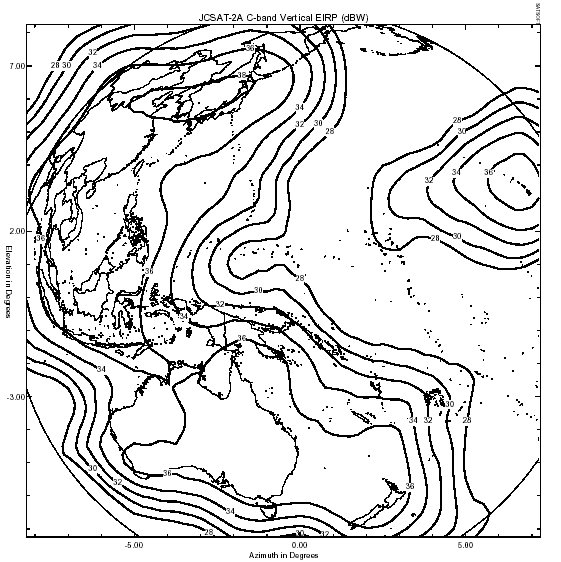

Apstar 1A 134E 4180 V "CCTV 5 and CCTV 8" are encrypted again.
AAP1 108E 12704 "FGTV" (Japan?) reported here by Tawanese website, in NTSC analog! try this one Dxer's
PAS 10 68.5E 3940 V "Occasional feeds", Sr 6620, Fec 2/3.
NEWS
Indosat Buying Deutsche Telekom's Stake in Satelindo
From satnewsdaily
International phone operator PT Indosat disclosed today it is finalizing with Deutsche Telekom purchase of the latter's 25 percent stake in wireless operator PT Satelit Palapa Indonesia or Satelindo.
State-owned Indosat has been negotiating for weeks to buy Deutsche Telekom's share in Satelindo, Indonesia's second-largest cellular operator. The government said it was discussing payment terms at the agreed price of $325 million although Deutsche Telekom says some points remained to be resolved on the sale.
Satelindo was established in 1993 and now provides satellite, cellular and international telecommunication services. In 1995, Deutsche Telekom AG, through its subsidiary DeTeMobil Deutsche Telekom Mobilfunk GmbH, subscribed for new shares in Satelindo.
The government wants Indosat to gain full control in Satelindo from its current 75 percent to increase Indosat's value ahead of its planned privatization this year. Projected sale of Indosat will be used to help reduce the country's budget deficit.
Debt-laden Deutsche Telekom is expected to sell all its stakes in Southeast Asian telecoms operators over the medium term to focus on Europe and the United States. The German company also has holdings in Malaysia's TRI Celcom and Globe Telecom Inc. in the Philippines.
But selling its stake in Satelindo will do little to relieve the German telecommunications company's debt crisis. Concern over its 67 billion euro mountain of debt forced Deutsche Telekom shares to a record low of 12.02 euros in Frankfurt trading. They later recovered to close 3.7% higher at 12.79 euros but have fallen over 13% over the past month.
Everclear International Inc. Merging Into Satellites
From satnewsdaily
The Directors of Everclear International Inc. has (OTCBB:EVCR) announced the formalization of a merger proposal received from Dinsmore Investments Ltd. The pending merger with Everclear will enable Protostar-Dinsmore to proceed with the corporate strategy of acquiring, and subsequently operating, satellite systems in Asia.
About three months ago, Protostar -- a private Bermuda corporation -- initiated the activation of Dinsmore Investments in order to establish a publicly traded vehicle to facilitate the raising of both capital and debt.
Management of the merged entity, to be re-named Protostar Holdings Inc., believes extreme weakness in the telecom industry is presenting unprecedented opportunities to acquire satellite systems at significant discounts.
Satellites offer many advantages to Asian users, stemming mainly from the geography of the region. In particular, China's huge landmass is a huge obstacle to optimal fiber coverage. Using satellite technology, customers can quickly and easily adjust their capacity as their bandwidth needs change, a feature that is particularly attractive to small ISPs in developing regions. Asia is the fastest growing region in the world measured by numbers of Internet users, and is expected to exceed 150 million users by 2003. Satellites are also proving effective in addressing the last mile problem, where the lack of sufficient local loop infrastructure makes it difficult to economically connect to international links.
The Company requires a total of US$ 75 million to initiate the purchase, upgrade and launch of one Protostar satellite. The funds will be arranged in stages, depending upon market conditions. Initially, the funds will be raised via debt-equity hybrids with a substantial straight equity financing anticipated in the future, at which time strategic investor equity participation will be sourced.
Specific details pertaining to the merger will be announced shortly.
Cable TV act incorporating CAS introduced in Parliament today
From indiantelevision.com
The Cable TV Networks (Regulation) Amendment Bill, 2002, incorporating mandatory conditional access for cable TV systems was introduced in the lower house (Lok Sabha) of parliament today by information and broadcasting minister Sushma Swaraj. It marked a major victory for Swaraj who has been at the forefront of pushing through the legislation which has been perceived as a bugbear of some broadcasters but has on the whole been welcomed by cable TV operators.
The Bill is to be discussed in the Lok Sabha tomorrow, and if passed it will be introduced in the Upper House the day after, just before Parliament closes.
The CAS ammendment will result in the introduction of set top boxes in consumer homes, government control over the free to air bouquet with similar control for pay channels being in the hands of cable TV operators.
Its announcement resulted in a schism in the broadcasters' ranks with Zee TV openly favouring it, ditto with Sahara. Sony has been sitting on the fence, while Star India and ESPN Star Sports have been opposing it. .
(Craigs comment, Star and Espn could go as far as turning off the encryption on their satellite services! let's hope so anyway)
Viewpoint: Is CAS amendment government's attempt to muzzle TV channels?
From indiantelevision.com
A new scare has emerged in the television industry about the possibility of the current government controlling and muzzling the media - more specifically television through the Cable TV Networks (Regulation) Amendment 2002. The Amendment seeks to hand control of the free to air channel bouquet to the government, its pricing and its contents location wise.
According to one school of thought, the BJP-led NDA government has been reeling from a backlash from the media - more specifically channels such as Star News - which have criticised it for the manner in which it has dealt with Gujarat and the massacre of Muslims in the state. Earlier, it had also been hit by the defence related Tehelka scam and the bad media it got.
Says an observer: "It is quite likely that the government is pushing through CAS in the manner it is to serve its own agenda. Television channels are hurting its image. The government can - if a broadcaster goes against it order the cable TV operator not to carry a specific channel or carry it in an unfavourable frequency position so that very few individuals get to view it. "
The observer asks why can't the Indian government decide to take the same tack with the print media too. "Does the government decide the pricing of a newspaper or is it left to the publishing house," she asks. "And why are cable TV operators complaining about TV channels hassling them? Don't publishing houses change the pricing of their newspapers time to time? Don't they have packages for distributors? Does the government intervene when they force newspaper distributors to carry publications as part of a package at a specific price? Why should it do so for television?
"Cable ops are excited about their getting a chance to get back at channels (through CAS) who they believe have been armtwisting them with apparently uncalled for channel subscription package increases. Broadcasters on their part have been busy fighting or backing its entry. Consumers don't know any better.
"Most people are missing the possibility of the government muzzling the television channels," says the observer. "Maybe it may not, but there is always the possibility it may."
The ball is over to the Indian government to clarify its position on the issue.
Set-top boxes to change TV homes
From http://timesofindia.indiatimes.com/articleshow.asp?art_id=9907105
MUMBAI: Shortly, your TV set is likely to get a domineering spouse. It will not screen channels you have not paid for or those that are not good for your health.
It will also ensure that the cable-wallah does not reduce you to a non-entity by not declaring your connection — henceforth, you will officially feature in the national headcount of viewers.
The set-top box is about to be married into your drawing room with the government about to change the Cable Television Networks (Regulation) Act, 1995 to accommodate the conditional access system (CAS).
Instead of allowing a flood of unwanted channels, this small device will decode only those pay channels you have subscribed. Every user will have an electronic code.
The box also works as a channel enhancer, whereby even old TV sets can receive stations that they weren’t earlier privy to. One does not need the gizmo to watch freeto-air channels.
All this, of course, will carry a cost. One can look at imported analogue set-top boxes for Rs 3,500. Digital ones will come for Rs 7,000-8,000, and will help broadcasters and advertisers ascertain TRP more accurately by tracking the exact time spent by each viewer-home on each channel.
A new manufacturing, marketing and distribution industry is waiting at the horizon, with just greater Mumbai having an estimated 4.5 million cable connections. Finance companies are poised to come up with small consumer loans.
?Till we are importing, the cost will be Rs 3,500. When we start making the boxes in India, preferably from a free trade zone, import duties and other costs will go. One can then look at a price around Rs 2,000-2,500,’’ says Avinash Mandelia, a director with JVS Infocom, one of the five or six set-top box distributors in India currently.
It has a distribution and after-sales arrangement with Dalvi Technology, who have been in this business in the UK for the last eight years. Other big global players include USbased NDS and Korean LG.
?There has to be multiple vendors. No distributor can cater to the entire demand,’’ he says, admitting that the prospective industry did not expect the government to move so fast on the bill. “If the bill is passed immediately, we will not do a pilot project.We have already tested in Orissa in 500 homes with hundred per cent success,’’ says Mr Mandelia.
According to arrangements still being finalised, each distributor will provide boxes to a particular MSO. There is an exciting clandestine angle too. Since the signals emerge from encryption, once the code is broken, it can be developed underground. “It involves proprietary technologies, but these are not difficult to hack,’’ says Sisir Pillai, a cable industry expert.
An entire illegal species may come up in Ulhasnagar, for which the consumer pays a higher onetime price and evades pay channel subscription till he is miraculously caught. Pirated set-top boxes are also widely advertised on the internet. With set-top boxes, channels will have to attractively price bouquets vis-a-vis single channels to push the packages.
?People who control the skies were controlling the ground as well. Now, if broadcasters refuse signals to operators, it will be a clear case of restrictive trade practices,’’ says Mr Pillai, adding, “The government has to look at competition. With greater declaration by operators, MSOs must put the extra money into the business and raise the quality of service. The government should also introduce open auctioning so that customers can choose their cable provider.’’
B4U Movies To Go Pay In June
From http://www.financialexpress.com/fe_full_story.php?content_id=9005
Mumbai: B4U Movies is planning to go pay in June, after having successfully tested its encryption system on April 29 in London. B4U currently uplinks both B4U Movies and B4U Music from BT Towers in London.
The movie channel, which scree-ns five films a day, will be priced at Rs 8.90 a month per suscriber. B4U will use the Nagravision digital receivers from Eurostar. The company is also negotiating with Eurostar to provide a low-cost dish for rural operators. “We are in talks with Eurostar to provide a 6-8 ft dish which small operators in rural areas would be able to afford,” said B4U Television Netwo-rk distribution head Debashish Dey.
B4U Television Network is also planning to encrypt B4U Music by the end of this year. It will be available at a nominal annual licensee fee of around Rs 3,000.
The decoder boxes for B4U Movies will be sold at a subsidised price of Rs 8,000 per unit. B4U will also introduce a rural scheme, for which cable operators will have to pay two equal installments of Rs 9,999 spread over a year. This will include the subscription fee the operators will have to pay to B4U.
The company plans to seed close to 7,000 boxes across the country in the first year of pay operations. B4U is in the process of appointing dealers across the country, after it broke away from Modi Entertainment Network (MEN) which was distributing its channels. B4U had terminated the distribution contract as Fashion TV switched to MEN directly. Incidentally, FTV was being handled by MEN through B4U. MEN had moved the court, saying that its contract was valid. “We are setting up 42 dealers nationwide,” said Mr Dey. B4U will launch its movie channel with the same encrypted feed in South East Asia. B4U was recently launched in Europe and North Africa. The company has a library of 650 movies. “If conditional access is implemented, we will look at video on demand and pay per view,” said Mr Dey.
14/05/02
Live satellite related chat in the chatroom 9pm NZ onwards and 8.30pm Syd onwards tonight.
Good news Jcsat have come up with the goods and have supplied a very usefull PDF of the official Jcsat2a footprint there is a problem with it though it requires an extra 6 meg download Japanese support pack for Adobe Acrobat 5 Reader. I am trying to get them to modify it as it seems there is no actual use of Japanese fonts though one is embedded it won't display until you get the add-on for it. I hope to make that available tommorow I might be able to modify it myself anyway according to the file the C band Beacon on Jcsat 2a should be on 4199.375 so have a look and please report if you can see it.
I am working on a new advanced listing page , think of Lyngsat but with every little bit you need to know or even don't need to know. As it is currently I have 18 columns of data that for each channel!, that's just the template I have put together so far. If you can think of any data that Lyngsat dosn't show that enthusiast wish to know then let me know
In the news section quite a bit about the Indian Cable situation maybe not of interest to some but it could have a large effect on the satellite FTA market if some pay channels decide to switch back to FTA.
From my Emails & ICQ
Nothing to report
From the Dish
Optus B3 156E 12532 V "SET Asia" has left , moved to 12336 V.
Jcsat2a 154E Transponders, Center Freq listed, Beacon on 4199.375
| EC-2 | 3440 | H |
| EC-4 | 3480 | H |
| EC-6 | 3520 | H |
| EC-8 | 3560 | H |
| EC-10 | 3600 | H |
| C1 | 3670 | V |
| C3 | 3720 | V |
| C5 | 3760 | V |
| C7 | 3800 | V |
| C9 | 3840 | V |
| C11 | 3880 | V |
| C13 | 3920 | V |
| C15 | 3990 | V |
| C17 | 4050 | V |
| C19 | 4100 | V |
| C21 | 4170 | V |
Asiasat 2 100.5E 3640 H The ERTU mux with Nile TV International, Nile Family and Kids, Nile News and Radio Cairo has left .
NEWS
CNBC Asia Pacific and MBN's joint channel launching in South Korea today
From indiantelevision.com
Maeil Business TV News (MBN) and CNBC Asia Pacific are today launching a new joint television news service, 'MBN-CNBC', which will beam into more than 4.5 million households broadcasting predominantly Korean-language programming.
MBN-CNBC will blend MBN's Korean-focussed news and business programming with CNBC's international business and financial programming. MBN-CNBC will also incorporate a live customised ticker from the Korean Stock Exchange. CNBC's English-language cable channel will continue to be distributed to 2.2 million households in Korea, with MBN's assistance, an official release states. Maeil Business News Group claims to be South Korea's leading media conglomerate.
President and publisher of Maeil Business News Group Dr Dae-whan Chang said: "The launch of MBN-CNBC represents an important milestone for MBN. At a time when the global economy continues to face vigorous market changes, our audience is looking for the most up-to-date and continuous coverage of the Korean and international markets with in-depth analysis and expert commentary. The joining together of three major business news services in the region - MBN, CNBC and Dow Jones - means that we will be able to offer the most reliable and influential 24-hour news channel in South Korea.
Acting CEO of CNBC Asia Pacific Shawn Galey said: "MBN-CNBC represents an important step in realising CNBC's goal of further increasing its reach and relevance through strategic relationships with leading regional business media companies.
Mugunghwa Satellites Generate First-ever Profit
From http://www.chosun.com/w21data/html/news/200205/200205131007.html
KT Corp.'s satellite telecommunications operation has begun generating profits for the first time in about 12 years since the state-run giant kicked off operation back in 1990.
According to KT Monday, its satellite operation using Mugunghwa Satellites or Koreasats posted a net profit of W2.5 billion from sales of W26.4 billion in the first quarter this year.
KT launched Mugunghwa Satellite No. 1 in August 1995 but it failed to go into orbit. Mugunghwa Satellite No.2, which was launched in January 1996, although reaching orbit, has been left unused for nearly five years as the government failed to pass the satellite broadcast bill through the National Assembly.
After the country began satellite broadcasting tests in November last year, the KT's satellite operation has been generating daily sales of W200 million and a net profit of W20 million.
An official at KT said that the satellite operation will easily be able to reach the company's target of W100 billion in sales and W10 billion in net profits this year.
Swaraj slams broadcasters' opposition to CAS, says pressure tactics will not work
From indiantelevision.com
A day before the amendments to the Cable TV Networks Regulations Act, 1995, is slated to be introduced in Parliament, information and broadcasting minister Sushma Swaraj lashed out at the broadcasters saying "their pressure tactics would not work with her as CAS is in the interest of cable viewing consumers.""In a meeting with some 25-odd cable operators from various parts of the country, Swaraj said that the government is determined to see the amendments to the Act concerned passed before 17 May when Parliament takes a break.
The minister is reported to have told the delegation of cable operators that "talks of referring the amendments to the Act relating to the CAS to the Parliamentary Standing Committee on IT and Telecom are all delaying tactics which would not work."
"According to Vicky Chowdhry,a Delhi cable operator who attended the meeting: "The minister was sympathetic towards the problems of the cable operators and exhorted the broadcasters not to further raise the subscription fee of the pay channels in the interim till the time CAS is implemented as it will be unfair for the consumer."
Another cable operator who attended the meeting said that Swaraj also assured them that a separate notification regarding CAS would be issued for the states of Karnataka and Andhra Pradesh after consultations with the chief ministers concerned if the cable operators thought CAS would benefit the consumer.
The government is initially thinking of implementing the CAS in the four metros - Delhi, Mumbai, Calcutta and Chennai.
Broadcasters divided on CAS
From http://economictimes.indiatimes.com/articleshow.asp?art_ID=9798182
MUMBAI: As the Union government readies to push through the Conditional Access System in the form of an amendment to the Cable Network (Regulation) Act, broadcasters are disunited over the government move.
Sahara TV, a member of the Indian Broadcasting Foundation (IBF), has “decried the decision of the IBF committee to oppose the proposed conditional system (CAS) recommended by the Union Government.” On the other hand, the IBF has hesitantly supported CAS, but sought a “planned and phased transition.”
Calling the IBF’s opposition to conditional access “a factional and anti-consumer move”, Sahara TV chief Sumit Roy claimed that the IBF ignored the majority — the free-to-air members — of the apex broadcasters’ body and not invited them to the May 10 meeting of the organisation.
This has been denied by Mr Bhuwan Lal, executive director of IBF, who said Sahara TV representatives were present and voiced no opposition to CAS at the meeting.
Conditional access — the system through which consumers have the choice of opting and paying for the pay channels they watch rather than a bundle dished out by cable networks — is to be introduced through an amendment in the Cable Network Act, 1995. The amended provisions envisage a bundle of free-to-air channels for which the government would fix a base rate, and a package of pay channels whose pricing would be left to market forces.
STAR’s initial opposition to the immediate introduction of CAS has also raised many an eyebrow. While internationally STAR is in favour of conditional access as a system that is transparent and makes commercial sense, in India its executives have been harping on the line that “it is premature and unfeasible”.
STAR initially opposed the introduction of the CAS in the IBF’s May 10 conclave but veered around to “tacit approval” for the government view on CAS, industry sources said.
An IBF release says that it welcomes any move to introduce “transparency and breaking up of the existing ground monopolies of the cable operators.” However, “there are too many issues concerning technology, funding, availability of set-top boxes...An amendment to the Act is unlikely to resolve the fundamental issues that face the industry. It may in fact result in exploitation of customers in terms of the services charged by cable operators...,” the release cautions.
Meanwhile, the Consumer Guidance Society of India — a body purporting to represent television viewers and which has consistently taken a stand against cable networks — has opposed the introduction of the Cable Network Act amendment. The amendment offers no protection to consumers against monopolistic cable networks and limits consumers choice, CGSI’s chairman Anand Patwardhan said.
While consumers will pay huge amounts for the set-top boxes, the choice of free-to-air channels will rest with the government, the choice of the pay channels will be decided by cable operators, he added.
Cable Operators Make Merry Even As Broadcasters Talk Of Loopholes In CAS
From http://www.financialexpress.com/fe_full_story.php?content_id=8929
New Delhi: In what appears to be a thanksgiving gesture, cable operators from all over the country met Information & Broadcasting Minister Sushma Swaraj here on Monday. This follows the government’s move to introduce the conditional access system (CAS), which would enable cable TV viewers to watch and pay for the channels of their choice. The Cable TV Networks (Regulation) Amendment Bill 2002, which seeks to incorporate CAS into the system, is likely to be tabled in Parliament on Tuesday.
As CAS has been a long-pending demand of theirs, cable operators are particularly happy with the development. In contrast, broadcasters, under the aegis of the Indian Broadcasting Foundation (IBF), have pointed out the loopholes in the proposed addressability system. Ms Swaraj expressed surprise that broadcasters are not happy with CAS as it was them who sought a transparent system. But, cable operators say that the minister made it clear that the government would not bow to any pressure.
Even as the draft bill for CAS indicates that cable operators will determine which pay channels to provide to their subscribers, the government is considering to have a ’must provide’ clause for pay channels, according to sources.
On pricing of free-to-air channels, the minister has told the cable operators that it would be done only after it is clear as to how many pay channels turn free-to-air. Also, the government may consider the request of cable operators to freeze the pricing of pay channels till CAS is introduced.
In the draft bill, however, there’s no mention of government intervention in fixing the prices of pay channels. It only says that “every cable operator shall publicise, in the prescribed manner, to the subscribers the subscription rates and the periodic intervals after which such subscriptions are payable for receiving each pay channel provided by such cable operator”.
On the free-to-air channels, however, the draft says that the government may specify the number of free-to-air channels to be included in the basic package. Different numbers of channels may be specified for various states, towns, cities etc. Also, the government may fix a maximum amount for the basic tier (read free-to-air channels) service.
On the cost of set-top boxes, Ms Swaraj said that she has been in talks with the Consumer Electronics and TV Manufactuers’ Association (Cetma) and that she has been told that a basic box could be available at just Rs 1,500 in the country. According to Cetma, the price range of an analog set-top box could vary between Rs 1,500 and Rs 5,000.
CATV bill amendment likely to be introduced in Parliament tomorrow; circulation among members today
From indiantelevision.com
No, the amendment to the Cable TV Networks (Regulation) Act, 1995 incorporating conditional access (CAS) is not being introduced in the Lok Sabha (Lower House) today as expected by many in the industry, the date has been set for tomorrow, according to sources.
The note is slated to be circulated among members of Parlimanet to allow them to vote on it tomorrow, reveal sources. Meanwhile, a group of the cable TV trade was expected to meet up with information and broadcasting minister Sushma Swaraj to give the cable TV industry viewpoint once again and clarify any doubts that may have arisen out of the protestations of some broadcasters.
Speaking at Panaji (Goa) yesterday to a leading business daily, Swaraj was quite clear that the government would not budge on CAS, and that she was convinced that it would be beneficial for all as it "would bring the much needed transparency in the system.
" She insisted that reports that boxes would cost Rs 7,000-8,000 were totally false and misleading, adding that the actual pricing woul be between Rs 1,500-2,500.
She was also highly critical of the group of broadcasters opposing CAS and asked the daily: "Do they not want transparency in viewership?".
Mumbai-based consumer body flays CAS
From indiantelevision.com
The Consumer Guidance Society of India has recommended that the government should first ensure that CAS addresses the critical issue of dismantling the on ground cable monopolies and that choice of selecting the channels rests with consumers, before implementing the system.
According to CGSI chairman Anand Patwardhan, the Cable Networks Regulation Amendment Bill 2002, to be tabled in Parliament tomorrow, offers no protection to consumers against monopolistic cable ops, nor does it seek to redress the grievances of consumers. Patwardhan points out that while the choice of free to air channels to be part of the basic service will now rest with the government while the choice of which pay channels to be offered to consumers will rest with cable ops. While the burden of buying the set top boxes will have to be borne by the viewers, the consumers will also have to pay a higher monthly fee monthly fee for receiving the pay channels, he feels.
"The consumer will have no recourse if a particular pay channel that a consumer wants to see and is ready to pay for is not made available by the cable op. Neither will the consumer have a choice to see the FTA channel of his choice," says Patwardhan. He also terms as discriminatory the bill's proposal to "legalise" consumers being charged differently in different areas of the same city, he observes.
IBF move to oppose CAS does not constitute voice of broadcasting fraternity: Sahara TV
From indiantelevision.com
It is not just Subhash Chandra and his Zee TV that have struck a discordant note vis-à-vis the Indian Broadcasting Federation's (IBF) opposition to the government's moves to introduce conditional access system (CAS).
Free-to-air channel Sahara TV, also an IBF member, in an official release issued yesterday decried the decision of the IBF committee to oppose CAS.
Terming the IBF's opposition to the proposed CAS as a 'factional and anti-consumer move', Sumit Roy, head of Sahara TV, a free-to-air channel, said that the IBF had not taken a majority of its members into confidence while opposing the government's move to amend the Cable TV Regulation Act.
"The IBF on Friday, 10 May, had called for a select meeting of channel heads who opposed the Centre's move to the proposed amendment in the Cable Regulation Act. Surprisingly, all those channels which are free to air and form a majority in the Indian broadcasting industry were not invited to the meeting despite being key members," the release states.
Roy said that the decision of a fraction of the IBF could not be constituted as the "voice of the Indian broadcasting industry" as it urgently required a broad-based review and debate among all the industry players.
Vulnerability Is Discovered in Security for Smart Cards
From http://story.news.yahoo.com
SAN FRANCISCO, May 12 Two University of Cambridge computer security researchers plan to describe on Monday an ingenious and inexpensive attack that employs a $30 camera flashgun and a microscope to extract secret information contained in widely used smart cards.
the newly discovered vulnerability is reason for alarm, the researchers said, because it could make it cost-effective for a criminal to steal information from the cards.
Smart cards are used for dozens of different applications, including electronic identity protection, credit and debit cards and cellular phone payment and identity systems.
The Cambridge researchers said they had discussed their discovery with a number of card manufacturers, and several had acknowledged the vulnerability. One company reported that its security testing teams had already considered types of attacks similar to the one mounted by the Cambridge team and that they believed their products were not vulnerable.
The researchers said they had also proposed a potential design change to the companies that would protect against the attack.
"This vulnerability may pose a big problem for the industry," they wrote in their paper, "Optical Fault Induction Attacks." The researchers argued the industry would need to add countermeasures to the cards to increase their security.
The Cambridge group's discovery is one of two new smart card attacks that will be introduced Monday evening in Oakland, Calif., at an Institute of Electrical and Electronics Engineers symposium on security and privacy.
A team of researchers from I.B.M.'s Thomas J. Watson Laboratory in Yorktown Heights, N.Y., said they would present a report at the conference based on their discovery of a different vulnerability in subscriber identification module, or S.I.M., cards. These are used in the type of digital cellphone known as G.S.M., widely used in Europe and to a lesser extent here.
The vulnerability would make it possible for a criminal to find the secret information stored in the card, steal the user's cellphone identity and make free phone calls.
Smart cards are credit-card-like devices containing a microprocessor chip and a small amount of computer memory for storing bits of electronic data that represent money or other information that can be used to ensure identity, like a code or a digitized retina scan or fingerprint.
More widely used in Europe than in the United States, the cards have long been promoted as the key to a cashless society as well as for identity and authorization applications. Some countries have begun using them for national identity cards, and they have recently been discussed as a way of confirming travelers' identities to speed airport security.
The Pentagon (news - web sites) has armed soldiers with smart cards for online identity and physical access, and the cards are in use in the United States in commercial services like the American Express Blue credit card and the Providian Smart Visa Card. Both cards are offered by their providers as a convenient and safe way to make Internet purchases, although their actual use for those purposes so far has been limited.
Some of the information stored in the card is in the form of a number composed of ones and zeros that cryptographers refer to as a "private key." That key is part of a two-key system that is used to encode and decode information. The security of such systems is compromised if the private key is revealed.
Typically, after the card holder authenticates the card by supplying a pin number, the private key will then be used to encrypt any sort of transaction using the card. For example, the card might be used to authorize a purchase or a transfer of funds, make an e-mail message private, log on to a computer network or enter a building.
The researchers from Britain, Sergei Skorobogatov and Ross Anderson, who are based at the University of Cambridge Computer Laboratory, discovered the flaw after Mr. Skorobogatov found that he could interrupt the operation of the smart card's microprocessor simply by exposing it to an electronic camera flashbulb.
They were able to expose the circuit to the light by scraping most of the protective coating from the surface of the microprocessor circuit that is embedded in each smart card.
With more study, the researchers were able to focus the flash on individual transistors within the chip by beaming the flash through a standard laboratory microscope.
"We used duct tape to fix the photoflash lamp on the video port of a Wentworth Labs MP-901 manual probing station," they wrote in their paper.
By sequentially changing the values of the transistors used to store information, they were able to "reverse engineer" the memory address map, allowing them to extract the secret information contained in the smart card.
Mr. Skorobogatov is a Russian emigrant who was once employed in the former Soviet Union's nuclear weapons program, where his job was to maintain bombs.
Mr. Anderson is a well-known computer security researcher whose work in both computer security and cryptography is widely recognized.
The researchers said they had discussed their findings with a number of companies that had acknowledged the vulnerability. However, at least one manufacturer who had read the paper said it believed its products were not vulnerable to the attack.
"This is a paper for an academic conference," said Alex Giakoumis, director of product lines for the Atmel Corporation, a San Jose, Calif.-based maker of smart cards. "We've already looked at this area."
He said his company had built defensive measures into its products that would make them invulnerable to such an attack. However, he said he was unwilling to be specific about the nature of the security system, because such information would be valuable to someone who was attempting to break the security of the Atmel smart cards.
The I.B.M. paper, which is titled "Partitioning Attacks: Or How to Rapidly Clone Some G.S.M. Cards," was prepared by Josyula R. Rao, Pankaj Rohatgi, Helmut Scherzer and Stefan Tinguely.
The researchers reported that they had dramatically shortened the time needed to steal secret information from today's G.S.M. cellphones.
Their new approach can seize the information within minutes, they said, making it a much more useful method than either breaking the cryptographic algorithms used by the card or by intrusive attacks such as the Cambridge approach. The I.B.M. researchers' report also offers advice to the smart card industry on how to protect against vulnerabilities.
13/05/02
Monday and lots of news, you are probably wondering about all the news about Indian cable tv well with the new laws we could see some Indian channels that are PAY channels revert back to FTA mode in an effort to keep advertisers. The Indian Cable/Satellite scene is huge. I will trim the page later and update the History for last month.
From my Emails & ICQ
From Chris Pickstock 12/05/02
2.45 pm SA time
B1, 12397 H, Sr 7200, "National Soccer League Grand Final"
B3, 12336 V Mediasat, "NRL, "Bulldogs v Penrith Panthers"
Chris P
From George (Thailand) 12/05/02
Jcsat 2a KU reception

12422 H Sr 3470 Fec 3/4 "jcsat2a testcard"
12437 H Sr 3097 Fec 3/4 "jcsat2a testcard"
%69 on 7.5ft mesh dish using Hyundai 710A Digital receiver
Some more Updates from him.
MRTV on Thaicom 3 which is on 3671H right now posted some change to 3569 FEC 3/4 on their channel today right now
also the Program ID for ABC AsiaPacific on PAS 2 has changed from regular it comes up as Open or Adhoc II changed to Australian Broacasting
the ERTU mux on Asiasat 2 which I think belongs to TARBS is it on 3640H is not there anymore
the 4180V CCTV 3,5,6,8 mux on Apstar 1A has CCTV 5 and 8 FTA right now
though lyngsat reports 3 and 8 are FTA CCTV 5 is the sports channel it has boxing on right now!
From the Dish
JCSAT 2A 154E 12422 H "A test card has started" Fta, Sr 3470, Fec 3/4.
JCSAT 2A 154E 12437 H "A test card has started" Fta, Sr 3100, Fec 3/4, SID 2, PIDs 32/33.
Apstar 1A 134E 3840 H "CCTV 12" has started , Fta, SID 306, PIDs 517/700.
Apstar 1A 134E 4180 V CCTV 3 is encrypted again. CCTV 5 is Fta.(CTTV is the Chinese National Sports channel)
Apstar 1A 134E 4180 V "CCTV 8" is Fta.
Palapa C2 113E 4080 H New APID for RRI Pro FM : 660.
Measat 1 91.5E NTV 7 has started on Astro ch 7.
Yamal 102 90E 3591 R STS (+7), not 3594 L.
NEWS
AUSTRALIA'S NATIONAL BROADCASTER ACCUSED OF BRAINWASHING
From http://www.asiamedia.ucla.edu/Weekly2002/05.07.2002/Australia2.htm
SUVA, Fiji Islands -- The Australian Broadcasting Corp (ABC) is trying to brainwash Pacific Islanders, according to the South Pacific's biggest magazine publisher.
By offering its programs to small Pacific stations for free, the ABC's highly respected Radio Australia division is trying to dominate broadcasting in the region, said Islands Business International editor-in-chief Laisa Taga. "The Aussies seem to have launched a massive drive to influence Pacific Islands people by providing news and views the Australian way through Radio Australia and Australian television," Taga wrote in her column in Fiji-based Pacific Magazine.
"Turn on your radio in many Pacific Islands these days, and you'll get news and views with an Australian accent and slant. Turn on your television and it could be the same. Suddenly, Australians are everywhere."
Taga questioned the effect of Australia's influence on the local people. "This is obviously good for Australia. But is it good for Pacific Islands countries to have Australia having such an influence on what people hear and see?"
Taga said Radio Australia had been busy offering free satellite dishes to Pacific Islands radio stations in an effort to get them to rebroadcast its programs. "It seems to be working," she said. "A check on Radio Australia's website shows it now proudly gives a long list of Pacific Islands' stations rebroadcasting its news and views. Australia Television is also welcoming Pacific Islands television stations rebroadcasting its programs."
Taga is a former editor of the Daily Post newspaper in Fiji.
(Craigs comment, Very interesting considering the limited amount of services available to the Pacific Islands they should be thankfull that ABC Radio and Asia Pacific TV actually broadcast to them. They shouldn't bite the hand that feeds them.)
New Skies posts revenues of $ 51.8 million during Q1 2002
From Indiantelevision.com
Dutch comunication company New Skies Satellites has reported that revenues grew to $51.8 million, an increase of $0.6 million over the same period in 2001, for the quarter ended March 31, 2002.
The company, which launched the satellite NSS 7 on 16 April, also signed contracts with New Zealand broadcaster TVNZ for the delivery of television news and sports events around the world; with the International Broadcasting Bureau/Voice of America for digital video links between the US and locations in the Caribbean and with a major Indian ISP data access for internet services during this quarter. New Skies has, during the first quarter, tied up with Arab Digital Distribution for their customer Star TV for video services from Hong Kong to Italy; and with major European telecommunication companies, Telenor and CPR Marconi, for voice and data services over NSS3, a release says.
New Skies Q1 EBITDA (earnings before interest, taxes, depreciation and amortization) are $ 28.6 million, while net income is put at $ 6.4 million. The EBITDA for the same quarter grew by $ 0.9 million or 3 per cent. The net income for the first quarter of 2002 decreased by $ 1.6 million and the diluted earnings per share for the same period reduced by $ 0.01, compared with the same period in 2001. The decrease in the current quarter primarily relates to the lower interest income, according to the release.
(Craigs comment, New Skies next satellite will be NSS 6 a high powerd KU bird at 95E with a good beam on Australia and part of NZ!!)
Indonesia's Telkom 2 to be Launched on Either Ariane or Delta
From satnewsasia.com
Boeing Space and Communications, the world's largest space and communications company, and European consortium Arianespace, the world leader in commercial satellite launches, are the two leading contenders for the contract to build and launch a new telecommunications satellite for state-run telecoms monopoly PT Telkom.
Telkom Planning Director Kristiono said six companies had indicated interest in taking part in the US$160 million project to construct and launch the Telkom-2 satellite, but that Arianespace and Boeing were at the head of the pack. Telkom-2, will replace the Palapa B4 satellite that will cease to operate in 2004. Some 70 percent of the new satellite’s transponders will be used for business purposes (mainly for retail businesses) in contrast to Palapa B4, which is mainly used for Telkom operations.
Kristiono said it will take 18 to 20 months to produce the new satellite. The launch of Telkom-2 is expected to take place in the first quarter of 2004 at the latest. Telkom-2 was originally scheduled to launch in 2003. Boeing builds the flight-proven Delta series of rockets that can accommodate single, dual, or multiple payloads on the same mission.
Telkom is the principal provider of telecommunications services in Indonesia, providing local and domestic long distance telephone services with 7.2 million lines. The company is majority state-owned, and is one of the largest companies in Indonesia with total operating revenues and operating income for year ended December 31, 2001 of Rp 16,131 billion (US$1,587 million) and Rp 7,616 billion (US$749 million) respectively.
Hong Kong's Phoenix Satellite TV Loss Widens
From satnewsasia.com
Leading Chinese-language broadcaster Phoenix Satellite Television Holdings Ltd reported a loss of US$5.2 million for its fiscal third quarter and a drop in revenues.
The loss was our times more than the same year-on-year period. Revenues fell 4.4 percent for the quarter to some US$20 million, according to one analyst. It was also US$63.3 million less during the nine-month period ended March 31. Analysts expect disappointing figures for the remainder of the year as Phoenix takes more losses from the acquisition of new channels.
Phoenix, which is owned 38 percent by News Corp, blamed its underperformance on sharply lower advertising spending caused by the global economic downturn. It did, however, note more encouraging ad sales in March. Phoenix said its operating costs for the nine months increased 23 percent to US$79 million because of its acquisition of new channels, one of which is Xing Kong Weishi, a Mandarin-language channel that broadcasts in wealthy Guangdong province. Phoenix Chinese Channel remains the company's main revenue generator, accounting for some 90 percent of Phoenix’s revenue.
Phoenix Chairman and CEO Liu Changle described the performance of Phoenix Chinese Channel's as satisfactory in view of the overall downturn of global advertising markets. Liu said overall advertising for the group rose by 10.5 percent during March from the same month a year earlier and there was a likelihood that this upward trend will continue. The company is exploring ways to improve its performance and cut costs.
TVB May Seek To Extend Deadline On Pay-TV Project - Report
From satnewsasia.com
Television Broadcasts Ltd (TVB), Hong Kong’s dominant free-to-air broadcaster, said it might apply for an extension of its troubled pay-TV project instead of abandoning it.
TVB made this declaration as it approaches a government-imposed June deadline for finding investors for its Galaxy Satellite Broadcasting pay-TV project. TVB’s pay-TV license, stipulates that the company reduce its stake in Galaxy to less than 50 percent by June 30 because of TVB's dominant position in the free-to-air broadcasting market. It was also forced to delay its launch to 18 months after the launch by other license winners.
Media reports said TVB had not cancelled its US$64 million pay-TV project and that the company was talking to a number of potential investors, with one source saying that six companies were interested in coming on board. The potential investors include Pacific Century CyberWorks and satellite operator Asia Satellite Telecommunications Company (AsiaSat). Peter Jackson, AsiaSat CEO, said the company wouldn't invest in Galaxy on its own, as the project is too big, but that is was considering taking a smaller stake in Galaxy.
One TVB executive was quoted as saying that the odds are that TVB would likely ask the government to extend the June deadline since time was running out. The government would likely be willing to extend the deadline because without TVB's participation, i-Cable Communications, the only cable TV provider in Hong Kong, would maintain its near monopoly in the market.
The only other potential rivals to i-Cable include U.K.-based Yes Television and Pacific Digital Media of Taiwan. Two of the original license winners—News Corp's Star TV and Sino-i.com's pay-TV arm, Hong Kong Network TV—have abandoned their pay-TV plans citing stiff competition.
(Craigs comment, there is a FTA TVB mux on Pas 2, they also have a pay service for Australia via Pas 8)
Indosat to Sell Non Core Assets
From satnewsasia.com
State-owned telecom company PT Indonesia Satellite Corporation (Indosat) will sell off non core assets to concentrate on expanding its cellular and fixed telephone operations.
President Hari Kartana said one of the company assets to be sold is convertible bonds valued at US$15 million that could be converted into shares in PT Cipta Televisi Pendidikan Indonesia, operator of TPI television broadcasting station. Kartana said a number of assets will be sold in a number of companies in which it is a minority shareholder.
Indosat is selling off selected assets to expand its range of services to compete against foreign players when the local telecoms industry is liberalized.
Shanghai VSAT to use iPSTAR for providing broadband throughout China
From indiantelevision.com
Shin Satellite has signed a framework agreement with Shanghai VSAT Network Systems.
The joint venture, SVC, will be one of iPSTAR's National Service Providers (NSP) in China and will use the First Generation iPSTAR Ground System to provide broadband services to customers throughout China by the third quarter of 2002. Once the installation of an iPSTAR gateway has been completed in China, SVC expects to deploy more than 5,000 iPSTAR user terminals throughout the country.
SVC will deploy iPSTAR user terminals for three major projects, including a Community Information Center project for the Ministry of Civil Affairs. This project will enable local communities to gain access to information that would otherwise be inaccessible due to lack of local terrestrial broadband network.
Another project is the Nationwide Welfare Lottery Network project, which will also use the high-speed system to connect to lottery terminals at key locations nationwide, and two retail chain networks using an iPSTAR based Virtual Private Network (VPN) solutions that acts similarly to a private network.
The iPSTAR system will allow these retail chains to connect all of their branches with headquarters through satellite and to enable them to exchange data instantly. This will allow the companies to keep abreast of the needs of consumers in numerous locations simultaneously.
Sony to buy out Discovery stake in JV
From http://economictimes.indiatimes.com/articleshow.asp?art_id=9697728
NEW DELHI: Sony Entertainment TV is willing to buy back Discovery Communications’ entire 26 per cent stake in their 74:26 distribution JV if Discovery wants to exit the venture at any point of time.
Sony Entertainment TV and Discovery had floated a joint venture in March, creating a platform of six channels. Initially, the joint venture would be limited to a distribution partnership, where the pay channels of the two groups would be jointly marketed as a single package.
The rate of the Sony-Discovery bouquet was hiked by Rs 10 per month per subscriber after the JV. It now stands at Rs 40 a month.
In the long term, company officials say the intention is to make the joint venture to work towards a single corporate entity in India. The current scope of the SET-Discovery JV is to work towards marketing cable and satellite TV channels, appoint distributors, enter into licence arragements with operators on behalf of both the companies.
Discovery beams two channels to India—the flagship Discovery Channel and Animal Planet. SET, on the other hand, has four channels, flagship Sony, AXN, SET Max and CNBC India.
The SET-Discovery JV is the second such high-profile distribution JV between two media entities in India. Zee has also formed this year a distribution JV with the Turner International, called Zee-Turner Pvt.
In the soon-to-be-bygone era of channel bouquets, it made sense to have a bouquet studded with different kinds of channels, so that your bouquet will appeal to a wide variety of audiences. The Zee-Turner bouquet for example strengthened Zee’s position in the Southern markets, where Turner is strong.
However, in the conditional access system era for pay TV channels, likely to be ushered in this year itself, the whole concept of bouquets becomes quite meaningless.
Govt can decide who sees what on cable TV
From http://www.business-standard.com/today/economy11.asp?Menu=3
The amendments to the Cable Television Networks (Regulation) Act, 1995, will put significant discretionary powers in the hands of the government so far as the broadcast of channels under the conditional access system is concerned.
The amendments propose to give the government powers to decide not only the number of free-to-air channels but also which channels a cable operator can offer. In addition, the government can also decide the free-to-air feed for different cities. It can thus block a certain free-to-air channel in a city or a state if it thinks it is in the public interest.
The new law also proposes to give powers to the government to specify the maximum amount that a cable operator can charge for the basic service tier (the bouquet of free-to-air channels). Again, the government can specify different rates for different places.
The pricing of the pay channels will be left to the discretion of the broadcasters.
While broadcasters agree that the Bill will benefit them in the long run, they insist that the issue of implementation needs to be addressed first. The Indian Broadcasting Foundation has pointed out that the transition should be carried out in phases and it should also be planned well to enable the consumers to benefit from the switch over.
The foundation has also demanded that the Bill to amend the Indian Television Networks Act should be referred to the parliamentary standing committee on information technology and telecom headed by Somnath Chatterjee.
Pointing out the factors that might hinder the implementation of the conditional access system, the foundation's executive director Bhuvan Lall said, "There are many issues concerning technology, funding, availability of set-top boxes, regulation and non-discriminatory implementation that need to be addressed. Further, all the issues related to the implementation of the conditional access system need to be addressed in totality."
The Indian Broadcasting Foundation is of the opinion that the amendments to the Cable TV Regulation Act are unlikely to resolve the fundamental issues faced by the industry.
"If the government wants to bring down the fee for cable TV subscription, it should take steps to check under-declaration by cable operators,” said Star India CEO Peter Mukherjea.
The foundation has also asked the industry, broadcasters, vendors, cable operators and regulators to work together to work out model for the conditional access system. "In the meantime, the broadcasters have decided to come together and focus on the immediate problem of under-declaration and demand 100 per cent transparency from cable operators," Lall said.
Govt writes a big role for self in telly beams
From http://economictimes.indiatimes.com/articleshow.asp?art_id=9697820
NEW DELHI: The stage is set for an overhauling of the Indian television industry. After the Cabinet gave its go-ahead to the conditional access system for pay TV, the government is ready with the draft Bill for amending the Cable TV Regulation Act 1995.
A sneak peek into the draft Bill shows that the government may play a major role in deciding the mix of channels that will henceforth be beamed into people’s homes.
The government will, after the amendment to the Cable Act, decide not only the maximum price of the basic package of channels consisting of free-to-air channels, but also “specify” the number of free-to-air channels to be included in the basic package. It will further decide the “genre-wise” mix of “entertainment, information, education” and other such categories of channels to be included in the basic package of free-to-air channels.
Interestingly, not only will the government prescribe the number of free-to-air channels for the basic service package, but that number may vary for “different cities, towns, states or areas”.
The maximum price for the basic package consisting of free-to-air channels may also vary between states, cities and even towns.
While how the government determines the number of channels in the basic package or decides the genre-wise mix of channels is unclear, at first glance, this does indicate a greater role for the government in deciding which free-to-air channels people may watch.
As reported earlier, the government is amending the Cable TV regulation Act, 1995, which will now make it compulsory for cable operators to show pay channels through set-top boxes installed at the subscriber’s home.
Besides these pay channels, a number of free-to-air channels will be included in a basic service package, for which a maximum price will be fixed by the government.
No set-top box may be required for receiving these free-to-air channels.
Apart from Doordarshan’s three national channels, a host of DD regional channels, MTV, Aaj Tak, BBC, SAB TV, Sahara TV and a number of regional channels down South continue to be free-to-air.
What You See Is What You Pay For: Will India Follow The US Conditional Access Story?
From http://www.financialexpress.com/fe_full_story.php?content_id=8847
New Delhi: Before we move into the conditional access system (CAS) or the addressability regime, from the clutches of the arbitrary cable TV system of the present times, let’s see how the system works in some of the developed markets, for instance in the US.
Take pricing, to begin with. While for the free-to-air channels in the CAS service, there’s a fixed monthly price, pay channels are priced according to their demand and popularity in the US.
There are both individual pricing and package pricing for channels in the pay service there. After adult channels such as Playboy, the drivers in the US market are movie channels, mainly HBO and Cinemax. Going by the popularity of these channels, these are also the most expensive ones.
In India, although modalities and pricing for the CAS offering is yet to be worked out, the pattern will be almost the same as in the US. That is, a basic tier for free-to-air channels, and a pay service.
Even as the industry is talking of individual pricing of pay channels under CAS, there are indications that bouquets and packages will also exist. As a cable operator put it: ‘‘The success of a broadcaster will depend on how he packages the channels.’’
The developed market in the West is doing that and more. Like deals and discounts in everyday shopping, cable TV also offers the same freebies.
So, it’s like if you’re watching channel A and B, watch channel C for free for two months. If you like to continue with channel C beyond those two months, pay for it.
The idea is to get subscription volumes for channel A, B and C. Broadcasters in India have not decided yet whether to offer such freebies or not.
Also, even as there’s a feeling that some Indian channels may turn free-to-air from being pay channels, a CEO of a free-to-air channel feels that it’s not so simplistic.
?‘I think, broadcasters will bundle channels in the conditional access system. I don’t see them turning free-to-air from being pay channels,’’ he said. Rather, he says that pay channels would be forced to improve their content to get viewers addicted. Going to another aspect of pricing, pay per view in the addressability system is very popular in the developed markets. The pay per view service is particularly relevant for movies, events and sports, besides premium adult content. In the pay-per-view system, a viewer pays for only specific programmes on demand.
Surprisingly, the Indian broadcasters haven’t started talking about the pay-per-view service so far, but cable operators say that it can be a feature in the addressibility system. The viewer would use the same CAS set-top box for the pay-per-view service. How a viewer gets the set-top box is quite different in the US. Right now a contentious issue in India, it is likely that the viewer will have to foot the bill for the CAS set-top box.
Even if the Indian viewer gets the box on rental, he’ll have to dish out a hefty sum as refundable deposit. The analog set-top box would cost around Rs 3000-4000. In the US, however, set-top boxes are available on a monthly rental, without any large deposits.
Another difference is that while in India, the CAS viewer will have to buy his box from the cable operator, in the US, they’re available off-the-shelf.
Finally, if pay channels disappear on the TV sets even for a few hours in countries like the US, the viewer pays that much less to the cable operator. Whether a similar practice can be expected in India is yet to be seen.
T S I C H A N N E L N E W S - Number 19/2002 12 May 2002 -
A weekly roundup of global TV news sponsored by TELE-satellite International
Editor: Branislav Pekic
Edited apsattv.com Edition
A S I A
AUSTRALIA
SEVEN NETWORK TO CLOSE C7 SPORT
Seven Network has closed down its C7 Sport pay-TV channel, claiming it was
no longer financially viable following Optus' decision to discontinue its
carriage agreement for the channel. Satellite platform Optus decided to
dump the channel in favour of Foxtel's sports channels when it unveiled a
content-sharing deal with Foxtel. Seven had continued to produce C7 since
the end of March even though no pay-TV operator was carrying it. Optus
announced the carriage of Foxtel's two FoxSports channels as part of the
Foxtel-Optus-Telstra arrangements now being considered by the Australian
Competition & Consumer Commission. Seven said delays to cable access caused
considerable damage to its subscription television business and C7. It
added that it would continue to focus on a significant presence in
subscription television and "vigorously pursue" its access rights to the
Telstra Multimedia cable service.
CHINA HONG KONG
ASIASAT INTERESTED IN GALAXY
Regional satellite operator AsiaSat has reportedly taken an interest in
Hong Kong terrestrial TVB's struggling pay-TV venture Galaxy. To date, TVB
has had difficulty in attracting an investor for Galaxy. Local reports said
that TVB is still likely to shelve the operation despite AsiaSat's
last-minute interest. Officially, TVB remains committed to the venture.
NICKELODEON TO LAUNCH LOCAL SERVICE
Viacom owned children's channel Nickelodeon will soon be broadcast in China
after the localisation of all program content, Li Yifei, general manager of
MTV China, revealed in an exclusive interview with Zhongguo Jingying Bao
(China Business) in Beijing. According to Li, Nickelodeon's target viewers
are children between the ages of two and 16. Currently, several hundred
provincial and municipal television stations in China have aired some
Nickelodeon programs, which have reached an audience of 300 million to 500
million Chinese, including children in 80 million households.
CABLE TV SIGNS UP TV CHANNELS
Cable TV, the Star Group and ESPN Star Sports announced on May 10 they have
sealed a deal for Cable TV to continue to carry ESPN, Star Sports, the
National Geographic channel and Phoenix InfoNews channel on an exclusive
basis in Hong Kong. Cable TV is owned by i-Cable Communications, part of
Wharf (Holdings) Ltd. Cable TV is currently the monopoly cable TV operator
though several companies have won pay-TV licenses and are planning to
launch services soon. The exclusive arrangement for sports channels is
significant for Cable TV ahead of the widely watched World Cup football
matches in May and June.
INDIA
MURDOCH INTERESTED IN DTH SERVICE
According to Variety, Star TV Group chairman James Murdoch recently went to
India, where he asked the government to lift restrictions stopping the Hong
Kong-based company from launching a direct-to-home satellite TV service in
the region.
NEPAL
FIRST PRIVATE TV STATION TO LAUNCH
Kantipur Television Network Pvt Ltd, the first nationwide TV station from
the private sector, is said to begin its operation within eight to 10
months. Jeewa Lamichhane, managing director of Kantipur Television,
disclosed that the TV station is planning to commence its broadcasting
within eight to 10 months. Kantipur Television will focus on telecasting
current affairs and decent cultural infotainment programmes. The channel
will begin with six to 10 hours' test transmission and operate 24 hours. It
will begin its transmission through terrestrial system and go for satellite
link from the second year. It would gradually expand its coverage, with a
target of 45 per cent of the geography and to reach to 70 per cent
population within five years. In order to ensure global coverage, the
station is planning to sign agreements with leading satellite operators so
that Nepalis living in any part of the world can view Kantipur Television.
The TV would dedicate 30 per cent of its airtime to current affairs, 35 to
entertainment, 17 to educational and awareness-generating programmes and 18
per cent to miscellaneous shows.
SINGAPORE
PAY-TV MARKET TO OPEN UP NEXT MONTH
Singapore is to open up its pay-TV market in June when Singapore Cable
Vision loses its exclusive rights, but few bidders are expected for the
as-yet unspecified number of licenses to be offered by the government. To
date, only one company, the local telecommunications giant, Singapore
Telecom, has given strong indication of its intention to enter the market,
which has an estimated annual revenue of SIN$200 million. The Singapore
Broadcasting Authority said others have "expressed" interest but gave no
further details.
THAILAND
GOVERNMENT PUTS PRESSURE ON UBC
The government is being accused of pressuring the country's largest pay-TV
platform, United Broadcasting Corp. (UBC) into dropping a news channels
allegedly for being over-critical of Prime Minister Thaksin Shinawatra's
administration. UBC was reportedly offered the incentive of being allowed
to carry advertising on its platform, which it had been lobbying for over
the last few years, saying it could not become profitable until it no
longer had to strip out advertising. The controversy surrounds Channel 8, a
Thai news service operated by the National Multimedia Group. Channel 8
editor Adisak Limprungpattanakij said he had been warned by a senior
unnamed member of the ruling Thai Rak Thai Party that his channel's content
stood between UBC and its request to carry advertising.
UBC RESPONDS TO WORLD CUP CONTROVERSY
Pay-TV operator UBC has clarified its position regarding the upcoming World
Cup football tournament and said it will not seek to stop its subscribers
viewing the competition through its equipment. UBC denied reports it had
demanded five exclusive games and said there was no need for it to bid for
the TV rights when free to air channels 9,11 and ITV will air all games
live.
A F R I C A
SOUTH AFRICA
E.TV SELLS WORLD CUP PAY-TV RIGHTS
Free-to-air TV channel e.tv has sold the satellite broadcast rights for the
World Cup to pay-TV company Supersport. According to industry sources, the
sale of satellite rights to Supersport was an attempt to recoup some of the
money the station had paid. e.tv and Supersport declined to divulge the
value of the deal, but it is understood Supersport paid about 20 million
rands for full access to the tournament and an additional 1.2 million rands
for rebroadcasts and highlights of football matches. The figure is way
below the widely reported 80 million rands the station paid KirchMedia last
year for exclusive broadcast and licensing rights to the games. e.tv had
hoped that the cost of screening the World Cup would have been recovered
through advertising revenues, but it has struggled to secure sufficient
sponsorship.
12/05/02
No updates Sunday
11/05/02
Not much to report today, just a reminder I don't do SUNDAY updates. So don't expect one tommorow!
Don't forget to look for the G.P tommorow, maybe someone can locate some actual feeds of it?
From my Emails & ICQ
From John Harrison
Pas 8
3740H
Sr 27500
Fec 2/3
MTV S.E.A. apperars to have started fta, only had colour bars when i have checked here before.
(Craigs comment, MTV China here Fta as well, its also started on Apstar, there is also MTV India FTA on Pas10 in analog and Digital and MTV Indonesia which screens on "Global tv" in the Palapa C2 mux)
From the Dish
PAS 8 166E 3740 H "MTV Southeast Asia" has started Fta , SID 8, PIDs 385/386.
PAS 8 166E 3860 H "CTS" has started , Fta, SID 3, PIDs 430/431.New SID and PIDs for FTV: 4 and 440/441.
Agila 2 148E 12581 V "Net 25" is now encrypted
Agila 2 148E 12541 V "FTV has replaced FTV News Channel" , Fta, SID 9.
Apstar 1 138E 3860 V "MTV Southeast Asia" has started, Fta, SID 8, PIDs 385/386.
NEWS
AsiaSat 4 launch rescheduled to end 2002
From Indiantelevision.com
Asia Satellite Telecommunications Company Limited (AsiaSat) has announced that its fourth satellite, AsiaSat 4 satellite will not launch this month, as scheduled earlier, due to manufacturing delays at Boeing.
The decison, says the company, was taken following meetings with satellite manufacturer Boeing Satellite Systems. Asiasat 4 was earlier supposed to launch in May 2002 by the Atlas IIIB rocket from Cape Canaveral, Florida, USA. Boeing has reportedly decided to conduct additional tests on AsiaSat 4 and other spacecraft to ensure the quality and reliability of its product line.
The delivery of AsiaSat 4, a Boeing 601HP, is now expected to be delayed by at least four months, putting the new delivery date as sometime in September 2002. However, Asiasat CEO Peter Jackson has been quoted as saying that given the other scheduled launches in 2002, it might be difficult to find a launch slot before the end of the year.
The company is in talks with International Launch Services (ILS), the launch services provider to determine a new launch date for AsiaSat 4. A new date will be determined in the next couple of months, the company says. The spacecraft will be located at the 122 degrees East orbital position, providing region-wide C-band coverage over Asia and focused Ku-band beams for East Asia and Australia. The satellite will carry 28 C-band and 20 Ku-band transponders including the four BSS (Broadcast Satellite Service) transponders to be used for Hong Kong's DTH (Direct-to-Home) services.
AsiaSat 4 Launch Rescheduled
PRESS RELEASE
Hong Kong, 9th May, 2002 - Asia Satellite Telecommunications Company Limited (AsiaSat) announced that the launch of its fourth satellite, AsiaSat 4, will be rescheduled beyond its original May 2002 launch date following its recent meetings with the satellite manufacturer, Boeing Satellite Systems.
The rescheduling is due to manufacturing delays at Boeing. To ensure that the highest quality and reliability of its product line can be achieved, Boeing has decided to conduct additional tests on this and other spacecraft. The delivery of AsiaSat 4 is expected to be delayed by four months from the original date. This will put the new delivery date as sometime in September.
AsiaSat is also in talks with International Launch Services (ILS), the launch services provider to determine a new launch date for AsiaSat 4. It is anticipated that a new date will be determined in the next 1-2 months.
"Although disappointed with the delays, our main priority is the quality and reliability of the spacecraft. With this in mind, we naturally agreed to Boeing's decision to conduct extra testing on our spacecraft. We are working closely with both Boeing and ILS to determine a new launch date for AsiaSat 4. Given the other scheduled launches in 2002, it may be difficult to find a launch slot before the end of the year," said Peter Jackson, Chief Executive Officer of AsiaSat.
AsiaSat 4, a Boeing 601HP satellite, was originally scheduled for launch in May of 2002 by the Atlas IIIB rocket from Cape Canaveral, Florida, USA. AsiaSat 4 will be located at the 122 degrees East orbital position, providing region-wide C-band coverage over Asia and focused Ku-band beams for East Asia and Australia. The satellite will carry 28 C-band and 20 Ku-band transponders including the four BSS (Broadcast Satellite Service) transponders to be used for Hong Kong's DTH (Direct-to-Home) services.
AsiaSat is Asia's leading provider of high-quality satellite services to both the broadcast and telecommunications markets. AsiaSat serves telecommunications customers for public telephone networks, private VSAT networks and high speed Internet and multimedia services. AsiaSat is a wholly owned subsidiary of Asia Satellite Telecommunications Holdings Limited, listed on both the Hong Kong (SEHK: 1135HK) and New York (NYSE: SAT) stock exchanges.
For further details, please contact:
Sabrina Cubbon
General Manager Marketing
AsiaSat
Tel: (852) 2805 6650
Fax: (852) 2504 3875
Mobile: (852) 9097 1210
email: [email protected]
Winnie Pang
Corporate Affair Manager
AsiaSat
Tel: (852) 2805 6657
Fax: (852) 2504 3875
Email: [email protected]
The cable guise
From http://www.theage.com.au/articles/2002/05/10/1021002390271.html
Chris Anderson says he's a great believer in logic and common sense - which is why he is so confident the Australian Competition and Consumer Commission will accept the proposed pay TV deal between Foxtel and Optus. He can't see "why on earth it won't be approved".
"The ACCC is a logical, rational body with capable people," he says ever so politely. "No one in their right mind thinks that the pay TV business is a viable, sustainable business the way it is."
But the application of logic and common sense has never featured prominently in Australian telecommunications policy. And despite the loud insistence of everyone from the Packers to the Murdochs to Telstra to Optus that the ACCC will have no real choice, they can't be sure of just what logic that notoriously difficult fellow, Professor Allan Fels, will follow.
So while Anderson sounded relatively buoyant as he announced the Optus results from SingTel headquarters in Singapore this week, he warned that the ACCC might yet blow up any rationale for Optus to stay in pay TV or local telephony at all.
"To continue to stay in a business which is losing $350 million a year and not give customers the best service available I don't think is sustainable," he announces rather tartly.
What's more, for all the focus on pay TV, the bigger challenge to the ACCC is in Optus' threat to withdraw from the local telephony market too, leaving Telstra to tower over the entire landscape as opposed to just most of it.
"The main game, the only real game, is local telephony and, in the end, it is very hard to justify to SingTel that it should keep paying out the $350 million for a business going nowhere," Anderson says.
The warning is a powerful one considering Telstra's dominance, and Anderson knows it. Australia's second-largest telecommunications company says it has much larger and far more successful interests to pursue in mobiles and in the data and business telecommunications market. Why bother with the rest when it's costing it so much for such an unpromising future?
Success in the telecom industry at the moment is a very relative thing indeed. Anderson was actually announcing a $402 million net loss for Optus, after adopting the stricter accounting standards of its new owner, Singapore Telecommunications. The "good" news - a decade after it started as the government's great market alternative to Telstra - is that Optus expects to break even within two years.
But that is because it is relying on continued strong growth in its mobile business and a pick-up in the corporate and data market while being able to cut costs. What it doesn't want to do is spend more money on a consumer and multimedia division where low customer numbers and high expectations got so out of whack in the last several years.
Anderson dwelt on the return to "rational" pricing policies, which are now more feasible since all those cheap and cheeky upstarts like One.Tel got chased out.
But wait a minute. Whatever happened to that mad scramble of a decade ago, where Optus and Foxtel chased each other around urban streets to lay their own very expensive cable?
It turns out that SingTel has 'fessed up to the reality that the cable was no longer worth the billions Optus had invested in those heady days.
Last September it paid $13 billion for Optus. This week, it put most of that down to goodwill, which will be written off in the SingTel books over 20 years.
But it also slashed the official value of Optus' most concrete asset - the hybrid fibre coaxial cable network - from $1.6 billion to about $640 million. And it is signalling it is prepared to leave most of it completely unused if it can't get approval of the Foxtel Optus deal through the ACCC. Optus projections of breaking even by 2003-04 don't rely on the deal actually happening.
Anderson had been pushing for a dramatic move in the clearly unprofitable pay TV industry for years but was alway resisted by the Foxtel partners, Telstra, PBL and News.
After the humiliating collapse of One.Tel, Lachlan Murdoch and James Packer were more amenable.
Murdoch 'sets deal record straight'
From http://www.theage.com.au/articles/2002/05/10/1021002390561.html
News Corp deputy chief operating officer Lachlan Murdoch came out punching to quash the "extraordinarily and mischievously misleading" criticisms of the Foxtel-Optus agreement, as mounting opposition threatened to derail the watershed pay TV deal.
Mr Murdoch said yesterday he wanted to "set the record straight" about the implications of the proposal for Foxtel (in which News Corp has a 25 per cent stake) to share programming with rival Optus.
"I blame myself for not having corrected the gross mistakes and misleading comments that (have been) made until now," he said.
His decision to speak out comes as Foxtel shareholders News, Publishing and Broadcasting, and Telstra, resign themselves to the fact that they will not meet their self-imposed deadline of deciding by next week whether to pursue the deal.
The Australian Competition and Consumer Commission is a long way from deciding whether to approve the deal, which has been criticised by every media and telecommunications company in the country - apart from the Foxtel partners and Optus - as anti-competitive.
Mr Murdoch said that from a pay TV perspective, the deal ensured more competition, as consumers would have the choice of three suppliers. He conceded it was unlikely to be approved in its current form. The ACCC has already told Foxtel and Optus it raises serious issues.
"We're realistic that there might be some concessions that have to be made." he said.
The potential for Telstra to exploit its half-share of Foxtel to protect its dominance of the industry has emerged as one of the key concerns for the competition watchdog. ACCC mergers and acquisitions commissioner Ross Jones said: "The commission would have concerns if control over content was used to prevent competition in infrastructure."
It has been suggested that the ACCC may require Telstra to separate itself as an infrastructure supplier from a News Corp and PBL-owned Foxtel content company. Would the Foxtel partners contemplate overhauling the shareholder structure?
"(News Corp) would not want to do that," Mr Murdoch said. "Both of our partners have been very supportive and very focused on trying to create some value out of what's basically a shit sandwich."
Last week Telstra chief Ziggy Switkowski said Telstra was "absolutely not" prepared to sell out of Foxtel. Mr Murdoch said the Foxtel partners would "probably" be willing to put a time frame on upgrading the analog cable network to digital.
Contrary to claims by News Corp's competitors, Mr Murdoch said News was actually $370 million out of pocket on its involvement in Australian pay TV. Critics claim that News and PBL recoup their losses on Foxtel through their ownership of content company Fox Sports.
10/05/02
Yes we are back, hopefully with a few items of interest.
Jcsat2a according to Emails will "officially" broadcast in June, lets hope for much improved signals
Satfacts pages has had an update
From my Emails & ICQ
From Chris Pickstock
On Pas 8, 12500 H, I get a super strong signal ( 84% on the Integra, compared with 70% for TARBS) with an sr of 2600. No pids load though. I am assuming it could be data, but maybe others could have a look. There have been news feeds here before and at 12490 H.
Chris
From Siam Global
Many thanks to Mr Weaver for restating the facts re Hong Kong. The facts with regard to Thailand are that a one year UBC complete bouquet subscription costs Baht 1200 per month which equates to US$335 for a year. Add the cost of a cheap Chinese made decoder / receiver at $150 and the total cost is just one quarter that of Hong Kong !
As Mr Weaver states, Hong Kong, now part of China with its population of 6 million is one of the only territories in the free world that prohibits its residents from subscribiing to non national bouquets. This law was clearly designed to protect local business interests and not the freedom of choice of its people. The new European community wide satellite law, on the other hand , specifically permits its 300 million + citizens to subscribe to any sat bouquet they wish, from any country whose satellite signal they can pick up. (What is not permitted is the commercial sale of hacked smart cards of any European broadcaster which is perhaps understandable and justifiable.) Clearly some areas/ countries give greater freedom to their citizens than others when it comes to satellite viewing. Siamglobal, Bangkok
ps I was in the territory last month and had the geatest difficulty finding any sat equipment for sale (only 2 retailers located).
The vast majority of viewers...probably 98% have cable tv there.
From the Dish
Agila 2 148E Updates in Dream: Mux10 radio channels have started on 12581 H, enc., SR 25600, FEC 3/4.Area 51, Oggonoid and Pinball have started on 12541 V, SIDs 53-55.Net 25 has replaced Fashion TV on 12581 V, clear, SID 18, PIDs 167/108.Tech TV has started on 12661 H, enc., SID 49, PIDs 170/120.
Palapa C2 113E 4080 H "Global TV/MTV Indonesia has replaced Quick Channel Fta, PIDs 512/650.
Palapa C2 113E 11132 V TTV is now encrypted.
Cakrawarta 1 107.7E 2535 H New SR for the mux is : 15000.
Asiasat 3 105.5E 4182 V "Sahara TV" has left (PAL).
Asiasat 3 105.5E 12598 H Sr 8889 "Asian channel?" should be recievable in Australia
Yamal 102 90E 3594 L STS (+7h) has started Fta, Sr 5100, Fec 3/4, PIDs 2160/2120.
Insat 2E 83E 3693 V "Asianet" has started on , Fta, Sr 4340, Fec 3/4, PIDs 308/256, wide beam.
Thaicom 3 78.5E 3480 H "MKTV Sat" is now encrypted.
Thaicom 3 78.5E 3640 H New FEC for the TARBS mux : 3/4.
Thaicom 3 78.5E 3640 The Egyptian radio channels are now encrypted.
Thaicom 3 78.5E 3640 H "Jame-Jam TV Network 3" has started, Fta, SID 12, PIDs 523/651.
Thaicom 3 78.5E 3640 H "NTA" has started, Fta, SID 11, PIDs 522/650.
Thaicom 3 78.5E 3671 H "Occasional MRTV feeds" on , PIDs 49/52.
Thaicom 3 78.5E 3671 H "MRTV 3" is back, Fta, PIDs 33/36.
A few Pas 10 feeds freqs to check (let me know if you see something on these)
Pas 10 68.5E 3934 H Sr 2000 Fec 3/4
Pas 10 68.5E 3996 V Sr 19850 Fec 3/4
Pas 10 68.5E 4064 H Sr 19850 Fec 7/8
Pas 10 68.5E 4124 V Sr 20000 Fec 3/4
NEWS
Arianespace, Delta vying for Telkom satellite
From http://www.thejakartapost.com
European consortium Arianespace and U.S. company Delta are competing to win the tender for the construction and launch of a telecommunications satellite belonging to state-owned telecommunications firm PT Telkom.
The satellite, to be called the Telkom-2, is expected to be put into orbit sometime in the first quarter of 2004. It will replace the B4 satellite, which will end its service in the middle of this year at the latest.
"Preparations for the launch of a satellite to replace the B4 satellite are underway, including selecting the company that will build and launch the satellite," Telkom's director for planning and operations, Kristiono, was quoted by Antara as saying on Tuesday.
He said the cost of the construction and launch of the satellite was expected to reach between US$125 million and $150 million.
He added that negotiations with the bidders would focus on the cost of the project.
Kristiono said Telkom had to move fast in selecting a winning bid because the construction of the satellite would take at least 18 to 20 months.
He said that while 70 percent of the B4 satellite's capacity was used for Telkom's internal purposes, and the remaining 30 percent for commercial, the new satellite would be mainly used for commercial purposes.
"The orientation of the new satellite will be changed, with 70 percent (being used) for commercial development, particularly in the retail sector," he said.
The telecommunications industry is seen as having great growth potential in Indonesia, which has a population of over 200 million and a relatively low rate of telephone penetration.
Discovery Not Keen On Bringing Its Other Channels To India
From http://www.financialexpress.com/fe_full_story.php?content_id=8490
Kolkata: Discovery, the digital pay TV channel, is not keen to launch its other specialised channels separately before getting a better feel of the market pulse.
The channel, which uses the Panamsat-10 satellite, has a big bouquet of specialised channels ranging from Discovery Kids, to Health, Home & Leisure, People+Arts, Sci-Trek, Travel & Adventure, Civilisation and Wings. At present, programmes from these channels are shown selectively on Discovery.
These channels are beamed over 62 separate feeds in 33 languages via 11 satellites to over 400 million households globally.
Mr Deepak Shourie, managing director, Discovery Communications India, said there was no plan to bring the whole family of channels to India for now.
Echoing Mr Shourie’s views, Discovery director (sales and advertising) Rahul Johri, said it was essential to get a proper feel of the market pulse before launching a channel. “We don’t see any reason to launch them in India now,” he said. The Discovery team was here last week to promote its ‘Football season on Discovery channel’.
Discovery is not only worried about other channels, but has also found it tough going solo for distribution and networking. Last month, it joined hands with Sony Entertainment Television (SET) for distribution of Discovery and Animal Planet.
Now, Discovery and Animal Planet come as a package together with SET, SET Max, CNBC India and AXN for Rs 40. Any one channel individually, except CNBC, comes for Rs 36 a la carte.
Including CNBC and Animal Planet, the a la carte rate is Rs 15, while any two channels come in a Rs 36 package, three channels for Rs 37 and all five or six for Rs 40.
Multi-system operators (MSOs), who receive the satellite signals and feed smaller operators via cable, place Discovery in the mid- or non-prime band, while giving a prime slot to National Geographic, a channel that is part of rival STAR’s package. Iin Kolkata, the MSO RPG Netcom shows NGC on the No. 4 slot and Discovery on the No. 31 slot.
When asked why Discovery had tied up with Sony, Mr Shourie and Mr Johri said the only reason was to make the partnership stronger.
According to industry observers, Discovery may not continue the partnership with Sony for long, as STAR is planning to tie up with Sony to fight the Zee-Turner association.
&#xle operators will not be disturbed if you take any Zee channel off air, but if they pull off HBO or Cartoon Network of Turner International, they will be flooded with complaints from viewers,” an observer said.
For SET, it makes sense to tie up with Star later. In fact, the rights to the cricket world cup were sold by Global Cricket Corp of Mr Rupert Murdoch to SET as the first step towards a partnership.
?SET will earn a lot up to 2007 and that is why it has paid GCC $375 million,” the industry watcher said.
Mr Johri claimed Discovery made a handsome profit, but declined to disclose the figure. It charges Rs 20,000 for a 30-second prime-time advertisement slot, but does not have fixed rates for non-prime time. “We run this channel with the solid back up of all leading automobile companies, financial institutions and FMCGs,” he said.
However, like other pay channels, Discovery too is unhappy with cable operators since they pay the channel only 20 per cent of the revenue they get from viewers by under-reporting viewership.
In Satellite Piracy War, Battles on Many Fronts
From http://www.nytimes.com
WINDSOR, Ontario -- THE palm-size cards started appearing last year at border inspection points. They were stashed in glove compartments and trunks. Tucked into pockets and wallets. Hidden in brown paper packages.
Drivers tried too hard not to appear nervous, and flubbed explanations when questioned by American customs inspectors.
A new kind of contraband was trickling across the border from Windsor into Detroit along with the pseudoephedrine and the Cuban cigars. Initially, United States customs officials say, they found the cards puzzling. They looked innocuous enough — blue plastic cards imbedded with computer chips.
As the inspectors investigated further, it soon became clear to them that Americans were flocking to Windsor for more than the second-rate casinos and strip clubs. They were crossing the border to satisfy an illicit desire of a different sort: one for pirated satellite television.
In the past few years, satellite TV piracy has become a multimillion-dollar industry in the United States, with as many as one million households, by some estimates, illegally obtaining programming from the nation's two big satellite providers, DirecTV and EchoStar. The desire to tap into satellite channels without paying the monthly fees has spawned a loose distribution network of fly-by-night dealers and Web sites, raids by law enforcement agencies, and an electronic cat-and-mouse game between the pirates and the satellite companies.
But if piracy has become big business in the United States, it owes a lot to Canada, where until recently it was legal to receive pirated satellite signals. In border cities like Windsor, a mini-industry of pirate providers flourished, selling the means for Americans, be they individuals or dealers, to gain access to satellite programming.
For now, that industry is reeling from a Canadian Supreme Court ruling in late April that it was illegal for Canadians to watch American satellite television. Stores were closed and equipment removed, and several online stores were shut down.
But dealers say that the demand is too great and the business too lucrative for the industry to disappear entirely. It will either move offshore or underground, many dealers predict, ensuring some sort of supply chain for Americans.
"All they really do is push it below ground," said Adam Dicker, owner of Satan's Playhouse, a chain of three satellite television stores in Toronto. "It's the dealers they want to put out of business, but we only get more business."
In satellite piracy, the cards are the keys. Inserted into an inexpensive receiver, a card unlocks the streams of entertainment to a user who points a small dish antenna in the right direction. Legitimate users pay a monthly fee to unscramble the signals. But a satellite access card can be transformed to a free card through reprogramming. What was once available only by subscription — basic channels and premium services like HBO, pay-per-view movies and sports — can be viewed for the one low price of hiring someone to hack the card, anywhere from $20 to $50 a pop.
"It's like heroin," said Joann Kolonelos, a dealer at DSS Pirate, a satellite piracy store in Windsor whose clientele has been approximately one-third American. "Once you have access to all those channels, all those movies, you can't give it up."
The satellite companies and law enforcement agencies call it theft, plain and simple. The companies, which together have about 18 million paying subscribers in the United States, hesitate to put a figure on the price of satellite piracy. But cumulatively, the cost of enforcement, legal action and lost revenue has probably run into the hundreds of millions of dollars, according to industry experts. In 1997, DirecTV was awarded damages of $33 million as a result of a single lawsuit against 30 dealers in Seattle.
DirecTV, whose encryption system was cracked before EchoStar's, is pouring money and people into its anti-pirating division, the Office of Signal Integrity. The office helps law enforcement agencies conduct frequent raids on satellite dealers across the country. In three raids on a single day in May 2001, for example, police officers confiscated $4.5 million in satellite piracy paraphernalia in Orange County in California. Since the beginning of this year, there have been 33 seizures of satellite access cards by customs inspectors in Detroit alone.
Satellite piracy is a federal crime punishable by up to five years in prison for dealers and one year for viewers, in addition to fines. But many scoff at the idea of getting caught.
"There are so many people doing it, it becomes socially acceptable for you to do it too," said a hotel manager from Detroit who spoke on the condition that he not be identified. The manager, who went to Windsor to obtain cards and satellite equipment, started pirating signals in 2000 when he became frustrated with his high cable bills.
He crossed the border because Canadians were able to exploit a discrepancy: government jurisdictions stop at borders, but satellite signals do not. Piracy of American satellite television could not be challenged here because the companies are not licensed in Canada. And while there are two Canadian satellite broadcasting providers, the appetite for American programming is overwhelming.
Today, an estimated one million Canadian households — about 10 percent of the population — are watching American satellite TV, in most cases without paying DirecTV or Echostar. Satellite dishes have sprung up on Canadian houses like gray mushrooms after a spring shower. Piracy Web sites flourished, and hundreds of stores opened as legitimate tax-paying businesses. In Windsor alone, 40 piracy stores emerged from 2000 to 2002. Classified ads were filled with offers to hack satellite cards.
By serving as wholesalers to dealers in the United States or selling to individuals who crossed the border into Canada, hackers and piracy shops nurtured the temptation for Americans to steal satellite signals.
How far are people willing to go for television? Windsor dealers say that customers have driven from as far as Oklahoma, West Virginia and Texas. Some have bought dozens of cards to sell or give to friends. Some Americans who could not get to Canada mailed their cards to friends in the Detroit area with pleas that they be returned before the big game, said the hotel manager.
The access cards are a valuable commodity. One Satan's Playhouse store was held up at gunpoint last year, said the owner, Mr. Dicker. The thieves made off not with cash but with hundreds of satellite cards worth tens of thousands of dollars.
To create the finished product, Canadians have had to look to the United States for the original cards. Last year the Canadians found a new source across the border for large volumes of low-priced cards: Wal-Mart, which like many retailers was selling DirecTV systems, which consist of a satellite dish and a black-box receiver, for a heavily subsidized $50.
Canadians printed out maps of Wal-Mart locations from the Internet and headed for the border, said David Fuss, the president of Incredible Electronics, a major Canadian wholesaler. They bought the systems by the dozens and the hundreds. What Canadian dealers wanted were the included satellite cards, which could be hacked and sold for $150, a handsome profit.
DirecTV's accounting showed that hundreds of thousands of cards disappeared into the vortex of piracy during that period. Last fall the satellite company started shipping systems to Wal-Mart without the card. "It was costing us a lot of money," said Larry Rissler, the head of DirecTV's Office of Signal Integrity. Now subscribers who buy from Wal-Mart have to order the card separately from DirecTV.
Last year DirecTV hired five law firms to mail cease-and-desist letters to American addresses obtained from raids on dealers. To date it has mailed over 7,500 letters. "We are going after the users," Mr. Rissler said. "We are trying to teach them a lesson."
The company is also fighting fire with fire, with its engineers hacking to fight the hackers. The Office of Signal Integrity designs little bits of code with a name that evokes cold war weaponry: Electronic Counter Measures, or E.C.M.'s. The E.C.M.'s, which travel up to the satellite and down to the cards, are the equivalent of heat-seeking missiles. When they find a card that has been hacked, they destroy the programming on it.
A few months ago, DirecTV stepped up its E.C.M. attacks to two or three a week. Within minutes of each attack, dealers said, their phones would start ringing and people would begin lining up in front of the Windsor stores to get their cards reprogrammed.
"It's television," marveled Patrick Reid, manager of Pirate Satellite, another store in Windsor. "It's supposed to be entertainment. But for some people it's critical."
Some viewers have found a remedy to the E.C.M. attacks: they are buying the hardware to program and fix the cards themselves. The devices, called loaders and unloopers, hook up to a PC. After an attack, hackers devise a software remedy and distribute it on the Internet. Within a day, most people are up and running again.
With a PC and an Internet connection, anyone can now be a pirate. The price of hardware has plummeted as competing manufacturers have flooded the market. Equipment that used to cost several thousand dollars has dropped to $100 or $150.
"Everybody and their neighbor has a programmer these days," said Rod Freire, a satellite installer in Windsor who has five satellite dishes on his house.
Still, the Canadian Supreme Court decision on April 26 changed the picture. The ruling that it was illegal for Canadians to watch American satellite television came on a Friday, and over the weekend, satellite piracy in Canada came to a stumbling halt. Storefronts were shuttered and Web sites were pulled down. Apologetic signs went up. Customers panicked. What would they do without their satellite TV? On the Monday after the ruling, the shelves and tables in one Windsor store were bare. The owner had stripped out all his equipment over the weekend. But customers kept calling.
"I can't talk to you on the phone," the owner said. "You can come here and we can talk face to face."
Customers wandered into the store one by one. An older man pulled a small envelope out of his pocket and took out a card. "Do you still . . . ?" he asked.
"We don't program anymore," the proprietor said firmly. Well, at least not officially. The owner then asked the man to leave his name and number on a piece of paper.
"We'll contact you," the owner said. "We'll work something out." The owner, who spoke to a reporter on the condition that he not be identified, said he would probably start making house calls but that his prices would go up.
There is currently an injunction on the enforcement of the ruling. But no matter the outcome, satellite piracy will continue, dealers say, with Web sites moving to offshore servers and more viewers buying the hardware themselves. Decoder News (decodernews.com), for example, a site that had been operating out of Toronto, plans to move its server to the Caribbean.
"If you never give kids candy in the first place, they'll be O.K.," said Mr. Dicker, the owner of Satan's Playhouse. "But you can't give kids a bunch of candy and then take it away. The same is true for satellite."
Set-top box may scare pay channels to go free
From http://economictimes.indiatimes.com/articleshow.asp?art_id=9290769
NEW DELHI: The Cabinet’s decision to make conditional access system (CAS) mandatory for pay TV channels has set cat among the pigeons for TV channels.
While none of the senior officials of the major TV channels wanted to go on record with their plaints against CAS, the mood is palpably sombre in the TV world.
According to industry sources, things are expected to reach a boil when the Indian Broadcasting Federation meets on Friday to decide on the future course of action for the TV channels.
The association is expected to “oppose” the proposed CAS and may even represent to the information and broadcasting ministry against the provisions of the CAS.
Says a senior channel official, “Many mainline channels, be it Sony, STAR or Zee, will have second thoughts about remaining pay channels once the CAS falls in place.
These channels have more than 70 per cent of their revenues from advertising and they may be tempted to let go of the earnings from the pay mode to protect their ad revenues.”
Television channels are quite scared of the loss of audience that they may suffer once the CAS is implemented and people need set-top boxes to view pay channels.
This lack of reach, they fear, can damage ad revenues. The scare of losing audience comes from two sources.
First, global experience shows that the true popularity of TV channels becomes very public once CAS is set into place. No more hiding behind accusing cable operators of “under-declaring” subscription figures as people will vote for a channel through their set-top boxes.
This kind of exposure of a channel’s true worth in the public eyes could be extremely damaging for a channel’s ad revenues.
Besides, channel executives are also worried about who will foot the bill for the set-top boxes.
As a top executive of a prominent TV channel says, “The TV channels are already battered down by the ad slump. Now, if we have to shell out money for subsidising set-top boxes for subscribers, then we have had it.”
And, in case the consumer has to pay for the boxes, the moot question is how many subscribers will actually shell out Rs 4,000-plus for a set-top box.
The fewer people that opt for set-top boxes, the less the reach of the pay channels, and the less attractive they remain for advertisers.
This especially when major channels like Doordarshan, Aaj Tak and MTV continue to be free-to-air.
Another bogey the TV channels are raising in a big way is the question about where will the millions of set-top boxes come from?
Current production, they claim, is way too low for meeting the demands of a burgeoning Indian cable TV market.
However, domestic telecom manufacturers are sanguine about their ability to meet any sudden increase in demand for set-top boxes.
According to TEMA officials, if the government comes out with a clear technological standard for set-top boxes, they can roll out the boxes in a short span of time.
An Interview with Chris McDonald 10 Sports
From Indiantelevision.com
Chris McDonald has seen it all in sports television in Asia and India. He was one of the key senior professionals in launching sports TV services such as ESPN and Star Sports as basic pay TV services in India and was also involved in the rationalisation of both which resulted in ESPN-Star Sports. Today he is facing a fresh challenge as CEO of the Abdulrahman Bukhatir-promoted Ten Sports. His charge has not managed to develop partnerships with the MSOs in the major metros, despte a marketing push and a distribution ally. That should be worrisome with a big property like the World Cup football hardly a fortnight or so away. But McDonald is not letting these problems bog him down. In a free wheeling conversation with indiantelevision.com, he says things are on course and that Ten Sports is here to stay. Excerpts:
On Ten Sports' distribution in India.
I won't say I'm satisfied. We are in about 10 million homes currently, which is quite good coverage for a month old television channel. Yes, there are holdouts in Mumbai, Delhi, Bangalore but we are in discussions with the MSOs in these areas.
I am expecting greater progress every day with the big push that we are givng Ten Sports. With the World Cup coming soon, I expect to finalise the discussions and reach our target of 20-30 million homes by then.
I won't call what we are facing as problems, rather it is a natural process of growth for a new service. Our partner HMA Udyog - yes, Modi Entertainment is one of the promoters - has placed a signficant number of Irdeto Atlanta DTH boxes in India. Yes, there are minimum guarantees in the contract and achievements, but I don't want to dwell on that now.
"We are a big player and cricket is a sport we will have on our plate"
On Ten Sports, the channel.
We have a very good product in Ten Sports, we have very high production values and I want to improve the product further. Yes, we don't have cricket this year, which is the biggest thing in India. But from next year, we have loads of it. Additionally, we have the World Wrestling Federation (WWF) fights which are the next most popular sport in India after cricket. There is a positive buzz in the market after we aired the first of the fights last week.
On specifics about the sports properties lined up.
We have lots of cricket lined up for 2003. Two tournaments in Morocco, two in Sharjah, and the tours of cricket playing nations in Sri Lanka. The CSI cricket covering Australia, New Zealand, South Africa and Zimbabwe and Pakistan rights are up for grabs. We are pursuing all these rights aggressively. We are a big player and cricket is a sport we will have on our plate. We expect the bid results to be out in the next one or two months.
But it is not as if Ten Sports will be just about cricket, like the other channels. It's an expensive game, mark my words. We want to make an emotional connection with Indian viewers, we want a marketing connect with the viewer. We want to promote Indian sport like go-karting, golf, racing.
The response to Ten Sports from advertisers has been good. So we are on track in India.
9/05/02
Still sick, I may update Friday
8/05/02
Sick, No update sorry
7/05/02
Livechat tonight 9pm NZ and 8.30 Syd time onwards.
Not much else happening today, I am working on a design for some Advanced listings a bit like Lyngsat but with everything included that he leaves off his charts.
From my Emails & ICQ
From Dave Weaver
For the information of Siam Global the CNN report is 100% correct.
We have a law here (in Hong Kong) that specifically outlaws the importation of pay satellite decoders licenced and Copyrighted for use in other countries.
The relevant ordinance is The Broadcast Ordinance, (Unauthorised decoders) Section 7.
Regarding price the local Chinese sell the Thai UBC IRD's for:- prices vary between HK$ 16,000 and $18,000 and charge HK$4,000 to $6,900 for second year subscription renewal. You can work out the US$ prices because HK$7.8 = 1 US$.
CNN has done the Hong Kong satellite industry a favour by bringing this situation into a wider public domain.
I and others are not much interested in what is, or, is not, illegal or otherwise elsewhere in the world.
Regards,
Dave Weaver
From Fred B.
Subject: ZEE TV
In reply to your question to Apsatters on Zee tv pirate cards , I can inform you that these are quite prevalent in Thailand, especially with the Indian community. Furthermore as long as hacked cards are not for use with UBC the local dth service ...impossible anyway at present, as Irdeto 2 being used,....... the Authorities here are not much concerned.
Fred B. Northern Thailand
From the Dish
Asiasat 4 is Delayed, now scheduled to launch with Atlas in September
Optus B3 156E 12532 VZee TV Australia and Zee Cinema Australia have left , moved to 12336 V.
Measat 2 148E 11602 All channels in the mux here are now encrypted in Viaccess,except MAC TV.
Agila 2 146E 3824 H New SR for TBN : 3000.
Yamal 102 90E 3796 L New SR for HeliosNet: 5400.
Yamal 102 90E 3714 L "Udivitelniy Mir and Nasha Muzika" have swapped PIDs.
PAS 10 68.5E 3716 V "NASA TV" has left .
NEWS
Game over for Seven's C7
From AFR.com
Kerry Stokes's Seven Network has shut down its C7 Sport pay-TV operation -
saying it was unviable as it had lost the rights to major sporting events -
but the group has vowed to continue its fight for access to the Telstra
platform.
Seven told the ASX on Tuesday that C7 was "no longer financially viable"
after its contract with Optus ended last month and after its failure to
secure sports television rights.
Optus and Austar had dumped C7 from their basic package when it lost the TV
rights to the Australian Football League to a consortium led by Rupert
Murdoch's News Ltd.
The C7 closure comes as the Australian Competition and Consumer Commission
considers a controversial plan by Optus and Foxtel to share content.
Seven's decision to switch off C7 could impact the ACCC's deliberations as
it removes the only major competitor to Fox Sports.
Fox Sports is run by Kerry Packer's Publishing & Broadcasting Ltd and News
Ltd, which both own 25 per cent of Foxtel.
Industry rivals claim the Optus/Foxtel deal will further entrench Foxtel's
market dominance, which will be enhanced by C7's closure.
Mr Stokes had fought for access to the Telstra cable network, which
exclusively runs Foxtel, to give C7 a broader audience. But he was met with
stalling from Telstra and Foxtel.
In a bid to dampen his opposition to the Foxtel/Optus deal, Foxtel has
offered Mr Stokes analogue channels offered as a tier (not part of the basic
package and costing extra) on the Foxtel platform.
But the Seven owner wants access to a digitised network and for his pay-TV
channels to be part of the basic package.
"While closing C7 Sport, Seven is continuing to focus on a significant
presence in subscription television," Seven said in its statement. "The
company will continue to vigorously pursue its access rights following a
series of court rulings and a determination in the company's favour from the
ACCC on Seven's right to access the Telstra multimedia cable."
Seven's chief executive of new media and investments Steve Wise said: "We
will continue to pursue our right for access on the Telstra cable. The
delays to date in securing access have caused considerable damage to our
subscription television business and the closure of C7 as a competitor in
the pay television market in Australia."
Seven is also considering whether to take legal action against the News
Ltd-led consortiums, which secured the AFL rights, and also the National
Rugby League television rights, claiming it conspired to kill off C7.
The closure of C7 means Seven had conceded that non-sports programming would
not make the operation viable.
Mr Wise told the Federal Court last year "C7's survival at all after 2001
may depend upon C7 focusing on other (non-sports) forms of programming".
Shares in Seven were 8¢ lower to $6.15.
Seven pulls the plug on pay TV channel
From http://www.theage.com.au/articles/2002/05/07/1019441491414.html
The Seven Network Ltd today closed down its C7 Sport pay-TV channel.
Seven said C7 was no longer financially viable following Optus' decision at the end of March not to continue its agreement to screen the channel.
C7 has been the subject of a bitter battle between Seven and Foxtel over access to the pay-TV operator's cable network, which is owned by Telstra.
Optus decided to dump the channel in favour of Foxtel's sports channels when it unveiled a content-sharing deal with Foxtel at the end of February.
Seven said it intended to vigorously pursue access to Telstra's cable network.
Seven's chief executive of new media and investments Steve Wise said delays to cable access "have caused considerable damage to our subscription television business and the closure of C7".
"This is a disappointing day for C7 and our people who have dedicated themselves to creating a quality sports channel," Mr Wise said.
Seven had continued to produce C7 since the end of March even though no pay-TV operator was screening it.
The network said the channel no longer had a sustainable business model - the agreement with Optus had broken down, it did not have access to key content such as AFL or Super 12 rugby and access to the Foxtel platform was not forthcoming.
Seven shares were down 12 cents at $6.11 at 11:29 AEST.
6/05/02
Monday, so quite a bit of news, just a reminder I choose not to do the site on Sundays as I do like to have a break from it. Nothing much happens anyway. Anything that does gets reported Monday.
I had a bit of a look at Zee via Mediasat, not impressed its very low quality video and audio. Here's what the Nokia says
Zee Cinema, 704x576 resolution, 2.496 Mbit/s, 128K Audio, Dual Channel
Zee TV, 704x576 resolution, 2.587 Mbit/s, 128K Audio, Dual Channel
Sony (Set Asia), 704x576 resolution, 2.189 Mbit/s, 32K Audio, Single Channel
Most Pay TV services usually use a minimum Mbit of 3.5Mbit/s.
Is it any wonder Indian viewers are putting up Cband systems and watching Zee Via Asiasat 3 using "pirate" cards?
From my Emails & ICQ
From Andrew Harrison
G'day everyone.
With regard to Jcsat 2A, here in Port Vila (169E 15S) on 3960V 21700 SR I get 0 to 6% quality on the Satcruiser. This is nowhere near enough to lock. I'm using a 15deg Yuri LNB attached to an ADL CP 400 on an Orbitron SX12 which is a 3.7 metre mesh dish.
Does not look good.
Andrew Harrison.
From Tarek 5/05/02
RE: Jcsat 2A
3960 V Fec 1/2 Sr 21700, In Sydney 3.7 meter, dual feedhorn 17% using humax
From Bill Richards 5/05/02
0205 utc
LM1 75E
3961 H SR 27497, Fec 2/3 Only Pid Transmitted = 0
A New Service to start here ????
Regards
Bill
From Dave Knight 5/05/02
B3 12336 V 30000 3/4 Occasional 1.NRL West Tigers V Warriors.
From Campbelltown Stadium. Looks like the 16x9 feed for Channel 9.
From Siam Global
Subject: THAT CNN ARTICLE
I JUST LOOKED UP THE CNN ARTICLE YOU REFERED TO ON YOUR SITE SATURDAY RE UNAUTHORISED SAT VIEWING .
TO BE HONEST THE WRITER IS CLEARLY NOT A REGULAR SAT VIEWER NOR HAS A CLUE, AS MUCH OF WHAT HE WRITES IS SHERE DRIVEL. TO START WITH ANYBODY WHO PAYS $2000 FOR A UBC DECODER WITH SUBSCRIPTION CARD MUST BE DAFT. IF THEY VISIT THAILAND THEY CAN LEGALLY PURCHASE A CHEAP DECODER WITH A YEAR'S UBC SUBSCRIPTION FOR A QUARTER OF THAT SUM. FURTHERMORE THEY CAN WATCH MUCH SPORT FOR FREE IF THEY "POINT THEIR DISHES" (FIGURATIVELY SPEAKING) TOWARDS
COUNTRIES SUCH AS LAOS AND INDONESIA AND WATCH THE SPORT ON FTA SAT TV THERE, AS ALL APSATTV REGULARS WELL KNOW .
SECONDLY THE WRITER SEEMS TO THINK IT IS GENERALLY ILLEGAL TO SUBSCRIBE TO AND WATCH SAT BOUQUETS IN OTHER COUNTRIES IN BREACH OF COPYRIGHT . WELL HE SHOULD KNOW THAT IN EUROPE SUCH VIEWING IS SPECIFICALLY LEGALISED (AS LONG AS THE CARDS WERE PAID FOR ) AND HE CLEARLY IS UNAWARE OF THE HALF A MILLION CANADIANS CURRENTLY SUBSCRIBING TO AND WATCHING THE U.S DIRECTV (THE CANADIAN SUPREME COURT IS CURRENTLY EXAMINING THE LEGALITY OF THIS BUT IT IS STILL LEGAL ) . PERHAPS CNN JOURNALISTS SHOULD DO THEIR HOMEWORK BEFORE WRITING ARTICLES ON SUBJECTS THEY CLEARLY KNOW NOTHING ABOUT.
SIAMGLOBAL, BANGKOK
From the Dish
PAS 8 166E 4060 H "Channel J" has left , replaced by a test card.
Palapa C2 113E 4080 H New APID for Swara : 654.
Palapa C2 113E 11132 V "ERA News has replaced Hua ren Theater Channel", Viaccess, SID 11, PIDs 72/73.
Sinosat 1 110.5E 4088 V "Golden Shopping Channel" has left , replaced by a test card.
Asiasat 3 105.5E 4140 V "A Zee TV test card" has started , Mediaguard, SID 18, PIDs 164/96. (Could be for Cartoon/CNN or HBO)
ST 1 88E 3632 V All TV channels in the MMBN mux on are encrypted again.
ST 1 88E 3632 V Updates, Savoir Knowledge Channel has replaced Hakka TV on PIDs 49/33.PTS has replaced Savoir Knowledge Channel on PIDs 6193/6177.
Thaicom 3 78.5E 3480 H "MKTV Sat has replaced NTA" on , Fta, SID 21, PIDs 520/648.
NEWS
We'll shut pay-TV: Optus
From http://finance.news.com.au/common/story_page/0,4057,4262237%255E462,00.html
OPTUS is threatening to shut down its pay-TV and local telephony business if regulators block its planned content-sharing deal with Foxtel.
The threat is the latest step in negotiations with the Australian Competition and Consumer Commission. Concern is growing at Optus and Foxtel the deal will be blocked or conditions for approval will prove too onerous.
Optus's pay-TV and local telephony business is losing about $350 million a year.
Telco analysts said the threat to close the business was grounded in commercial reality rather than a negotiating tactic.
Optus parent Singapore Telecommunications is set to announce on Thursday a $1 billion writedown on Optus's cable network and a $450 million loss on the pay-TV business for the year to March 30.
The ACCC is continuing to interview telco and media executives about the Optus-Foxtel proposal, which would allow Optus to give more than $600 million of Hollywood contract liabilities to Foxtel and become a reseller of Foxtel pay-TV content.
Opponents say the deal would create a monopoly and give too much product and pricing power to Foxtel half-owner Telstra.
Smaller telcos are concerned they won't be given commercial access to Foxtel pay-TV so they can also resell the service.
The threat to shut the Optus local telephony business is understood to have been discussed during meetings last week between the company and ACCC officials.
The expectation within the ACCC was that Optus's broadband cable network would be bought by a rival.
The value of the network is expected to fall to $600 million on Thursday, after a downgrade by SingTel.
But even that would be out of reach for any company interested in buying the network, given the disdain of capital markets for telco investments.
Optus has been bundling its pay-TV product with its fast internet and local telephony services across the cable network with some success in the past two years.
It now has some 500,000 local telephony customers.
Nonetheless, the business is still not viable, with the massive Hollywood liabilities and ongoing capital expenditure needed to maintain the network.
Optus has argued that the deal with Foxtel is crucial to help it protect its local telephony business, which is the only real competition to Telstra in the $5 billion local-call market.
Analysts said they would listen carefully to Thursday's announcement by Singtel chief Lee Hsien Yang, to hear if he gives any public commitment to Optus's local telephony and cable business if the Foxtel-Optus deal is approved.
Austar asserts its right to a slice of the pay TV pie
From http://www.theage.com.au/articles/2002/05/05/1019441459723.html
Regional pay television provider Austar has warned that the Federal Government's apparent change of heart on multi-channelling could damage its already fragile business.
The satellite broadcaster last week revealed a cash crunch on its balance sheet but was optimistic ahead of the release of its first-quarter results next week.
That is, until the government said it was considering a backflip on its digital broadcasting policy by allowing free-to-air networks to broadcast extra channels.
The key concern is that the shrinking advertising pie and audiences would be further fragmented if the free-to-air networks were allowed to act as rival subscription-TV services.
Although the government appears to have taken heed of these concerns by softening its stance, a policy change would be a serious blow to Austar.
Austar spokesman Bruce Meagher warned that multi-channelling would undermine investor sentiment. "If the government is halfway through the policy cycle and decides to change the rules, the perception would be that we would be suffering (and) it would do our business a lot of damage in terms of investors who believe it becomes too risky," he said.
Austar was hit with a $10.7 million bill from last year's restructuring, and higher interest payments after breaching its loan covenants, which accelerated its cash burn for the three months to March 31.
Austar got through $43.5 million in the first quarter of 2002 and had a cash balance of $59.6 million at March 31. This compares with the $24.4 million spent in the three months to December 31, 2001.
Its position is expected to improve dramatically if the watershed content deal between Foxtel and Optus goes ahead.
Its 50 per cent interest in XYZ Entertainment is on the verge of becomeing its most valuable asset if the content alliance gains regulatory approval.
Last year, it produced earnings before interest and tax of about $17 million from revenue of $90 million.
Australia's FedSat to be Launched Before Yearend
From satnewsasia.com
Speculation is widespread that Australia will finally launch its Federation Satellite-1 (FedSat-1) scientific satellite by yearend.
Unconfirmed reports said that FedSat will piggyback with three other satellite payload on Japan’s new H-2A rocket to be launched from the Tanegashima Space Center. FedSat was to have been launched June 2001, the centenary of the Commonwealth of Australia, but the launch was postponed for a variety of reasons. FedSat-1 is a low cost microsatellite that will give Australian scientists and engineers valuable data about the space environment, and experience in space engineering and in practical applications of space technologies.
The five principal missions of FedSat are communications; space science; remote sensing; engineering research; and education/training. FedSat-1 will be placed in a low Earth orbit from 800 to 1,000 km altitude. This orbital plane will promote inter-satellite and ground-to-ground communication.
Previous Australian scientific satellites were Wresat (1967), and the radio ham satellite Oscar V (1972). Australia was the fifth nation in the world to launch a satellite (Wresat). FedSat-1 will be Australia's first satellite in 30 years. Its launch was postponed four times, with the last being caused by the closure of the launch company, Company Space Innovations Limited, owner of the test facility, which went out of business in July 2001. Its assets were taken over by Surrey Satellite Technology (SSTL).
The Cooperative Research Center for Satellite Systems (CRCSS), an agency of the Australian government, is considering upgrading Australia's test facilities to allow testing to be conducted at home. The job of CRCSS is to deliver a new sustainable advantage for Australian industries and government agencies (including universities) involved in services based on the applications of future generations of small satellites.
Australia's Telstra Partners with Iridium Satellite
From satnewsasia.com
Telstra Corporation Ltd, Australia’s leading telco, will become a service partner for Iridium Satellite LLC, a provider of a global wireless communications system using the satellite constellation and infrastructure of the failed Iridium Company.
The multi-year deal permits Telstra to retail Iridium services and equipment throughout Australia, particularly in remote locations. The high cost of providing satellite services to remote rural communities was previously a major barrier to expanding this market. Telstra will provide Iridium services on a non-exclusive basis in Australia.
Telstra will work closely with Iridium's Asia Pacific market coordinator, Quadrant Communications, to market and sell Iridium services including voice, data and text messaging. Under the deal, Telstra will purchase equipment and airtime from Iridium and will resell it through its existing distribution network. Telstra has also agreed to support a range of specialty equipment built for use with the Iridium system.
Iridium Satellite CEO Gino Picasso said that new Iridium's affordable pricing, business model and leadership has helped overcome this barrier and is proving to be a real success story. “The Telstra-Iridium agreement demonstrates that affordable satellite communications have an important role to play in remote markets”.
Picasso noted that the Australian market had unique attributes that included vast remote regions that can only be consistently serviced by satellite communications. Iridium said its satellite network service provides coverage in all ocean areas, air routes and landmasses, including the North and South Poles. Eighty-six per cent of the world's landmass and all of its oceans are without wireless or landline service coverage.
Quadrant Iridium chairman Michael Boyd said Telstra's decision to offer satellite services confirms the strength of Iridium’s new business model. “We expect to achieve significant gains in Australia and throughout the region as result,” Boyd said.
Iridium's new owners is a consortium of investors led by Melbourne-based Quadrant Australia Ltd. and Inepar SA of Brazil plus a group of private American and British investors. The new company bought all the old Iridium's assets, including 66 satellites in a low earth orbit constellation, for a mere US$25 million on condition that a contract with the United States military is included in the buy out. The low acquisition cost has enabled Iridium Satellite to dramatically cut call costs. Quadrant has been appointed Asia Pacific regional coordinator and will offer Iridium services in 37 countries.
Iridium Company was originally established in 1988 by a consortium headed by Motorola. After launching more than 70 satellites and attracting only 60,000 customers worldwide, however, Iridium went bankrupt in August 1999 because of a customer backlash against call charges as high as US$14.00 a minute, poor call quality and expensive handsets.
Indonesia Telkom To Compensate Indosat Over Failed Deal
From satnewsasia.com
Dominant Indonesian domestic phone operator PT Telekomunikasi Indonesia (Telkom) will pay state-owned international phone operator PT Indonesia Satellite Corporation (Indosat) some US$198 million over the next 14 months as compensation for a cancelled deal.
Telkom had agreed to sell a subsidiary, PT Mitra Global Telekomindo, to Indosat but the deal was called off after both companies failed to meet the necessary conditions. The deal was to have been worth US$375 million and had been scheduled for completion at the end of last January.
Mitra and Telkom signed a 15-year contract in 1996 to provide local telephone services in central Java. Indonesia's plans to open its telecoms market to foreign competition by 2003, however, means the government had to prematurely terminate that agreement. Telkom and Indosat are trying to expand their range of services to compete against foreign players when the local telecoms industry is liberalized.
Telkom will pay Indosat US$198 million in compensation, which Indosat will use to further develop its domestic network. Indosat will begin operating a domestic call business in some Indonesian cities this August. Telkom said it will make compensation payments beginning May 18.
Internet via Satellite
From satnewsasia.com
Mention Internet via satellite in Asian telecom circles and the name more likely to be associated with it is Thailand’s Shin Satellite pcl. Since going public with its plans to launch Asia’s first broadband Internet satellite in 1999, ShinSat has remained true to its vision of being Asia’s premier Internet via satellite provider come hell or high water.
ShinSat plans to launch its iPSTAR-1 Broadband Internet Satellite in late 2003. The satellite will provide high-speed data transmission for Internet and multimedia applications. iPSTAR-1 will provide telecommunications and multimedia services to households, business and private organizations. It is expected to become one of ShinSat’s main revenue generators. Executive chairman Dumrong Kasemset said that about 45 percent of the satellite's total capacity would be filled after deals are completed with India and Australia. Kasemset also said that company revenues for 2002 were expected to rise at least 22 percent from US$120 million last year because of strong demand for high-speed data communications.
The iPSTAR Broadband Satellite System’s marketing effort centers around the satellite’s capability to provide a nominal capacity of over 50 gigabits per second (the equivalent of more than 1,000 standard 36 MHz transponders) and is 20 to 40 times more efficient than conventional satellite technology, claims ShinSat.
ShinSat will soon receive a US$250 million loan from the U.S. Export-Import Bank to finance iPSTAR-1, which will become Asia’s most powerful satellite after it launches in 2003. ShinSat expects that iPSTAR to become its flagship satellite with 13 million users by 2008, of which 600,000 customers will be in Thailand. Its biggest market, however, is expected to be China. The new satellite is seen as the main driver of the company's future earnings. ShinSat has already sold 30 percent of iPSTAR's capacity to companies in China, Malaysia and India. Shin Sat presently has three satellites covering Asia, Australia, Africa, the Middle East and most of Europe.
ShinSat’s faith in Internet via satellite is being severely tested by the glut of fiber optic bandwidth in Asia; leading to rock bottom prices for fiber bandwidth. In the Philippines, for example, an E1 line that used to cost up to US$34,000 in 2000 can now be had for a measly US$3,000—less if the client is a privileged client of the provider. Singapore has also experienced substantial cuts in fiber prices as has Hong Kong, which already has one of the cheapest telecom prices in Asia.
Satellites, however, do offer many advantages to Asian users that stem mainly from the peculiar geography of the region. China’s huge landmass is a huge obstacle to optimal fiber coverage while Indonesia, the world’s largest archipelago, has long been a stronghold for satellite provided services.
Using satellite technology, customers can quickly and easily adjust their capacity as their bandwidth needs change, a feature that is particularly attractive to small ISPs in developing regions. Satellites are also proving effective in addressing the last mile problem, where the lack of sufficient local loop infrastructure makes it difficult to economically connect to international links.
As richer media evolves on the Internet, the need to address congestion-related problems takes on added urgency. Satellites can bypass terrestrial network congestion, and offer an ideal platform for the efficient and cost-effective transmission of content from a single source to any number of receive sites.
With some 30 million people online in Asia in 1998, a figure expected to more than double by 2002, Internet transmission services in this region are poised for rapid growth. While there is a bandwidth glut in Asia, it is due largely to overbuilding and to a weakened state of most of the richer economies as a result of the backlash from September 11. As the region's economies begin to pick up, however, this situation to change rapidly due to the growing use of Internet in the region.
While the strengths of satellites in delivering the Internet are leading to significant growth opportunities, there are technical, marketing and regulatory obstacles that need to be addressed. Technical issues involving bit error rates and queue management, for example, can seriously impact IP-over-satellite performance. The satellite industry has managed to work around the latency and TCP performance issues with a number of technical fixes and hybrid satellite/terrestrial return solutions, but the perception that satellites do not constitute a viable network solution still lingers in the terrestrial networking industry.
In the year 2000, over 11% of the world's ISPs used a satellite link to connect to the Internet backbone, a percentage that is certainly larger today. An increasing number are using satellite caching and multicasting services to improve performance and contain costs. Many are now looking to use two-way satellite terminals to provide high-speed Internet access to their corporate end-users, thus bypassing telcos and allowing them to keep control of their networks.
Analysts believe that the Internet will drive growth in Asia’s satellite services industry as broadcasting and telecommunications weaken because of softer consumer demand. ShinSat’s experience in successfully marketing iPSTAR-1 seems to confirms analysts predictions that Internet growth is vital to the Asia’s satellite services industry. On the upside, Asia has embraced the Internet as a tool for profit and economic development faster than any region in the world. By 2004, the Asia-Pacific region is expected to account for 20 percent of worldwide online spending, with e-commerce revenues reaching US$1.6 trillion. Annual e-commerce growth from 2000 to 2004 is estimated at 140 per cent annually.
Asia is the fastest growing region in the world measured by numbers of Internet users. Internet use is increasing strongly in China and India (the world's two most populous countries) and is making remarkable progress in Japan, South Korea, Singapore, Hong Kong SAR and Taiwan.
According to the US Department of Commerce, Asia has the potential to become the most important regional information technology (IT) and telecommunications market in the world. The growth of the Internet in Asian countries will vary because of substantial differences in telecommunications, liberalization and political agendas. Internet growth in Asian countries will be among the highest in the world, clearly ensuring a more lucrative business for satellite operators.
In Asia, satellite based Internet access will be seen as Asia's relatively inexpensive and reliable platform for high-speed Internet access. This need has not been lost on Asia's Internet entrepreneurs. Asia is broadband's true heartland. Korea, Hong Kong, Australia, New Zealand, Taiwan and Japan, to some extent, are showing that the road to Internet riches lies in broadband. The Internet is the driving force behind Asia's obsession with broadband. One industry report said that more than half of the world's estimated 500 million Internet users worldwide in 2005 will come from Asia.
There will be more than 150 million Internet users in the Asia by 2003. At present, half of the world's top 10 Internet user countries are Asian. Australia, China, Korea, Japan and Taiwan accounted for more than half of the world’s Internet usage in 2000. Surging Internet use is driving demand for high-speed access in Asia.
Pentagon aims to boost satellite signals
From http://www.macon.com/mld/macon/news/opinion/3203484.htm
WASHINGTON - The Pentagon wants to turn up the power on its network of satellites used to guide U.S. troops and the bombs they fire.
The $200 million proposal is one of the military's first to fulfill Defense Secretary Donald H. Rumsfeld's plans to protect the United States from a "space Pearl Harbor."
The money would pay to upgrade the newest Global Positioning System satellites, which have yet to be launched. That would allow the transmission to military receivers of signals that are eight times more powerful those sent by the current generation of satellites.
These boosted signals would be powerful enough to burn through electronic jamming put up by an adversary. American troops would not get lost and satellite-guided smart bombs would still find their targets.
The ever-more-popular GPS devices used by civilians would not be affected or receive the boosted signal, defense officials said.
By 2006, enough new satellites would be in orbit so that troops with GPS receivers should be able to receive a boosted signal anywhere on the Earth's surface, according to the plan.
The Bush administration is seeking about $50 million for the program in its proposed 2003 budget.
A GPS receiver works by comparing the radio signals it receives from several satellites. Each signal can be computed to learn the receiver's distance from each satellite. The distances can be compared, and, like a surveyor triangulating his location, the receiver can figure out where it is.
The military uses the system for navigation and targeting. During the Gulf War, U.S. tanks relied on GPS directions to find their way around the desert in Iraq and Saudi Arabia.
But the increased power would only be transmitted on channels used exclusively by the military. Over-the-counter GPS locators used by foreign militaries, merchant ships and expensive cars would continue to receive the low-power transmissions, leaving them more vulnerable to jamming.
Just one boosted signal would make it easier for receivers to find other, low-power satellites, even in an environment full of electronic noise thrown up to drown out the GPS signal, military officials said.
The plan would allow the U.S. military to jam an adversary's over-the-counter GPS equipment on a battlefield, but still use its own.
Jamming GPS signals is relatively easy, according to a Transportation Department report last year on threats to the system. But it is unclear if anyone, except perhaps the United States, has used this technology on the battlefield.
"Short, lightweight, short-lived jammers with power from one to 100 watts could cost less than $1,000," the report says. "These jammers can be built by people with basic technical competence from readily available commercial components and publicly available information."
Some experts, who note the U.S. commerical sector has become reliant on GPS for everything from navigation to setting clocks used to time financial transactions, suggest the boosted signals also be made available to civilians.
"I won't be critical of them taking steps to protect (Defense Department) infrastructure first," said L. Paul Bremer III, a former U.S. ambassador-at-large for counterterrorism who has studied the issue. "But protecting GPS needs to be looked at much more broadly."
Boosting the military GPS signal is part of Rumsfeld's push to protect the U.S. advantages that arise from its supremacy in space, said Air Force Col. Roger Robb, a GPS program official, in a written response to questions.
Until shortly after he was nominated by President Bush in January 2001, Rumsfeld was chairman of the Commission to Assess United States National Security Space Management and Organization.
The commission created by Congress concluded that the government was becoming more reliant on space for its military and intelligence programs, but was doing little to protect these advantages against attack.
The commission said a lack of attention by the government to its satellites and space policy makes the United States "an attractive candidate for a space Pearl Harbor."
Since becoming defense secretary, Rumsfeld has also reorganized some of the senior command structure for military space programs.
For example, a new generation of communications satellites would be able to transmit through the electromagnetic pulse created by a nuclear detonation, according to officials at the Space and Missile Systems Center at Los Angeles Air Force Base, Calif.
The administration is seeking $825.8 million for the program in 2003. The launch of the first of five of these satellites is expected in 2005.
Indian DTH entry rules not to be relaxed for now
From http://www.hinduonnet.com/bline/stories/2002050601680100.htm
THE Government is unlikely to relax the stiff entry norms prescribed for permitting companies to get into direct-to-home (DTH) broadcasting unless it becomes a platform for the masses.
Despite repeated pleas by the Star Group chief, Mr James Murdoch, to ease the entry norms, senior officials in the Information and Broadcasting (I&B) Ministry ruled out any relaxation in the near term, saying that DTH was still an elitist platform.
"There would be no point in easing the entry norms till it becomes a platform for the masses," said a senior I&B Ministry official.
According to market estimates, for viewing channels through the DTH, a consumer would have to cough up anything between Rs 8,000-10,000 for a set top box. This apart, the monthly subscription expense could be over Rs 1,000 for a bouquet of channels.
"The DTH policy was framed with the objective that the platform would be available to broadcasters just as digital broadband and other platforms. However, if any company could bring in technology that would scale down the prices, then we could consider changing the rules,'' the official said.
The industry has been asking for easing of guidelines for DTH. In fact, Mr Murdoch met top Ministry officials a few days ago to discuss the DTH issue.
The Planning Commission too in its 10th Working Group report had said that the present policy on DTH needs to be reviewed as it has restricted the growth of the market and defeated the very objective of consumer interest.
Space Television, which has been the first company to apply for a licence, has also indicated that the 10 per cent revenue sharing arrangement with the Government would make the service unviable. It has also made a case for lowering of import duties on set top boxes.
The Government had come up with stringent guidelines for DTH and had capped total foreign investment, which includes foreign direct investment, investments by non-resident Indians, overseas corporate bodies and foreign institutional investors at 49 per cent. It had also stipulated that a broadcasting company could not hold more than 20 per cent in a DTH venture.
Sony to telecast Ceat Cricket Rating Awards Sunday
From Indiantelevision.com
In line with its trend of telecasting events, Sony TV will telecast the sixth International Ceat Cricket Rating Awards,which were held in Mumbai in March this year.
Mutaiyah Muralitharan is this year's(2000-2001) Ceat International Cricketer Of the Year while the Ceat International Cricket Team Of the Year is South Africa.
Top cricketers and models attended the event. The event will be telecast on Sunday at 8 pm.
(Craigs comment this should be on Sony, on B3 Mediasat mux since its "live and direct from India" just work out the local time difference)
UK to fine BBC if programming poor
From http://economictimes.indiatimes.com/articleshow.asp?art_id=8965897
LONDON: The British government said on Sunday it may fine the British Broadcasting Corporation if it dumbs down its television programming.
Culture, Media and Sport Secretary Tessa Jowell will publish a long-delayed draft Communications Bill next week that will shake up regulation of the entire media industry.
Commercial broadcasters complain they are more heavily monitored than the publicly funded BBC, which has been criticised in recent years for chasing ratings rather than focusing on high-quality, public service television, which is a key part of its remit.
"We are keen to see the regulation as far as possible on a level playing field," Jowell told BBC Television. "The commercial broadcasters can be fined for failure to meet their licence conditions.
"Yes we are going to look at whether or not the same sort of sanctions should apply to the BBC...The outcome is not yet determined. It is under consideration."
The Communications Bill, so sensitive even after months of consultation that it is still only being published in draft form, is expected on the whole to lighten the regulatory burden on the industry and could pave the way for a merger between commercial TV broadcasters Granada and Carlton.
Late last year the government said it was planning to maintain a ban on non-European ownership of Britain's free-to-air television companies, blocking media giants such as Rupert Murdoch's News Corp and AOL Time Warner from buying terrestrial TV stations.
Current UK media legislation limits a non-EU company from owning more than 20 per cent of a UK terrestrial broadcaster.