31/08/02
Very quiet again today, keep an eye out for feeds and please lets have some reports or info coming in. Otherwise I have nothing to put up for the site.
B4u Movies on Pas 10 will go encrypted from tommorow
From my Emails & ICQ
From Chris Pickstock
Port Adelaide v Brisbane
B1, 12370 H sr 6110, Vpid 4096, Apid 4097, labelled "10/AFL"
Also loading is a radio channel labelled "Squawk", Apid 4099. Seems
to be a directors Audio link.
I do not recall finding anything at this frequency before.
That was 2 pm SA time. Since then Imparja has moved to 12379 H. It could be whilst 12370 H is in use, but Imparja was definitely running on 12360H whilst 12370H was also running. I suspect it will shift back again like last time. Picture quality is a bit poor, but then again I noticed it is just as poor on B3. The Ten feed on 12370H is superb, as is the sound, but I must get a widescreen TV !!
One last thing to report, 12397 H sr 7200 has been running "Sky Racing" all afternoon
Chris
From the Dish
PAS 8 166E 3860 H "FTV News Channel" is Fta again.
Jcsat 2a 154E "Byu TV is still Fta here, just not fulltime
(N Kawano)
Koreasat 3 116E 12270 V "FNS" has left .Occasional feeds on PIDs 1028/1029.
Koreasat 3 116E 12370 H "OBC" has left , moved to Koreasat 2.
Koreasat 3 116E 12450 H "Home CGV has replaced NTV", enc., PIDs 1920/1921.
Koreasat 2 113E 12370 H The test card is now encrypted.
Asiasat 3 105.5E 3749 V "Ekushey World" has left .
Chinastar 1 1 87.5 4091 H Sr 5632 Fec 3/4 Chinese card
Thaicom 3 78.5E 3569 H:New PIDs for MRTV 3 :33/36.
Thaicom 3 78.5E 3695 H "Sky Racing 1-2" are encrypted again.
PAS 10 68.5E 4154 H "MTV India" has left , PIDs 1860/1820, replaced by an info card.
NEWS
Another TV Pirate Arrested In Wollongong
From aapmedianet.com.au
The Australian Subscription Television and Radio Association
(ASTRA) said today that yet another arrest in relation to
subscription television piracy yesterday sends a strong warning to
the public that piracy is a crime, that can lead to criminal
penalties.
Yesterday in Wollongong, a 22 year old man from Unanderra - an
employee of a local TV and video repair shop - was arrested and
charged for subscription television piracy. This closely follows
last week's conviction of a Wollongong resident, for a similar
crime.
In a joint operation between AUSTAR/FOXTEL and NSW Police, a
search warrant was successfully executed and a quantity of
fraudulent subscription television smart cards and business records
were seized.
The 22 year old Unanderra man was arrested and charged under
federal legislation with selling a broadcast device knowing it
would used to illegally access subscription TV broadcasts. He will
appear before, Wollongong Local Court.
Executive Director of ASTRA, Debra Richards said, "This latest
arrest, along with recent arrests in Ballarat, Melbourne and
Canberra, send a clear warning to people not to be hoodwinked into
being involved in a criminal activity. Piracy is a crime with
serious consequences."
BACKGROUND
* Piracy occurs when a viewer or end user gains access to a
subscription television service without payment to the relevant
subscription television provider.
* Piracy is a crime incurring civil and criminal penalties.
Criminal penalties can reach fines of $60,500 and imprisonment for
up to five years.
* Since its inception in Australia in 1995, the subscription
television industry has invested $8 billion in people,
infrastructure, technology and programming and now directly employs
over 3,500 people ranging from program makers and advanced IT
professionals to call centre staff and sales people. Thousands of
others are indirectly employed in related industries.
*Piracy undermines this contribution, costing the subscription
television industry millions of dollars in lost revenue, each year.
For further information please contact:
Debra Richards
Executive Director, ASTRA
0418 236174 or 02 9200 1486
www.astra.org.au
Australia's Biggest Sporting Events Live
From http://www.abcasiapacific.com/guide/soon.htm
ABC Asia Pacific TV brings you live coverage of Australia's biggest springtime sporting events.
The Grand Finals of Australia's two football codes, AFL and NRL and the region's most famous horse race, the Melbourne Cup, will be televised live throughout the Asia Pacific region.
Coverage of AFL finals begins September 6 and culminates with the AFL Grand Final on September 28.
Rugby League coverage includes selected games from Qualifying, Semi and Preliminary final rounds plus live coverage of the NRL Grand Final on October 6.
Our special presentation of the Melbourne Cup on November 5 includes a live call of the race plus after-race interviews.
Transmission details
AFL (Australian Football League)
Wk 1 Finals Sep 6-8
Wk 2 Finals Sep 13-14
Wk 3 Finals Sep 20-21
Grand Final Sep 28 - Live from 1.30pm AEST
NRL (National Rugby League)
Wk 1 Qualifying Finals Sep 13-15
Wk 2 Semi Finals Sep 21-22
Wk 3 Preliminary Finals Sep 28-29
Grand Final Oct 6 - Live from 7.00pm AEST
Melbourne Cup
Race time Nov 5 - 3.10pm AEST
(Craigs comment, good to see more Live sport up there!)
Scientific-Atlanta's new PowerVu compression system to boost bandwidth efficiency
From indiantelevision.com
ATLANTA, US: Scientific-Atlanta claims to have developed a new system for programmers and broadcasters which aims at helping companies to offer more digital services and programming, such as HD and IP data, while conserving their valuable bandwidth.
Scientific-Atlanta's new PowerVu advanced modulator (model D9390T) with 8PSK Turbo Code will increase bit rates, used to expand the number of channels that can be delivered by a single transponder. Transponder space costs as much as $1 million-$2 million per year, according to the Satellite Industry Association. In a performance comparison conducted by Scientific-Atlanta, changing from QPSK to 8PSK using Turbo Code in an existing network, throughout was increased by more than 30 per cent. This frees up more transponder space for additional programming, or even may allow the programmer or broadcaster to lease the extra space to generate more revenue, says the company release.
When combined with the PowerVu professional receiver (model D9224), the PowerVu advanced modulator will deliver a powerful end-to-end solution for maximizing bandwidth and significantly lowering the cost of delivering more digital programming. Ordinarily, using higher order modulation may mean the antenna system at every downlink site needs to be changed. But, by using Turbo Code error correction with Reed-Solomon encoding (a popular method for correcting communication errors), the new Scientific-Atlanta solution will allow the downlink to use the existing antenna, eliminating the cost associated with installing a new antenna, says the release.
Scientific-Atlanta claims that the new PowerVu solution will let customers take advantage of 8PSK technology to boost the number of channels they can deliver using existing bandwidth. This reduces transponder cost, significantly increasing their ability to expand services.
The PowerVu professional receiver is one of a series of Scientific-Atlanta MPEG-2/DVB digital compression products designed for broadcast and professional applications requiring 4:2:0/4:2:2 decoding. The receiver offers features such as the capability to receive digitally encrypted video, audio, utility data, IP data, VBI, teletext and conditional access. The PowerVu professional receiver is currently available for shipment. The PowerVu advanced modulator is expected to be available for shipment next month.
India to launch education satellite in year's time
From http://www.hindustantimes.com/news/181_55730,0008.htm
The Centre would soon put a satellite in the orbit for transmitting educational programmes across the country, Union HRD Minister Murli Manohar Joshi said on Friday.
The details of the satellite - Eduset, being finalised by the Indian Space Research Organisation, would be ready within a year's time, he told reporters here.
Joshi said educational programmes for the students of all age groups would be transmitted simultaneously in five linguistic zones through the project.
He said new technology would enable students to take lessons sitting at their homes by downlodding relevant materials.
The minister said the states would be required to build necessary infrastructure on the ground for receiving the programmes.
He also said that a satellite education authority would be set up for regulating education materials to be beamed.
30/08/02
Seems to be some activity with a few older Russian sats who knows where they are off to?
Also off is Ekushey TV who have been shutdown. ! due to irregularities in how the station obtained its license. The Mormons are also missing on Jcsat2a, encrypted??
Has anyone seen coverage anywhere of the World Basketball Championships?
From my Emails & ICQ
A reply from Rhema about Shine TV (Which I will respond to later tonight)
From John Harrison
Asiasat 2
3705V Sr 6111 Fec 3/4 "B5 Slot A" (encrypted)
3714V Sr 6111 Fec 3/4 "B5 Slot B" (encrypted)
From the Dish
JCSAT 2A 154E 3915 V "BYU TV" is now encrypted. (unconfirmed they may have just dropped the pids from the stream again)
Express 9 (103E) Express 9 is now empty, moving west.
PAS 10 68.5E 4114 H New FEC for the Geo Pakistan tests : 2/3.
Gorizont 31 Gorizont 31 has left 40 East, moving east.
NEWS
Bangladesh's Only Independent TV Station Taken off Air
From http://www.voanews.com/
Bangladesh's only independent television station has been taken off the air after losing a legal battle over its broadcasting rights.
Bangladesh's Supreme Court Thursday formally revoked the broadcasting license of Ekushey Television, known as ETV, citing irregularities in how the station obtained its license.
Hours after the court ruling, ETV's transmission was switched off.
The popular television channel broadcast a variety of news and entertainment programs. The station, which received its broadcast license in 1998, was Bangladesh's first private national television network.
The station began its first broadcast in 2000.
(Craigs comment, Ekushey (Asiasat 3) was also known for its Friday night WWF Wrestling)
Bangla bans TV channel
From http://www.asianage.com/main.asp?layout=2&cat1=4&cat2=37&newsid=17528
Bangladesh’s Supreme Court on Thursday cancelled the licence of popular private television channel Ekushey, or ETV, citing irregularities in its obtaining of the licence four years ago.
The appellate division of the Supreme Court formally cancelled the right to broadcast after it upheld an earlier verdict by the high court on cancellation of the licence given in 1998, lawyers said.
"ETV has no right to continue its transmission," Chief Justice Mainur Reza Chowdhury said after the full bench of the appellate division completed hearing an appeal by ETV for reviewing the high court decision.
Within hours of the verdict, ETV’s transmission was switched off.
"We have cut off the terrestrial line of the ETV after the order came from the information ministry," said an official of state-run Bangladesh Television.
ETV became immensely popular with a variety of programmes that viewers said had ended Bangladesh Television’s monopoly and relieved people from monotonous pro-government propaganda.
ETV officials said they still hoped to resume broadcasting, suggesting they might try to obtain a fresh licence from the government.
The ETV was granted transmission rights using a terrestrial line borrowed from Bangladesh Television in 1998.
Data Access, New Skies sign deals
From http://economictimes.indiatimes.com/articleshow.asp?art_id=20580590
NEW DELHI: Global satellite communications company New Skies Satellites and Data Access announced on Thursday that they have signed agreements for capacity on two New Skies satellites - NSS-6 and NSS-703. The agreements have an aggregate value in excess of $100 million, a press release stated.
NSS-6 is scheduled to be launched at the end of this year. NSS-703 operates in the Indian Ocean region, the release stated.
The long-term agreements, which were signed on August 24, at New Skies' headquarters in The Hague, provide Data Access with multiple, high-power transponders on the NSS-6 satellite for a 10-year period and on the existing NSS-703 satellite for the transmission, primarily, of international voice traffic between India and west Asia, northeast Asia, southeast Asia, Australia and Europe.
Operating under the NOW brand, private international voice carrier Data Access is a joint venture between PCCW Ltd., Hong Kong, and SPA Enterprises Limited, Delhi.
Data Access managing director Siddhartha Ray said, "We are particularly excited about the soon-to-be-launched NSS-6 satellite. By allowing us to improve the performance of our networks and giving us greater flexibility in the management of our traffic between various voice gateways in Asia, the Middle East and Europe, our selection of NSS-6 will give us a real competitive advantage in the market. With our voice and data business currently growing at a rapid pace, we needed to procure a large amount of bandwidth that can be flexibly deployed."
The deal is one of the largest satellite capacity deals for telecom deployment ever, according to the release.
CEO of New Skies Satellites Dan Goldberg said, "NSS-6, with the best inter-regional connectivity in the industry and high-power performance, is ideally-suited for state-of-the-art voice, data, and video transmissions in and among the Middle East, India, north and southeast Asia, China and Australia."
With the government liberalising the international voice market by issuing three new licenses to offer international long distance voice and data carrier service on April 1 this year, the market for these services is expected to grow exponentially.
Data Access started offering international long distance carrier services commercially on July 24. The network is carrying over two million minutes of voice traffic to India everyday through its interconnect with more than 65 leading tier 1 and tier 2 carriers throughout the world.
NSS-6 will offer high-powered Ku- and Ka-band services to more than 60 per cent of the world's population with its six interconnected beams covering India, China, northeast Asia, Southeast Asia, Australia, west Asia and South Africa, the release stated and added that there are a number of technical features on the satellite, such as built-in flexibility for dynamic allocation of capacity among the coverage regions.
(Craigs comment, NSS703 is at 57E meanwhile NSS6 will be high powerd KU from 95E!)
Boeing to offer new line of satellites
From http://www.siliconvalley.com/mld/siliconvalley/news/3965690.htm
LOS ANGELES (AP) - Boeing Co. will start making a new satellite that will be cheaper, lighter and more flexible than its top-of-the line model, the company said Thursday.
The new satellite line could be ready in two years and prove a trendsetter in the industry, as well as pulling up the bottom line for Boeing's sagging commercial market.
The new model will be built much like the company's best-selling 601 satellite, a workhorse that has provided services for DirecTV and other telecommunications.
However, the new model will carry the more powerful propulsion system and electronics of the larger 702 satellite, said Boeing spokesman George Torres.
``We're taking the best of two great satellites and coming up with a hybrid design,'' he said.
Boeing is the world's largest satellite manufacturer. It doesn't divulge its satellite business revenues, but analysts believe overall commercial and military sales were around $3 billion last year.
The 601 satellite sells for about $100 million while the 702 goes for about $200 million, analysts say. Torres said the new satellites would cost somewhere between the prices of the two older satellites. He declined comment on how much the other models fetch.
The most important feature of the new satellite is the ability to reconfigure it in space, Torres said.
Current satellites are dedicated for one task, such as beaming data or TV signals to single regions, such as North America. Satellites typically stay in orbit for up to 15 years in orbit.
The new satellite will be able to adjust its payload to handle Internet, radio, telephone or other signals, Torres said, and could shift the signal to different regions of the globe as needed.
An improved solar panel array will provide power to the satellites. Boeing warned last year that the 702's solar arrays could degrade more quickly than expected, reducing power.
SES Americom, the world's largest satellite fleet operator, expressed interest in the new satellite and said Boeing could receive orders for hundreds of millions of dollars in the 2004-2005 fiscal year.
Monica Morgan, spokeswoman for the Princeton, Calif.-based SES Americom, said the concept of reconfiguring satellites in space is intriguing.
``It would be great differentiator if they were able to pull it off,'' she said.
SES Americom is the U.S. unit of SES Global SA of Luxembourg, which has 42 satellites in orbit with eight more being built for its use.
But Morgan said SES Global wants to make sure the new Boeing technology is reliable.
``We're like the car buyer. We're not going to buy the first-year model. These things are very expensive ... and they have to last a long time.''
Over the last year, Boeing announced 1,400 job cuts from its southern California satellite manufacturing division.
The division's work force could increase somewhat as Boeing develops the new satellite, but the number of jobs is hard to predict because actual satellite assembly is still several years away, said Paul Nisbet, an aerospace industry analyst with JSA Research.
29/08/02
Nothing much to comment about up here today
But how about these Nokia Prices I noted in one of the newsgroups, It makes Local prices look rather sick
Nokia 9200 complete with Irdeto Cam
All boxed and complete ready for immediate dispatch. complete with Remote, Scart Lead and Irdeto cam.
1 - 10 @ 165.00 ukp
11 - 30 @ 145.00 ukp
31 - 50 @ 139.00 ukp
50 + P O A
Digital Sales
Chip House
Byron Crescent
Coppull
Lancashire. PR7 5BE
Phone +44 (0) 1257 471204
Fax + 44 (0) 1257 793525
www.digitalsales.co.uk
A wide range of digital accessories and cards are available. Also the Horizon Digital satellite meter
Visit our web site for details, products and prices.
From my Emails & ICQ
From Gerry Donnelly (Formally Digisatnz)
http://www.vszone.com/nzfta/
VSZone.com for "NZ FTA" Equipment, complete kits for TV1/2 reception via Optus B1
Note: All our TechniSat boxes are fully compliant with European standards.
GR
(Craigs comment, Gerry has promised to send down a Technisat Digity1 FTA receiver for testing)
From: "MOHAN PHADKE"
Dear sir
can you please give me the frequencies of DD1 and dd national as i am having problems to find them i have a satellite tv
thanking you
regards
Mohan
(Craigs comment, They have changed to a Zone beam check http://www.lyngsat.com/in2e.shtml for the details.)
From the Dish
PAS 8 166E 3860 H "Super TV" is Fta again.
Apstar 1A 134E 3820 V "CETV SD" has left (PAL), moved to 3836 V.
Apstar 1A 134E 3900 V "CCTV 1" has started, PAL.
JCSAT 3 128E 3960 V Several updates in the C Sky Net mux MAC TV and Tzu Chi TV are now encrypted.
Telkom 1 108E 4085 H New PIDs for Trans TV : 33/36.
Apstar 2R 76.5E 4108 V New SR for the MAK TV Network mux : 14200. (Are people getting this one ok now?)
Website http://www.maktelevision.com/
NEWS
It's all systems go as FedSat counts down
From http://www.theage.com.au/articles/2002/08/24/1030052995897.html
The ability to withstand wild temperature fluctuations, lethal radiation doses and extreme pressures while being flung into space are not the kinds of specifications one expects to find in an average tender document for a computing project.
However, these are just some of the challenges facing the builders of FedSat, Australia's first satellite project in three decades - scheduled to be launched in November from Japan's Tanegashima Space Centre.
FedSat is a product of the Cooperative Research Centre for Satellite Systems. The total budget of the centre is about $60 million over seven years, with $20 million of that allocated for the mission.
Built in Canberra, FedSat was this month undergoing vibration testing at Vipac Engineers & Scientists in Port Melbourne.
The tests simulate the forces FedSat will experience as one of three micro-satellites hitching a ride with the Japanese Earth observation satellite ADEOS-II on a 285-tonne NASDA H-IIA multi-stage launch rocket.
Only 58 centimetres square and weighing 50 kilograms, the tiny FedSat satellite is packed with five scientific experiments and all of the instruments required to communicate with Earth during its anticipated three-year life. At the heart of the satellite is a 10MHz ERC-32 processor - a SPARC-based 32-bit RISC processor developed for high-reliability space applications.
The ERC-32 sacrifices processing power for durability and reliability. It uses three chips to process a modest 10 million instructions per second and two million floating-point operations per second - less than 1 per cent of a Pentium 4's capabilities.
The pay-off is reliability: the ERC-32 uses concurrent error-detection to correct more than 95 per cent of errors.
Power-hungry microprocessors such as the Pentium 4, which runs a standard office PC bought off the shelf today, would be an intolerable burden on the solar-powered satellite. The ERC-32 consumes less than 2.25 watts at 5.5 volts.
Designed to survive extreme radiation bursts from solar flares, the ERC-32 can tolerate radiation doses up to 50,000 rad. This is 100 times the lethal dose for humans.
Low-Earth-orbit is "a cruel place to put a computer", says software engineer Alan Brain, who is responsible for FedSat's data-handling system.
It will orbit at about 803 kilometres above the Earth's surface and will circle the planet every 100 minutes.
"The radiation will cause random bit-flips and can even fry components," Brain says. "The vacuum boils the volatile gasses out of normal chips, making them useless and coating everything nearby with conductive gunk. In the Earth's shadow, temperatures make Antarctica look balmy, and in the sun's glare it's hotter than the Simpson Desert. On the way up, the vibration of the rocket would shake most normal circuit boards to pieces."
Spaceflight avionics software development is not for the faint-hearted either.
"The question for software developers is not, 'Are you paranoid?', the question is, 'Are you paranoid enough?' " Brain says. "Every software module, every function, procedure or method has to assume that information coming in may have been spoilt by a malfunction and be prepared for the worst. The system must be ductile - bending, not breaking - when things go wrong. In space no one can press Control/Alt/Delete."
A team of Australian programmers developed FedSat's onboard software, building on work done in Britain. It is written in Ada-95, a programming language designed for embedded systems and safety-critical software. All it has to work with is 16MB of RAM, 2MB of flash memory for storing the program, a 128K boot prompt and 320MB of DRAM in place of a hard disk that would never survive the launch process. All essential data is stored in three physically different locations.
Along with controlling the satellite, this software must interface with the satellite's five experimental payloads. These are designed to study UHF and Ka-band transmission characteristics and coding methods, the Earth's magnetic field, Global Positioning System applications, high-performance computing and the stars.
Along with power restrictions, the main constraint on FedSat's designers is its limited contact with Earth.
The FedSat ground station will control the satellite via an S-Band bidirectional radio link using a dish on the roof of the Signal Processing Research Institute building at the University of South Australia's Mawson Lakes campus.
Owing to FedSat's orbit, the ground station will only be able to communicate with the satellite during two 20-minute periods each day.
As such, a large component of the software's work is logging data to be downloaded and storing commands to be executed while the satellite is out of contact.
Along with downloading data, ground staff must also squeeze maintenance into each 20-minute window, says assistant project manager Carl Todd.
"The interesting challenge for us is to devise our tests in such a way that we can debug the satellite using only what we get back from it in terms of telecommands and telemetry," he says.
"We can't plug in debug cables, all we can do is use what we get back, so we've got to make sure that the onboard software can actually monitor its own health."
The ability to upgrade the software once the satellite in is orbit is a luxury hardware designers don't share, says onboard software engineer Ross Frazer. "That's one of the good things about looking after the software, it is basically the only component that is replaceable after launch," he says.
"We can upload a new image to boot from and the onboard software can boot from the memory."
Outback races to be seen via Satellite in Vegas
From http://www.thecouriermail.news.com.au/common/story_page/0,5936,4990488%255E953,00.html
PRIDE of the Bush, the Birdsville Races could gallop straight into Vegas as part of an ambitious plan from the Queensland Events Corporation. Advertisement
The QEC is putting up $30,000, which will enable the September 7 races to be shown live on television at Doomben racecourse.
It will be the first time the event has been telecast into a metropolitan racing venue.
QEC chairman Des Power's ambition is to use an identical satellite broadcast to extend coverage to the gambling capital of the world.
The ultimate objective is to highlight the Queensland Outback as a tourism destination.
"I want to put it up there so the world talks about it. There is no race like it in the world," Mr Power said.
"I have always felt we had an event that could be taken to the world.
"It is the character (of Birdsville). It is how the town comes alive. It is the Simpson Desert at the end of the airstrip. And there is no better medium to tell that story than television."
Diamantina Shire Mayor and Birdsville Pub part-owner, David Brooks, welcomed Mr Power's vision.
"It is exciting. The Outback holds great interest for international people because they don't see anything else like it in the world," Mr Brooks said.
"We need them (tourists) and they want to come. It could be one of the things that draws people to Australia."
Mr Power estimated satellite coverage into Las Vegas would cost "less than $50,000". "Las Vegas can pull anything out of the sky," he said.
Mr Brooks said he expected more than 6000 people to attend the races, with about 200 planes and 30 buses ferrying patrons.
Mr Brooks said the short-term benefit of coverage into Doomben was that "city people catch a glimpse of what happens"
Boeing to Focus Satellite Program on Smaller Models
From http://story.news.yahoo.com/news?tmpl=story&u=/dowjones/20020829/bs_dowjones/200208290009000006
LONG BEACH, Calif. -- Boeing Co. (NYSE: BA - News), hurt by quality-control problems afflicting a number of its largest satellites, has embarked on a major shift to build smaller and more-flexible models to try to regain customers, The Wall Street Journal reported Thursday.
Randy Brinkley, head of Boeing's satellite unit, said the company is committed to manufacturing and marketing a new line of satellites weighing significantly less than its current top-of-the-line 702 spacecraft. Boeing expects some of these satellites will be the first built that are capable of being reconfigured in space to meet changing customer and market demands. Though the engineering work and technology development could take two years or more, Mr. Brinkley said "we believe it's something doable" and "that's where we're headed."
Mr. Brinkley's comments during an interview and an earlier speech to an industry conference here yesterday offered the most detailed explanation yet of a strategic change that promises to shake up the world's largest satellite manufacturer. Revisions to Boeing's satellite-products lineup come at a time when satellite orders are depressed world-wide. Boeing's commercial-satellite sales have been hit worse than certain competitors partly because some big satellite operators have shunned its 702 models due to nagging reliability concerns. Boeing says it has solved the problems and "absolutely" will continue to offer 702s in future years.
Boeing officials previously suggested they were in the early stages of developing smaller variants of the 702, which was launched with fanfare less than three years ago. But Mr. Brinkley stressed that Boeing is moving ahead with plans to offer a hybrid model, intended to be a more-powerful version of the company's workhorse 601 satellite that will share the basic battery and power system of the larger 702. "Having one power system (and) providing commonality between the two" models "reduces our costs" Mr. Brinkley said.
(Craigs comment, smaller lighter and cheaper to launch seems to be the way to go nowdays)
28/08/02
The Taiwanese mux on Panamsat 8 appears to be testing encryption on various channels. It is known that they are trying to provide a cband Pay tv service to Aus and NZ. Just like Spacetv/MMBN use to offer via Palapa C2
Very lite on news today for some reason
Waiting on email responses from Sky, Rhema (about Shine tv), and the Minister of Broadcasting
From my Emails & ICQ
Nothing to report
From the Dish
PAS 8 166E 3860 H "FTV News Channel" is now encrypted.
PAS 8 166E 3860 H "Super TV" is now encrypted.
Koreasat 3 116E 12530 H 30 Music Station Kiss channels have started on , enc., SIDs 901-930, Apids 2305-2334.
Koreasat 2 113E 12370 H "MCN" has started , Fta, SID 12, PIDs 502/550.
Koreasat 2 113E 12530 H "Hao TV has replaced Shopping B , Fta, PIDs 220/221.CNGO has started on PIDs 300/301.
Koreasat 2 113E 12617 H "A test card has started" on , Fta, SID 6, PIDs 101/102.
Koreasat 2 113E 12731 H "SUN and OBC" have started, Fta SIDs 27 and 28, PIDs 1616/1557 and 1792/1808.
Thaicom 3 78.5E 3554 V "Channel Nepal" has left , replaced by a test card. (This one didn't last long!)
Apstar 2R 76.5E 4108 V "Five MAK test cards" have started here as expected, Fta, PIDs 1160/1120-1560/1520. (reports from Australia needed)
LMI 1 75E 3459 H "TV Lanka" and occasional feeds have started , Fta, Sr 9000,Fec 3/4, SIDs 1 and 3, PIDs 1160/1122 and 1260/1220, beam B. (Reports needed of this I think many in Australia could get it last time despite what the beams said)
NEWS
High-tech satellites launch space industry into new era
From http://www.abc.net.au/news/scitech/2002/08/item20020827152928_1.htm
A new breed of small satellite technology is about to undergo a final round of tests in Canberra.
FedSat is the first satellite to be built in Australia since 1967 and will be tested in simulated space conditions this month before it is shipped to Japan for its launch in November.
Cooperative Research Centre for Satellite Systems spokesman Dr Brian Embleton says it could herald a new era of satellite production in Australia.
"You can do very smart things in small packages and demonstrate to the Australian community that we don't have to be thinking in terms of billions of dollars for a sensible space project," Dr Embleton said.
"We can actually do it for orders of millions of dollars."
Mak TV test signal on as of 3:46 pm today
From indiantelevision.com
MUMBAI: The soon to be launched Manoranjan Aur Kya (Mak) Television Network officially started its test signal today at 3:46 pm (Indian time) with the uplink out of Singapore.
The six channels that will form the Mak bouquet once the network becomes fully operational are Mak Prime (Hindi entertainment), Mak Telugu, Mak Music Mak Bangla Movies, Mak Sindhi and Mak Style (fashion).
The channels will be broadcast as a digital FTA feed in the beginning before but will become encrypted in due course, Mak chairman and managing director Karan Saluja, has said.
Indian Govt mulls profit sharing for DTH
From http://www.business-standard.com/today/economy6.asp?Menu=3
The government is considering a proposal to amend the existing guidelines for Ku band direct-to-home (DTH) telecast services to permit profit sharing instead of revenue sharing between the DTH operator and the government.
As per the existing guidelines, the companies operating in the DTH sector will pay an annual revenue share of 10 per cent.
The companies have been lobbying for such a change in view of the large investments required in running DTH operations.
As a result of this, companies are able to make profits only after at least five years of operation.
It is estimated that a typical DTH platform with about 100-odd channels will require investments in the region of $500 million.
According to a senior government official, “The present norm of 10 per cent revenue share is likely to delay the breakeven point of the companies operating in the field. We are considering a proposal to allow companies to share profits once they become profitable so that they are encouraged to participate in this sector.”
The government is also likely to allow companies to rent out set-top boxes instead of customers buying them as a move to give customers the freedom to change the service provider.
This move by the government comes at a time when the much-publicised DTH policy of the government, announced in November 2000, failed to attract companies. Since then, only one company, Space Television, has applied for a DTH licence.
Companies like Star TV and Subhash Chandra-promoted Agrani have been proposing changes in the existing DTH policy to provide companies with an easier operational environment.
The 10th Five-Year Plan working group of the Planning Commission had asked the government to review the DTH policy.
"The present policy has not encouraged any player to promote the use of digital set-top boxes so far. This needs to be reviewed at the earliest," it said.
27/08/02
Livechat tonight 9pm NZ and 8.30pm Syd time onwards in the chatroom
We have a very interesting item in the news section, written by the Technical department here at apsattv.com be sure to read in the News section "The future of New Zealand's Telecommunication Services" its a good followup to all the recent broadband internet talk in the NZ media lately
More talk of broadband internet for rural areas, and it seems New Skies have had a change of plans as to the move of the NSS 803 satellite. Maybe no demand in the Pacific for it?
New channel mentioned the other day "Shine TV" from the Rhema group, will be via Optus B1 on Sky NZ. Now the important part an email from them (Rhema) "Thank you for your enquiry. The Shine TV channel on Sky TV will not be free to air. You will need to subscribe to the Sky TV basic package to receive the signal as it will be encoded. If you do not already subscribe to Sky a special Sky TV package will be made available to members of Rhema Broadcasting Group. This will be announced soon." So you will need Skys box and to pay a monthly rental fee for the pleasure of watching "Shine tv" I expect it would be available as part of the basic , Tv1,2,3,4,Prime,Trackside package. But then you have the pleasure of paying $20 a month decoder rental fee. This is a Prime example of people in the NZ satellite broadcasting scene having no clue. Does the Rhema group even realize just a tap of the dish to the left is the professional Trinity channel broadcasting to Australia and NZ totally FTA with no charges. I have emailed them with some facts and am waiting for their response.
Just for fun
Try and get, B3, B1 and Jcsat 2a (Cband mormons) on a 1 meter dish setup (So when the time comes you can provide "Religion" installations) Those in Australia will have to make do with just the 2.(Lucky them, oops)
From my Emails & ICQ
From Optus
Subject: Aurora Update
Dear All,
We wish to advise of the following upcoming changes on the
Aurora Platform. We trust this will assist you with any customer queries &
minimise the impact on our help-desks.
1/10/02 - SBS South East TV service to move from TV Ch 46 to TV Ch 2
1/10/02 - SBS Western Australia TV service to move from TV Ch 48 to TV Ch 3
1/10/02 - SBS South East Radio service to move from Radio Ch 64 to Radio Ch 15
1/10/02 - SBS Northern Territory Radio service to move from Radio Ch 65 to Radio Ch 16
1/10/02 - SBS Western Australia Radio service to move from Radio Ch 66 to Radio Ch 20
2/9/02 - 1/10/02 - For the month prior to the above changes,all services will be played out on both channels. There will also be an EPG message visible on the current channels, advising of the change of channels on 1/10/02.
2/10/02 - 9/10/02 - For the week after the above changes,there will be EPG messages visible on the old channels advising of the new channel numbers to which the services have moved.
For any further queries, you can contact us on [email protected] or 1300 301681.
Regards,
Satellite Support Services
"Yes" Optus
Service Out of this World!
From Mark
Craig,
How do you figure out what size dish you would need by looking at a
footprint.
Cheers
Mark
(Craigs comment, good question it also depends on the Fec setting of the service as well. I will try and get a chart up that explains it tommorow, a good item to have on the tech pages)
From the Dish
PAS 2 169E 3901 H "TV Chile"is now Fta
Optus B1 160E 12644 V "Nui FM" has started Fta, SID 1103, Apid 661.
Apstar 1A 134E 4060 V "EuroSport News" has started Fta, Sr 7140, Fec 1/2, PIDs 34/35. (Northern Australia should get this one pretty easily? reports please the Fec 1/2 should make it lockable with less signal level)
Asiasat 3 105.5E 3840 H "The Channel V Chinese info card" has left.
Intelsat 704 66E 3805 R "Globecast FT" mux with Sky News has started NDS, SR 22900, Fec 3/4, SID 4, PIDs 515/640, East hemi beam.
NEWS
Optus puts rural folk in the loop
From http://www.nzherald.co.nz/
Australian carrier Optus has begun selling a satellite broadband service that will appeal to rural internet users left out of the broadband loop. But it comes with hefty set-up and data costs.
Optus hopes to repeat the success it has had in remote parts of Australia - where hundreds of schools beyond the reach of the DSL (digital subscriber line) services of Telstra and Optus are receiving distance learning materials via satellite.
Data from New Zealand would be bounced off the satellite to the Optus hub in Sydney and out to the internet from there.
The service allows a download speed of up to 200Kbps (kilobits per second) with an upload speed of 77.6Kbps nationwide.
Most people will require a 1.2m satellite dish to access the service. In hard to reach places a 1.8m dish will be required.
But those wishing to buy their own dish will have to stump up around $8300. A $95 per month download fee would then be charged.
Leasing would cost customers $371 a month for a 36-month contract or $288 a month for 60 months.
All of the plans come with a relatively restrictive download cap of 250MB of data a month. Extra downloads were charged at 18c per megabyte.
Optus' country manager for New Zealand, Tony Hill, said a handful of customers, including a Government department, used the service. Hill put the high cost of the service relative to DSL down to the inherent costs of operating the satellite. The service would not be suitable for supporting VoIP (voice over internet protocol) phone calls.
An option to cut down costs would be for communities or clusters of businesses to share a satellite link, splitting the cost of buying the dish and the monthly data charges.
Optus was keen to facilitate that, but the networking of PCs sharing the one connection would be left up to the customer.
Auckland company Niche Media International has been recruited as a reseller of the service.
Niche would sell the service but it also had a contract with Sky to roll out a number of local TV channels that would soon become available via satellite.
Niche spokesman Nicholas Samitz said the company would start with a channel tailored to the rural community that would be available free to air to Sky subscribers.
Niche offered a "rapid file distribution" service which would simultaneously send copies of files to remote offices throughout New Zealand and Australia.
Hill said Optus was involved in tendering for business as part of the Government's Probe project to get high-speed internet to all schools.
But splitting the tendering by region would not make Optus the most cost-effective option in some areas.
Optus would also struggle to meet the Government's data speed requirements.
"We would love to win all of the schools, but realistically, we are more effective in servicing the last percentage [that is hard to reach]. That would be where we have a distinct advantage."
But Optus was no stranger to providing broadband via satellite to the education sector - and working with the Government to do so.
Across the Tasman, the carrier is using Federal Government finance to provide interactive distance learning services for the schools, reaching 3700 students.
Live video streaming, application sharing, full duplex audio and two-way data transfer was possible via satellite servicing remote areas of the Outback.
Last March, Optus won a A$7 million deal to deliver high-speed internet access via satellite to all public schools in the Northern Territory connecting 4000 computers which are used by 35,000 students.
The Australian schools had aggregated their broadband requirements to secure better rates from Optus.
"In places like the Northern Territory, the schools have bought a chunk of bandwidth between them and they're getting speeds a lot higher than 200kbps as a result," said Hill.
Yet another satellite operator, Thai company Shin Satellite, would look to offer a satellite internet service when it launched its iPSTAR-1 satellite to service the Pacific region in late 2003.
Shin had also expressed fleeting interest in the rural broadband tenders.
Shin consultant John Humphrey said the structure of the tenders did not suit a national satellite service. Timing had also been an issue.
"The first generation gateway installation in Australia has not been finalised yet and we are unable to provide the required pricing for the RFI response in time," he said.
Shin would consider establishing a satellite earth station in New Zealand in preparation for iPSTAR-1's launch.
The gateway would cost around US$2.5 million to build.
Satellite access devices were forecast to cost around US$1000 next year, with prices dropping to US$750 within two years.
Users would have true high-speed internet with a maximum download speed of 8Mbps and an upload speed of up to 4Mbps.
High-speed satellite put on hold
From http://www.nzherald.co.nz/
Dutch satellite operator New Skies Satellites has put off a move to supply high-speed two-way data services up to 2Mbps into New Zealand.
The firm said in late May that its 803 satellite would be drifted into position and operational by late August, claiming it was just in time to meet demand for rural internet.
However, Alan Marsden, Sydney marketing manager for subsidiary New Skies Networks, has confirmed that plans for 803 are up in the air.
He said the satellite had been released from duties over the Atlantic but no decision had been made as to where it would now be used.
The original plan was to replace the older 513 satellite, which has about two years' life left. The 803 has a spot beam capability that the company has said is suitable for high-speed internet.
Marsden said the ultimate destination of 803 was always subject to market at that time and a decision would be made "in the near term".
Bulk-buying a sensible alternative
From http://www.nzherald.co.nz/
Editorial by Chris Barton
NZ Herald I.T Editor
The Government's Probe project to provide low-cost broadband access to schools is not only missing a crucial ingredient, but also may have blown a golden opportunity. Probe's raison d'etre is to get broadband capability to schools and regions where it is sorely lacking. But nowhere in the project does it say the schools have to buy the broadband once it's there. And at the prices Telecom charges many would still say "we can't afford it".
By holding open tenders for broadband capability region by region, the Government hopes to stimulate broadband competition and hence reduce prices. But by focusing on infrastructure capability rather than actual delivery to a customer - the schools - the Government has adopted an all too familiar hands-off, free market stance. Yes, Rogernomics is alive and well in the regions and supported, somewhat ironically, by none other than the people's bank saviour Jim Anderton and closet Rogernomes Trevor Mallard and Paul Swain.
But what else could the Government do? A more logical approach would be to aggregate the broadband demand of all the schools and put that out for tender. In other words ask the market for a price to actually supply all schools and in the process gain the benefit of buying bandwidth in bulk. Such a tender would provide a massive incentive to newcomers which would be guaranteed a cornerstone customer to help justify their investment. It would also provide broadband to schools for many years to come at massively cheaper rates than on the free market - a sweetheart deal broadband vendors would fall over themselves to offer in order to win the tender.
Interestingly, TVNZ's transmission arm BCL offered the Government just such a deal before Christmas. But it was rejected - apparently because the Government wanted to make tenders for broadband to schools contestable.
It's the type of deal Optus did in Australia last year with the New South Wales Department of Education and Training to deliver two-way, broadband internet access via satellite to 171 remote and rural schools in the state at a cost of A$4.5 million. That was followed up in July with Commonwealth Government funding of A$8 million to establish a shared broadband Interactive Distance Learning (IDL) communications infrastructure for New South Wales and the Northern Territory.
As well as showing a real commitment to improving education, the Australians have rapidly provided a broadband to regions that were unlikely to ever get it, and given a leg up to viable broadband competition to the Telstra monopoly. What the Australian politicians have grasped that our politicians have for so long failed to comprehend is the fundamental tenet of telecommunications - bigger is better. That aggregating demand - in this case the bulk broadband needs of remote schools in two Australian states - is a hugely tempting carrot to dangle in front of telcos and satellite operators.
Were our Government to do the same, it would have at least three satellite operators - Optus, New Skies and iPSTAR lining up with offers. Not to mention what BCL, Telecom, TelstraClear and probably quite a few other players would do. But interestingly, to reach all of New Zealand's remote schools, satellite would be the only option able to deliver. Even wireless network BCL with its nationwide infrastructure of transmission sites admits there's at least 10 per cent of rural customers it cannot reach. And Telecom admits at least 15 per cent of its customers cannot get its fast internet. Worryingly, many of those unreachable customers are schools - and quite a few are not just in remote areas, but actually in major cities.
As a pioneer customer to help offset a $10 million to $25 million investment, schools are hugely attractive to satellite operators because they are largely daytime users of broadband. That means the operators can resell the provisioned capacity to evening and night home and business users.
But unless the Government holds out such a carrot, satellite infrastructure is going to pass New Zealand by. Already New Skies is looking elsewhere because prospects for business in New Zealand look bleak. Optus can sell here, largely by piggybacking on its Australian investment, but its technology is seen by many as first generation broadband and will need more capital soon to compete with newcomers like iPSTAR. The latter is due to launch one of the world's biggest communication satellites at the end of 2003. It promises more bandwidth than ever thought possible via satellite (2Mbps return and 8Mbs forward) and smaller dishes costing less than US$1000.
It also has spot beams and, more importantly, a gateway beam earmarked for New Zealand. But unless there's a business case, that too may never eventuate.
But the real problem this Government faces in getting broadband to schools is overcoming the philosophical and economic constraints it introduced in 1989 under the guise of Tomorrow's Schools. That dogma - whereby individual schools take responsibility for the management of their running costs - means our children are largely cut off from the benefits of bulk-buying.
In telecommunications - and in particular broadband - that path could provide not only huge savings for our education system, but also huge benefits. Not just for our children, but also for residential and business broadband users who would gain access to more choice and greater competition.
But sadly our Government is still haunted by the ghost of Roger Douglas and seems unable to break free from his ill-thought-out economics. The result is most of our Tomorrow's Schools are increasingly looking like Yesterday's.
Pay TV reps lobby Govt
From http://theaustralian.news.com.au/common/story_page/0,5744,4973919%255E1702,00.html
PAY television companies Austar United Communications Ltd, Optus and Foxtel have joined forces to lobby the Federal Government on industry initiatives as they seek to drive penetration levels in Australia higher.
Austar chief executive officer John Porter said around 30 pay TV industry representatives including the three main platform providers - Austar, Optus and Foxtel - were in Canberra putting across the industry message to around 70 MPs and Senate members.
Channel providers including the BBC, Showtime, TV1 and Fox Sports were also represented.
The industry employed more than 4000 and so far had invested around $8 billion in infrastructure in Australia as well as $150 million on local drama development, according to Austar.
Mr Porter said the 20 or so industry bodies involved in talks were outlining the amount spent on production, and the amount of money that could be spent on the digitisation process.
The industry representatives are members of the Australian Subscription Television and Radio Association (ASTRA).
"The response we're getting is it's really great to hear the industry speaking with one voice about what it has to offer and what it's doing," Mr Porter said.
He said the industry was not looking for specific legislative help, but added that antisiphoning laws could be updated, with around 70 per cent of sports listed as part of those laws not shown by free-to-air providers.
Those laws determine if free-to-air TV or pay TV receives the rights to major sporting events.
Also of concern to pay TV investors was potential multichannelling by the incumbent free-to-air networks, Mr Porter said.
Some free-to-air operators favour being able to offer multichannels, with a government review due by 2005.
Mr Porter said the pay TV industry had penetrated around 21 per cent of Australian households, a relatively low level compared to New Zealand where the level was 44 per cent.
"New Zealand launched multichannel TV in 1992 so they were at it around five years before we were, but there's no reason that when this industry is allowed to get some reasonable cost structures in place, that we can't start to grow towards those sorts of numbers."
Mr Porter said he remained supportive of Optus' proposed pay TV deal with Foxtel to share content particularly that bought from overseas given the status quo of the industry was unsustainable.
The Australian Competition and Consumer Commission (ACCC) is currently examining the deal, which would reduce programming costs by giving Optus access to Foxtel's content.
It is understood the ACCC will move on to the next stage of its examination process later this week or early next week, possibly inviting comment from outside parties.
Mr Porter said the industry was also developing a campaign for the general public, and would launch that consumer message in around two weeks.
Foxtel is 50 per cent owned by Telstra, with the other 50 per cent split between News Corp and Publishing & Broadcasting Ltd; while Optus is owned by Singapore Telecommunications Ltd
(Craigs comment, part of the reason why levels in NZ are so high is we don't have any legislations to protect major sports. Also the government has no spare money to purchase sports event for screening on the FTA TVNZ Channels. Which means in most cases Sky ends up with them by default as there are no other pay tv providers in NZ. Therefore Sky has a monopoly on practically every sport worth watching. Do Australian viewers want this?)
The future of New Zealand's Telecommunication Services
From the Technical Department www.apsattv.com
Further to the story on Broadband services featured in today's NZ Herald News paper featured on my site tonight. I am able to provide a glimpse of the expanded range of telecommunication services that could be provided via a dedicated Direct Broadcast satellite initiative if it were developed for New Zealand.
Historically countries that have launched Domestic Satellites for expanded telecommunications services have been those that could not provided cost effective telecommunications solutions and services to rural and urban locations using traditional methods.
Countries that have embarked upon domestic satellite initiatives have spent Hundreds of millions of dollars building, launching their satellites and developing the on ground infrastructure required to support such a telecommunication's network. The nearest Domestic satellite network is found across the Tasman, Launched originally in 1985 Aussat now named Optus initially launched three Hughes medium powered A series satellites designed to provide expanded Telecommunications services through out Australia. These satellites and associated on ground satellite telemetry, and operations facility based at Belrose near Sydney. Seventeen years later they have launched a total of five satellites with the operational B series B 1 and B 3 nearing the end of their mission lifetime.
When Aussat was launched only governments could ever dream of launching and operating such a network due to the astronomic costs involved. However that was seventeen years ago and in seventeen years a lot of things have changed in the satellite industry.
Projects are being formulated to develop a new global network of small to medium satellites for private investors with limited funds and countries with average demand for telecommunications traffic to develop and establish satellite communication networks using their own in orbit satellites.
These new generation satellites will have a life span of 12 to 15 years. Taking New Zealand's Perceived telecommunications Requirements into consideration, New Zealand's first Domestic satellite would have to feature the following Payload criteria.
The payload configuration for Direct to Home and broadband multimedia services will have to correspond to the ITU frequency downlink coordination for ITU region 3 12.250 GHz to 12.750 Ghz.
Ideally each satellite should feature a minimum of 16 Ku (12 GHz) and several S band (2GHz) transponders. Its weight in flight would be 120 to 230 Kg and its solar wings will produce 1.5Kw to 2,5 Kw of power. From its orbital location ideally as close to New Zealand as possible without causing interference to other Countries satellites. The whole of New Zealand can be placed in a very tight Ku band 3 x 3 degree spot beam providing a much higher signal level allowing the use of smaller receive antennas.
By selecting 27 MHz as the transponder bandwidth, thus making 31Mbts of usable data available to Pay TV operators at FEC rates of R 3 / 4 identical to that currently used by Sky TV and TVNZ, on The Optus B series craft. These pay TV services could relocate to the new platform by simply repointing customers Receive antennas only.
Given the tight 3 X 3 degree spot beam centered on New Zealand Down link signal strengths of between 55 Dbw to 60 Dbw could allow the introduction of Flat plate Planner array antenna technology as well as the more widely used offset dishes.
By using such high power dish sizes 45cm to 60cm dish will provide improved receive performance. Rain fade, which plagues current satellite transmissions will cease to be such an annoying problem. Anticipating the customer's requirements C, Ku, KA, S and V band frequencies should be made available and be registered with the International Telecommunications Union (ITU).
Besides the traditional satellite services the addition of S band (2 GHz) transponders would make it possible to provide a cost effective two way satellite Internet and other interactive satellite services using the S band transponders for the return Path thus eliminating the traditional Telco twisted pair phone line return path.
Using a standard configuration this platform will meet all modern and prospective technical requirements and support all types of telecommunications service including the following:
(1) Direct to home Television and Radio.
(2) Videoconferencing
(3) Internet back bone conductivity
(4) Electronic News gathering
(5) Remote Area Television and radio distribution,
(6) Distance Education
(7) Telemedicine networks,
(8) Civil aviation networks
(9) Telephony, Data exchange in PSTN
(10) Corporate V sat networks
(11) Cable or microwave restoration
(12) Television programming distribution
(13) Internet broadband multicasting
The cost of manufacturing and launching such a Satellite for New Zealand has been estimated to be between US $ 50 to $60 million dollars trimming the length of time that the capital investment is required. Direct benefits are dramatic with increases in profitability for the satellite operator, and a reduction in technical and financial risks. As a direct result tariffs for the customer will be dramatically reduced enabling operators to offer less expensive but high quality satellite communications services.
This would be very beneficial to private investors or the New Zealand Government who wish to take full advantage of the new digital trend in satellite communications, but cannot readily afford a larger satellite costing up to US$ 300,000,000 to manufacture and launch. This new initiative provides the platform but does away with the extensive on ground infrastructure required to operate such a venture as the satellite operator carries out the day-to-day operational functions Leaving the marketing and provision of services to the marketing and Technical services company that is responsible for this part of the venture.
Using a standard 45cm dish installed on customers rooftops broadcasters and PayTV operators have the capacity to provide a total of 160 television channels including dozens of free to air services, ethnic TV and radio channels as well as two-way broadband Internet services as an initial start if the satellite platform was dedicated to multimedia services. A dedicated New Zealand satellite would have the capacity to provide enhanced telecommunications and broadcasting services for the next 15 to 20 years.
This could well become the standard size antenna required for Direct to home services such as Pay Television and Radio if New Zealand launches its own domestic Direct Broadcast Satellite.
Prasar Bharati, WSN reach agreement on terms for ICC cricket telecast
From indiantelevision.com
MUMBAI/NEW DELHI: Prasar Bharati has agreed to accept a third-party guarantee for minimum revenue from Nimbus Communications Ltd for the ICC cricket matches to be telecast on national broadcaster Doordarshan.
Doordarshan has bagged the terrestrial telecast rights after negotiations with World Sport Nimbus, a joint venture between World Sport Group and Harish Thawani's Nimbus Communications.
Though some doubts were raised initially, the decision was taken because of the legal validity of a third party giving the bank guarantee and the top honchos of Prasar Bharati decided to accept the offer. After all a bank guarantee is a bank guarantee.
The guaranteed payout varies depending on whether the cricket match is classified as A, B or C. But the average MG works out to between Rs 9 and 10 million. The per match MG varies between a low of Rs 7.5 million to a high of 15 million.
As per the agreement that was signed, Nimbus Communications and not WSN will issue a bank guarantee to DD for their share of the revenues. The escrow account will be used and reciprocal jurisdiction will apply.
However, Prasar Bharati has referred a clause of the contract between it and WSN to the I&B ministry for an opinion.
The contract with WSN stipulates that in case of any arbitration, it will take place in London under the rules of ICC. Prasar Bharati has been insisting that any arbitration, if necessary, should be done under the Indian laws and as per the Arbitration Act of the country.
"We have sought the ministry's advise on the issue and whether Prasar Bharati should insist on its stand on arbitration in India as per Indian laws, or agree to the offer of having the arbitration settled in London under ICC rules and regulations," a senior Prasar Bharati official said. The advise from I&B ministry is still awaited.
(Craigs comment of interest to those who can still get the DD channels)
26/08/02
Thumbs up! Sky NZ has a new FTA radio on B1, 12644 V Sr 22500 Fec 3/4 "Nui FM" good to see them adding radio and FTA like all National terrestrial tv and radio services Should be.
Thumbs down! Sky NZ after quite heavy tv promotion to "subscribe now see NZ defend its title in the Champions Cup Trophy in Sri Lanka". I open my new Sky Watch magazine to find they are only screening 8 of the 15 matches. Another half arsed lame effort from Sky. To go with their recent poor coverage of Cricket
New Mak TV Hindi mux can someone please check the signal for this in Sydney, current levels seem very weak, with a 2.3 meter dish not loading it.
Pan Pac Swimming from Japan, up there somewhere?
From my Emails & ICQ
From Bill Richards
Apstar 2R 76.5E
Unidentified Station
4108 Vert Sr 15200, Fec 3/4
Vpid Apid SID
1160 1120 31
1260 1220 32
1360 1320 33
1460 1420 34
1560 1520 35
All Chs transmitting Colour Test Bars
Regards
Bill
(Craigs comment, this should be the new MAK TV hindi mux which was supposed to start on the 24th)
From JSAT
New mux apstar2r
yes loads as 6 service channels 5 with test cards.
50% on my Dbox, 3m KTI , c/ku feed..
lower south west of WA..
regards jsat
From Andrew
New Mux Asia sat 3
Channel V analog on Asiasat 3 has been added to a new digital Mux on 4000H
SR26,850 7/8 this info is being displayed on the analog freq. It loads here
with 50% signal quality. 9 channels, 4 fta at present.
Channel V
Xing Kong
Phoenix Channel
Phoenix I
This Mux locks up the Satcruiser after 30 seconds on any channel. Weird.
From Duthie
There is a new sat channel coming in december on Optus B3
called Shine TV a christian channel and radio stations dont know if
thay will free I have emailed them just waiting reply.
(Craigs comment, this seems to be associated with www.rhema.co.nz I don't have any more details)
From Basset
Tarbs Chile Tv [panamsat 2] 3901 H 30.800 3/4 is now playing FTA, with a NTSC signal.
From Zapara (W.A)
Scan of Apstar2R @ at 76.5E
These found but won't load on Nokia PMT not found? anyone know how to get that worked out?
Maybe all data?
3680 H Sr 27893 Fec 7/8
4032 H Sr 4339 Fec 3/4
4120 H Sr 3905 Fec 1/2
3705V weak now not loading , Channel news Asia
Nokia Dvb software tip. You can enter I.F Freqs in MHZ in the Nokias tuner menu e.g 1130 just hit ok when you have enterd the freq
From Bonner Martin (NZ)
Big Brother wants to control our lives "TARBS"
Stand up and fight We all should voice our concern write to politicians,
have your say. TARBS wants it all their own way. We had a similar
suituation here in NZ some years ago where a satelite programme provider
hired private people to go looking for large dishes in back yards and
then potted them. I can't think of anything more low that what some big
business people are Their greed in my opinion makes them in my eyes the
lowest of the low.
Bonner Martin
(Craigs comment, interesting point about people going around potting people with the big dishes surely the Australian Ethnic Pay tv providers wouldn't take things that far?)
From the Dish
Agila 2 146E 4151 H "GMA Network and GMA Radio" have left (NTSC), moved to Measat 2. (To turn up on Pas 8 ku I bet)
Koreasat 3 116E 11900 L "SkyChoice" has started, enc., SID 403, PIDs 1072/1073.
Koreasat 3 116E 12450 HEBS Plus 1 and Travel & Leisure TV have replaced EBS 1 and Travel & Fashion TV on , enc., PIDs 1824/1825 and 1888/1889.
Asiasat 3 105.5E 3840 H "Channel V Chinese" has left (NTSC), replaced by an info card.
Yamal 102 90E 3588 L "TV Nord" has left , replaced by a test card.
Express 6A 80E 4125 R "Kino Klassika and Nasha Muzika" have started , Fta, SIDs 2 and 6, PIDs 161/84 and 165/100.
Thaicom 3 78.5E 3433 V "MRTV" has started, Fta Sr 5785, Fec 3/4, PIDs 308/256,Asian beam.
Apstar 2R 76.5E 4108 V Five test cards have started Fta, Sr 15200, Fec 3/4,SIDs 31-35, PIDs 1160/1120-1560/1520.(Reports needed please)
PAS 10 68.5E 4114 H New FEC for the Geo Pakistan tests: 3/4.
NEWS
Press Release - TARBS warns against large satellite dishes
From http://www.tarbs.net/frames.htm?news/releasebody.asp?id=54~mainFrame
Released 8/21/02
TARBS Cautions Australia’s Multi-Cultural Communities Against Buying Expensive Satellite Dishes
Australia's premier multi-cultural Pay TV and Radio broadcaster, TARBS World TV, has warned Australia's multi-cultural communities against buying expensive, large satellite dishes to watch overseas programming.
TARBS World TV Chief Executive Officer, Mrs Regina Leviste-Boulos, said "A growing number of local councils across Australia are becoming increasingly concerned with the negative visual impact generated by large dishes and as a result, are now implementing tough, new restrictions against their use.
"We are concerned that a growing number of multi-cultural families are wasting as much as $3,000 to buy and install expensive satellite dishes to watch their home broadcasters, as they are running the risk that their local councils will order these dishes off their roofs," said Mrs Leviste-Boulos.
"Families are also running the risk of their satellites' transmission becoming encrypted without notice, or the broadcasters' satellite systems changing," she added.
For around $60 a month, families can watch programming from their homelands on the TARBS World TV Direct to Home satellite broadcasting system. TARBS now delivers a combination of quality multi-cultural broadcast services via small, unobtrusive 65 cm. dishes on roofs, which are guaranteed to meet local council regulations.
TARBS World TV is quickly moving to service more than 1 million multi-cultural households in city and regional areas across Australia with its extensive range of 65, 24 hour multi-lingual Pay TV channels, including Mandarin, Cantonese, Arabic, Italian, Filipino, Korean, Spanish, Portuguese, Macedonian and Russian channels. Subscribers also receive six quality English language channels, with a range of other language channels and services to launch soon.
TARBS World TV is able to offer viewers the best in multicultural broadcasting via its exclusive long term programming joint ventures and licence agreements with the world's leading broadcasters and distributors.
TARBS World TV currently broadcasts its range of multi-cultural and English language Pay TV channels from its headquarters in Pyrmont, Sydney, through its Direct to Home satellite broadcasting system.
"By subscribing to TARBS World TV, households do not need to go to the expense and trouble of organising their own large dishes and then having to take the very real risk that either their channels may disappear or that local councils may ban the use of their dishes," concluded Mrs Leviste-Boulos.
For Further Information Call:
Emilio Simbillo, Jr Tim Allerton
Television & Radio Broadcasting Services City Public Relations
Ph: (02) 9776 2053 Ph: (02) 9281 7272
(Craigs comment, there isn't much we can say or do about this press release, let them use their scare tactics there will always be hobbyists around to enjoy whatever FTA is left up there. They can't get rid of us that easily!)
Broadband deadline extended
From http://www.stuff.co.nz/stuff/0,2106,2030317a28,00.html
The Government has extended the deadline for consortiums to express interest in providing high-speed Internet services to 14 New Zealand regions.
No responses had been received by the end of last week to a request for information (RFI) issued on July 23 and closing today. Project Probe director Tony van Horik says the deadline has been pushed out till September 9 in response to requests from potential participants.
None of the other timelines has changed. The Government expects to issue tenders and to have signed contracts for some regions by December.
As well as bringing broadband Internet and video-conferencing to New Zealand's 2700 state schools, Project Probe is expected to help people and businesses access improved data and voice services.
About 100 organisations asked for the RFI documentation, though Mr van Horik says not all are potential bidders.
The extension to the deadline is "absolutely not" an indication of lack of interest among vendors, he says. "If anything, it is an indication of the very serious work going into the proposals."
Three of the 14 regions - Southland, Northland and Wairarapa - are pushing ahead with their own community-based regional broadband initiatives.
The initiatives have been endorsed by the Government and are set to receive a share of the $30 million or so in government money set aside in the budget for the broadband rollout.
Steve Canny, Southland District Council special projects manager, says Southland expects to begin rollout of core infrastructure for its "whole of community" broadband telecommunications service in October.
The region has shortlisted three service providers, after receiving bids from eight consortiums and companies. Its appraisals are expected to be completed by September 16. The process will be reviewed by the Project Probe advisors.
Mr Canny has declined to reveal bidder names, but says one bid involves satellite. New Zealand's major telecommunications interests - Telecom and TelstraClear - are represented "in one way, shape or form, as either a lead bidder or component bidder".
Responses for the Northland tender were due by the end of last week. .
Robin McNeill, principal of Invercargill's McNeill & Associates, which is overseeing the tenders for Northland and Southland, was unable to say how many bids had been received for Northland on Friday, but says there were initial registrations of interest from three potentially "strong" bidders. "There could be other ones as well."
Initial recommendations are expected on September 23, followed by a more detailed analysis.
More than one month has been allowed for one bidder to provide proof of concept, though Mr McNeill says that, if the bidder has already been selected by Southland for proof of concept, the Northland trial will not be needed.
"There is a close cooperation between Southland, Northland and Wairarapa, so anything like a trial would be shared."
Geoff Copps, a spokesman for Smart Wairarapa - the local government and community-based organisation overseeing Wairarapa's broadband RFI - says that nine responses had been received by its deadline of August 16.
He says Smart Wairarapa is happy with their quality. A shortlist is due by the end of the month.
The three regional tenders require higher broadband speeds than the Project Probe RFI. Some observers are concerned that the technical specifications are too low for Project Probe.
There are also concerns that many regions will be unable to provide an informed response by a mid-September deadline to the Government's request for an indication of aggregated demand from communities and businesses in their region.
This may mean that consortiums would demand significant subsidisation from regional trusts or other regional funding sources, to offset the risk factor of going beyond schools.
Enough talk: Maharey ready to walk the walk
From http://www.nzherald.co.nz/storydisplay.cfm?thesection=news&thesubsection=&storyID=2351206
Expect less talk and more action from new Broadcasting Minister Steve Maharey.
The Government's first term achieved few critical broadcasting aims, including turning TVNZ into a Crown-owned company with a public service charter.
Mr Maharey takes over broadcasting from Marian Hobbs, who asked the Prime Minister if she could "move on" from the portfolio, he said.
There are plenty of decisions to be made - from the questions of local content quotas for television and a strategy for digital television, to how TVNZ will pay for its charter obligations and whether the Government should push ahead with a controversial youth radio network.
"A lot of talking has gone on. I don't think people would thank me if they thought I was simply going to restart conversations with them," said Mr Maharey.
"I think it's my job to finish these things off."
He wants to work with television towards a voluntary quota for local content rather than a mandatory system.
"I think the best of all worlds is for industry to make the commitment and I think in radio they are keen to do that now," he said.
"If television could do the same, it would mean a low-cost regime which would deliver the local content we all want to see."
And he expects a "lively debate" on funding, including how taxpayer money spent on broadcasting is administered.
"What we've got to do is try to get a system in this very tight financial situation where each of the key players think it's fair, otherwise the pressures start to build on the problems of trying to get access to money. And that includes independent producers and the broadcasters themselves," he said.
"It's not something the Government has hands-on experience with, because we leave that to New Zealand On Air, but we do set the rules of the game, and that's what I want to make sure we get right."
Mr Maharey said the Government would be encouraging TVNZ to find alternative incomes, and no one wanted it run as "an old-style BBC, totally funded by the taxpayer" model of public service broadcasting.
He said digital television - the least-developed but most important broadcasting policy to be resolved - would give TVNZ the opportunity to earn more money from new channels.
But he would not comment on how he could guarantee TVNZ had access to a digital platform while the gateway was controlled by Sky Television.
"It is one of the most crucial things to decide on and the door is closing as more and more people take a Sky decoder and the market dominance of Sky grows," he said.
"I'm not saying I'm for it or against it, but I know it changes the parameters of the decisions, so I think it needs to be made soon."
Mr Maharey said he was not a subscriber to Sky at home in Palmerston North but had the service in Wellington.
(Craigs comment, His contact details below now might be a good chance to encourage an open platform mux with all terrestrial radio and TV channels being FTA. Let me know how you get on !)
Email: [email protected]
Phone: 04 470 6552
Fax: 04 495 8443
Global Satellite Firms Vying for Koreasat-5
From http://www.korealink.co.kr/kt_tech/200208/t2002081917560245110.htm
At least three global aeronautics giants are considering competing in bids for the nation’s next satellite project, Koreasat-5, industry sources said yesterday.
Telecommunications giant KT has already signed a memorandum of understanding to launch a new satellite for military purposes with defense authorities last year.
The exact cost of the project has not been revealed, but the estimated price of satellite bidding was some 300 billion won, the source said.
The Koreasat-5 will be launched before 2005 to replace Koreasat-2 that will be nearing the end of its lifespan by that time.
For the contract, the U.S. defense contractors Lockheed Martin and Boeing are each planning to bid for Koreasat-5, citing their success in launching the first three Koreasat satellites.
The European Aeronautic Defense and Space Company (EADS), a European aeronautics and defense giant, is also preparing for the bid in a move to tap Korean aerospace market.
KT will send request proposal from possible bidders in the middle of September and plans to name a prime negotiator by the end of this year, the official said.
``We will invite bids for the manufacture and launching of the satellite by the end of the year, and we hope the satellite will be launched in 2005,’’ the official said.
The prime negotiator will be selected after a review of prices and the degree of aerospace technology transfer for satellite manufacturing are considered, he added.
South Korea currently has three satellites, all used for non-military purposes such as communications, weather observation or scientific research.
The new communications satellite Koreasat-5 will be shared equally by private users and military authorities, the official said.
T S I C H A N N E L N E W S - Number 34/2002 25 August 2002 -
A weekly roundup of global TV news sponsored by TELE-satellite International
Editor: Branislav Pekic
Edited Apsattv.com Edition
U.S
BT BROADCAST SERVICES BRING US OPEN TO EUROPE AND AUSTRALIA
For the broadcast of this year's American Grand Slam event - the US Open
2002 - to Europe and Australia, broadcast right holders Eurosport and
Network 9 Australia respectively turned to BT Broadcast Services (BT) for
complete, all-digital solutions. BT's solution starts at The Arthur Ashe
Stadium in Flushing Meadows, transmitting to multiple destinations in
Europe using BT's Ku-band "Special Events Mux", uplinking 5 simultaneous
channels of 36 MHz to the brand new NSS 7 satellite. The same flyaway will
also transmit a SCPC (Single Channel Per Carrier) signal to NSS 7 for
unilateral contribution feeds for stand-up shots and various ad hoc feeds.
BT's C-band flyaway will uplink 18 Mhz of capacity to AMC4 to be used as a
domestic backhaul path to BT's Media Center in Los Angeles and uplinked to
Network 9's full time service also provided by BT on I701 180(Degree) for a
downlink in Australia. Lastly, a 270 Mbit local fibre loop from the venue
to BT's New York switch at 60 Hudson Street is used as a fibre backup to
the satellite feed to Australia.
A S I A
AUSTRALIA
NO GROWTH IN PAY-TV FIGURES
Pay-TV gained only 5,000 new subscribers in Australia in the June 2002
quarter, according to News Limited. The News Corporation subsidiary is a 25
per cent stakeholder in Australia's largest pay television entity, Foxtel.
Stockbroker Credit Suisse First Boston has revealed that there has been no
growth in pay-TV subscriber numbers in the period since Foxtel and Singtel
Optus announced a proposal to share programming. This proposal is before
the Australian competition regulator. Foxtel's cable system must be
upgraded to digital, News Limited has also revealed.
FOXTEL TO UPGRADE PAY-TV SERVICE
Foxtel, Australia's largest pay-TV company, may spend between A$250 million
and A$350 million to upgrade its network to sell interactive services, the
Australian Financial Review reported on August 20. Foxtel was keen to push
ahead with an upgrade of its network within three years, the newspaper
said, citing Peter Macourt, chief operating officer of News Ltd., News
Corp.'s Australian unit, which manages Foxtel and owns 25 per cent of it.
In June, the nation's antitrust regulator rejected Foxtel's proposed
alliance with a unit of SingTel Optus, Australia's No.3 pay-TV company,
saying it would substantially lessen competition. Under the rejected
agreement, Foxtel would have assumed SingTel Optus's liability to movie
studios, while Foxtel had agreed to use a SingTel satellite to help
distribute its service. Optus is a unit of Singapore Telecommunications.
Telstra Corp., the nation's largest phone company, owns half of Foxtel.
Publishing & Broadcasting Ltd. owns the remaining quarter.
SEVEN NETWORK DENIES CAPITAL MANAGEMENT CHANGES
Australia's Seven Network Ltd. said on August 20 it doesn't plan to make
any capital management changes. On August 20, the Australian Financial
Review reported that the company is preparing to raise up to A$200 million
via a hybrid equity issue to strengthen its balance sheet. "The company is
aware of speculation in relation to the various capital management
opportunities which may be available, however we advise that the board has
not approved any restructure of the company's capital," Seven Network said.
"If, and when, any proposal is approved, the company will advise the market
immediately, in accordance with the requirements of the listing rules," it
said.
TEN CHARGED IN PIRACY BUST
Ten Canberra men and women are facing dishonesty charges after a police
crackdown against the illegal use of pay-TV. Police seized a number of
smart cards and computer equipment from the homes during the raid. It was
part of an investigation launched after police received information in May
that a network of ACT satellite television users were gaining illegal
access to programs. The Australian Subscription Television and Radio
Association praised the police operation last night. Executive director
Debra Richards said it was important that people were aware that pay-TV
piracy was a crime. She said piracy cost the pay-TV industry millions of
dollars in lost revenue each year.
CHINA - HONG KONG
ASIA TV GETS GOVERNMENT APPROVAL TO BROADCAST
Asia Television, a broadcaster in which billionaire Li Ka-shing plans to
buy a one-third stake, has won China's approval to beam programs into the
country's southern province of Guangdong. Gaining entry to China's richest
province, with an audience 10 times Hong Kong's 6.8 million, would pit the
broadcaster against Phoenix Satellite Television Holdings, 38 per cent
owned by Rupert Murdoch's News Corp., which is the only other foreign
company currently airing programs in China. It may also bolster Asia
Television in its rivalry with Television Broadcasts, the bigger of Hong
Kong's two free-to- air stations. Asia Television's Home and ATV World
channels will be carried by the Guangdong Cable TV network. Gaining rights
to beam programs into Guangdong will boost Asia Television's revenue and
valuation. Meanwhile, Tom.com said on August 19 that it had scrapped a
proposed deal to acquire a 32.75% stake in ATV. The media company said it
had not been able to conduct a meaningful financial assessment of the
network's value and had terminated a preliminary agreement signed July 9.
I-CABLE LAUNCHES FOUR CHANNELS
I-Cable Communications Ltd. said on August 19 it will launch four new
channels to attract viewers from Hong Kong's minority ethnic groups. The
launch follows a newspaper report that Pacific Digital Media (Hong Kong), a
new entrant to the local pay-TV market, will launch eight new channels and
introduce a low-fee plan to lure subscribers from dominant i-Cable. i-Cable
said it was launching Japanese NHK World Premium, Korean Arirang TV, French
TV5 and German Deutsche Well-TV "to expand Cable TV's service to ethnic
groups residing in Hong Kong." In a related development, i-Cable has
performed at the top end of analyst's expectations in the first half of
2002, taking subscribers to 600,000 for the first time. The company
attributed a 9% increase in pay-TV revenues to HK$877 million and added
40,000 new subscribers thanks to World Cup football and anti piracy
initiatives. Churn has been cut to 18%. Overall revenue was HK$1.1 billion,
a 20% increase year on year.
GALAXY RESUMES TALKS WITH MEASAT
Television Broadcasts' pay-TV arm Galaxy is valued around US$120 million,
said Ronald Jones, senior manager of TVB's business development department,
on August 20. Jones said in an interview that the company is in talks with
three or four groups of investors regarding the sale of a stake in its
pay-TV operations. TVB said it has resumed talks with Measat Broadcast
Network Systems, a Malaysian broadcaster that pulled out of a planned
investment in Galaxy in 2001.
BROADCASTING SECTOR SET TO GROW
China's TV broadcasting market will become another major growth engine,
following in the footsteps of the telecom sector, industry experts said at
a forum held on August 22. At the forum, held ahead of the Beijing
International Radio, TV and Film Equipment Exhibition, attendees were shown
a market that is rich in potential but slightly tapped. Today's TV programs
are far from satisfying demand, and the gap means big business
opportunities, said Zhang Haitao, vice-director-general of the State
Administration of Film, Radio and Television (SAFRT), the regulator of the
broadcasting industry. Chinese people can now access 1,047 different TV
channels for information and entertainment, Zhang said. On average, most
families receive over 40 different TV channels at home. But these channels
are more or less the same as they all target the mass market. Most of the
channels are similar to each other in progam arrangement and content. The
shortage of distinguishing characteristics drive many people away from
their TV sets, Zhang said. To cater to diversified tastes, more programs
that focus on specific fields should be produced, he said. A good example
is the popularity of programs from The Discovery Channel of the United
States, which shows scientific documentaries. Personalised TV programs,
like video-on-demand and interactive TV that allow people to decide what to
watch, have also received a warm market response in trial operations in
some cities, Zhang said. China's TV penetration rate is 94 per cent with
100 million cable-TV subscribers. This represents a viewing population of
over 300 million, making China the world's biggest cable-TV market,
according to statistics from SAFRT.
INDIA
SITICABLE TO LAUNCH INTERACTIVE CHANNEL
Zee Telefilms' cable arm SitiCable is planning to launch a 24-hour
interactive entertainment channel aimed at family audiences, The Asian Age
has reported. Siti has already sought clearance from the information and
broadcasting ministry for the project. The channel, which will be free to
air and city specific, has broadly been modelled on the lines of the
popular NY1 in New York, which is Time Warner Cable's exclusive local news
channel having live 1-minute news updates every half hour and special shows
focussing on local business, politics etc. SitiCable will leverage on its
strength of having its own teleport in Noida thus enabling it to do live
interactive programming like FM radio through satellite uplinking. The
programming will consist of live entertainment shows and events,
infotainment shows, music on demand, popular serials from Zee library, also
interactive film entertainment which the channel claims is a new concept.
CARTOON NETWORK ON ZEE
National broadcaster Zee has dropped kid's channel Nickelodeon India's
block and replaced it with Turner's Cartoon Network. Nickelodeon will
switch its focus to its own channel while Cartoon Network will air for an
hour in the morning on Zee and then in the evening through the week.
UNITED ARAB EMIRATES
NEW INDIAN TV CHANNEL TO LAUNCH
A 24-hour free to air digital satellite channel Middle East Television
(MET) is all set to start broadcasting from November 1. It will be the
Indian satellite channel to be launched from Dubai Media City. Although it
will focus on a substantial viewership of expatriate Malayalees, it will
also feature regular slots for Hindi and other South Indian languages. It
will also cater to the International Indians globally with local programmes
produced mainly in the UAE. MET will telecast via the Panamsat PAS-10
satellite at 68.5 East. MET will use the latest server-based transmission
technology and will be uplinked from DMC's state-of-the-art Teleport
facilities, said Sudhir Kumar, Executive Director, MET. He added that "the
new channel will have geographical reach to homes across the world
including UAE, Saudi Arabia, Kuwait, Oman, Qatar, Bahrain, Iran Iraq, the
Indian subcontinent, Europe, far East Asia, Australia and Africa." The
channel, with an initial investment of $20 million, is expected to provide
stiff competition to other Malayalam channels like Surya and Asianet,
Thomas said.
25/08/02
No update on Sunday
24/08/02
First a correction! the Pace DSR 2000 mentioned yesterday is NOT the one Sky are considering selling at Dick Smiths. They are installing these boxes though. I don't have the pictures yet. Is there any Sky installer out there that has more info? No names need to be mentioned.
Not much to report today things quiet.
From my Emails & ICQ
From George (Thailand)
Globecast mux is on I704 66E 3805 RHC Sr 22900 Fec 3/4, Encrypted, Service 3 has FTA txt, Service 4 has Sky news audio FTA)
From Zapara (W.A)
Int 704 66 deg E. 3805 R
Weak
All Encrypted NDS
Sky News
Service 1 ViID 512 PCR 3326 SID 1 PMT 256
Service 2 VID 513 AUD 589 SID 2 PMT 257
Service 3 VID 514 AUD 644 TEXT 578 SID 3 PMT 258
Service 3 VID 515 AUD 646 PCR 5118 SID 4 PMT 259
The Teletext on Service 3 shows the timing between segments and breaks etc.
From Chris Pickstock
4pm Syd 24/08/02
12420 V, sr 6110 Channel V music bus
12430 V, sr 6980 NRL, Fox feed
Chris
From ME 2pm Syd
B1, 12410V Sr 6110 Fec 3/4 "Afl feed"
From the Dish
PAS 8 166E 3860 H "Z Channel" is Fta again.
Asiasat 3 105.5E 3840H "Channel v" analog has it left ?
Thaicom 3 78.5E 3695 H "Sky Racing 1"is now Fta.
I704 66E 3805 RHC "Globecast FT mux is still here, with Sky news and 3 other services all NDS encrypted except Sky news audio" (also confirmed by Zapara .W.A)
NEWS
ISRO to launch METSAT soon
From http://www.hinduonnet.com/thehindu/holnus/02232010.htm
India's first meteorology satellite Metsat, would be launched within a month on-board a modified Polar Satellite Launch Vehicle, Indian Space Research Organisation Chairman Dr K Kasturirangan said today.
The $ 16 million Metsat which will carry very high resolution radiometer (VHRR) and data relay transponder (DRT), to specifically provide meteorological data, will be launched on-board a PSLV modified to undertake geo-stationary satellite launch vehicle (GSLV) mission, he told reporters here.
Metsat is a geo-stationary orbit satellite (stationary in relation to the rotation of the earth) which actually needs to be launched by the GSLV rocket.
However, India's GSLV programme is still in the trial stages and therefore, the PSLV would be modified to launch the satellite, Kasturirangan said.
The new satellite will replace the capabilities of INSAT-2E whose VHRR failed in 1999 and INSAT-2B which ran out of station-keeping propellant on November 4, 2000, he said.
First International Cricket Tournament in Stadium Made For Television
From http://allafrica.com/stories/200208230287.html
Cricket in Morocco might seem as feasible as the Tour de France in the Sahara Desert, but it makes sense for one top Arab multi-millionaire.
It was Abdul Rahman Bukhatir who, back in 1981, envisaged turning Sharjah, an outpost in Arabia, into another Mecca for world cricket, after falling for the game when at school in Pakistan. His cricket stadium in the United Arab Emirates was then just a concrete block and a couple of tents, with the grass playing area leased from the local football club, but he had faith.
Today it is resplendent with multi-tiered stands, floodlights and the ring of confidence that comes with hosting 191 one-day internationals, more than all the grounds in England combined. Sharjah has even hosted two Tests, when last January it stepped in to offer a safe haven for Pakistan to play the West Indies.
Arrangements are now being made for the series recently cancelled between Pakistan and Australia to take place in Sharjah.
The question is, can Bukhatir repeat that success in Tangiers? All the signs suggest the answer is yes.
His latest venture already has a state-of-the-art stadium, called "world-class" by Malcolm Speed, the Australian CEO of the International Cricket Council (ICC).
Speed was there on the opening day of the Morocco Cup, a triangular affair involving Pakistan, Sri Lanka and South Africa, along with excited groups of local children who have already been coached well in chanting "Pakistan Zindabad", even if leg breaks are beyond them.
Any serious Moroccan XI is a long way off, and its principal purpose would be to attract development funding rather than to pose a challenge to the game's established powers.
Wealthy as he is, Bukhatir would rather he did not have to underwrite Tangiers by himself. He is angling for financial support from the ICC to pay for things such as an electronic scoreboard, a media centre and further seating. This can only be given to countries that achieve ICC Associate status, which is a way off for Morocco.
So Bukhatir has hired the Indian legend Mohinder Amarnath on a three-year contract to be the Moroccan Cricket Federation coach. Once the team reach Associate level, they will attract development capital from the ICC. Even so, Bukhatir is investing £14-million in the Tangiers complex across the next five years, for non-cricketing facilities such as an 18-hole golf course, villas, and a luxury hotel.
Tangiers is ideal for cricket fans based in Europe and Africa, as the 200 or so self-funded spectators from England, South Africa, Zimbabwe, Pakistan and even Belgium confirm. One local travel agent received requests for 120 visas from Pakistan alone.
Sharjah pulls in thousands when a team from the Indian subcontinent plays even a qualifying game. But gate receipts are not the reason he is looking to expand.
Sharjah did not turn a profit until the mid-1990s, when rights to televised cricket were finally given their true worth by the late Mark Mascarenhas of WorldTel, who would also become Sachin Tendulkar's agent. His successful £8,5-million bid for the 1996 World Cup started a new era.
Bukhatir has formed his own television production company, TenSports, and owns the cable and satellite channel Taj TV, which has a Middle East and Asian footprint. Its most recent coup was securing the Asian rights to football's World Cup.
"Vertical integration was the logical step," he says with a Cheshire cat smile. It is certainly in the game plan to invite teams to play in his stadiums, to be filmed by his cameras, to be shown on his station.
It all leaves him perfectly placed to exploit cricket, especially if he can arrange the clash that hundreds of millions wish to see.
The Indian government forbids the national team from playing Pakistan as a result of the border tension in Kashmir. Officials on both sides, though, are confident the teams will meet again soon -- on a neutral ground. The television rights to these matches have stratospheric value. A five-match one-day series, should it ever come off, would be worth more than that £8,5-million that Mascarenhas paid for the whole 1996 World Cup, according to industry insiders.
Bukhatir is on good terms with Jagmohan Dalmiya, the head of the Indian board of control and an increasingly important power broker in the game. When India and Pakistan were unable to play each other in their own countries, between 1989 and 1996, Bukhatir's Sharjah venue acted as effectively a second home for them.
So while this year's Morocco Cup had a price tag of $2,5-million, and made a loss, Bukhatir hopes that it will serve as an advert for the new stadium.
Attracting India to play is crucial even if the opposition is not Pakistan, as it is home of the largest and most lucrative TV market for cricket. England and Australia would be welcome, too, because they have great worldwide appeal -- everyone likes to see them lose.
Tangiers may end up being Bukhatir's biggest gift to the cricket world, for it is a venue that can host games for nine months of the year. It is immune to the heat and humidity of the Indian subcontinent, southern-hemisphere winds and rain, and the English "summer". Tangiers is "a very good option for world cricket", the ICC's Speed confirms.
The expansion will not stop there. David Richardson, the former South African wicketkeeper and now ICC commercial manager, says that Abu Dhabi "is just around the corner from becoming an international venue".
Tangiers is in a similar time zone to Britain, but also offers live cricket in prime time for India, Bangladesh, Sri Lanka and Pakistan. All those eyeballs, all those channels, all that empty space waiting for a sponsor's logo.
It will be television viewers around the world, above all in India, who will determine if Bukhatir has built a white elephant or a gold mine.
23/08/02
Bad news? someone who just had a new Sky install done said they have a new Pace box its a DSR 2000 it has 2 rf ports and SVHS at the back. The box is faster than the ones previously used. The bad news part my contact says these are the ones Sky plans to sell in Dick Smiths. Treat that as rumour at the moment but it makes it all rather clear why 3,4,Prime and trackside have all remained encrypted dosn't it. My prediction is Sky will flog these near Christmas at $500 a pop with a fta viewing card that lets you watch 1,2,3,4,Prime and Trackside and maybe Sky1 as well. Advice to dealers don't order in any new stock of FTA receivers until we have better details of Skys plans. Maybe they will wait until Skys box is in the shops then make 3,4,Prime , Trackside fta??? Oh well a nice dream.
I hope to put up some digital camera pics of the unit soon
A link to the possible specs of the box
http://www.pace.co.uk/paceproducts/popup.asp?section=SA§ioncode=SPEC&box=21
A number of satellite pages were updated last night thanks to George for helping with that.
From my Emails & ICQ
From Ilyas Ahmed
Hi Craig
Unfortunately TV Maldives does not have a web site yet. They do not publish a printed programme guide but the following day’s schedule is shown every day before the close of transmission. Because the weekly sheduled is fixed and does not change much, people would remember when each programme will be shown.
Below is a small write-up on their setup and programming. Feel free to write, if you need any more information.
TV Maldives is not a 24 hour station yet. Currently it broadcasts for about 12 hours a day at the following times:
Morning
0090 1200
Afternoon
1400 1530
Evening
1700 - 0000
News is broadcasted at the following times:
1000 News in Dhivehi (Maldivian Language)
1400 News in Dhivehi
1900 CNN News
2000 News in Dhivehi
2100 News in English
2300 CNN News
The above times are local and Maldives is 5 hours ahead of GMT.
TV Maldives is state owned and operates two channels. The standard channel TVM is on VHF channel 5 terrestrially, and on Thaicom 3411V (as your are aware). The second channel TVM Plus is a pay channel in terrestrial channel 7 (analogue).
Regards
Ilyas
(Craigs comment this channel is on Thaicom 3 and can be received in many parts of Australia)
From the Dish
PAS 8 166E 3860 H "TTV, CTV, CTS, FTV and Z Channel" are now encrypted. (Viaccess?? anyone know?)
JCSAT 2A 154E 3915 V "BYU TV" is back on , Fta, Sr 3424, Fec 3/4, PIDs 4121/33.
Asiasat 3 105.5E 3760 H "Indus Music" has started Fta, PIDs 1030/1031.
Asiasat 2 100.5E 3660 VAn Al-Alam News Channel promo has started on , clear, SID 7,PIDs 513/651.
PAS 10 68.5E 4114 H "Geo Pakistan" has started testing, Fta, SR 3300, Fec 2/3,PIDs 33/36.(Mentioned yesterday anyone take a look ? supposed to be a 24 hour Urdu news and current affairs channel)
NEWS
An old item but it mentions GEO-TV starting in August, its on PAS10
UGA PROFESSOR DEVELOPS FIRST 24-HOUR ALL-NEWS NETWORK IN PAKISTAN, FIRST HINDI-LANGUAGE NETWORK IN INDIA
ATHENS, Ga. After a successful launch of the first all-news Hindi-language channel in India, University of Georgia professor David Hazinski has recently completed negotiations to manage the launch of a new Urdu-language news and current affairs channel for Pakistan. Called GEO-TV and based in Karachi, with bureaus in Islamabad and Lahore to start, Hazinski’s team will build studios and a satellite uplink in Dubai. The channel will launch in August 2002.
"We like to find ways that somebody else hasn’t thought about to get more efficiency," said Hazinski, a professor of telecommunications at UGA’s Grady College of Journalism and Mass Communication. "It’s kind of a competitive sense. I don’t want to just beat the tar out of them; I want to beat the tar out of them for 20 percent of the amount they’re paying."
Aaj Tak, the Hindi-language network in India, was launched in January 2001 and now has a 60 percent share of the news audience in India. Aaj Tak means "up until now" or "right now." In December, Aaj Tak was named best news channel at the first Indian Television Academy Awards.
To create Aaj Tak, Hazinski gathered an international group of consultants. The newsroom system was Czech, the graphic designer was Spanish, the graphics system was Norwegian, the editing system was Swiss and Americans and Brits put it all together. Cobbling the pieces together was a challenge but cheaper than going with one company’s system and being locked into buying expensive upgrades. Hazinski basically built a custom system, creating the bridges (software, for example) that brought all the elements together.
The owners of Aaj Tak have more freedom in maintaining and upgrading their system, but also more responsibility since each upgrade will require an investment of time and research as well as money. But they’ll control their fate as a business — they can directly influence how efficiently they operate, which affects the station’s ability to generate a profit.
Mabuhay Satellite eyes new markets to tide difficulties
From http://itmatters.com.ph/news/news_08232002a.html
Philippine Long Distance Telephone Company (PLDT)-owned Mabuhay Philippines Satellite Corporation (MPSC) plans to beef up its satellite-based value-added services in a bid to boost revenues amid continuing economic difficulties and increasing competition.
MPSC is the owner and operator of Philippine satellite Agila II located at 146 East Longitude and which covers Asia and the United States.
In a press conference yesterday, MPSC president and chief executive officer Gabriel Z. Pimentel said the company is working with its customers to enable them to serve their own clients with two-way satellite-based Internet service.
The company is also in talks with sister company Infocom Technologies for the development of a hybrid Internet package that would allow customers to access the Internet downstream via satellite, and upstream via regular dial-up connection. It is also pursuing a similar arrangement with CBCPWorld.
Aside from these arrangements, MPSC is also tapping international news agencies by providing them with teleport and satellite bandwidth packages in hotspots around Asia to allow their field reporters to feed breaking news to their respective bureaus.
"Our goal is to be more than a platform for the wholesale of transmission bandwidth, but to enhance revenues through the development of satellite-based value-added services," Mr. Pimentel explained.
MPSC offers bandwidth and integration services for high-speed Internet access throughout Asia (backbone and distribution) using Agila II and strategic partnerships with teleports in Hawaii, USA who have direct access to Tier 1 providers.
INCREASING PRESSURE
Mr. Pimentel said the global weakening of the telecom sector as well as the increased competition not only from other satellite operators but also from terrestrial fiber facilities is affecting the revenue streams of satellite operators like MPSC.
"We are facing decreasing market prices and stiffer competition at the same time cost pressures like insurance," Mr. Pimentel said.
"Events like 9-11 (terror attacks in the US) have heightened the impact of this (tightening) economic trend not only in Asian economies but global economies," he said, adding that the satellite community has not been immune to these negative developments.
"Satellite players today do not only compete with each other, but also face substantial competition from terrestrial facilities especially the global and regional submarine fiber optic networks," he noted.
MPSC yesterday reported first half revenues at 760 million Philippine pesos (US$14.59 million at PhP52.089=$1), or about 3.8% lower than the PhP790 million posted last year. Operating income (before taxes) for the same periods stood at PhP57 million from PhP62 million, while net income was PhP55.5 million, down from over PhP60 million it made in first semester last year.
However, Mr. Pimentel expressed optimism that the company will be able to at least maintain its revenues for the second half of the year.
"We are up to the challenge of maintaining our revenue flow at the current levels," Mr. Pimentel said, even as MPSC has to settle $105 million worth of obligations to creditors by 2007.
"MPSC has an adequate cash flow to service debts, maintaining our present revenue levels. Only last July, we paid $7 million in principal with US Eximbank," he added.
EXPANSION
The company is also exploring new markets to increase its customer base.
Some of the new markets MPSC is pursuing include China, India, and Indonesia. "China, India and even Indonesia would prove to be key markets for us that we would need strong collaboration with other satellite operators in the region," Mr. Pimentel said, explaining that partnering with other satellite operators and other service and channel providers aims to expand MPSC's market coverage.
Mr. Pimentel, however, said there are no immediate plans to launch another satellite after Agila II which marks its fifth year in space this month after it was launched in orbit on August 20, 1998.
Such undertaking is highly capital-intensive and the downtrend in the telecommunications sector still doesn't justify the need for MPSC to set up a new satellite facility, he said.
As it is, only 68% of Agila II's 28 C-Band commercial transponders is currently in use. Agila II's C-band footprint covers USA (via Hawaii), Bangladesh, Bhutan, Cambodia, China, Hong Kong, India, Indonesia, Japan, Korea, Laos, Malaysia, Mongolia, Myanmar, Nepal, Singapore, Sri Lanka, Taiwan, Thailand and Vietnam.
Similarly only a third of the capacity of Agila II's 18 commercially available Ku-band transponders are now in use. The Ku-band transponders cover China, Hong Kong, Taiwan and the Philippines.
In the Philippines, Mr. Pimentel said DREAM Broadcasting System is the biggest user of the Ku-band. DREAM Broadcasting of the Philippine Multimedia Systems, Inc. offers digital direct-to-home TV entertainment via satellite.
Asia Satellite says H1 net flat, no H2 pick-up
From http://money.iwon.com/
HONG KONG, Aug 22 (Reuters) - Asia's leading satellite operator, Asia Satellite Telecommunications Co Ltd (1135) (SAT), posted a flat first-half net profit on Thursday and said it saw no recovery in flagging demand until at least next year.
"Given the prevailing market conditions, the group does not anticipate an improvement in the second half of 2002," said Peter Jackson, chief executive officer.
The company's net profit rose 0.6 percent to HK$279.8 million (US$35.87 million) for the six months ended in June, versus earnings of HK$278.1 million in the same period last year.
The year-earlier number was adjusted from a previous figure of HK$274 million, to reflect changes in accounting policy as dictated by the stock exchange last year, the firm said.
Losses incurred by its associate firms, including multimedia content provider SpeedCast Holdings Ltd, narrowed to HK$4.1 million from HK$22.7 million a year before.
Asia Satellite upped its holding in SpeedCast to 45.3 percent from 36.5 percent in the first half, paying US$2.5 million in cash and US$1.5 million in transponder capacity for the stake.
SpeedCast posted an operating loss of HK$26 million, down from HK$62 million in the first six months last year.
FOURTH SATELLITE ON TRACK
Asia Satellite reiterated that its fourth satellite, which was originally planned to be launched in May, would blast into space by early 2003.
Company officials also repeated earlier statements that the postponement would not hurt full-year earnings, although HK$1.3 billion had been spent on the satellite, AsiaSat 4, by the end of June.
Another US$5 million to US$40 million is being earmarked for capital expenditure for the company's Tai Po Control Centre and the insurance premium for the launch of AsiaSat 4. The firm said it could not give a narrower range for the capex spending because it did not yet know how big the insurance premium would be.
The firm's main competitor, Bangkok-based Shin Satellite Plc (SATT), is expected to launch its fourth satellite at the end end of 2003.
Overall turnover for Asia Satellite, which derives 19 percent of its revenue from China, was virtually unchanged at HK$478.8 million, reflecting the weak demand.
Asia Satellite is 68.9 percent controlled by a joint venture company set up by Chinese conglomerate China International Trust and Investment Corporation and Luxembourg-based SES Global (SESF), the world's biggest satellite operator.
Shares of Asia Satellite ended up 4.85 percent at HK$10.80, off a high of HK$11.05. By Wednesday's close they had lost more than nine percent over the last month and almost 30 percent over the last three months.
(US$1=HK$7.8)
(Craigs comment, I wont publish the whole thing its to big for here but if interested have a read at http://www.asiasat.com/eng/01_company/news_20020822.html )
22/08/02
Jsat 2a 154E is back active with everyones favourite Mormon programming, signal is just as powerfull as ever
Gma has encrypted, anyone know which encryption format?
New Indian channel testing on Pas 10?
B3, 12313 H some testing and other activity going on there for those that can get it.
From my Emails & ICQ
From George (Thailand)
Insat 2E 83E
DD Telugu 3930V analogue
DD Bangla 3850V analogue
DD 1 National 4089V analogue
DD 2 Metro 3960V analogue
DD Telugu 3911V SR 5000
DD Bangla 3831V SR 5000
DD National 4070V SR 5000
DD Metro 3979V SR 5000
Please pass on to all viewers checked this morning 7:00 a.m. Bangkok Time
Hyundai 710-A Reciever 7.5 ft dish
From Zapara (W.A)
I assume this is LMI 1 as the other analog signal is so strong that an exact dish position can not be calculated. I do not think it is Insat 3c as there are no other signals there.
Dish 2.7mt solid, Palcom 7700 receiver.
LMI 1 75deg E 3780 V "DD1 National" analog, PAL Audio 5.5 Weak P2.
I did a complete Vert scan on Pas 10 with the Nokia and came up with the following
Pas 10 68.5deg E
4126 V "ESPN PT - Main" Sr 7437, Fec 7/8, Vpid 308 Apid 256 Sid 4 PMT 32
4116 V "ESPN FT - Main" Sr 7437, Fec 7/8, Vpid 308 Apid 256 Sid 1 PMT 32
Audio Format comes up as MPEG layer 3
Both services are encrypted Format unknown
From John Hooper
To: **
Sent: Wednesday, August 21, 2002 5:56 PM
Subject: Philippine TV in Australia
Dear John,
You will not be able to access GMA's satellite signal using your setup because encryption will take effect within this week. However, there are ongoing plans to bring GMA programming in Australia and we will certainly issue announcements once the plans are finalized.
In the meantime, thank you for your interest.
Very truly yours,
Darlene Dimaano
GMA WORLDWIDE, INC.
From "Anon"
Subject: GMA on Measat 2
Dear,
Effective this week GMA will encrypt its satellite signal so it is
indeed not advisable to invest on a dish. There are ongoing plans to
bring the GMA channel to different parts of the world including
Ausralia. We will issue announcements once the plans are finalized and
deals are closed.
In the meantime, thank you for your interest.
Very truly yours,
Darlene Dimaano
GMA WORLDWIDE, INC.
(Craigs comment, "Different parts of the world including Australia". Could they be about to launch "GMA Global" brought to you by our friends at "T**** World televsion?)
From Mitch
Jcsat 2a C band channel is running again 3915 V 3426 3/4 sports show about grid iron, hasn't shown a channel ID as yet also TF6 on 10975 H 30000 3/4 I701 canal sat is currently FTA
From the Dish
PAS 8 166E 3860 H "TTV and CTS" are Fta again.
Jcsat 2a 154E 3915V "Byu TV" Sr 3426 Fec 3/4 Active again with powerfull signal
Measat 2 148E 4085 V "GMA Network" is now encrypted.
Asiasat 3 105.5E 3760 H "ATN World" has left , replaced by a test card.
Asiasat 3 105.5E 3760 H "Indus Vision" has started, Fta PIDs 1050/1051.
Asiasat 2 100.5E 3660 V "Sahar Universal Network 1" has left .
Measat 1 91.5E 4154 H "VTV 2" has left , moved to 4158 H.
Measat 1 91.5E 4158 H A VTV mux has started Fta, Sr 9766, Fec 3/4, PIDs 201/101-203/103, line-up: VTV 1, VTV 2/VTV 4 and VTV 3.
Not sure how accurate the info below is, try the freqs reported by George (Above)
Insat 2E 83E 3830 V "DD Bangla" has left .
Insat 2E 83E 3910 V New PIDs for DD Telugu : 308/256.
Insat 2E 83E 3961 V "DD Metro has replaced DD Telugu" PAL.
Insat 2E 83E 4089 V "DD National" has replaced DD Bangla, PAL.
Pas 10 68.5E 4126 V "ESPN PT - Main" Sr 7437, Fec 7/8, Vpid 308 Apid 256 Sid 4 PMT 32
Pas 10 68.5E 4116 V "ESPN FT - Main" Sr 7437, Fec 7/8, Vpid 308 Apid 256 Sid 1 PMT 32
reported 22/08/02 5.15pm Syd
Pas 10 68.5E 4116 H " geo Pakistani or Indian?" Fta, Sr 3298 Fec 2/3 Vpid 33 Apid 36 (Could be new MET Indian channel?)
NEWS
Roof dishes get bad reception
http://www.dailytelegraph.news.com.au/common/story_page/0,5936,4941677%255E21302,00.html
THEY look like the suburban version of the Parkes radio telescope and with diameters of up to 2m the satellite dishes capture anything from Asian game shows to European soap operas.
But the increasing number of large receivers is angering councils which are pushing for them to be removed.
When placed on people's roofs, the black mesh dishes are seen as an eyesore and regularly attract complaints from neighbours.
Fairfield City Council yesterday wrote to three householders and fined them each $1500 for refusing to remove the dishes. They had previously received two letters warning that their erection was unlawful.
Orders have been issued against the owners of 77 premises since April, resulting in the removal of 38 dishes.
Council's building surveyor Peter Green said he was unhappy that many satellite dish installers charged up to $2500 to install the dishes but did not tell people they needed council approval.
"I'd like to be able to take action against the installers but I can't do that under planning laws," he said.
Mr Green said most of the council orders had followed resident complaints, sometimes through their ward-elected councillor.
The dishes are often used by families from a non-English speaking background to catch free-to- air stations from countries as diverse as Portugal, Spain, Greece, France, Italy and Cambodia.
People are also able to obtain the news services CNN and CNBC.
The images are captured from satellites such as Asiasat or Pansat, launched about three years ago.
The south-western Sydney council voted last week to continue its campaign to rid the area of unlawful satellite dishes and also embark on an education program regarding planning rules.
"There is a prolific number of satellite dishes in prominent positions that constitute a visual intrusion into the skyline and streetscape through the council area," a council report says.
On occasions, three residents in the same street have been forced to remove the dishes because they are in a prominent position.
Fairfield is not the only council to take action against the dishes both Strathfield and Ryde councils have also had to deal with complaints.
While the average pay television dish is only about 650mm wide, and is usually exempt from council rules if it cannot be seen from the street, the larger satellite dishes can be anywhere up to 1.8m wide.
Fairfield City Council wants people to lodge a development application, at a cost of $110, before erecting a dish with a diameter greater than 650mm.
One Fairfield West man interviewed by The Daily Telegraph said he had installed a dish after being told he did not need approval.
The man, who fled Cambodia in the late 1970s, says he uses the dish to learn about happenings in his homeland.
(Craigs comment, this is pretty poor report most of the basic facts are incorrect yes cband dishs look ugly to some people but the fact is there are still fta ethnic channels out there that require larger dishes. The only alternative is Tarbs and they are not exactly value for money is it surprising people are still putting up the bigger cband dishes? perhaps if Ethnic Pay tv prices came down so would those bigger dishes)
Internet to reach South Pole
From http://news.bbc.co.uk/2/hi/sci/tech/2207259.stm
The cable will stretch over the desolate polar plateau
The internet is coming to the South Pole following a decision to lay a fibre-optic cable nearly two thousand kilometres across the polar ice.
It will be one of the most dramatic and challenging engineering tasks ever carried out in Antarctica. It will take years to design and construct, but when finished it will revolutionise communications with the South Pole.
This is going to be a major engineering challenge
Professor Gordon Hamilton, University of Maine
The South Pole is the only permanently inhabited place on Earth that cannot see geosynchronous communication satellites, a fact that severely restricts communication with the base.
The American National Science Foundation has just issued a request for industry to bid to build the trans-Antarctic fibre optic link. It is planned to be in use in 2009.
Present satellite communication with the base is unsatisfactory. It involves using aging satellites that have drifted away from their geostationary orbits into ones that can, for a part of the day at least, be just visible from the South Pole base.
Some satellites in elongated orbits that take them above the pole are also used but they are difficult to work with, say scientists.
Significant engineering problem
A permanent high-capacity fibre optic cable would solve all these problems. The data link will give high-speed and reliable internet access to the South Pole station. Scientists will be able to transmit data, and researchers in other parts of the world would be able to control Antarctic experiments remotely.
It will also provide straightforward telephone contact for the first time as well as much better medical data about the people there to be monitored.
The cost of the fibre optic cable is put at about $250 million and it is clear that it will be a major technological challenge and engineering feat.
It would run from the South Pole to Concordia, a permanently-manned French station in a region called Dome C. The cable distance is about 1670 kilometres (1040 miles). Concordia is at latitude 75 deg S and is in direct line of sight with geostationary satellites.
The cable will be placed directly on top of the polar plateau. It will have to be laid during the Antarctic's summer months but at the moment engineers do not know how many seasons it would take to lay.
Cable strain
The Polar Plateau is one of the most inhospitable places on Earth. It has an average elevation of 3,000 m (9,900 ft) and the ice is typically 4 km thick. The ice moves a few metres a year but it is quite flat.
In some parts of the traverse crevasses would be a problem. Where there is a risk tractors usually have a radar probe protruding in front of them looking for cracks in the ice.
The cable would be covered with ice where it is expected that it would be subjected to a stable minus 50 deg C.
A significant engineering problem will be how to deal with increased strain in the cable cause by the ice flowing under it and distorting its direct path.
"This is going to be a major problem," Professor Gordon Hamilton of the Department of Earth and Environmental Studies at the University of Maine told BBC News Online.
"The cable will have to stretch as the ice moves. It is important we find a way to allow it to do this that does not freeze and snap the cable."
Just getting the cable to the ice will be a major task.
One plan under consideration calls for tractor traverses from the base on the coast at McMurdo to the pole via the newly established Leverett Glacier route to transport the cable. Alternatively it could be shipped to the French port Durmont d'Urville and traversed to Concordia (1110 km or 690 miles) from there.
It might be necessary to develop new snow tractors and some engineers believe that the current ones, capable of towing 60,000 lbs, are not powerful enough.
(Craigs comment, Satellite mentioned are probably the old inclined Russian satellites)
CAT, Hong Kong's SpeedCast to offer quick Net connections
From http://www.bangkokpost.com/Business/22Aug2002_biz62.html
Broadband services use AsiaSat satellite
The Communications Authority of Thailand has entered a partnership with SpeedCast Ltd of Hong Kong to provide high-speed Internet connection service via the AsiaSat 3S satellite.
The CAT would market SpeedCast's broadband services and distribute and install reception and transmission equipment at end users' sites, said Prajin Kecharanant, the agency's senior executive vice-president.
SpeedCast, in turn, will provide high-speed Internet connection services via its global networks. Revenues generated from the service would be shared, he said.
SpeedCast is a joint venture between TechSystem Ltd and Asia Satellite Telecommunications Co Ltd, the operator of AsiaSat.
Mr Prajin said the new service was not intended to compete with the high-speed Internet access service now provided by Loxinfo but was intended to give more choices to customers.
He said high-speed Internet access services had the potential for strong growth, because they were convenient and fast. The launch of the services abroad had received a good response from customers and Thailand was moving in the same direction, he said.
The CAT aims to sign up 50-100 corporate customers for the new service and is targeting technology users such as hotel and resort chains and schools.
Under a promotion available until Oct 20, users will be exempt from circuit activation charges for each new first entry. As well, the charge of 4,000 baht per terminal charge for transmission/reception equipment will be waived, and a 20% monthly discount will apply throughout the term of the contract.
Mr Prajin said the minimum charge for equipment and installation was about 40,000 baht.
He said the service had advantages over those of competitors because the AsiaSat satellite was unaffected by reception problems in heavy rain.
Initially, the CAT will provide two services, SpeedCast Galaxy and SpeedCast Plus.
SpeedCast Galaxy provides Internet connections on an unlimited basis at stepped speeds ranging from 64 to 1024 kilobytes per second.
The bandwidth is guaranteed for every group of customers, allowing unlimited download capacity and time online. Access is possible from a single dish or across multiple customer receiver sites.
Boeing picks Malaysia as regional HQ
http://thestar.com.my/news/story.asp?file=/2002/8/22/nation/boeingi&sec=nation
KUALA LUMPUR: The Boeing Company has chosen Malaysia as its headquarters for South-East Asia and has named Paul Walters to head the office here as regional vice-president.
Walters, who was a Peace Corps volunteer serving in Kedah in the 1960s, where he helped to introduce double cropping, will be responsible for co-ordinating Boeing business activities in a number of countries in the region.
The office will be located at the Petronas Twin Towers, which is within the Multimedia Super Corridor (MSC).
In announcing the new appointment, Boeing chairman and chief executive officer Phil Condit said “Asia is a vibrant, growing economic power and home to an increasing number of important customers and partners.”
?Paul will help us to further develop these relationships,” Condit was quoted as saying in a statement issued from the company’s world headquarters in Chicago on Tuesday.
Walters will lead and facilitate Boeing’s strategy and globalisation process in South-East Asia.
He also will help expand Boeing’s profile and presence in the region beyond Singapore and Malaysia, where Boeing now is well represented.
Boeing works closely with Asian aerospace industry organisations and the region’s armed forces and leading airlines.
From a manufacturing joint venture in Malaysia, to commercial airplane sales in Thailand, and from satellite sales in Indonesia to commercial airplane sales in Vietnam, Boeing’s business interests in the region are numerable and growing.
?The strength of the region, coupled with its inherent growth prospects, provide us with an excellent opportunity to expand our globalisation initiatives in a meaningful way,” Tom Pickering, Boeing senior vice-president (international relations) said in the statement.
Before this assignment, Walters was vice-president for Asia at Boeing Space Systems International Service Company, which is the international marketing division of Boeing Satellite Systems and a subsidiary of The Boeing Company, based in Kuala Lumpur.
The Boeing Company, the largest aerospace company in the world and the United States’ leading exporter, is Nasa’s largest contractor and the largest manufacturer of commercial jetliners and military aircraft.
The company has customers in 145 countries.Bernama
21/08/02
Thanks to all those that showed in the chatroom last night it was very busy! which is good to see. Especially since we even had a few international visitors which makes the chat more interesting.
Changes happening on Insat 2E. Please let me have some reports.
Sorry the news sections a little short on items I had a visitor while preparing the site. There is another item about broadband internet in NZ. I still think my suggestion of launching a satellite is the ideal solution.
From my Emails & ICQ
From George (Thailand)
Insat 2E changes
3849V DD1 National, digital
3929V DD2 Metro, digital
3961V DD2 Metro, analog
4089V DD1 National, analog
From Victor Holubecki
New channel on Asiasat 2
on 3660 V 27500 3/4 (Eurosport's Bouquet) AL-ALAM has started.vpid- 513 apid- 651
Is SAHAR1 still here? It appears to be gone.
Changes on Asiasat 3
Indus Vision is now on 3760 H 26000 7/8 (NOW TV's Bouquet).
From Rex
Hi,
I am able to receive GMA7 off Measat 2 in Katherine,
Northern Territory, Australia. My wife is over the moon
as she comes from the PHilippines. I have a 3.7m
mesh dish using a D7.5 Media Star receiver. While
the signal quality is not very strong, fluctuating
between 10-20, we have not experienced any break-
ups as yet. Have been watching it for the past four
hours.
We do hope GMA7 remains free to air in Australia as
this means a lot to the Filipino community.
Regards and will keep in touch.
Rex Jeffery
(Craigs comment, good news, also are you aware up there you should get reasonable reception off the Agila 2 satellite at 146E which has GMA 7 in analog please have a try at the analog version if you have an analog receiver)
From the Dish
Koreasat 3 116E 12270 V "Channel V Chinese" has left , replaced by a test card.
Asiasat 2 100.5E "Sahar 1" has left
Insat 2E 83E 3830 V "DD Bangla has replaced DD National" Fta, Sr 5000, Fec 3/4,PIDs 512/650.
Insat 2E 83E 3849 V "DD Bangla has replaced DD National" on , PAL, 5.50 MHz.
Insat 2E 83E 3910 V "DD Telugu has replaced DD Metro", Fta, Sr 5000, Fec 3/4,PIDs 512/650.
others report 3910V is DD1 National on wide beam
Insat 2E 83E 3929 V "DD Telugu has replaced DD Metro" on, PAL, 5.50 MHz.
Insat 2E 83E 4035 V Occasional feeds on , Sr 3280, Fec 3/4, wide beam.
A lot of the Insat 2e stuff dosnt appear to be right! I can't check it though, I need reports from Indians who can actually make sense out of the different languages, and hopefully the correct beams)
NEWS
Crack Down on Pirate Network -- Australian Subscription Television & Radio Association
Crack Down on Pirate Network
ACT policing, in a co-ordinated effort involving 37 officers,
successfully executed warrants simultaneously on 10 Canberra homes
earlier today. Police seized a number of subscription TV smart
cards and computer equipment relating to an alleged network of
illegal pirate subscription television activities.
As many as ten Canberra residents will be summonsed to appear
before the ACT Magistrates Court in relation to dishonest use of
computers under Section 134 of the ACT Crimes Act 1900 at a date to
be fixed.
These warrants follow investigations that commenced in May jointly
conducted by police and Subscription Television operators.
The Australian Subscription Television and Radio Association
(ASTRA) supports police investigations in relation to this matter.
Executive Director of ASTRA, Debra Richards said, "It is important
that people are aware that Subscription Television piracy is a
crime for which there are significant consequences. ASTRA's members
continue to work actively with police to identify unlawful activity
that results in significant losses to our members and threatens the
long term viability of our services."
BACKGROUND
? Piracy occurs when a viewer or end user gains access to a
Subscription Television Service without payment to the relevant
subscription television provider. Use of pirate smart cards is a
crime.
? Since its inception in Australia in 1995, the Subscription
Television industry has invested $8 billion in people,
infrastructure, technology and programming and now directly employs
over 3,500 people ranging from program makers and advanced IT
professionals to call centre staff and sales people. Thousands of
others are indirectly employed in related industries.
? Piracy undermines this contribution, costing the subscription
television industry millions of dollars in lost revenue each year.
? Piracy is a crime - incurring civil and criminal penalties.
Criminal penalties can reach $60,500 in fines and imprisonment for up to five years.
Further contact:
ASTRA
Debra Richards, 0418 236174 or 02 9200 1486
www.astra.org.au
10 charged over pay-TV piracy after raids
From http://canberra.yourguide.com.au/
Ten Canberra men and women are facing dishonesty charges after a police crackdown against the illegal use of pay television.
Thirty-seven police officers simultaneously raided 10 Canberra homes yesterday resulting in the people being summonsed to appear before the ACT Magistrates Court to face charges of dishonestly using a computer - an offence which attracts a maximum penalty of 10 years' jail.
Police seized a number of smart cards and computer equipment from the homes during the raid.
It was part of an investigation launched after police received information in May that a network of ACT satellite television users were gaining illegal access to programs.
ACT Policing fraud team member Detective-Constable Frank Gill said this type of crime was prevalent and growing in Canberra."It is everywhere, unfortunately," he said.
The Australian Subscription Television and Radio Association praised the police operation last night.
Executive director Debra Richards said it was important that people were aware that pay-television piracy was a crime.
She said piracy cost the pay-television industry millions of dollars in lost revenue each year.
ASTRA was serious about cracking down on the illegal use of pay television.
"ASTRA's members continue to work actively with police to identify unlawful activity that results in significant losses to our members and threatens the long-term viability of our services," she said.
Detective Gill said yesterday's operation should act as a warning to others who might be tempted to engage in such fraudulent activity and police viewed it seriously."While it's often seen as a victimless crime, illegal access to satellite programming results in significant financial losses to satellite television carriers which are ultimately passed on to consumers," he said."At the end of the day it's the legitimate satellite television user who ends up paying the price."
People involved in such an offence were either legitimate pay subscribers who copied the smart card provided, modified it and used it to access further programs and channels or obtained their own satellite dishes and decoder boxes to obtain pay television.
Police would continue to crack down on offenders.
Big things begin in backblocks
From http://www.nzherald.co.nz/
A major new telecommunications competitor is in the offing as Government-owned Broadcast Communications readies its broadband wireless technology for nationwide coverage.
The broadcasting arm of TVNZ is upgrading its wireless network in a $5 million deal with Ericsson as part of a plan to offer wholesale high-speed internet and voice telecommunications services.
BCL will initially focus on providing broadband in rural areas, where it has identified a market of 20,000 dairy farmers and sharemilkers who were unable to take advantage of productivity gains offered by the internet due to have slow and unreliable dial-up links to the web.
Its technical director, Keith Ladyman, said Ericsson engineers were already working to add the IP (internet protocol) element to the network. Completion was expected by the end of January.
That will mean services ranging from basic internet browsing through to high-quality video conferencing and voice over internet protocol telephone calls will eventually be available in the regions.
In Taranaki, BCL had already partnered with Telecom for trials of wireless technology that eventually would be extended nationwide.
Trials are also under way in Southland.
BCL managing director Geoff Lawson said the company would remain a wholesaler, selling its services to retailers such as Telecom and TelstraClear.
While Telecom was an obvious partner for broadband in other regions, it was not the only player BCL would link up with.
"Telecom is one of the companies we're looking to work with. No one company can do it on its own. We're working with more than one retailer," said Lawson, declining to name other potential partners.
BCL will now make bids in conjunction with other parties to provide broadband to other regions as part of the Government's PROBE project, which divides the country into 14 regions with the aim of providing broadband to 2700 schools.
Lawson said BCL had orignally offered a nationwide service that would reach all schools in one hit, but it was rejected in favour of regional developments.
Florida wireless technology specialist Airspan will provide BCL with the technology users need to access the service.
Airspan, Nasdaq-listed and based in Florida, was using a proprietary standard, direct sequence CDMA for broadband delivery, similar to the technology underpinning Telecom's high-speed mobile network.
BCL was testing Airspan's equipment in trials in South Taranaki and Southland, at data speeds of 128Kbps (kilobits per second), bursting to 512Kbps and as high as 2Mbps (megabits per second) over distances of up to 50km
In rural areas, about 70 per cent of users with the Airspan receivers will be able to receive wireless internet directly from BCL's towers. Repeaters will be used to reach a further 20 per cent, and satellite may be used to reach those in the remotest places.
BCL has been discussing with Australia's Optus obtaining capacity on one of its satellites.
Displaying an access package that will probably be available to subscribers, Airspan's regional director, Grant Stepa, said a standard package including a receiver, power supply and wireless access device allowing two voice channels and a high-speed internet connection was selling elsewhere for about US$1500.
The BCL development is being mirrored across the Tasman by wireless broadband provider Unwired, which also has Ericsson and Airspan as technology partners.
Unwired successfully bid in the 2000 auction of Australian spectrum licences in the 3.4 GHz band and holds spectrum licences for around 95% of the Australian population, or up to seven million homes.
Unwired's plan is to reach 95 per cent of the Australian population by the middle of 2004, something that will cost an estimated A$350 million. Unwired also was a wholsaler and having invested A$110 million in radio spectrum was now selling capacity to Telstra.
Lawson said BCL's focus would not initially extend to cities, where competition among broadband providers was reasonably strong.
"The dairy industry alone has identified potential productivity gains of $300 million in one year through the use of applications and tools made available to farmers over the internet."
Extending the access network nationwide could cost from $50 million to $100 million.
(Craigs comment, well double that amount they could have their own satellite with far more options without having to rely on the Optus birds, Like I said yesterday its time for our own "Silverfern sat" to be launched, a full multimedia satellite offering fta,pay tv, radio, television, two way internet etc. They should maybe considering lowcost "Litesats" these go for $50 or $60 million each and are configured with 16 transponders including sband for 2 way traffic)
Scrum time over free-to-air rugby
From http://www.nzherald.co.nz/storydisplay.cfm?thesection=news&thesubsection=&storyID=2350289
TVNZ is expected to make an aggressive bid for the free-to-air broadcasting rights to rugby when they come up for negotiation soon.
Sky Television's broadcast partnership with TV3 expires at the end of the National Provincial Championship.
TV3 has held the rights since striking a deal in 1999 on the back of a soured relationship between Sky and TVNZ.
TV3 at present has access to All Black home games and Tri-Nations matches, and a selection of matches in the Super 12 and the NPC.
It is understood TVNZ will investigate how existing money spent on sports rights can be moved into paying for rugby.
Spokesman Glen Sowry said it was too early to talk about the bid. TVNZ would look at whether it made commercial sense.
A deal would suit TV One by providing a build-up to the Rugby World Cup towards the end of next year.
TV3 head of sport John McDonald said he did not think TVNZ could justify spending millions of dollars on rugby as a crown owned company operating under a public service charter.
"They are out there saying that they fully plan to go hard for it. But we don't get too alarmed by that sort of thing," said Mr McDonald.
TVNZ would appear to have some added advantage to a bid this time around by having a former TV3 senior executive heading its feasibility study.
But TV3 has an advantage in the tendering process through an existing clause in its contract with Sky, which allows it to see the bids and make the final offer.
(Craigs comment, they don't make any mention here of Prime, what if it ended up no one paying for the fta rights? Tv3 isn't exactly rolling in cash, neither is TVNZ)
UBC expects profit next year
From http://www.bangkokpost.com/Business/21Aug2002_biz71.html
Pay-television operator United Broadcasting Corporation Plc expects to make its first profit next year after seven consecutive years of losses, which totalled 12.5 billion baht as of the end of last year.
The growing number of subscribers, improved revenue and lower operating costs would all contribute to the improved performance, said deputy chief financial officer Vasili Sgourdos.
The company, which posted a modest net profit in the second quarter but lost money over the first half, hoped to break even sometime this year and become profitable next year, he said.
With aggressive marketing and promotion, especially leading up to the World Cup, UBC has attracted 15,000 new subscribers this year, bringing its total to 420,000 as of the end of June.
This year the company has allocated 540 million baht for advertising and promotion, 20% more than last year.
``This is one of our biggest advertising spending growth rates, as our regular growth is around 5-12%. And we are now looking at our marketing budget, which is likely to be revised upward,'' said Mr Sgourdos.
Cost cuts related to programmes and decoders, as well as staff cutbacks, had also helped the company control operating expenses.
However, Mr Sgourdos said the profit forecast was not certain as there were questions about the value of the baht.
``About 60% of our outflow is dollar-dominated for satellite transmission, programme and decoder services,'' he said.
Analysts had expected UBC to lose one billion baht this year. But the company's first-half performance was better than expected, prompting a more optimistic view of UBC stock.
In the first quarter the company posted a net loss of 29 million baht, compared with a loss of 521 million in the same period last year. In the second quarter it made a net profit of 10.9 million baht, a major turnaround from a net loss of 445 million in a year earlier.
UBC shares closed yesterday at 17.50 baht, up 10 satang, in trade worth 3.15 million baht. The stock has traded in a range between 5.20 and 20.10 baht in the past 12 months.
(Craigs comment, pay tv is beginning to make profits, part of UBC's improvements could be due to them having moved to the less pirated Irdeto2 encryption. UBC operates on Thaicom 3 at 78.5E, KU band)
New Indian TV channel to be launched from Dubai
From http://www.hindustantimes.com/news/181_40392,00030002.htm
Aimed at the 2.5 million strong Malayalee community in the Gulf, Dubai-based Middle East Television (MET) will launch the first Indian 24-hour free-to-air digital channel from here in November.
The channel will have a mix of news and entertainment programmes as well as regular slots for Hindi and other south Indian languages, John Thomas, Managing Director, MET said here today.
MET will reach the Indian diaspora worldwide with a footprint that will cover a large part of the globe including the Middle east, Indian subcontinent, Australia and Africa.
The channel, with an initial investment of $20 million, is expected to provide stiff competition to other Malayalam channels like Surya and Asianet, Thomas said.
"Compared to the other channels the viewership for MET will be more because of the multi-language programme platform and the larger footprint," he said.
To be launched on November one, the 'Kerala day', the channel will have offices in all the Gulf countries and later in major Indian cities.
MET will telecast through panamsat 10 (pas10) satellite, an important link for broadcast network delivering quality video, data and internet services the world over, Thomas said.
MET - a sister concern of Alan media, a Dubai-based IT company - is the second such media venture after the Jeddah-based Malayalam newspaper, 'Malayalam News'.
20/08/02
Live chat tonight in the chatroom, 9pm NZ and 8.30pm Syd time onwards
Good news for Indian readers after losing a few channel lately, Sabe TV has announced it plans to stay FTA (Asiasat3) also DD Sports is considering becoming a FTA channel ( Pas 10). Also a new Indian channel is launching via Pas 10!
Hindin.com has changed name and is now www.vmart.com.au after a overhaul.
Some signals on B1, 12608V were FTA this afternoon, yes Disney channel is still there..
From my Emails & ICQ
From Bill Richards
Thaicom3, 3600H sid3

From the Dish
Superbird C 144E 12688 V "Tzu Chi TV" is back on , Fta, Sr 2900, Fec 5/6, SID 99, PIDs 33/34,NE Asian beam.
Apstar 1A 134E 4180 V "CCTV 3, CCTV 5, CCTV 6 and CCTV 8" are encrypted again.
Koreasat 3 116E 11747 L "EBS Plus 1-2 have replaced EBS 1-2" on , clear, PIDs 131/132-141/142.
Koreasat 3 116E 12370 H "HKB" has started , Fta, PIDs 1102/1100. E Channel has left this mux.
Koreasat 3 116E 12270 V A KSB mux has started, Fta, Sr 26046, Fec7/8, PIDs 1001/1002-1067/1068, line-up: IBS, KSB Movie 1-2, KSB Drama, KSB Board Game, NSN,Channel V Chinese and FNS.
Koreasat 3 116E 12730 H The KSB mux has left .
NEWS
Broadband for everyone just a satellite dish away
From http://www.nzherald.co.nz/
By CHRIS BARTON
It was November 2000 at the E-commerce Summit that the Government first addressed concerns about the growing "digital divide" - not between rich and poor but between urban and rural communities.
Information Technology Minister Paul Swain said the Government was committed to securing internet access for all. But chief executive of Aoraki Corporation and chair of the summit Sir Gil Simpson chimed in by saying internet access for everyone in New Zealand wasn't possible.
At the press conference I asked why not? Swain said rather than ensuring internet was available to every home, the first step would be to provide public access at community level, in libraries and maraes. Sir Gil said internet everywhere was not feasible, especially for the more remote parts of the country, because it would be far too expensive.
Two years later their comments - besides having an appalling lack of vision - seem quaint. But the distressing part is that today it's still true. Large parts of the country can't get internet access or have phone lines of such poor quality that dial-up internet is too slow and intermittent to be bothered with.
The situation is even worse when it comes to the prospect of fast internet. At least 15 per cent of New Zealand homes - including some in urban areas - simply can't get Telecom's Jetstream because they're outside the technology's reach. Not to mention the exorbitant prices Telecom charges which ensure only the rich can afford it.
But that's apparently all about to change thanks to the Government's Probe (Provincial Broadband Extension) project.
Probe aims to make broadband available to most of New Zealand's 2800 schools by November 2003 and to all of them by November 2004. It divides the country into 14 regions and purports to have some "tens of millions" of dollars of Government money to help the regions achieve the goal.
In the process of providing to schools Probe hopes broadband will also reach others in the digitally impoverished regions and "encourage competition in broadband telecommunications".
But here's where you have to wonder whether the Government has really thought things through. Dividing the country into 14 regions is not necessarily a bad idea. But it automatically disadvantages one solution that could meet all the Government's needs in one cost-effective swoop.
I'm talking about two-way broadband via satellite. Pah, you say, as I did echoing Sir Gil - too expensive and too unreliable. But you'd be wrong. A little research shows two-way broadband via satellite is not only viable for covering the entire country, but also, with the right number of subscribers, quite reasonably priced.
Equipment manufacturer Nera for example says it could provide 1000 access points anywhere in New Zealand for $10 million. That includes the cost of setting up a satellite hub station or teleport and the leasing of the 90cm satellite dishes and terminals used by subscribers.
Ongoing costs for 640Kbps download and 128Kbps return path internet access would be a flat rate of $280 a month including voice calls. Not a great price for residential subscribers I know, but certainly reasonable for small businesses and schools for feeding multiple users.
Nera estimates the cost of reaching all of New Zealand's schools would be $25 million.
The company is not just making this up. It provided me with a detailed business case that showed a return in the second year. Nera is also supplying incumbent Norwegian telco Telenor with equipment to provide access to Norway's schools.
Nera's position is backed up by other digital video broadcasting (DVB) return channel by satellite (RCS) providers such as Aramiska which offer services to the UK starting at £199 ($650) a month for a 256/64Kbps service. Or Blastsurf which offer two-way satellite access at starting at US$70 ($150).
Intelsat - which has several satellites over New Zealand - has examples too such as its just announced broadband satellite service in Colombia offered over a Gilat SkyStar 360E platform.
Then there's New Skies, which announced in May it was planning to sell two-way satellite services here.
So if this is such a viable technology, why hasn't it happened here?
Probably because no one is prepared to take the $10 million to $20 million investment risk without being assured of some customers. Nera does admit it is at present working with Wellington-based satellite systems integrator V-SAT Communications to establish the network infrastructure for a DVB-RCS system. It says also it's in discussions with several service providers to establish an operator organisation to run the network.
Sky TV, our only residential satellite provider here, has unfortunately missed the broadband boat because both the set-top boxes and dishes it has chosen for digital TV aren't capable of two-way broadband.
A broadband satellite operator here also needs an internet termination contract with a local telco and an interconnect agreement if it is also to provide voice calls. But the satellite model doesn't fit well with either Telecom or TelstraClear because it threatens their investment in traditional wire-line technology. Ditto for TVNZ's transmission arm BCL which has most of its investment eggs in a terrestrial digital wireless network.
To find the $25 million or so funding for the establishment of a DVB-RCS based network to meet Probe's requirements it makes much more sense to combine the demand and requirements of all the 14 regions.
But the Probe project and the Government have their eyes on the ground when they should be looking to the skies.
(Craigs comment, the solution is so obvious launch a satellite for NZ!)
ESS claims to double distribution reach in China with deals around EPL
From indiantelevision.com
MUMBAI: Asian sports broadcaster ESPN Star Sports (ESS) claims to have signed its biggest ever distribution agreement in China, resulting in the English Premier League being broadcast live to over 100 million football fans across the country from this weekend. This is the first time the EPL will be broadcast live nationwide in China, says an official release.
According to the release, ESS has concluded distribution deals with over 20 regional TV stations as well as national channels CCTV 5 and Hunan Satellite, allowing Chinese viewers to see up to 165 live matches from August through May 2003. With this distribution, ESS claims to have more than doubled its previous distribution in China.
China's national sports channel CCTV-5 picked up the Star Sports Saturday night match, Hunan Satellite TV brought live coverage of ESPN’s second Sunday match and Star Sports’ Monday night match beamed to a national audience of over 100 million cable households, claims the release.
The ESPN service is one of only three foreign channels approved to supply programming to Chinese broadcast partners direct 24 hours a day, STAR Sports is available through all hotels, says the release. The season opener on ESPN saw newly promoted Manchester City visiting Leeds United (shown live at 9:55 pm on 17 August ). On Star Sports, popular club Manchester United played host to West Bromwich Albion on the same day.
Besides match coverage, ESPN STAR Sports will also air daily EPL coverage in prime time as well as daily news on SportsCenter, Asia’s top daily sports news service.
- PanAmSat Moves on Ka-Band Plans - - -
From skyreport
PanAmSat is moving ahead with plans to develop its Ka-Band spectrum,
recently contracting satellite manufacturer Orbital Sciences to build a bird that will support the company's
next-generation satellite system.
The Ka-Band satellite being built by Orbital, under a non-contingent agreement between the companies, is
set to be delivered sometime in 2005. PanAmSat said the Orbital contract helps it meet milestones associated
with the Ka-Band authorization it received from the Federal
Communications Commission.
"We are exploring the business case for the use of Ka-Band frequencies and may conclude that we will not
pursue the construction of the satellite to completion," PanAmSat said in a recent filing at the Securities and
Exchange Commission.
Asia Television: China broadcast planned
From http://www.taipeitimes.com/news/2002/08/20/story/0000164968
Asia Television Ltd, a broadcaster in which billionaire Li Ka-shing plans to buy a one-third stake, has won China's approval to beam programs into the country's southern province of Guangdong, Hong Kong newspapers and its main rival said. Gaining entry to China's richest province, with an audience 10 times Hong Kong's 6.8 million, would pit the broadcaster against Phoenix Satellite Television Holdings Ltd, 38 percent owned by Rupert Murdoch's News Corp, which is the only other foreign company currently airing programs in China. It may also bolster Asia Television in its rivalry with Television Broadcasts Ltd, the bigger of Hong Kong's two free-to-air stations.
(Craigs comment, perhaps we could see this startup via Asiasat 2 or 3?)
China OKs Hong Kong TV Network
From http://www.macon.com/mld/macon/business/financial_markets/3894718.htm
HONG KONG (AP) - Chinese authorities have granted Asia Television Ltd., Hong Kong's second largest broadcast television network, the right to broadcast to the mainland's Guangdong province, company executives said Monday.
The approval would make ATV the fourth non-mainland TV network to broadcast legally into the economically booming Pearl River Delta in Guangdong, southern China.
While Hong Kong returned to Chinese rule five years ago, it is ruled separately and its businesses are governed by separate laws.
Meanwhile, Tom.com Ltd. said Monday that it had scrapped a proposed deal to acquire a 32.75 percent stake in ATV. The media company said it had not been able to conduct a meaningful financial assessment of the network's value and had terminated a preliminary agreement signed July 9.
ATV Chief Executive Chan Wing-kee said Monday that the station received official permission from the State Administration of Radio, Film and Television early August to beam its two channels - ATV World and ATV Home - through cable across Guangdong.
ATV is now in talks with Guangdong Radio and Television Broadcasting Bureau and the Guangdong Cable TV network over details of the deal, said Chan, a Hong Kong delegate to the National People's Congress, the national legislature.
The approval comes two months after Liu Changle, a mainland China-backed businessman and former propaganda official in the People's Liberation Army, became ATV's controlling shareholder with a 46 percent stake.
Liu is already chairman of Phoenix Satellite Television Holdings, the first non-mainland network to be permitted to broadcast in China.
Critics have expressed fears that Chan and Liu's strong connections with Beijing might compromise ATV's editorial independence.
Chan, however, stressed that ATV would not tone down its coverage of politically sensitive topics such as the meditation sect Falun Gong, which is outlawed in mainland China but remains legal in Hong Kong.
"We have very strict standards for news freedom at ATV," said Chan. "The editorial policy of ATV News will stay independent."
Chan said ATV is discussing a joint venture with Guangdong authorities to boost the broadcaster's revenues by enabling it to tap into the rapidly growing advertising market on the mainland.
The new arrangement will likely give ATV an edge over rival TVB, the dominant network here. Both TV networks broadcast via two channels, one in the local Cantonese dialect and the other in English and Mandarin.
Millions of Guangdong viewers can already watch programs from the two TV networks using illicitly installed receivers. But illegal operators now sell their own advertising spots, which they place over the commercial breaks in the original broadcasts.
China's communist leaders view television as a vital propaganda tool and tightly control airwaves. Foreign TV channels can be seen in hotels and luxury housing, but the government prohibits foreign broadcasters from reaching TV audiences directly.
Indian TV channel to be launched from Dubai
From http://economictimes.indiatimes.com/articleshow.asp?art_ID=19647911
DUBAI: Dubai-based Middle East Television (MET) will launch the first Indian 24-hour free-to-air digital channel in November. The channel targets the 2.5 million strong Malayalee community in the Gulf.
The channel will have a mix of news and entertainment programmes as well as regular slots for Hindi and other south Indian languages, John Thomas, managing director, MET said on Tuesday.
MET will reach the Indian diaspora worldwide with a footprint that will cover a large part of the globe including the Middle east, Indian subcontinent, Australia and Africa.
The channel, with an initial investment of $20 million, is expected to provide stiff competition to other Malayalam channels like Surya and Asianet, Thomas said.
"Compared to the other channels the viewership for MET will be more because of the multilanguage programme platform and the larger footprint," he said.
To be launched on November 1, Kerala Day, the channel will have offices in all the Gulf countries and later in major Indian cities.
MET will telecast through Panamsat 10 satellite, an important link for broadcast network delivering quality video, data and internet services the world over, Thomas said.
MET — a sister concern of Alan media, a Dubai-based IT company — is the second such media venture after the Jeddah-based Malayalam newspaper, 'Malayalam News'.
DD Set To Bag Terrestrial Rights To ICC, World Cup Matches For Free
From http://www.financialexpress.com/fe_full_story.php?content_id=15596
Chennai: In a coup of sorts, public broadcaster Doordarshan (DD) is on the verge of getting the terrestrial telecast rights for the ICC (International Cricket Council) Championship Cup to be held in Sri Lanka as well as the World Cup 2003 without paying a penny.
The channel, which is negotiating with Global Cricket Corporation (GCC) for the terrestrial rights, is in fact being paid for it. Interestingly, GCC had originally asked DD to cough-up $90 million for the terrestrial telecast rights. Sony TV has already acquired the satellite telecast rights for the same.
?We are not paying a single paisa for the rights,” said Mr KS Sarma, chief executive officer of Prasar Bharati, at a media conference in Chennai. According to him, the deal is structured as a joint venture where the rights are the equity of GCC, while the DD platform with its massive reach is Prasar Bharati’s equity. GCC, which will have the marketing rights, has guaranteed to pay DD a minimum of Rs 1 crore per match telecast and all money earned over and above that will be shared in a ratio of 20:80 - 20 per cent to DD and 80 per cent to GCC, he said.
Meanwhile, the board of Prasar Bharati is also considering the possibility of making DD Sports a free-to-air channel, as it mainly showcases Indian sports. However, this can be done after it gets out of the legal wrangle with Modi Entertainment Network (MEN), which was distributing DD Sports. MEN floated another company to bundle DD Sports with FTV, Hallmark and Ten Sports - a situation neither palatable to DD nor cable operators in the country. While DD sports is priced at only Rs 7.15, they have to shell out Rs 22.75 for the bouquet, according to Mr Kayal Ilavarasan, secretary of Tamizha Cable TV Urimaiyalargal Sangam.
Mr Sarma was in the city to implore compliance from the cable operators in Tamil Nadu in showing the three DD channels - DD-1, DD-2 and Podigai - on the prime band. However, the compliance in the state at 80-85 per cent is higher than in the rest of the nation, which is at less than 60 per cent, he said.
Meanwhile, All India Radio (AIR) is looking at outsourcing the marketing of its archival material. It has 17,000 hours of archives - 12,000 hours of speeches and 5,000 hours of music. In-house efforts are on to convert the 42,000 spool tapes into CDs with an investment of Rs 2 crore. About 20 per cent of the job has been completed so far, said Mr Sarma.
PB may convert DD Sports as free to air channel
From http://economictimes.indiatimes.com/articleshow.asp?art_id=19587474
CHENNAI: Prasar Bharati is contemplating to convert DD Sports, now a pay channel, into a free to air channel, its CEO K S Sarma said here on Monday.
He told a press conference here the channel, which had a revenue of just Rs 20 crore per annum, was primarily meant to promote Indian sports and there was no point in continuing it as a pay channel.
He said the PB was consulting legal experts on the matter as the move was to get the approval of Modi Entertainment Network for this.
He said PB would hold talks with Global Cricket Corporation for getting the terresterial telecast rights for airing the Champion's Trophy and World Cup at Mumbai on Sunday.
The PB had evolved a proposal through which the DD I channel would be given for telecast and GCC would have to do marketing. The GCC would be asked to pay some money for the platform offered, he said.
He said the deal would be struck at tomorrow's meeting.
He said conditional access system would be introduced in the country "very, very soon" and it would reduce subscription to the cable TV operators by the viewers.
Under CAS, cable TV operators would be asked to give at least 16 channels at fixed rates. If the viewers wanted more channels, they would be asked to pay more, he said adding, the rates would vary from place to place.
SABe TV decides to stay free for greater reach
From http://www.moneycontrol.com/news/highlights/newsdetail.php?filename=news19082002122915.htm
Conditional access may be round the corner, but SABe TV has decided to remain free. This gives it more reach in non-urban areas, says VC & MD Markand Adhikari. The channel has no immediate plans of roping in a strategic partner either.
Sri Adhikari Brothers, SABe TV, has bagged second position in terms of channel share in the 7-8 pm slot on weekdays. The company has no immediate plans to go pay and will enter a strategic partnership only when the timing and price is right.
Markand Adhikari, vice chairman & MD, SABe TV, says the company will go in for a strategic partner only if it gets the right value for its shareholders. "Otherwise the company is doing well and the board will take a decision at the right time," he told CNBC India.
The company also does not intend to go pay in the near future, as staying a free-to-air channel gives it tremendous reach in the non-urban areas. He said lack of clarity on the Conditional Access Bill, as it has yet to be passed by the Rajya Sabha, is also one of the reasons that SABe TV has decided to remain free for now.
The company has been raking in about Rs 2-2.5 crore (Rs 20-25 million) per month in advertising revenue and is now planning on uplinking locally, from Noida. This will lead to a saving of about Rs 1 crore (Rs 10 million) a month and also enable it to tap the Rs 400 crore (Rs 4 billion) local advertising market, he said.
Recently, a Patna court refused to grant a stay on the telecast of a controversial serial and served show cause notices on its director, producer, and artistes.
Speaking on the issue, Adhikari said, "Some people tried for a non-bailable warrant, but we immediately moved the Bombay High Court, which stayed it. We have clarified our stand that it is a political satire and fiction. They think that the character looks like Lallu Prasad Yadav. That's just a coincidence."
SABe TV to begin local uplink from 1 October
From indiantelevision
MUMBAI:The Adhikari brother's promoted SAB Network has announced it will begin locally uplinking from 1 October onwards. SAB has already secured government clearance and will be uplinked from the Essel-Shyam Telecom facility in Noida on the outskirts of Delhi.
Markand Adhikari, vice chairman and managing director of SABTNL, revealed this in an interview this morning to CNBC India. It is from the Essel-Shyam facility that the Zee Network channels are uplinked. At present, SAB is uplinking from Singapore. SAB reportedly estimates that local uplink will result in a cost saving of Rs 10 million a year.
But even more significant for SAB than the operational cost savings is the new government policy that allows non-exporting companies (local advertisers) to advertise on satellite channels as well. These local advertisers will improve commercial time utilisation rate and spot rates; they are also expected to drive advertisement revenues in the future. With the local market opening up, all broadcasters are aggressively wooing local advertisers.
Adhikari estimates the size of the local advertising market at Rs 4 billion and says SAB will be looking to aggressively tap that.
VH1 Set For India Launch
From http://www.financialexpress.com/fe_full_story.php?content_id=15603
Mumbai: Media major Viacom, which has already introduced MTV and Nickelodeon to Indian audiences, is planning to launch its third popular channel VH1 in India in 2003.The company is working out a business plan. Apart from funds required for the venture, Viacom will also examine the need to recreate the channel’s content and package it for Asia including India. “We have taken an in-principle decision to launch VH1 next year. We are examining the logistics and the programming needs,” said Sanjev Hiremath, vice-president, network development, MTV India and South Asia.
MTV India has gone digital, leaving transponder space for Viacom to launch its third channel in the country. On August 6, the analogue signals were shut and MTV became available only as a digital channel. “We will save on transponder space. By becoming a digitally encrypted channel, we will also be able to safeguard the revenues that we get from Pakistan, Sri Lanka and Bangladesh where we operate as a pay channel. Besides, it will provide us a ready platform to go pay,” said Mr Hiremath.
VH1 will remain an international music channel. “While MTV will be local and contemporary, VH1 will be a global channel, catering to a slightly older demographic. Though there will be no local content on VH1, the playlist will be tailored for Asian and Indian audiences,” said Mr Hiremath.
VH1 will be a pay channel. On MTV plans to go pay, a final decision will be taken by the year-end. “If we go pay, we will either handle all the channels ourselves or strike an alliance with a partner for distributing all of them,” said Mr Hiremath. MTV distributes the music channel while Nickelodeon is part of the Zee-Turner bouquet.
With the two-hour Hindi block of Nickelodeon being withdrawn from Zee TV, speculation is rife that the distribution pact may break. Nickelodeon, however, has a five-year distribution contract with Zee Telefilms. “We have completed three years and Nickelodeon is available in 12 million homes. Our focus will be on promoting the 24-hour channel rather than just the Hindi block. The two-year deal to supply the Hindi block on Zee TV expires on August 31. There is no renewal,” said Mr Hiremath.
Nickelodeon, however, will be exploring possiblities to syndicate multiple language blocks in regional channels. “We will also look at Hindi channels, though it is not a priority at the moment,” admitted Mr Hiremath.
The recent development has encouraged Sony Entertainment Television to believe that it can woo MTV Networks to come under its distribution bouquet. “This will improve our chances to get MTV and its other channels into our bouquet,” said SET India chief executive officer Kunal Dasgupta. Sony lacks a music and a kid’s channel in its bouquet.
19/08/02
After E mailing Prime (NZ) last week they honoured me with a reply today , I had enquired last week if the FTA prime transmission which was seen on the Saturn mux was just a test or hopefully a long term initative. Seems that Prime being a free to air channel enjoyed on UHF in selected areas ie main centers is quite content with its current distribution agreement with Sky a pay tv operator to only be available to whose who can afford one of Sky's over priced packages.Its ironic that out of 1,400,000 New Zealand TV households apart from its UHF coverage Prime is only available to the much lamented 500,000 Sky subscribers that is, after you subtract the analog UHF subscribers rumored to be 140,000 to 200,000. By going Fta they would become available to all the 1,400,000 TV homes instantainously sitting along side the bastion of kiwi viewing TV1 and of course TV 2 and people would buy satellite systems for that threesome.
Imparja problems, People seem to be having trouble with Imparjas signal on B1 a drop in power perhaps?
Measat 2 Cband reception reports please keep them coming in, results so far from Brisbane and Sydney, Malyasia and Thailand.
Football Fans, CCTV China has the rights for the U.K Premiere league football they are sharing the matches with 3 regional Chinese channels. The main games will probably be on their CCTV encrypted sports channel. I have lost the news item which was in Chinese, but I think one of the regionals that were going to show it was Hunan or Henan on Asiasat2 so keep an eye out on the Chinese regionals for adverts for U.K Soccer and please report once you find it.
Value for money PPV? Sky NZ viewers on Sunday paid $24.95 for the Tua vs Moorer fight and got 30 seconds worth for their money (sure they got the undercards as well but that wasn't what they were paying to see). $1.23 a second that worked out as! maybe Sky can insure the next PPV and offer a discount if its all over in less than 4 rounds.
From my Emails & ICQ
From Schippy
Found Measat 2 (148) on C Band
4085v 3360 3/4 Channel "GMA7 Manila"
40% Signal Quality on Emtech 300 Receiver
Brisbane on 2.3 Metre Mesh Dish.
From Dan
Measat 2 (148) Cband, GMA7
I'm getting it in Sydney Ok, breaks up every 5 minutes or so, level on
the spectrum analyzer is -62 dbm with 3.7 meter dish & Nokia &
Satcruiser.
From Mchung (Malaysia?)
Dear Sir,
GMA is FTA now and with strong signal and they are three chanels
altogether but the other two are still blank now.
Regards,
Mat
From George (Thailand)
Measat 2 , GMA strong signal on 7.5ft dish
From Mark
Hi guys, getting A/V dropouts on Imparja on B1, am in NW WA. Any idea
what causes this to happen? As before, losing sound and picture for a
couple of seconds every 10 seconds or so.
Any help would be appreciated!
(Craigs comment, several others are having similar problems with Imparja, I know the Optus guys read my page I expect they are already aware of the problem)
From llyas Ahmed (Maldives)
Hi Craig
I am a satellite hobbyist from Maldives and I visit your site quite frequently. If you are wondering where Maldives is, it is a group of islands in the Indian Ocean, passing through the equator, at around 73 degrees east.
My digital receiver is a Satcruiser DSR-101 which has gone bust recently. I am therefore thinking of buying another one. I know you and your group has a lot of experience with receivers, so may I ask you for a recommendation. I understand that it depends a lot on personal preferences too, but for someone like me who would like to explore and try out things, I am sure would have a few models in your preferred list. I see quite often people talking about Nokias. I don’t know much about them, but I have read a few reviews on Humax and they seem to be good. My old one Satcruiser is not a bad make either. But I want to hear from the experienced hobbyists.
Thank you in advance and keep up the good work on Apsattv.com
Best Regards
Ilyas Ahmed
(Craigs comment, Humaxs are very popular it depends on what feature you need! there is not much "junk" out there on the market if you stick with the well known brands you can't go wrong. If you are looking for more upmarket feature wise them Emtech and Topfield with twin tuners and built in HD recorder are supposed to be pretty good)
From Steve Johnson (NZ) 18/08/02
B1, 12430V, SR 6110, FEC 3/4.
V8 Supercars
Steve J
NZ
From Me 18/08/02
2.30 pm Syd time
12410 V Sr 6980, Fec 3/4, "NRL game"
From Bill Richards
Pas 2 12487 V Sr 11110, Fec 3/4 Ihug Ultra Internet Service
Regards
Bill
From the Dish
Measat 2 148E 4085 V "GMA Network" has started Fta, Sr 3360, Fec 3/4, PIDs 1160/1120. ( Would be a great channel to have via Globecast B3 mux, even if they had to black out the blockbuster english movies due to rights issues)
Apstar 1A 134E 3884 H "EuroSport News" has left again.
Apstar 1A 134E 4180 V All channels in the CCTV mux are now Fta.
Thaicom 3 78.5E 3600 H "Shock FM" has started Fta, APID 651.
NEWS
China's Demand for Satellites Expected to Soar; Fourth Unmanned Spaceship to Launch by Yearend
From satnewsasia.coim
China has announced its intention to launch more than 30 satellites for local use from 2001-2005. In addition, China also said it would launch by the end of this year its fourth Shenzhou (Divine Vessel) spacecraft, one of which will place the first Chinese astronauts into orbit by 2005.
The China Aerospace Science & Technology Corporation (CASTC) said nine satellites are now being prepared to provide China with telecommunications, weather and scientific research services. CASTC said a separate company called China SpaceSat Technology Company was organized recently to build satellites at a rate of eight to 10 a year. China SpaceSat will also develop a new family of powerful launch vehicles powered by non-toxic, non-polluting liquid hydrogen, liquid oxygen and refined kerosene. These new generation rockets should enable China to launch all kinds of satellites likely to be developed in the world until the decade of the 2030s, and will position China as a major supplier of commercial launch services, particularly in the Asia-Pacific.
CASTC president Zhang Qingwei announced that China would launch its Shenzhou 4 spacecraft by the end of this year. Zhang revealed that China has intensified development of the Shenzhou 4 and its carrier rocket. Zhang hinted that a successful mission might definitely mean a manned mission by 2005, the year China has targeted for orbiting its first astronauts.
Aerospace analysts said Zhang’s revelation of impending “breakthroughs” in spaceship docking and deep-space exploration, among others, might be hints that a manned space flight was in the cards. Also confirmed by Zhang was China’s production of Dongfanghong 4, a new satellite platform (or the framework that carries a satellite's equipment payload) featuring extended service life and larger capacity comparable to modern Western designs.
Last January, China said it intended to launch about 10 satellites, rockets and spacecraft this year, a third of the number it plans to launch in the next four years. The 10 launches are part of an overall program that will see China launch 30 non-military satellites in the next four years to accelerate the development of its space industry. Xu Fuxiang, head of the Chinese Research Institute of Space Technology (CRIST), said the satellites would be used for telecommunications, weather forecasting, environmental protection and navigation. China has successfully developed and launched 48 satellites with a success rate of 90 percent, according to the state run Xinhua news agency.
In 2000, China announced its intention to send a manned spacecraft into earth orbit within the decade. It has launched three Shenzhou spacecraft as part of this effort. China's announced ambition as a space power is to become the second nation to put a man on the moon, probably by the next decade, and to build a space station to rival the International Space Station.
Yuan Jie, Director of Shanghai Academy of Spaceflight Technology (SAST), said the record number of launches would make 2002 the busiest in Chinese history. Yuan, however, did not disclose any launch manifest and provided little information on payload details.
China's CASC Takes Over Listed Company
From satnewsasia.com
China SpaceSat Technology Company, a former tourist company recently bought by state-owned China Aerospace Science & Technology Corporation (CASTC) and transformed into a satellite technology and services company, has listed on the Shanghai stock exchange to attract financing via other channels.
China SpaceSat, formerly known as China Pan-Tourism Industry Development Company, will focus on boosting satellite services, including telecommunications and remote sensing operations, and equipment related to navigation and positioning. China SpaceSat is expected to become the flagship of China’s satellite service industry, said China SpaceSat president Wang Yanguang. CASTC officials said their company’s takeover of China SpaceSat will give it a funding channel to help speed up development of China's space technology. CASTC expects China's demand for satellites to soar in the next two decades.
CASTC, a state-run conglomerate with over 100,000 employees, builds China’s well-known Long March rockets and the new Shenzhou spacecraft expected to carry China’s first astronauts into space by 2005. It is also one of China's 10 state-owned defense contractors and builds missiles for the People's Liberation Army (PLA).
Japan's Space Communications to Launch '110 Degree' TV
From satnewsasia.com
Japan’s Space Communications, Inc. will begin offering a data communications service for corporate customers at a tenth of existing rates.
The company said its coming use of a communications satellite located at a geostationary orbit of 110 degrees east longitude will allow transmissions from the satellite to be received by roof top antennas designed for digital airwaves, cutting to one-tenth the standard initial cost for existing satellite-based data communications services. Subscribers can use the same antenna installed for reception of broadcasting satellite-based and communications satellite-based TV airwaves for data communications. The new service will also enable subscribers to use Internet protocol telephony and other advanced data transmission methods.
Space Communications hopes to earn some 1.5 billion yen in the first year by signing at least 30 customers. Japan last year deregulated the use of broadcasting infrastructure for data communications, enabling corporations to use communications satellite broadcasting networks to send data to customers.
Murdoch Rejects Li's Offer for Phoenix Stake
From satnewsasia.com
Tom.com, the Internet and media company owned by Chinese tycoon Li Ka-shing, has failed to purchase Rupert Murdoch's stake in satellite broadcaster Phoenix Satellite Television.
Reports from Hong Kong media said tom.com had approached Phoenix boss Liu Changle in hopes that he could persuade Murdoch to sell Star Group's stake in Phoenix. Liu and Star hold equal 37.59 percent stakes in Phoenix, a Mandarin-language station that broadcasts in China and to overseas Chinese.
Tom.com, however, said it was confident of clinching the deal with Star because there was speculation that Liu and Murdoch's relationship had gone sour and that Murdoch might abandon Phoenix to focus on Star's new Xingkong Weishi channel, which has broadcast rights in China's rich Guangdong province.
Star’s Vijay TV Goes Pay, Sun Shines Free-to-air
From http://www.financialexpress.com/fe_full_story.php?content_id=15519
Mumbai: Vijay TV has shifted from a free-to-air to a pay channel, setting the trend for pay TV in the southern regional language markets. STAR’s recently-acquired Tamil language channel has thus pre-empted Sun Network, which had announced plans to convert Gemini TV and Sun TV into pay channels.
Vijay TV was encrypted on Thaicom-3 from midnight August 4, making it the first regional channel in the southern region to go pay. Sun Network has a presence in all the southern states but wants to initially go pay in the Telugu and Tamil language markets.
Vijay TV is priced at Rs 9.50 per subscriber. “We went pay early this month. The stand-alone price of the channel is Rs 9.50 per subscriber,” said STAR India chief operating officer Sameer Nair. STAR has informed cable operators that the authorised decoders are available all over Tamil Nadu. The company claims that around 1,000 multiple system operators (MSOs) and cable operators have been seeded with STAR’s IRDs.
For a channel which is way behind Sun TV in Tamil Nadu, Vijay TV may find the going tough. Besides, Sun Network controls the cable distribution in Tamil Nadu through a company, Sumangali Cable Vision. “The channel itself is struggling way behind Sun TV and KTV, despite several programming initiatives after STAR took control over the network. As the leader is still a free-to-air channel, it will be difficult for Vijay TV to convince cable operators and consumers to pay for it,” said a media analyst. The move may put Hathway Cable & Datacom, where STAR has a 26 per cent stake, in a fix as the MSO has a “working truce” with Sumangali Cable Vision in Tamil Nadu. Sun’s cable arm may be reluctant to pay for Vijay TV and will look at opportunities where it can drop it.
T S I C H A N N E L N E W S - Number 33/2002 18 August 2002 -
A weekly roundup of global TV news sponsored by TELE-satellite International
Editor: Branislav Pekic
Edited www.apsattv.com Edition
AUSTRALIA
PAY-TV DEAL COULD GO-AHEAD
Optus chief executive Chris Anderson indicated on August 15 he thought the
Australian Competition and Consumer Commission had been convinced of the
merits of the pay-TV deal between the telecommunications company and
Foxtel. Anderson said he had been "surprised" by the undertakings given by
Foxtel to the competition regulator in a bid to get the green light, which
reportedly include guaranteeing access to rival regional pay-TV companies.
"This is a deal that allows access to third parties ... a deal that allows
consumers to make their minds up from a range of services what they want to
buy," he said. Other undertakings Foxtel has made are said to include
opening its network to competitors and spending $500 million on a digital
upgrade. The ACCC knocked back the pay-TV deal in June, saying the
content-sharing deal between Foxtel - whose shareholders are News Corp,
Telstra and Publishing & Broadcasting - and Optus would substantially
lessen competition. But Mr Anderson said Optus was losing more than $300
million a year on its pay-TV business and "it's a loss that I won't allow
to continue".
LOSSES DOWN AT AUSTAR
Losses have narrowed but subscribers dropped at regional pay-TV platform
Austar in the first half of 2002. Revenues for the period were A$176.9
million from A$179.8 million a year earlier while the net loss shrank to
A$94.4 million from A$196.1 million in the first half of 2001. Total
subscribers fell 3.5% to 417,196.
STC AGAINST FOXTEL
Independent US music channel California's Soundtrack Channel, which shows
music clips from film and TV soundtracks, is fighting Foxtel in Australia's
decision to drop transmission of the channel. The company has lobbied the
Australian Competition and Consumer Commission and launched a consumer
campaign to stay on air. STC accuses Foxtel of refusing to show it the
results of 'a fair and unbiased review' of the channel conducted during a
six-month trial agreed in March, thereby breaching earlier promises. Foxtel
accused STC's executives of providing misinformation about Foxtel's reasons
for pulling the channel, saying Australians just are not watching STC. STC
has been told that Optus is also taking the channel off the air.
CHINA - HONG KONG
CCTV GETS PREMIER LEAGUE
Chinese state broadcaster CCTV snapped up rights to English Premier League
football for the coming season. CCTV will air 31 matches, for the first
time, after inking a deal with global rights holder, Disney-backed ESPN.
Three regional broadcasters have more limited rights. English soccer is
expected to prove popular as four Chinese players now play in the league.
VIACOM EXPECTS FIRST PROFITS NEXT YEAR
Viacom Inc Chairman and Chief Executive Sumner Redstone expects to start
making profits in China and Asia within the next year. The South China
Morning Post reports Redstone - who met with Chinese President Jiang Zemin
this week, as saying, "We have not made money in China. We have made money
everywhere except in Asia. Within a year, we expect to move into profit in
both Asia and China. The driver of Viacom will be overseas networks."
Viacom operations in China include MTV, which broadcasts into 60 million
homes in China, and Nickelodeon, which broadcasts into about 40 million.
Its revenue in China comes mainly from advertising, with a small amount
from affiliate fees.
JAPAN
SKY PERFECT POSTS 2Q LOSSES
Japan's Sky Perfect Communications said on August 13 it posted a group net
loss of Y19.36 billion for the April-June quarter, a deterioration from the
Y3.14 billion loss in the same period a year ago. The company cited higher
operating costs for the deeper losses. Revenue for the latest quarter grew
23% on year to Y17.48 billion thanks to a steady increase in the number of
subscribers and higher advertisement income. The satellite broadcasting
service operator received a boost from its exclusive coverage in Japan of
all 64 World Cup football games in June. However, operating costs ballooned
as the firm wrote off most World Cup broadcasting rights-related costs in
the April-June period. The company also cited increased marketing costs. As
a result, Sky Perfect posted a group operating loss of Y18.49 billion for
the quarter, compared to a Y2.87 billion loss the same period a year ago.
Sky Perfect currently expects to post a group net loss of Y24 billion on
revenue of Y72 billion. In the previous fiscal year, the company posted a
group net loss of Y12.25 billion on revenue of Y59.43 billion.
KOREA
FIRST ENGLISH LANGUAGE EDUCATION CHANNEL
Korea's first English education cable TV channel, English TV, is to be
launched on September 9. MediaRex Corp. said that it will provide a test
service four three hours every day from Friday through until September 6
prior to the full-blown service. English TV will offer broadcasts to some 3
million subscribers in Seoul, Inchon and Kyonggi Province, according to Seo
Myong-won, a representative of MediaRex Corp. Subscribers will have to pay
additional charges from January next year, he added. MediaRex offers the
Travel and Leisure channel through satellite broadcasting company SkyLife.
NEW ZEALAND
CANWEST RECEIVES SEVEN BIDS FOR TV ASSETS
Canada-based media company CanWest received seven bids in all for the TV
and radio assets it is divesting to pay down debt. Up for grabs are New
Zealand commercial terrestrials TV3 and TV4. CanWest backed Australian
commercial terrestrial, Network Ten, is a confirmed bidder and given its
links with CanWest considered a good bet. Network Seven backed Prime TV is
another bidder. Four of the seven bids are from Australian concerns.
MORE SUBSCRIBERS FOR SKY
DTH platform Sky New Zealand subscribers increased 17% in the past year
taking the total to 503,249. Of these, 284,300 take a digital service.
Churn dropped to a record low of 11.7% in the period. A full year loss of
NZ$30.2 million will be turned around in 2003, according to Sky, which
expects to turn a profit in the second half of the year.
18/08/02
Sunday no update
17/08/02
Not a lot to report today!
OOPS! first up a correction, Telstar 10 is NOT Panamsat 10, It is in fact Apstar 2R at 76.5E which for most in Australia is far easier to receive. This will be the home of Mak TV's new mux.
Measat 2 148E 4085V "GMA-7" Sr 3360 Fec 3/4 This unconfirmed but reported on a Taiwan site, this could be good news for all those viewers wanting Philipino tv.
An update Satcodx site is reporting it as well so still unsure what are you waiting for GO have look for it!
Footprint indicates a 3.7m may be needed for lock in Southern Aus, in NZ a 5M
http//www.measat.com/footprint2.html
From my Emails & ICQ
From Steve Johnson
V8 test feeds seen earlier today on B1, alternating between 12420V & 12430V,
SR 6110, FEC 3/4.
Steve J, NZ
(Craigs comment, should be more there tommorow)
From Bill Richards
Lian Hua Sat TV test card off Asiasat 2

From the Dish
PAS 8 166E 3860 H "CTV is now Fta.
Measat 2 148E 4085V "GMA-7" Sr 3360 Fec 3/4? ( Unconfirmed but this beam covers Australia and NZ, please someone check for it) supposed to be 3 service here 1 GMA7 and 2 testcards.
Yamal 102 90E 3527 L Radio Unost has replaced ORR, Fta, APID 257.
Thaicom 3 78.5E 3585 V "Channel Nepal" has started, Fta, PIDs 513/641. (Asia beam)
NEWS
Scientific-Atlanta Cuts 400 Jobs
From http://www.nytimes.com
ATLANTA (AP) -- Cable equipment maker Scientific-Atlanta announced Friday that it was cutting 400 non-manufacturing jobs, or about 6 percent of its work force.
Scientific-Atlanta said the latest cuts, caused by reduced demand for its products, will reduce its costs and expenses by approximately $40 million annually, starting in the second half of its 2003 fiscal year.
The cuts, which include 245 jobs in Atlanta, would reduces the number of employees to about 6,250 worldwide. Atlanta will have 1,639 employees after the cuts, most of which are effective immediately.
In July, Scientific-Atlanta eliminated 1,300 jobs at its manufacturing plant in Juarez, Mexico -- about 30 percent of the work force there.
``Scientific-Atlanta deeply regrets the effect of this downsizing on its dedicated employees,'' the company said in a statement. ``However, the company believes that these actions are necessary to align its costs with reduced sales levels.''
On the New York Stock Exchange, Scientific Atlanta rose 49 cents, or 3.7 percent, to close Friday at $13.90.
Scramjet engine passes key supersonic test
From http://europe.cnn.com/2002/TECH/science/08/16/australia.scramjet.reut/index.html
The air-breathing hypersonic "scramjet" could slash international travel times
SYDNEY, Australia (Reuters) -- Australian researchers said an air-breathing hypersonic "scramjet" engine had successfully achieved supersonic ignition in the atmosphere for the first time -- reaching 7.6 times the speed of sound.
Project leader Allan Paull said Friday data analyzed from the July 30 test showed the engine, which uses oxygen in the atmosphere to ignite hydrogen fuel, had reached Mach 7.6 -- a speed that would dramatically cut long-haul flight times around the world.
"We do believe we achieved supersonic flight for the first time," Paull, who heads the University of Queensland "HyShot" programme, told Reuters after his team had finished analyzing the results from the experiment.
Engineers say any commercial application is still years down the road but the successful test of the HyShot scramjet at least proves the technology is viable.
The test over the central Australian desert of the air-breathing engine capable of speeds in excess of 5,000 km (3,100 miles) per hour was the first time engineers had managed to make a scramjet work in flight, outside an air tunnel.
The team fired the scramjet engine into the sky on back of Terrier Orion Mk70 rocket, which took it into the upper atmosphere.
The engine kicked into action on the way back down at 35 kilometers (22 miles) above the earth, with data transmitted by radio until it began to burn up.
NASA tests failed
A year ago, U.S. space agency NASA's test of its multimillion dollar, unmanned X-43A scramjet prototype failed and a previous attempt by the HyShot crew went awry when a rocket used to launch the engine span out of control.
A dream of aviation researchers for decades, scramjets, or supersonic combustion ramjets, could one day allow aircraft to travel from London to Sydney in just two hours compared with more than 20 now -- making in-flight movies obsolete.
But their first commercial application is more likely to be in satellite launching as they do not need to carry as much fuel with them as conventional rockets since they use the oxygen already in the atmosphere to ignite the hydrogen.
The extra payload potential could dramatically slash satellite launch costs.
Paull said the data analyzed from the July 30 test indicated the engine had reached Mach 7.6, or 7.6 times the speed of sound.
"We received data for the full length of the 10-minute flight," he said.
Low cost
At a cost of just A$1.5 million ($810,000), the success came relatively cheaply compared with the tens of millions of dollars NASA has been investing in its prototype.
NASA's scramjet was mounted on an aircraft whereas the HyShot scramjet engine was launched into the atmosphere on a rocket and plummeted back down to earth. The scramjet itself burned up at around 20 kilometer (12.4 miles) above sea level.
The HyShot project was funded by defence authorities from several countries, including Australia, Britain, the United States and Japan.
The University of Queensland said it hoped funding could now be found for continuing research into scramjets but it feared the success of HyShot could lead to the next stage of experiments being taken overseas where research pockets are deeper.
"Australia has proved we can develop this technology at a fraction of the cost of overseas programmes," university vice chancellor John Hay said in a statement.
"We must now build on success and secure the programme in Australia so the intellectual property is not lost to the country," he added.
16/08/02
Latest Satfacts is on my desk , Items include Articles on Cross Poll nulling, MediaStar D10 Receiver review (this one will do a full satellite bandscan!) , Build a BDM interface, Q & A with Rolf Deubel, Nokia 3 meg ram upgrade!, Afrts Item. Also you can now order the parts for various modifications from Bob's "Satellite Parts shop"
For those that didn't realize it the Telstar 10 satellite mentioned in the MAK TV article yesterday is more commonly known as Panamsat 10.
From my Emails & ICQ
From Dave Knight
B1 12420V 6110 3/4."Channel V music Bus feed"
For info on Music Bus dates, have a look at this link:
http://www.channelv.com.au/dynamic_diary/diaryintro.asp?diaryID=54
From Carl Ling
The Lian Hua on Asiasat 2 (literally means lotus flower in Chinese) test card announces that program broadcasting will commence on 18 October. It seems that it will concentrate on international business news.
(Craigs comment, Thanks for that Carl I will put up a screenshot of it tommorow)
From the Dish
PAS 8 166E 3860 H "TTV" is now encrypted.
PAS 8 166E 3860 H "FTV" is Fta again.
Apstar 1A 134E 3884 H "EuroSport News" is still on , Fta, Sr 7140, PIDs 34/35.
Apstar 1A 134E 4070 V "Lady TV" is still on , Fta, Sr 5200, Fec 3/4, PIDs 32/33, 08-21 HKT.
(T Termpaisit)
JCSAT 3 128E 3960 V "Hot Channel has replaced Rainbow Channel 1", Viaccess 1,PIDs 1152/1153.
NEWS
Pay-TV deal may go ahead
From http://finance.news.com.au/common/story_page/0,4057,4910175%255E462,00.html
THE competition watchdog could be close to allowing a proposed content sharing agreement between Australia's two biggest pay-TV operators.
Telecommunications companies Optus and Foxtel announced in March a $1.3 billion deal to bid collectively for programming, including sport, movies and television programs.
Optus chief executive Chris Anderson said yesterday the Australian Competition and Consumer Commission is leaning towards allowing the deal it knocked back in June.
Mr Anderson, in Canberra to address a business lunch, said the consequences of the deal being quashed were dire for the Australian pay-TV industry and strong arguments in favour of the plan would convince ACCC chief Allan Fels.
"The ACCC has the ability to impose conditions on this deal that in fact improve on the deal for all consumers and I think that is the way they are going," Mr Anderson said.
"As the ACCC deliberates, this industry is on a knife's edge. If the deal is vetoed by the ACCC then I think Australia will become a bleak island in an otherwise digitised world.
"The ACCC is an independent body and I'm not going to predict their views, but this is a pretty good deal."
ACCC spokeswoman Lin Enright said the watchdog has received undertakings from Foxtel and Optus and is considering them in consultation with other interested parties, such as the operators' competition and Federal Government.
Ms Enright said there is no definite time frame for the deliberations.
"It is not unusual for us to be given undertakings by companies that want to merge," she said.
Sky TV result shows improvement
From http://www.stuff.co.nz/stuff/0,2106,2021453a13,00.html
Pay-TV operator Sky Television's annual result was below market expectations and in the red, but showed an improvement on last year's figures.
Announcing the results in Auckland yesterday, chief executive John Fellet said Sky had significantly trimmed its loss from $42.3 million last year to $30.2 million in the year to June 30. Sky shares closed unchanged at $3.80 yesterday.
Despite the market expecting a loss of $27 million, the result was offset by a 17 percent increase in subscriptions. Sky TV now has more than half a million customers, 50 percent of which use the digital service. Total revenues rose 15 percent to $334.6 million. Mr Fellet said Sky was on track to break even in the second half of calendar 2003.
Sky made two landmark deals during the year including getting TVNZ into its digital satellite network. The other was an agreement with TelstraClear to provide its service on TelstraClear's cable television.
The number of people disconnecting the service also dropped to an all-time low of 11.7 percent. Mr Fellet said that so far in the new financial year disconnection numbers had been lower compared with the previous year.
However, net sales were not as buoyant, which he attributed to strong net sales last year, smaller backlog in Sky installations and more people watching free-to-air television during the Commonwealth Games and the recent general election.
Mr Fellet was worried that Sky and Telecom had not reached agreement about the future of a package deal presently being offered to customers. Sky has about 44,000 customers as a result of the arrangement but it is only a trial and due to expire next March. Mr Fellet was not confident a deal would be made.
Chief financial officer Jason Hollingworth said that despite the deal with Telecom attracting new customers, it was not bringing in the returns the company was wanting.
"It's bought subscribers on and we would like to bring that into a more permanent arrangement. But all that depends on prices and margins and that is exactly what we are negotiating at the moment."
The company would focus on signing more people up to the Sky service. "If we do a deal with Telecom, that will improve it. But we are not banking on that because it hasn't been done," he said.
Demand for Sky continued to be strong in all provinces, with Otago and Southland recording the biggest gains in penetration rates. Wellington recorded the biggest penetration in New Zealand at 50 percent while nation-wide it was 36 percent.
The board confirmed yesterday the appointment of Peter Macourt as director and chairman, after the resignation of Tom Mockridge.
Sky, INL profits lower than forecast but analysts unfazed
From http://www.nzherald.co.nz/business/businessstorydisplay.cfm?storyID=2349639
Annual results from media company Independent Newspapers Ltd (INL) and its 66 percent-owned Sky TV subsidiary came in below market expectations today, but analysts were unperturbed.
One said that while the profits were below those anticipated, underlying earnings were sound and the company was expected to make good progress going forward.
"The ebitda (earnings before interest, tax, depreciation and amortisation) or cashflow level - they're both pretty much in line, in fact a touch better than our numbers," Richard Leggat of UBS Warburg noted.
The market forecast a $46 million net profit from INL, but got $37.8 million. The result included Sky TV's result, a loss of $30.2 million which was higher than the $27 million forecast.
Sky's loss, while below the forecast, was offset by higher revenues per unit and a substantial rise in subscribers - a 17 percent increase or 73,000 customers, instead of the normal 40,000 to 45,000.
Chief executive John Fellet was not making earnings forecasts for next year but he was positive about the year going forward.
"We've been in business for about 11 years and we're 36 percent penetrated so we try to get 2-3 percent a year in growth. This year would have been our biggest net gain and that included some of the TelstraSaturn customers, but I would imagine somewhere around 40,000-45,000 net gain a year customers we'll be pleased with."
Even though the company was trading at a loss for the fourth year running as it reached out for more subscribers, Mr Fellet said "at least we're moving in the right direction".
Sky's result was a $12.1 million improvement on the previous year's $42.3 million deficit, and its ebitda rose 43 percent to $108 million.
Revenues were up 15 percent to $344.6 million and the company hopes to break even by the second half of next year.
INL's net profit of $37.8 million was a 45 percent increase on the previous year's $26.1 million, boosted by increased advertising and circulation revenue but dogged by a declining performance by Wellington Newspapers.
As a result the company spent $8.4 million merging the city's two papers, and $1.3 million in restructuring the Christchurch Press.
The profit was also weighed down by increased newsprint and circulation costs of $7.8 million and other severance costs of $4.1 million.
Non-cash abnormals were $2.7 million for goodwill and written off asset values following the sale of buildings in Australia and minor publications in New Zealand.
INL's internet news site, Stuff.co.nz, halved its losses.
Revenue was up 1.5 percent to $527.7 million but after expenses, INL Publishing ebitda was down 1.1 percent to $119.5 million, and margins dropped slightly from 23.3 percent to 22.6 percent.
Including Sky, however, the ebitda actually rose 75 percent to $218.6 million. Sky's tax losses were written off against INL's tax expenses.
INL executive chairman Ken Cowley said the strategy going forward would remain focused on margin improvement.
"We will achieve this by continuing to capture synergies across the publishing business and with Sky, by targeting growing circulation, improving advertising yields and maintaining a tight control on expenses."
Mr Leggat felt INL had done a good job with the Dominion Post merger and that the Sky TV stake was undervalued. He put Sky TV's share price at $4.75 and INL's at $4.
Sky shares closed unchanged at $3.80 and INL fell 10c to $3.35.
The company will pay a fully imputed final dividend of 4.5c per share.
Sky-Fi comes down to earth
From http://www.nzherald.co.nz/business/businessstorydisplay.cfm?storyID=2349723
Customers are unlikely to be offered any more "bundled" offers of Sky TV and Telecom products after Sky said yesterday that its negotiations with Telecom to extend the popular deals had fallen flat.
Last year, Telecom promoted "Sky-Fi" packages offering customers special deals to take up a combination of a home phone-line rental, internet access and Sky's digital service.
About 44,000 customers signed up for the deals.
Sky chief executive John Fellet said the bundling agreement between Sky and 12.2 per cent shareholder Telecom had expired in March and, after initial talks, he did not expect that the two companies would be able to complete a renegotiated contract.
He said Sky was talking to "three or four" other potential bundling partners.
However, a Telecom spokesman said the two companies were continuing to negotiate.
Failure to renegotiate the contract would not affect customers who had already taken up bundled packages.
* Former News Ltd chief operating officer and INL director Peter Macourt has been confirmed as chairman of Sky TV, replacing Tom Mockridge, who is moving to Italy.
Mockridge leaves New Zealand next week to become chief executive of Italian pay television company Stream, 50 per cent owned by News Corporation.
Will New Skies Be Debt Free In 2004?
From http://library.northernlight.com/FF20020814170000046.html
New Skies Satellites expects to clear any debt it picks up through its satellite rollout programme by the end of 2004. The operator, which has recently launched its NSS-7 satellite, is now preparing for the launches of NSS-6 and NSS-8 and believes its strong balance sheet should enable it to pay off its capital expenditure programme sooner rather than later.
Andrew Browne, CFO of New Skies Satellites, told Interspace in an exclusive interview: "These satellites have been part of our strategic plans since we started the company. We have been executing on that. In terms of debt, it will be in the range of $100 million to $120 million ... Because the cashflows are so strong in our business and in the entire FSS [fixed satellite service] sector, we expect to be able to pay the amount we draw by the end of 2004. It is relatively short period of time until we get back to a debt free position."
The NSS-6 satellite is due for launch in October this year, and NSS-8 is set to be launched at the end of 2003. New Skies can draw on a five-year unsecured loan facility if needed. The two new satellites will enable it to better serve the lucrative Americas and Asia markets. The launch of NSS-6 tops the agenda right now and tapping into the Asia Pacific markets is a key focus for the company. "The whole Asia Pacific region where we are launching the NSS-6 is a very exciting opportunity for us, especially if you look at the demographics, the populations of India and China, the economic engine and activity that is going in that whole area," Browne said.
New Skies has around $54 million in cash and assets totalling over $1.1 billion. In terms of its capital expenditure programme, Browne says: "With our capital expenditures for the second half of this year, we are looking for something in the region of $150 million to $170 million, and next year we are maybe looking at $110 million to $130 million."
Despite an ambitious capital expenditure programme, its financial clout remains a key strength. Robert Peck, a satellite equity analyst at Bear Stearns, said in a research note: "We remain encouraged by the company's balance sheet, particularly as investors try and avoid companies that highly levered."
Browne also believes that the company's financial flexibility is a major bonus. While the company is focusing on organic growth and its capital expenditure programme, it could also look at acquisition opportunities. Browne admitted: "We think merger and acquisition opportunities make a lot of sense in our business. There are great economies of scale given the commonality of the expense base. It is something we believe in and something we are continuously looking at. But, we are not going to do something that is silly. We are very keen and we have our eyes open."
Despite its financially prudent strategy, Browne does not rule out New Skies being involved in a large-scale transaction. "We are very open to any opportunity as long as it makes financial sense and is accretive to the company." 2002 Revenue Guidance
In its recent results, New Skies had revenues of $49.2 million, a drop of $4 million compared to the same three-month period last year. In the six months ended June 20, it had revenues of $101 million, compared to $104.4 million for the same period in 2001. Its backlog increased to $635 million from $603 million in the first quarter of this year.
New Skies has maintained its financial guidance for 2002 and expects to have revenues around $200 million to $210 million. Peck said: "Revenues of $49 million were slightly short of our $52 million estimate. The slightly lowered than expected revenues was driven by the continued slowdown on the sector as a whole. From an operational standpoint, the company outperformed our estimates by $3 million, reporting total operating expenses at $22 million versus our $25 million estimate."
Despite its strong balance sheet, an oversupply of transponders and a softening of transponder pricing is not making it easy for New Skies. The company has done a number of pre-launch deals for NSS-7, which could explain the slight fall in revenues. "In terms of pricing, with the launch of NSS-7, we have given some pre-launch discount deals that have modified our average pricing slightly," Browne said. "So, we have seen a slight reduction in Q2 from Q1 in average pricing. Most of that is attributed to pre-launch discounts for NSS-7. As we said, markets and economies are difficult. There is a lot of economic pressure around the world, which translates into pressure on pricing. We feel comfortable in the position we are in today," he added.
One of the major objectives for the operator going forward will be to get strong utilization rates on its new satellites. Its NSS-7 satellite already has a utilization rate of around 50 percent. According to Browne: "We also said we have done a number of large deals on the NSS-7 satellite and in fact our backlog in the quarter was up five percent over Q1. We put $80 million of new orders on the books during the quarter. NSS-7 was a large contributor to that. We feel very heartened by that. We would expect the fill rate on the NSS-7 to continue to grow as we progress through this year and into next year."
The situation is slightly different for NSS-6, as NSS-7 was taking over some existing capacity from satellites New Skies had at that orbital position. Doing some pre-launch deals for NSS-6 is a key focus right now. "What we have said for NSS-6, is that we are looking at a range of 10-15 percent in deals prior to launch of the satellite. We still feel this is something that we will accomplish."
--Mark Holmes
New Skies Launch Schedule
Transponders
Satellite Date Orbit Region Ku-band C-band Ka-band
NSS-6 Oct. 2002 95E IOR 50 0 Yes
NSS-8 Nov. 2003 105W AOR 42 46 No
NSS-9 May. 2005 57E IOR 58.5 51 No
NSS-10 Sept. 2005 125W Amer. 54 0 No
NSS-11 Dec. 2005 121W AOR 58.5 51 No
NSS-12 Nov. 2006 57E IOR TBD TBD No
Source: Bear Stearns
Interspace, Vol. , No. 750
Trickle-feed approach for iTV
From http://www.sundaytimes.co.za/business/technology/Tech2.asp
Multichoice has signed up between 4 000 and 5 000 users for its interactive television offering in the last six weeks.
The company held a media briefing yesterday at its Randburg offices to discuss the new system with journalists, in an event timed to match the ramp-up of its marketing campaign for the transparent blue keyboard and modem which provides a return path for the DSTV decoder.
Multichoice Africa CEO Nolo Letele says the offering will help the company boost average revenue per user figures without increasing the price of the decoder or subscription fees.
?While we're charging the same subscription fee, we can start to charge for TV Mail,” says Letele. “These are optional things. We are putting it out for free, for a period of time, so that people get comfortable with it.”
Letele says interest in enhanced TV – the limited interaction that DSTV has offered since 1997 – failed to capture the imagination of advertisers. “There was a reticence among advertisers since there was no return path. Now that it's there, things are starting to get quite interesting.”
Interactive TV – or iTV – is not a new concept in the industry, with successes by the likes of French broadcaster Canal+ and the UK's BSkyB leading the field. There have also been some casualties along the way, such as ITV Digital, which was recently shut down after losing £800 million.
?We decided not to be at the forefront ourselves,” says Letele. “Let the pioneers get shot by the Indians. They realised that some things didn't work. They thought that everything interactive would be exciting, but it turned out that people didn't want all those services.
?Our business model is that we're not going to put it as a standalone business – they tried that at BSkyB and had to reintegrate it. If it adds significantly to the viewing, satisfaction levels go up greatly. We don't want to scare people away, so we trickle-feed the products for people to get comfortable with them before rolling out more.”
So far, real-time reality show Big Brother 2 and SuperSport have proved to be the biggest hits with interactive TV users. Multichoice believes that SMS integration into the TV mail system will also prove to be a huge success.
The company did admit, however, that its TV shopping portal leaves something to be desired. With a meagre selection of books and CDs and an anorexic catalogue from Mr Delivery, Multichoice expects its partners to come to the party in time for the Christmas shopping spree.
Mr Delivery's system relies on postal codes to route orders to the nearest branch, but the postal code database lacked the Rivonia area in a recent ITWeb test. Although Rivonia has been added since, several other suburbs are not represented in the database, which is not serviced by Multichoice but by Mr Delivery.
More is on the way, promises Multichoice. There's the SMS system, as well as TV banking planned for early next year. Plans are under way for other interactive channels, but the company would not say which ones.
15/08/02
Some good items in the news section seems Pay tv is beginning to make money, EXCEPT for Rupert Murdoch!
The NZ Government has had a reshuffle and we have a new Minister of Broadcasting, Steve Maharey is the new man with the job. Lets hope he does a better job than Marion Hobbs His contact details below.
Email: [email protected]
Phone: 04 470 6552
Fax: 04 495 8443
Optus B1, Prime tv has encrypted :-(
From my Emails & ICQ
From Bill Richards
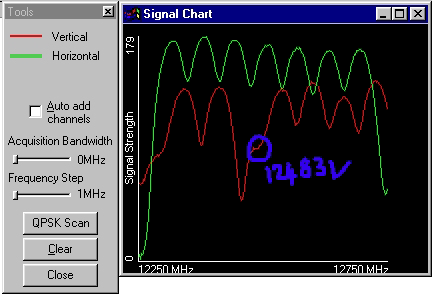
A Dvbedit scan done with his Nokia on Optus B3, the Blue bit is my addition, My Nokia using its built in spectrum scan shows the signal around 12483V also.
From Victor Holubecki
RE: Satlink
What was the deal with Asiasat 2 Satlink (3714 V 5632) last night?
It had the normal Satlink video up, but had the audio from some porno channel.
Any reason for this?
(Craigs comment, wouldn't be the first time that a uplink site operator was watching porno at work and flicked the wrong switch and accidently broadcast it.)
From the Dish
Agila 2 146E 3843 H "Solar Network" has started , Digicipher 2/ Fta, Sr 4880, Fec 3/4, VC 1.
Agila 2 146E 4083 H New PIDs for HTV : 1110/1211.
Gorizont 33 145E 3775 R "ORT (+8h), Radio Mayak and Radio Rossii" have left (SECAM).
Gorizont 33 145E 3925 R "NTV and TNT" have left .Quite likely they are moving to the new bird at 40E
Apstar 1A 134E 4070 V "Lady TV" has left .
Koreasat 3 116E 11862 L "KBS 1 and KBS Korea" have started, SR 21300, Fec 7/8,PIDs 816/817 and 928/929.
Asiasat 2 100.5E 4148 V A "Lian Hua Sat TV" test card has started, Fta, PIDs 650/651.
NEWS
Austar makes first profit
From http://theaustralian.news.com.au/common/story_page/0,5744,4903425%255E643,00.html
TROUBLED regional pay-TV group Austar United has scraped up its first top-line profit, but remains firmly in the hands of banks, having required waivers on its unmet subscriber targets.
Austar's net loss improved 51.8 per cent on a year ago to $94.4 million, but most of that related to interest ($17.9 million), depreciation and amortisation. Before those costs, the company managed a $700,000 profit.
Austar has reduced its holding in TV shopping network TVSN from 51 per cent to 22 per cent and, when TVSN's losses weren't included, the top-line profit grew to $2.3 million.
Earlier this year, Austar faced enormous obstacles in refinancing its $400 million debt, and pledged to cut annual costs by $90 million.
That has resulted in capital expenditure falling 54 per cent over the previous half, to $22 million, and expenses from ordinary activities declining 22.9 per cent to $256.2 million.
But the restructure and tough regional economic environment hit subscription numbers, which fell 3.5 per cent from the same time last year, to 417,196.
That required Austar to seek a waiver from its banks on the subscription targets that should have been met by June 30, and again at September 30.
Austar is also negotiating with its banks on whether it should hedge its interest rates.
But chief executive John Porter expected subscriber growth in the second half, as numbers had declined as a result of a $3-a-month rate increase and improved credit checking procedures.
The rate increase lifted gross margins at the pay-TV business by 23.3 per cent or $11.1 million.
Austar's cash position declined by $58.2 million in the half. It now has $44.9 million in cash plus $30 million in a contingency account.
Mr Porter believed the company was on track to be cash-flow positive by the start of 2004.
"But we need to see some growth over the next 18 months on the top line and there is a range of things happening which we think will deliver that," he said.
It included potential competition approval for the Foxtel-Optus restructuring, which would increase distribution of pay-TV channels produced by Austar's half-owned XYZ Entertainment.
"We are on the verge of an industry rationalisation that will deliver real value over time, so I think the banks should be feeling pretty confident about now," he said.
As for Austar's other businesses, its mobile telephony reselling arm lifted revenue 50.5 per cent over the year-ago period, to $4.6 million, but internet subscriptions fell.
Billions in the red, but good times ahead: News
From http://www.theage.com.au/articles/2002/08/14/1029113957782.html
Rupert Murdoch's News Corporation professes to be poised for strong growth, underpinned by an improved advertising outlook despite posting a giant $12 billion loss for the 2001-02 financial year.
News Corp paid the price for its high-risk investment in electronic television guide company Gemstar as it booked the largest loss in Australian corporate history.
It sustained blows from its exposure to the Kirch Media group, the loss-making Italian pay TV Stream business and the shrinking value of its sports contracts.
The $11.96 billion net loss, which compares with $746 million in the corresponding period in 2001, was slightly larger than market forecasts.
Mr Murdoch said he was pleased with the company's performance in the face of a global advertising meltdown.
"The past fiscal year has been a time of extremely difficult operating conditions in markets and economies around the world," he said.
Net profit before abnormal charges was $1.2 billion compared with $1.3 billion in fiscal 2001.
The biggest new hit to the bottom line came from another $3.4 billion writedown on News' 43 per cent-owned Gemstar in the June quarter. This brought the total writedown for the year to $11 billion as the market value of the electronic TV guide group sank lower.
"Obviously we were disappointed with the writedowns of our investment in Gemstar, which we took during the year due to the company's declining share price," Mr Murdoch said. "Nonetheless, we are working closely with Gemstar's management to take the necessary steps to restore the value of that important asset."
Another dent was caused by the $US35 million loss from News' 50 per cent-owned Stream. Analysts questioned the wisdom of News' intentions to merge its Italian pay TV assets with rival operator Telepiu.
"There have been a number of very poor investments and I think people are questioning the due diligence undertaken by this organisation," said UBS Warburg media analyst Tony Wilson.
Mr Murdoch was optimistic about the advertising outlook and said the group's robust balance sheet and lower cost structure positioned it for continued profit improvement.
"After a sluggish first six months of the fiscal year, including our recovery from the operational effects of September 11, we have seen an improvement in both the American and international advertising markets."
Fox Television Stations was the main beneficiary of improved market conditions.
Strong subscriber growth and advertising sales underpinned a strong result from its cable operations.
"Our Fox operations . . . are enjoying the success that comes with market leadership and expanded distribution," Mr Murdoch said.
"At BSkyB in the UK and our pan-Asian Star platform we were able to convert the potential of their two premier digital satellite TV services into operating profitability by the end of the year."
Elsewhere in News Corp's operations, the box office hit Ice Age helped double earnings from the filmed entertainment division.
Newspapers worsened, again succumbing to the prolonged worldwide slump in advertising. In Britain, the print business' earnings declined by 5 per cent.
Earnings from its Australian newspaper business declined 7 per cent compared with a double-digit increase in the corresponding quarter of 2001. A fall in job advertisements and increased newsprint prices eroded gains in circulation revenue.
The company's 25 per cent owned Foxtel, made an $8 million loss.
News declared an unfranked final dividend of 1.5 cents on ordinary shares and 3.75 cents on its preferred stock, payable October 9.
INL announces profit increase
From http://www.stuff.co.nz/stuff/0,2106,2021323a13,00.html
Independent Newspapers Limited announced today a consolidated net profit after tax of $37.8 million, a 45 per cent increase on the prior year.
The result includes both INL's publishing business and its 66.25 per cent shareholding in Sky Network Television.
The company will pay a steady final dividend of 4.5 cents a share, after paying an interim of 4.0 cents a share.
In a press release, INL Executive Chairman Mr Ken Cowley said the consolidated result reflected a pleasing improvement in Sky's financial performance, with Sky on track to break even in the second half of calendar 2003.
Sky's net operating loss was cut by 29 per cent to $30.2 million on the back of increased subscriber numbers and higher average revenues per unit.
Mr Cowley said INL Publishing's operating ebitda continued at recent highs, down slightly (1.1 per cent) on the prior year to $119.5 million.
He said most of INL's publications had posted advertising and circulation revenue gains during the year. However, a declining performance by Wellington Newspapers had dragged down the overall result.
Overall, the company's ebitda margin declined slightly from 23.2 per cent to 22.6 per cent, but if we exclude Wellington, EBITDA margin rose 0.9 per cent Mr Cowley said.
"We have addressed this underperformance in Wellington with our decision to merge the two Wellington daily newspapers into The Dominion Post," he said.
"The shift to a single, stronger paper has allowed us to reduce costs significantly and pursue advertising and revenue growth."
The press release said The Dominion Post - launched on July 8 - was enjoying strong reader and advertising support. In its first month, The Dominion Post averaged daily sales of more than 100,000, with most advertisers converting to the new paper.
Across the publishing group, total circulation revenue had increased by 2.3 per cent, with The Geelong Advertiser having the strongest circulation gain in the group following its November 2001 switch to tabloid. Average net paid sales increased by nearly 1 per cent, an encouraging improvement on the overall decline of 2.3 per cent in the prior year.
Total advertising revenue was also up by 2.3 per cent, or $7.7 million. Again, the adverse Wellington results suppressed advertising volume and yields on the daily newspapers, but this was offset by strong revenue growth in community newspapers (up 8.7 per cent) and weeklies (up 3.1 per cent).
INL Magazines performed strongly while the Gordon & Gotch distribution business was impacted by lost volume and INL Interactive's business, Stuff.co.nz halved its net losses.
Total costs increased by $7.8 million (1.8 per cent), primarily attributable to a $4 million rise in newsprint expense due to higher circulation and increased newsprint prices. Group permanent full-time and part-time staff numbers declined from 3,302 to 3,214 and following already announced decisions would be further reduced to 2,980 by the September quarter 2002, 2,640 of which would be full time.
The results included a one-off charge of $8.4 million covering The Dominion Post restructuring, a further $1.3 million charge from restructuring at the Christchurch Press and other severance charges of $4.1 million around the Group.
Non-cash one-off items comprised $2.7 million, including amortised goodwill and written off asset values following the sale of buildings in Australia and minor publications in New Zealand.
Despite funding a $36 million share buy-back, debt attributable to the publishing division reduced $10 million to $452 million due to strong operating cashflows from the publishing division, up $5 million, reduced capital expenditure, down $5m, and sharply lower income tax expense because of the transfer of Sky TV's tax losses on consolidation.
INL's outgoing CEO, Mr Tom Mockridge, said in the press release the overall result was that INL had funded an increase in its investment in Sky TV while increasing net profit 45 per cent, an outcome much more favourable than that anticipated by the independent assessor when the acquisition was first contemplated last year.
Subsequent to balance date, INL had completed the sale of its two smaller Australian newspapers, further reducing the publishing division's debt from $452 million at 30 June to $430 million at 30 July.
On a fully consolidated basis, INL's ebitda rose 75 per cent to $218.6 million and net debt increased from $740.8 million to $779.9 million.
Looking to the challenges ahead, INL's Executive Chairman, Mr Ken Cowley, said INL's focus would remain on margin improvement.
"We will achieve this by continuing to capture synergies across the publishing business and with Sky, by targeting growing circulation, improving advertising yields and maintaining a tight control on expenses."
Books close for the dividend payment on 18 October 2002.
Stuff is operated by Independent Newspapers Limited.
PanAmSat says 8 top customers may not meet contracts
From http://www.forbes.com/technology/newswire/2002/08/13/rtr694599.html
Satellite communications firm PanAmSat Corp. (nasdaq: SPOT - news - people) on Tuesday warned that eight of its top customers, which represent 20 percent its backlog, may not be able to meet the terms of their contracts.
In a quarterly filing with the U.S. Securities and Exchange Commission, PanAmSat said the largest of these customers represents about $609 million, or 11 percent, of its total backlog and $83.9 million, or 10.4 percent of its expected 2002 revenue.
PamAmSat had $5.55 billion in total backlog as of June 30.
Wilton, Connecticut-based PanAmSat said the eight customers are currently meeting "substantially all of their obligations". Company officials declined to identify the customers.
James Cuminale, executive vice president and general counsel, said PanAmSat identified the risks based on factors including the nature of the customers' business and the amount of capital they have.
PanAmSat uses its satellite network to transmit television, video and Internet services for broadcasters, Internet service providers and telecommunications companies. PanAmSat's business has been hurt by the slow economy and downturn in the telecommunications industry.
"It wouldn't be surprising to us to find them perform to the length of our contracts," Cuminale told Reuters, stressing that the company did not see any near-term risk.
"On the other hand, given the analyses and the review we've done, we feel they represent enough of a risk to indicate to investors that there's some potential for inability on their part in the future to perform."
Cuminale said it conducted the review "due to the sensitivity of the disclosure, the economic events and conditions that have persisted over the course of 2002 and some serious business failures that have occurred over the course of the year that have caused people to be concerned."
Shares of PanAmSat closed off 76 cents or 3.4 percent at $21.64 on Nasdaq. PanAmSat is 81 percent owned by satellite television company Hughes Electronics Corp. (nyse: GMH - news - people)
MAK TV ready for rollout, plans to start 4-channel test feed 24 August
From http://www.indiantelevision.com/headlines/y2k2/aug/aug89.htm
MUMBAI: It's been a long time in the incubator but Manoranjan Aur Kya (Mak) Television Network is apparently ready to roll. The test signal starts 24 August for four of the channels of the six-channel pay network, says Mak chairman and managing director Karan Saluja.
The four channels are Mak Prime (Hindi entertainment), Mak Telugu, Mak Music and Mak Bangla Movies and are expected to be broadcasting with a full-fledged eight hours of fresh programming daily in digital free to air mode from 16 September, according to Saluja. By mid-October Mak Sindhi and Mak Style (fashion) will also be up and running as digital FTA, which is when the other four channels will become encrypted feeds, Saluja says.
By mid-November all six channels will have completed their encryption and would be a completely pay-driven network, he asserts.
On the distribution front, Saluja says Mak will be seeding about 15,000 Technosat set top boxes across the country and pricing them at Rs 15,000 per STB. Mak will be uplinked out of Singapore and has taken 21 MHz transponder space on the Telstar 10 satellite for downlink, Saluja says.
The industry had written Mak off but Saluja says work has been on at a feverish pace keeping the status of the project out of the public eye. Saluja, formerly head of Reminiscent Television, was the man who set up the Gujarati Channel 'Gurjari' and Punjabi Channel 'Lashkara'.
Saluja has been working away these past months even as network directors like Satish Menon (ex-Zee and now Sahara TV president), Prashant Sanwal (ex-Sony and now director of the Zee Group's Alpha regional channels) and Hitesh Sabharwal (Sony's former distribution head) upped and left. Saluja has put together a new team with Vishnu Patel (he was the programming head of Zee TV for brief stint till March 1999) heading programming and Sanjeev Fernandes heading distribution. One person who has been associated with Mak from the beginning in an advisory capacity and is still with them is Amit Ray, executive vice president, media, Mudra Communications.
Regarding finances, Saluja said he has put together $ 10 million for the first phase of funding. Queried as to who were Mak's promoters, Saluja says besides himself, there are three other promoters - Deepak Agarwal (he's in the impost export business), Sunil Kishorepuria (of the Kolkata-based Jeevan Sagar Group) and Somnath Battacharya (running a pharmaceuticals company). Saluja clarified that his was not sweat equity but funding, as was the case for the other four.
For three of the channels, Mak Prime, Mak Telugu and Mak Bangla, Saluja has the following as attractions that he says will immediately draw in viewership. For Mak Prime Saluja says he's in serious talks for concepts that are being developed around a few of Bollywood's brightest. Aishwarya Rai, Urmila Matondkar, Manisha Koirala, Rekha, Sunil Shetty, Ajay Devgan are some of the names that he throws around.
Mak Telugu will have a blockbuster show featuring Telugu film star Krishna as its channel driver, Saluja says. As for Mak Bangla Movies, Saluja claims he has the rights for 750 Bangla films, including rights for one year to "all 13 movies of the legendary filmmaker Satyajit Ray."
Saluja is certainly not thinking small. Now it remains to be seen how successful he is in seeing his vision through.
Cartoon Network block to replace Nickelodeon on Zee TV 1 September
From http://www.indiantelevision.com/headlines/y2k2/aug/aug87.htm
MUMBAI: Indian kids fled Zee TV ever since it lost the Disney animation block to Sony Entertainment and replaced it with Nickelodeon programming. Somehow it seemed that Nickelodeon characters and fare had failed to click with them to the extent that Disney cartoons, The Power Puff Girls, Tom and Jerry, Superman and The Flintstones do. At least some of the kids that Zee TV lost are likely to return come 1 September courtesy an alliance between partners in India the Zee Network and Turner.
The two have further cemented their relationship by signing an agreement to launch an exclusive Hindi Cartoon Network programming block on Zee TV branded Cartoon Network on Zee. The block will air twice daily (8:30 am–9:30 am and 6:00 pm–7:00 pm) Monday through Saturday. It will also air at 8:00 a.m.– 9:00 am and 6:00 pm.– 7:00 pm. on Sundays. The block directly replaces the slot which is currently occupied by Nickelodeon.
Nickelodeon India, meanwhile said it was parting ways with Zee to "focus on its 24-hour channel, which has taken rapid, successful strides in the recent past." The channel claims it is now available in more than 12 million homes across India.
Says Turner International India managing director Anshuman Misra: “As leaders in kids’ entertainment, it has been our mission to elevate animation to the level of general entertainment. The launch of Cartoon Network on Zee is a significant step in that direction.”
He adds: “It is also a vital strategy as we continue to aggressively localize the Cartoon Network brand and product offering in India."
Says Zee Network group broadcasting CEO Sandeep Goyal: "Kids 4-14 and young mothers are important demographics for a general entertainment channel. The association with the Cartoon Network brand and the introduction of some of the world’s best animated content on Zee TV will enable us to better serve these audiences during key day parts.”
With the launch of Cartoon Network on Zee, Hindi language programmes drawn from the animation major’s vast library of over 10,000 cartoons will be available to Zee TV’s 30 million households in addition to Cartoon Network’s existing loyal viewers on the 24-hour channel.
Among the cartoon characters and shows which will feature in the Cartoon Network on Zee include: Scooby-Doo, The Mask, The PowerPuff Girls, Dexter's Laboratory, Pinky and the Brain, Samurai Jack, The Real Adventures of Johnny Quest, The Flintstones, The Jetsons, Tom and Jerry Kids, Superman, Captain Planet, Ed, Edd N Eddy, The Rod Runner Show, Courage the Cowardly Dog, Sheep in the Big City, Mike, Lu & Og, Sylvester and Tweety, Mysteries and Batman-The Animated Series.
India renews satellite lease with Shin
From http://www.hindustantimes.com/news/181_37949,0003.htm
Thailand's Shin Satellite Plc said on Thursday India's Department of Space had extended a lease of seven transponders on the Thaicom III satellite for another six months.
Shin Sat, Asia's number two satellite operator, said in a statement the Indian government had leased transponders since 1998 and this was the seventh renewal of the contract, previously due to expire in September.
Shin Sat is 51-per cent owned by Thailand's largest telecom conglomerate, Shin Corp, founded by the family of Thai Prime Minister Thaksin Shinawatra.
India is Shin Sat's largest foreign market.
Shin Sat plans to launch a new $350 million high-speed satellite, iPSTAR, in 2003, which is seen as major source of revenues in the next few years.
By 0305 GMT, Shin Sat shares were up 0.46 per cent at 22 baht, in line with the overall Thai stock market.
14/08/02
Chatroom was quiet where was everybody? Another quiet news day as well.
Good news? B1, 12706 V SR 22500 FEC 3/4 NZ beam
"WCTL1" is Prime TV NZ FTA! Vpid 512 Apid 650 PCR 148 Sid 1701 PMT 256
Also listed as same pids as above but Sid 1018 PMT 254
Has Prime changed its mind and decided to be FTA???or are they just teasing us? It looks very much like an off air feed from Wellington? its lacking in colour, contrast and sharpness.
Satfacts magazine for August is in the mail today (Thursday 14th) at 2PM. Features include building BDM, origin and history of MOSC smart cards with photos of various stages of development, adding 2meg of additional (Nokia) RAM for much faster channel zapping.
OOPS! Measat 2 I did a page for ages ago but only just realized it wasn't linked on the left hand side of the page. Its up and updated.
From my Emails & ICQ
From Bill Richards
Jsat2A 3917v still there but no pics
From the Dish
Optus B1 160E 12706 V "WCTL 1" is fta, Prime NZ Vpid 512 Apid 650 PCR 148 listed as on Sid 1018 or Sid 1701
Optus B1 160E 12708 V "Business Link" is Fta with Colour bars, Vpid 512 Apid 650, Sid 1250, Pmt 257
Agila 2 146E 3711 H "ABC 5" has left , moved to 3636 H.
Express 6A 80E 3975 R "GTRK Sakhalin" has left .
Express A1R 40E 3675 R Strong test carriers .Test carriers on 3625 R, 3675 R, 3725 R, 3825 R, 3875 R, 3925 R and 4075 R.Very strong test carriers on 4125 R and 4175 R. (Can anyone in Western Australia get down to 40E to check for it the footprint map does show the edge of the beam hitting the coastal areas)
NEWS
Austar hits positive EBITDA in first half 2002
From http://www.austarunited.com.au/press.asp?action=show&record=1
Press Release
14 Aug 2002
Austar United Communications Limited (“Austar”) today released its second quarter and half year result, showing that the company met its target of achieving positive EBITDA for the second quarter.
Austar recorded EBITDA of $0.7 million for the quarter ended 30 June 2002, which reflects a 103% or $21.6 million improvement compared with the same quarter in 2001.
Excluding TVSN’s results, Austar recorded positive EBITDA of $2.3 million for the second quarter. As a result of TVSN’s acquisition of Danoz, finalised on 19 June 2002, Austar now only holds 22% of TVSN, and will no longer consolidate TVSN’s results.
In addition to achieving positive EBITDA targets, cash used in operating, investing and financing activities decreased from more than $43 million in Q1 2002 to $14.7 million in Q2 2002, as previously disclosed. The cash used in the six months to 30 June 2002 was $58.3 million, a significant decrease on the previous corresponding period, due to a number of factors including the renegotiation of the cost of certain programming and the restructuring of the business announced in the fourth quarter of 2001.
Highlights for Austar (excluding TVSN) for the six month period to 30 June 2002 included:
Positive EBITDA of $3.2 million for the six months ended 30 June 2002;
A significant gross margin improvement for the pay television business of $11.1 million or 23.3% as compared to H1 2001, primarily as a result of a rate increase effected 1 May 2002 and the renegotiation of certain programming costs effective 1 July 2001;
A significant decrease in operating and general administrative costs as compared to the same period in the prior year, as a result of the restructuring initiatives announced in the fourth quarter of 2001; and
A 54% decrease in capital expenditure down to $22 million, from $49 million for H1 2001.
Commenting on the result, John Porter, Chief Executive Officer, said, “It is pleasing to see that our major restructuring initiatives are having a positive impact on earnings. We believe that we now have successfully re-engineered the business and are well placed to move our business forward in accordance with the expectations of our shareholders and our banks.”
Mr Porter noted that a slowing in growth had been a necessary consequence of the company’s need to consolidate its operations following significant restructuring, as well as market conditions in regional Australia.
Subscriber numbers in the pay television business reflect a small decrease, with the company recording 417,196 subscribers at 30 June 2002, a reduction of 3.5% against last year. Despite this slight reduction in subscribers, Austar retains its position as having the highest penetration level of any pay TV service provider in Australia.
?There is no doubt that in light of interest rate increases and an ongoing severe drought, regional Australians are being cautious about how they apply discretionary expenditure,” said Mr Porter.
?In the last six months, we have focused strongly on consolidating our business since our restructure, and we have taken steps to ensure we are extremely well placed to take advantage of industry developments. We have also made huge steps forward to improve our delivery of customer service.
"In the next six months, we will focus on attracting and keeping quality, profitable customers and reducing churn, as we continue to control costs and drive increased efficiency into our service delivery.”
China's demand for satellites due to soar
From http://news.xinhuanet.com/english/2002-08/13/content_522721.htm
BEIJING, Aug. 13 (Xinhuanet) -- China will launch more than 30 satellites for domestic use from 2001-2005, during the country's Tenth Five Year Plan.
However demand would increase to around 200 by the year 2020, sources with China Aerospace Science & Technology Corporation (CASTC) said.
Nine satellites are currently on track to provide telecommunications, weather and scientific research services.
At an ongoing working conference of CASTC, Zhang Qingwei, general manager of the corporation, said a limited company was established last year with an estimated annual output of 8-10 small satellites.
Meanwhile, the corporation is gearing up to develop a new generation of high-powered, pollution-free carrier rockets to meetthe increasing demand.
13/08/02
Live satellite chat tonight 9pm NZ and 8.30pm Syd time onwards in the chatroom. Last weeks turnout was pretty good, for those that have read Tboys article on the technical section he is usually in there and will answer any questions anyone might have.
Has anyone looked at Jcsat2a lately? I wonder what happend with the Mormons? they are not usually so easy to get rid of!
A pretty useless day for news items. Hopefully more new later this week
From my Emails & ICQ
From Zapara (W.A)
Eurosports Asiasat 2 Teletext (Yes the TXT is FTA, ), Other Screenshot is Indus News which is new on Asiasat 3
From Abdul Allouch
hi how are you craig, i live in melbourne and i recieve Asiasat 2 on a 2.3 mesh dish.
On one of the muxes has a channel named eurosport, but my reciever says it video only. Do you have any clue of whats happening with this channel?
Anyway im a mad sport fan, and i would like to know if it is possible to recieve "sky sports" channel from the UK.
please answer both questions,
Go the reds (Liverpool FC)
(Craigs comment, Not yet I emailed them 3 days ago no reply yet. One thing I know the teletext on that service is FTA. Also its NTSC! and in Viaccess. Sky Sports from the U.K is a pay channel and isn't available in Australia)
From the Dish
PAS 8 166E 3860 H "FTV" is now encrypted.
Optus B1 160E 12483 V The Saturn TV mux has left (Last week).
Optus B1 160E 12483 V "TVNZ mux has started" (Last week), Fta, Sr 22500, Fec 3/4, a copy of 12456 V.
Optus B3 156E 12313 H "Walking With Beasts" is here on , SIDs 9116-9120.
Optus B3 156E 12407 V "ABC TV National" has left .(can someone confirm if so where has it gone?)
Apstar 1A 134E 3884 H "EuroSport News" has left .
Asiasat 3 105.5E 4115 V "Indus News" has started, Fta, Sr 3331, Fec 3/4, PIDs 308/256.
Insat 2E 83E Star Vijay has left 3525 V, moved to Thaicom 3.
Thaicom 3 78.5E 3600 H A test card has started, Fta, SID 3, PIDs 514/670.
PAS 10 68.5E 4034 H New/correct FEC for the MTV India mux: 2/3.
PAS 10 68.5E 4090 H "China Radio International" has started, Fta, SIDs 1-2,APIDs 1122 and 1222.
NEWS
MGM Networks Significantly Expands Its Global Reach With Launch Of New Channels in Africa
From http://money.iwon.com/jsp/nw/nwdt_ge.jsp?news_id=cmt-224p9938&feed=cmt&date=20020812
MGM Networks, a unit of Metro-Goldwyn-Mayer Inc. (MGM), announced today that it will be launching two channels into Africa in agreements entered into with Multichoice Africa. The announcement was made today by Bruce Tuchman, Executive Vice President, MGM Networks.
To be carried on Multichoice Africa's DStv platform, MGM Networks will be supplying its 24-hour-per-day/seven-day-per-week MGM Movie Channel in English to subscribers throughout sub-Saharan Africa. In addition, for Portuguese speakers in Angola, Mozambique and Guinea Bissau, MGM Networks Latin America LLC will provide its Portuguese language channel on a 24-hour-per-day/seven-day-per-week basis, which currently reaches audiences in Brazil and Portugal as well.
Commented Mr. Tuchman: "Africa represents a real milestone in our network expansion initiatives, and we are particularly fortunate to be partnered with one of the world's leaders in Pay TV, Multichoice. With this deal, MGM now has equity interests in channels that reach every inhabited continent across the globe, from the Americas to Australia, from Asia to Europe and now Africa."
Both channels will present round-the-clock offerings from MGM's celebrated 4,000-title library, the largest modern film library in the world. On the English language channel, planned broadcasts include "Annie Hall," "Bull Durham," "The Fortune Cookie," "Last Tango in Paris," "The Manchurian Candidate," "Midnight Cowboy," "The Misfits," "Moonstruck," "Network," "Paths of Glory" and "The Pink Panther."
The Portuguese language service will further tap into rich MGM's library with planned broadcasts to include "Manhattan," "Marty," "Raging Bull," "12 Angry Men," "West Side Story," "When Harry Met Sally" and "Ulee's Gold." The channels are expected to launch this month subject to the approvals of relevant regulatory authorities.
MGM's channels in Africa will join the Company's growing stable of worldwide network interests which, with the launches in Africa, will reach over 90 countries, including branded channels in Latin America, Europe, India, Israel, Turkey and New Zealand, as well as the Middle East and South Korea (which launched earlier this year), and Greece (which is expected to launch next month). Since the beginning of 2002, the number of territories in which MGM Networks has a channel presence has grown more than four-fold.
Metro-Goldwyn-Mayer Inc. (MGM), through its Metro-Goldwyn-Mayer Studios Inc. subsidiary, is actively engaged in the worldwide production and distribution of entertainment product, including motion pictures, television programming, home video, interactive media, music, and licensed merchandise. The Company owns the largest modern film library in the world, consisting of approximately 4,000 titles. Its operating units include MGM Pictures, United Artists, MGM Television Entertainment, MGM Networks, MGM Distribution Co., MGM Worldwide Television Distribution, MGM Home Entertainment, MGM On Stage, MGM Consumer Products, MGM Music, MGM Interactive, and MGM Online.
In addition, MGM owns a 20 percent equity interest in four of Rainbow Media's successful national cable networks -- American Movie Classics (AMC), Bravo, The Independent Film Channel (IFC) and WE: Women's Entertainment -- and internationally has ownership interests in television channels reaching more than 90 countries around the globe. For more information on MGM, visit MGM Online at http://www.mgm.com .
For further information, please contact Lea Porteneuve of Metro-Goldwyn-Mayer Inc., +1-310-449-3660.
12/08/02
Not a lot to start the week with hopefully things will improve later in the week. The new Technical Apsattv pages have been started. I hope to add a lot more items on the technical side of satellite tv. The first article is Tboys item on out of footprint satellite reception. If you would like to ask more about it you can often find him in the chatroom on Tuesday nights.
Note if you can't see the Technical pages link on the left hand side try holding down CTRL and clicking on refresh in your browser to force a page refresh these days a lot of ISP's use cacheing which can stuff things up by displaying old info.
You will find the 1st item is available as a word97 file and also available as a onscreen html version, a PDF version will become available at a later date.
If you have any techinical info or have suggestions on what to add to the Technical page please let me know.
Abc Northern on B1, after a couple of days of very good signal strength, has now started to play up again signal swinging up and down by huge amounts just like it was last week.
The Channel 65 that appeard on Sky last week appears to be for PPV Boxing events.
From my Emails & ICQ
From "Satman"
Hi craigs!
here is good news.
according to TARBS homepage TARBS Asia /Africa service will start soon.
i read Subscription Contract and Terms and Conditions in TARBS Asia /Africa homepage .
arabic package, greek package, russian package, balkan package, portugueese
package, chilean package is available.
first of all this is good news for football fans.
Tarbs Asia/Africa homepage address is http://www.tarbs.net/asiaafrica/default.htm
(Craigs comment, they are advertising the services off of Cband via Thaicom 3 and Pas 2, Decoder is $170 U.S and the sub is $34.95 U.S per month with a minimum 12 month contract period.)
From Chris Pickstock
Feed seen
Asiasat 2, 3714 V, Sr 5632 is Tottenham v Latzio (dont know where they are from ).
Chris
From the Dish
PAS 8 166E 3860 H "CTV and CTS" are now encrypted.
Palapa C2 113E 3720 H "Quick Channel, Metro TV, TBN" and the occasional feeds have left .
Thaicom 3 78.5E 3585 V The Sahara TV promo has left again, replaced by a test card.
Thaicom 3 78.5E 3600 H "The test card" has left , PIDs 514/670.
PAS 10 68.5E 4034 H "MTV India" has started, enc., PIDs 417/418.(Cryptoworks)
PAS 10 68.5E 4064 V There is a Tarbs mux here , MDS, Sr 21000, Fec 3/4, PIDs 512/640-518/646, line-up: Video Italia, INN, Alice and Leonardo.
NEWS
Hughes Global Services to Provide Satellite to Pakistan
From satnewsasia.com
Pakistan said Paksat-1, its first geostationary satellite, is to begin commercial services by early next year after being moved to its new orbital slot at 38° East Longitude.
Pakistan made the announcement jointly with Hughes Global Services, Inc. (HGS), builder of Paksat-1. The satellite, which was launched in 1996 as the Indonesian Palapa C1, was renamed Paksat 1 after Pakistan took it over. HGS will also assist Pakistan fully develop the potential of their orbital slot. The contract is worth close to US$30 million over its five-year term.
With over 30 C-Band and Ku-Band transponders, Paksat-1 will provide commercial services including as Internet backbone services, remote Internet access, business communications, video, audio and data services and thin route telephony. Don Gonzales, president of HGS, said Pakistan is getting a very capable satellite to initiate its commercial communications business, and that HGS was very pleased to be able to partner them in this endeavor.
HGS provides one-stop shopping for satellite communications solutions in niche and underserved markets. It has provided services in over 70 countries worldwide to over 130 customers. HGS is a wholly owned subsidiary of Hughes Electronics Corporation, a provider of digital television entertainment, broadband services, and global video and data broadcasting. Hughes is a unit of General Motors Corporation.
OpenTV Partners with Eight Chinese Set-Top Box Manufacturers
From satnewsasia.com
OpenTV, the world's leading interactive television company, has announced agreements with eight Chinese partners to port its interactive software to digital TV set-top boxes designed for the Chinese market.
OpenTV’s lastest partners are Shenzen-based Coship Electronics Company Ltd, a leading satellite and cable receiver firm, Beijing Nokia Citic, Beijing Beida Jadebird, Shanghai Guangdian, Sichuan Jiuzhou, Beijing Compunicate, Shanghai DigiVision and Beijing DSP. The company said the deal further strengthens its technology leadership position in China’s 100 million-home TV market. Coship and Jiuzhou supplied OpenTV-powered set-top boxes to enable CCTV's interactive TV broadcast of last June’s FIFA World Cup.
OpenTV provides end-to-end interactive TV solutions, including set-top box middleware, content and professional services that are localized to meet specific market requirements. Its solutions provide support for Chinese characters and character entry to local set-top box manufacturers and all approved conditional access vendors throughout China. This support gives local partners an opportunity to quickly build expertise for new and innovative services being deployed to the local market.
Jeff Brown, OpenTV managing director, Asia Pacific region, said the company believes that continued support from manufacturers, along with the combination of OpenTV's localized interactive TV solutions and its more than three years of commitment to the Chinese market, will further speed the deployment of advanced interactive television content and applications in China. “We are excited to be working with partners who share our vision for high-quality, mass-media interactive TV services in China,” he noted.
Luck Chen, the general manager of Shanghai Digivision, said OpenTV’s advanced technology enables it to integrate sophisticated functionality supporting China cable operators provide fruitful digital and interactive TV programs for subscribers. “Working with OpenTV has been a very easy and productive experience for DigiVision. Our experience has shown that OpenTV provides excellent support, sharing its iTV technology and international experience with our knowledge of local market needs to bring a compelling solution for China cable operators.”
OpenTV's interactive television technologies, content, applications and services is being used by Austar in Australia, Jupiter Telecommunications Co., Ltd, in Japan, Beida Jadebird Huaguang, CBSat, CCTV, Henan Cable and Shanghai Cable in China, Sky Television in New Zealand, and consumer electronics manufacturers Sony Corporation and Matsushita. OpenTV has partnered with more than 18 manufacturers in Asia in Mainland China, Taiwan, Japan and Korea. OpenTV operates more than 25 million set-top boxes worldwide. The company provides a comprehensive suite of iTV solutions including operating middleware, web browser software, interactive applications, content creation tools, professional support services, and strategic consulting.
Indonesian Government to Sell 30% Stake in Indosat
From satnewsasia.com
The Indonesian government will start selling a 30 percent stake in state-owned long distance operator PT Indonesian Satellite Corporation (Indosat) in September following a similar sale last May that raised some US$110 million.
State Enterprise Minister Laksamana Sukardi made the announcement to the media but did not specify how much the government expects to raise from the sale of its Indosat holdings. The Indonesian government currently owns some 57 percent of Indosat.
Last week, Indosat said it would issue bonds and seek new loans to refinance a US$260 million loan coming due over the next few months. Indosat President Widja Purnama said that Indosat is in talks with a syndicate of local and foreign banks to organize a loan. Indosat took out a US$260 million loan from local banks earlier this year to buy out Deutsche Telekom's DT remaining stake in PT Satelit Pelapa Indonesia (Satelindo). Indosat is the majority shareholder of Satelindo, the second-largest mobile phone operator.
The government hopes that by fully owning Satelindo, Indosat will be more attractive to a strategic investor. Indosat currently owns 75 percent of the cell phone company. Jakarta is trying to sell a 45% stake in Indosat this to raise 6.5 trillion rupiah through privatization. The government will use the cash to cut its mammoth debt, which is now the equivalent of one year's gross domestic product (GDP). The Indonesian government plans to sell a further 30 percent stake in Indosat later this year to reduce huge state debts.
11/08/02
Sunday no update
10/08/02
Not much to report today, NZ vs South Africa Rugby is live on Star Sports Asiasat 3 tonight.
From my Emails & ICQ
From "ADI"
Hi.. it's me adi from ACEH Indonesia
today on 12 am, TBN was moved to 4040 H TBN Sr 28125 Pid V 2081, A 2082 & PCR 2801
you can find too Metro TV, Quick Channel and TVRI/STS ( Satelindo Station)
From "Rambod"
To those that are interested. Phoenixtv has announced on air that its analog broadcast on Asiasat3 will cease in early October this year. They will continue their digital broadcast as part of the 4000H mux on this bird.
Another analog signal to bite the dust!
(Craigs comment, think of it like this more room for digital services!)
From "Sungadi of Love"
There are several changes in Indonesia TV Station that trans. soccer FTA.
For English Premiere League: - TV 7 - Sat: Telkom-1 - taking from ESPN
Trans TV.
You can watch next Sunday, August 11, 2002 - The FA Community Shield
betwen Liverpool vs. Arsenal. The competition will begin in August 17, 2002
Bundes Liga, Euro Champion League - RCTI - Sat: Palapa C2
La Liga - Trans TV - Sat: Telkom 1
J-Legue - Japan - TVRI, every saturday - Sat: Palapa C2
Serie A, UEFA Cup - TPI - Sat: Palapa C2 (not confirmed yet).
From Me
3.45pm Syd time
Feeds on Optus B1,
12420 V Astralinks, Sr 6110 Fec 3/4
12428 V Astralinks, Sr 6110 Fec 3/4
From the Dish
Palapa C2 113E 4040 H "Quick Channel, Metro TV, TBN" and a test card have started Fta, Sr 28125, Fec 3/4, PIDs 33/34, 1057/1058, 2081/2082 and 3105/3106.
Thaicom 3 78.5E 3585 V "Sahara TV" promo has started, Fta, PIDs 513/641. ( I hope they are not moving from Asiasat 3!)
PAS 10 68.5E 4034 V "MTV test card" has started Fta, Sr 20500, Fec 3/4, PIDs 433/434.
PAS 10 68.5E 4154 H "MTV India" has started Fta, PIDs 1760/1720.
NSS 703 57E 3980 R "Udaya TV" has started Fta, PIDs 55/54.New PIDs for all channels in this mux.
NEWS
Arrest of Leading Internet Supplier of Pirate Smart Cards and Manufacturing Equipment
From astra.org.au
The Victoria Police, in a joint operation involving Subscription Television operators, on Wednesday arrested a man in Mill Park, a northern suburb of Melbourne.
The man is alleged to be one of Australia's leading suppliers of pirated subscription television smart cards and related manufacturing equipment. The arrest followed the successful execution of a search warrant and the seizure of a large quantity of smart cards, business records and equipment used in the manufacture of illegal pirate devices.
The man will be summonsed to appear before the Heidelberg Magistrate Court on a range of State and Federal criminal charges at a date to be fixed.
This arrest follows recent investigations and prosecutions of persons in Victoria involved in the sale, distribution and manufacturing of unauthorised 'broadcast decoding devices' under the provisions of the Copyright Act 1968.
"This arrest will assist Subscription Television providers and help prevent consumers being conned into paying for illegal services. The Australian Subscription Television & Radio Association's (ASTRA's) members have been working actively with police to identify the sources of supply of illegal devices and to help stop an unlawful activity that undermines the viability of our services" said Debra Richards, Executive Director of ASTRA.
Piracy occurs when a viewer or end user gains access to a Subscription Television Service without payment to the relevant subscription television provider. Use of pirate smart cards is a crime.
Since its inception in Australia in 1995, the Subscription Television industry has invested $8 billion in people, infrastructure, technology and programming and now directly employs over 3,500 people, ranging from program makers and advanced IT professionals to call centre staff and sales people. Thousands of others are indirectly employed in related industries.
Piracy undermines this contribution, costing the subscription television industry millions of dollars in lost revenue each year.
Piracy is a crime - incurring civil and criminal penalties. Criminal penalties can reach $60,500 in fines and imprisonment for up to five years.
(Craigs comment, rumoured to be Australian site "Tigermail")
SABC plans new African satellite channel
From http://www.mg.co.za/Content/l3.jsp?a=37&o=7149
The South African Broadcasting Corporation (SABC) on Tuesday announced plans to launch a new Africa digital satellite channel in October to broadcast news to Africa and the world.
SABC representative Marj Murray said SABC Africa would incorporate the present SABC Africa and Africa-to-Africa (A2A) on the DSTV suite of channels.
She said the channel would allow Africa to gather and broadcast news to the world instead of relying on British, European and American broadcast networks for news about Africa.
"SABC Africa will become a fully Africa-based international television broadcast network that will give the world Africa news, seen through the eyes of and told by Africans," Murray said.
The channel will be broadcast on DSTV and will also go out overnight and during parts of the day on SABC 2.
It will broadcast approximately 70% news and current affairs programmes and 30% Africa-produced entertainment, drama and magazine programmes.
Murray said the channel would use SABC-generated news and current affairs material from a network of contributing offices and SABC news bureaus as well as entering into partnerships with other broadcasting corporations in Africa.
SABC's director of corporate and regulatory affairs, Ihron Rensburg said that South Africans continued to be isolated from the continent.
"The new SABC Africa channel will foster real and meaningful communication between South Africa and the continent. It will also be in a great position to appraise and communicate progress made with the establishment of the African Union and other critical African projects," Rensburg said. - Sapa
(Craigs comment, sounds like it could be in the South African pay tv mux on PAS10. Hopefully as a FTA service)
Shin Satellite Increases Net Profit 25% in first half of 2002
From indiantelevision.com
MUMBAI: Shin Satellite Public Company Limited today announced continued growth for the first half of 2002, posting 25 per cent growth in net profit over the first half of 2001, or 804 million Baht, up from 642 million Baht in the same period last year. Consolidated revenue increased to 180 million Baht.
Satellite service revenue dropped 61 million Baht due to the 1.5 Baht per dollar decline in the value of the US dollar. However, this is offset by the exchange gain of more than 140 million Baht on the dollar denominated debt the company owes, a company release says.
Dr Dumrong Kasemset, executive chairman of Shin Satellite, noted: "The effect of up to 90 per cent of the company's revenue and much of its liabilities and debt being in that currency provided the company with a natural hedge against fluctuations in the foreign exchange rate and helped to maintain very stable revenue growth year-on-year.
"Furthermore, we maintained a steady rise in the utilization of our existing satellites, with C-band utilization moving up to 96 per cent and Ku-band utilization 53 per cent," he said. "This utilization is being enhanced by use of Ku-band by our iPSTAR customers, and we expect this to continue to strengthen over the year."
OpenTV No Longer Sees Profitability
From http://news.cnet.com/investor/news/newsitem/0-9900-1028-20254038-0.html
AMSTERDAM (Reuters) - OpenTV, maker of software for digital interactive TV, said it no longer expects to achieve pro-forma profitability in the fourth quarter and does not see revenue growth in the second half.
The company, which will soon be controlled by U.S. cable mogul John Malone's Liberty Media, issued the earnings warning late Thursday as it posted a 38 percent drop in revenue in the second quarter and a net loss of $30.8 million.
OpenTV reported a loss of $120.2 million in the same period of last year, but that figure included $97.7 million of goodwill amortization.
On a pro-forma basis OpenTV had a net loss of $16.4 million on $14.2 million in revenue in the April-June period versus a $4.1 million loss on $22.8 million in revenues a year ago. Proforma results exclude items like restructuring costs, amortization of goodwill and acquisition-related costs.
On its second half revenue expectations, officials were not available to clarify if OpenTV was referring to growth against the same period in the previous year or versus the first half.
The California-based company, which has a listing in Amsterdam, blamed its sagging results on current cable industry woes that have significantly slowed the deployment of interactive television technology and content needed to attract users.
OpenTV software lets TV viewers play games, get e-mail and personalize programming. Its more advanced versions can also provide for Web browsing, video on demand (VOD) and voice over IP (Internet protocol).
"To further reduce operating expenses and preserve our strong cash position, the company plans to institute a series of aggressive cost-cutting measures," OpenTV said in a statement.
Under a restructuring plan that needs to be approved by Liberty, the company plans to eliminate $20 million in annual expenses. Details of the plan will be released in the third quarter.
OpenTV is the market leader in software for digital interactive TV with more than 27 million units deployed worldwide. Its clients include News Corp's BSkyB and EchoStar.
In May, Liberty agreed to buy a controlling stake in Open TV for $185 million in cash and stock.
9/08/02
B1, Activity continues it seems pretty stable now on 12456 V TVNZ anyone having trouble is advised by TVNZ to reload the transponder. 4 Fta services should load 2 pairs of Tv1/2 Labled Wellington and Christchurch. Meanwhile Sky has added something labled "Channel 65" details are.
12544 V "Channel 65" Sr 22500, Fec 3/4 Vpid 515 Apid 653 Sid 1046 PMT 259
Dick Smiths in NZ are now selling satellite gear how about these prices.
Hills 60cm dish $135 NZ
Unknown LNBF $135
FTA Receiver unknown make and model $679
The problem is some will end up paying that without even knowing they are being ripped off and paying 3 times what they should be. Its not exactly a good thing for trying to create a FTA market. Not when any asian factory will sell a FTA box for $50 u.s.
Reminder to all readers, the Klez H virus seems to be doing the rounds again I have had 10 copies in the last 2 days sent to me. Please remember to update your virus scanner everyday, yes I said EVERYDAY. Nortons antivirus updates everyday (use the live update feature) The bad thing with these new viruses if someone is infected it falsifys the email headers and mail itself out to everyone in your address book. Since I am in a lot of addressbooks out there I end up getting a lot of viruses in my email. I am well protected but the issue is it makes my mail take forever to download!
Pas 8 page and gallery updated. Still a few missing though
From my Emails & ICQ
From John MC Dermot
4.30 pm Syd time
The Channel V Music Bus is back - on B1, 12420 V, 6110.
From Zapara (W.A)
More screenshots from Pas 8


NImeWorld, Cnbc Australia, Cnbc Hong Kong

MTV Southeast Asia, CCTV 4, CCTV 9

FTV News
From the Dish
Jcsat2a 154E 12318 V "Feeds" Sr 4820, Fec 3/4 (We need some of our readers in Asia to have a look for these)
Jcsat2a 154E 12271 V "Feeds" Sr 4820, Fec 3/4
Asiasat 3 105.5E 4029 H "CCTV 12?" reported in the CCTV mux here? possibly just a feed, worth a check
NEWS
Panamsat and BT partner to deliver video and broadcast services in Europe and the US
From indiantelevision.com
USA: PanAmSat which claims to be the premier provider of global video and data broadcasting services via satellite and BT Broadcast Services have announced the formation of a strategic alliance for the distribution of digital video services in Europe, the US and other markets. By leveraging and combining the power of each company’s network, PanAmSat and BT now offer customers a turnkey solution for the global distribution of digital video content.
President and CEO Panamsat Joe Wright said, "For our large video customers, it all comes down to two issues: service reliability and global distribution of digital content. On the first, PanAmSat has the youngest and most reliable fleet in the business. On the second, our agreement with BT provides customers with one of the most extensive capabilities for the global distribution of digital video content in the market. Through the agreement with BT, we have significantly increased the breadth and depth of our offering in Europe. We can now market digital solutions for Europe, as well as provide expanded capabilities to our existing customers around the world."
Under the terms of the agreement, PanAmSat customers will be able to distribute video programming via BT’s teleports and across their international fiber network. In addition, PanAmSat customers will be able to access a wide range of BT’s broadcast services and distribution platforms in Europe. BT’s customers will be able to take advantage of PanAmSat’s compressed digital video services, extensive satellite neighborhoods and teleports. With reciprocal access to certain resources, PanAmSat and BT will offer customers worldwide video distribution as one bundled solution.
Jon Romm, BT’s executive vice president, broadcast sales said, "This agreement is good for our customers as it enables the facilities of both BT and PanAmSat to be offered together in a single solution to broadcasters and content owners all over the world. The synergies of our networks provide a winning formula."
BT Broadcast Services claims to be one of the world’s leading suppliers of global broadcast solutions, providing a comprehensive range of terrestrial and satellite based multimedia transmission solutions as well as content and customer management services.
The group offers flexible, cost-effective tailor-made services to an international client base including broadcasters, news agencies, production companies, special event organisers, and large corporations around the world. The company claims to deliver technically advanced services based on the latest video and Internet technologies, including video streaming, digital terrestrial television, high speed Internet access via satellite and digital business TV.
ShinSat and Shanghai VSAT to commence iPSTAR service in China
From indiantelevision.com
THAILAND: The Shin Satellite Public Company Limited is deploying iPSTAR Service in China with Shanghai VSAT Network Systems Co, with the first iPSTAR Gateway to be setup in Shanghai, China.
The company will give a service demonstration will be given at the China Satellite 2002 Exhibition on 28 August in Shanghai. SVC is iPSTAR's National Service Provider (NSP) in China and will use the company's First Generation iPSTAR broadband technology to provide broadband services to customers throughout China starting from the third quarter of 2002. SVC expects to deploy more than 5,000 iPSTAR user terminals by 2003. When launched at end 2003, iPSTAR-1 will cover the entire Asia-Pacific region and will be capable of providing broadband access service to millions of users competitively to other terrestrial solutions such as DSL and cable modem.
Under the Framework Agreement signed with SVC in April 2002, SVC will deploy the iPSTAR Service using the gateway provided by Shin Satellite at its teleport in Shanghai using a Ku-band transponder on a Chinese satellite. SVC plans to provide broad range of broadband applications and services such as high speed Internet access, Virtual Private Networks (VPN), Voice-Over-IP (VOIP) and Video Conferencing.
Shanghai VSAT Network Systems Co., Ltd. (SVC) is one of the largest VSAT service provider companies licensed by China's Ministry of Posts and Telecommunications to supply domestic VSAT services, according to a company release. The iPSTAR satellite broadband project is one of the first satellite broadband systems to have a full funding closure, and to commence its first generation commercial service deployment.
CNBC India plans to expand — Targets 16 million homes in 18 months
From indiantelevision.com
CNBC India, a joint venture between Television Eighteen and CNBC Asia focussing on technology and business-related activity, is targeting to reach out to about 16 million homes within the next 12 to 18 months from the current 11 million homes.
The Chief Executive of CNBC India, Mr Harish Chawla, told Business Line that in less than three years, the channel has carved out a niche covering business related news and going beyond being a simple news channel. While expanding its network, the channel is targeting centres in some more cities and reach out to about 16 million homes within next 18 months.
"We have evolved the channel into a complete business and information medium, covering trends in various business sectors and have created a forum for chief executive officers (CEOs) to meet and discuss developments, their impact on the industry as also on India. With such coverage the young entrepreneurs look upon to us as not just information provider but as a resource base," Mr Chawla said.
Mr Chawla, who was in Hyderabad to organise a mega event `Southern Quadrangle' which will feature the Andhra Pradesh Chief Minister, Mr N. Chandrababu Naidu, and some top industry big-guns including Mr K.V. Kamat, MD & CEO of ICICI, Dr Anji Reddy, Chairman, Dr. Reddy's Labs, Mr Venu Srinivasan, Chairman, TVS Motors, said the event is a fitting tribute to the fast-paced changes these four southern States have brought in to script success stories.
These four southern States have been live and are like a distinct economic block and are among the progressing ones in the country. They have registered most rapid progress. This is a phenomenon that requires to be discussed and understood. Since business is affecting everyone, it is necessary to touch these issues and cover them in detail to help understand what is driving them toward development. For instance, the effort made by a State like Kerala to tap the potential in the IT sector is noteworthy, he said.
He said that the debate at the meet will focus on the economic development of the region which is principally riding on the IT wave, and is expected to generate specific themes on driving sustainable investment to and creating opportunities in this quadrangle.
B4U Movies targets end August for going pay
From indiantelevision.com
MUMBAI: B4U Movies, the stand alone channel that is going the pay way, aims to complete the seeding of set top boxes throughout the country by the end of the month.
The channel, which had earlier planned full encryption by end July, has started an encryption feed from 5 August. Chief distribution officer Debashish Dey says the STBs have just arrived and are being currently despatched to various parts of the country. The channel, says Dey, has received a very good response from the northern, western and eastern parts of the country. An estimated 5000 STBs are being distributed, he said. B4U is using the Smart-card from Nagravision as the encryption module and will switch off the analog feed from 30 August, he said.
B4U Movies will cost the subscriber Rs 8.90 per month. The channel is offering 15 per cent discount on its subscription rate to cable operators making advance payments or quarterly payments. The only channel that is going pay on its own without relying on a bouquet, B4U Music will also take the encryption route from December 2002, says Dey.
8/08/02
I got a good reply back from Consumer magazine they admitted they got the wrong idea from Sky telling them the TVNZ channels were FTA they assumed Tv3/4/Prime/Trackside would all be as well. The person who contacted me seemed very interested in Digital tv. I have to reply to their email later when I have time. I hope they can do a followup article on Digital tv that dosn't get taken in by all the Sky Hype.
TVNZ on B1, 12456V is not NDS Videoguard anymore this is the latest on the transponder at 5.30pm NZ
TV 1 Wellington Vpid 516 Apid 654 PCR 142 Sid 1035 PMT 263
TV 2 Wellington Vpid 517 Apid 655 PCR 143 Sid 1036 PMT 270
TV 1 Christchurch Vpid 518 Apid 656 TXT 576 PCR 144 Sid 1037 PMT 271
TV 2 Christchurch Vpid 519 Apid 657 TXT 577 PCR 145 Sid 1038 PMT 272
The Wellington services are 544x576 resolution. Hopefully they will fix this.
Update as of 7.20pm NZ all the channels on B1,12483V Saturn mux have gone and this mux is now a clone of 12456V!
From my Emails & ICQ
From Peter Clark
Further to previous advice re new activity - the following channles are coming
up in the absence of audio:
4027H 5632 3/4 'DYONG B'
4036H " " ASIA VISION
4054H " " SATELINDO
If somebody could get the PIDS for audio etc.
From "Schippy75"
Found a new Channel while scanning Asiasat 2 for changes.
No Broadcast on it at the moment, Might be a good idea for people
with Nokia's to check out.
Found Eurosport.
3660V 27500 3/4
From Steve McClark
Can also confirm Eurosport on the middle east package
on 3660V 27500 3/4 on as2, with vpid of 2816 and audio of 0000.
Nothing on it at this stage.
regards.
From [email protected]
Subject: Cams
G' day Craig
Pls post this on you site
Does any one have a source of Irdeto cams with 4.60 software?
From Zapara (W.A)
Who trimmed his garden and found God on PAS 10

God Channel



Aastha, Nime World, and CMM Music all via Pas 10, Despite the Thai script Nime World is Japanese
(Craigs comment, excellent shots they add a lot of colour to the page. More screenshots coming tommorow!)
From the Dish
Optus B1 160E 12456 V 12456 Sr 22500 Fec 3/4
Optus B1 160E 12456 V "TV 1 Wellington" Vpid 516 Apid 654 PCR 142 Sid 1035 PMT 263
Optus B1 160E 12456 V "TV 2 Wellington" Vpid 517 Apid 655 PCR 143 Sid 1036 PMT 270
Optus B1 160E 12456 V "TV 1 Christchurch" Vpid 518 Apid 656 TXT 576 PCR 144 Sid 1037 PMT 271
Optus B1 160E 12456 V "TV 2 Christchurch" Vpid 519 Apid 657 TXT 577 PCR 145 Sid 1038 PMT 272
Palapa C2 113E 3720 H "Quick Channel, Metro TV" and occasional feeds have started Fta, SIDs 1-3, PIDs 33/34, 1057/1058 and 2081/2082.
Thaicom 3 78.5E 3480 H All channels in the TARBS mux are encrypted again.
PAS 10 68.5E 3778 V "CMM Music" has started , Fta, Sr 2940, Fec 3/4, PIDs 4194/4195.
NEWS
C7 wounds reopened as Foxtel nabs ESPN
From http://www.theage.com.au/articles/2002/08/07/1028157962835.html
Foxtel yesterday challenged Seven Network's view that the pay television operator's deal with Walt Disney's ESPN sports channel proved it had ample room for extra channels.
A Foxtel spokesman said ESPN would not be offered as part of Foxtel's basic channel service. It would be available on a tier - meaning that subscribers pay extra - from September 1.
Despite gaining mandated access to Foxtel's network after a protracted court battle, Seven has so far been unable to agree with the pay TV broadcaster on the terms of access.
Seven knocked back several offers to broadcast its C7 sports channel as part of a tier, instead demanding that a range of channels be included as part of the basic service that every Foxtel customer receives. Further negotiations between the two parties appeared to have fizzled.
"Foxtel as recently as February 2002 made an offer to negotiate commercial terms for carriage of C7 (and) was prepared to reorganise its existing channel slots to make room for C7," a Foxtel spokesman said.
"Seven chose instead to reject (the) offer and later closed C7 Sports."
A Foxtel spokesman said limiting the number of channels on the basic service was part of broader strategy to drive subscriber growth.
"ESPN has subsequently joined Foxtel as a tier channel on commercial terms negotiated with Foxtel," he said.
"Foxtel has not found an extra channel for ESPN.
"Unlike C7, ESPN is happy to be directly accountable to subscribers for the quality of its service by going on a tier on Foxtel."
ESPN is already beamed to Optus subscribers and will become the fifth sports channel on Foxtel's service, which includes the two Fox Sports channels, Fox Footy Channel and Sky Racing.
AsiaSat To Launch Fourth Satellite By Year-end
From http://www.financialexpress.com/fe_full_story.php?content_id=14728
Kolkata: AsiaSatellite Telecommunications Company Limited (AsiaSat) will launch its fourth satellite by the year-end, according to industry sources.
AsiaSat had planned to launch its fourth satellite AsiaSat-4 in May this year, but it had to be rescheduled owing to manufacturing delays at Boeing.
?The decision was taken after a few meetings with satellite manufacturer Boeing satellite systems”, sources said, adding, “it was supposed to be launched by the Atlas IIIB rocket from Florida. Boeing has decided to conduct additional trial on AsiaSat-4 and other spacecraft to ensure the quality of its product line”.
Delivery of the satellite — a Boeing 601HP — is expected to be delayed by at least four months. AsiaSat is now planning to announce a date after discussions with service provider International Launch Services, to assist in finalising a new launch date.
Industry observers say that the date will be finalised within a couple of months. Now AsiaSat-2 beams 62 channels, while its third satellite AsiaSat3S works for 81 channels globally. Recently, ATN World has been shifted from Thaicom-3 to AsiaSat3S. Few channels will also be beamed through AsiaSat-4, coming out from their existing satellite, industry watchers feel.
Industry observers say that AsiaSat-4 has some interesting features. “The most interesting part is the spacecraft, which will be installed at the 122 degrees east orbital position, would provide regionwise coverage over Asia and focussed KU-band telecast for the eastern part of Asia and entire Australia”, they said.
AsiaSat-4 is able to hold 28 C band and 20 KU band transponders including four Broadcast Satellite Services (BSS), to be applied for Hong Kong’s Direct-to-Home (DTH).
Intelsat Sponsors "ONE CHILD - ONE VOICE" to Support UN World Summit on Sustainable Development
From Press Release
Hamilton, Bermuda, 7 August 2002 - In support of the upcoming 2002 UN World
Summit on Sustainable Development, Intelsat is sponsoring the global
distribution of one half-hour television special called "ONE CHILD - ONE
VOICE," a UN-endorsed program that inspires grassroots involvement in
worldwide environmental issues.
Intelsat has donated satellite capacity and financial aid for distribution
of the TV special that will be sent to nearly 3,000 broadcasters worldwide
for their unlimited use in public education programming. "ONE CHILD - ONE
VOICE" is a video, produced by award winning filmmaker Barbara Pyle, that is
based upon the true stories of children around the world to address a wide
array of environmental issues. The program calls for support of the TREE OF
LIFE campaign, which invites children worldwide to voice their support for
the goals of the UN Summit by drawing a leaf on a postcard and sending it to
be hung on an artist-created TREE OF LIFE. The Tree will be placed in
Johannesburg, South Africa at the UN Summit site for world leaders and
others to view. This year's campaign is expected to be larger than the TREE
OF LIFE campaign surrounding the Earth Summit in Rio in 1992, which boasted
leaves from over a million viewers from all continents.
"Without Intelsat's generous donation and support we would never be able to
carry our important message around the world," said Barbara Pyle. "It is
imperative for people to understand that individuals can have a huge impact
on global environmental problems."
Tony Trujillo, Senior Vice President of Corporate Services, Intelsat Global
Service Corporation, added, "Intelsat is honored to be playing a part in
this inspiring and educational event. We continue to be very committed to
the improvement and health of the global and local community."
The UN Summit will take place in Johannesburg from 26 August through 4
September. For more information on ONE CHILD - ONE VOICE, or if your local
television station wishes to broadcast the program, contact Barbara Pyle at
[email protected] or visit www.peoplecountTV.com. Leaf postcards should
be sent to: TREE OF LIFE; World Summit; Braamfontein; Johannesburg 2017;
South Africa.
Pakistan launches satellite project
From http://www.jang-group.com/thenews/aug2002-daily/08-08-2002/business/b5.htm
KARACHI: Pakistan has formally launched a satellite project in collaboration with an internationally recognised consultant to advise and assist it with developing the project at the orbital location of 38E.
"The project has finally been launched in collaboration with Hughes Global Satellite System", Salman Ansari, Advisor to the Ministry of Science and Technology (MoST) told The News over telephone on Wednesday.
Meanwhile, sources said; that since the project has now been launched it is expected that the country would have its two co-related satellites by the end of the current year. It is pertinent to note, that the Federal Minister for Science and Technology, Dr Atta-ur-Rehman about a couple of months ago had hinted that the country was ready to launch its two co-related satellites by the end of the current year to "enhance the country's communications as well as strategic capabilities".
Sources said, that the President of Hughes, Don Gonzales, who is on a visit to Pakistan held meetings with the minister and other senior officials of the MoST. The MoST had invited proposals from internationally recognised consultants to advise and assist it in developing the satellite project at 38E orbital location about a couple of months ago.
The National Commission on Science and Technology in its third meeting held in December 2001, chaired by the President General Pervez Musharraf had decided to pursue the 'Pak Satellite Project' as per the discussions of the cabinet.
The meeting was informed that the orbital slot allocated to Pakistan by ITU (38 degrees East) would lapse in April 2003 unless, Pakistan had a satellite in place with transponders switched on and the ownership of this slot was approved internationally.
It was also cautioned in the meeting that without it, Pakistan would be forever deprived of this orbital slot. The MoST was pursuing the objectives of occupations of the slot as per the decision of the cabinet.
However, the meeting was informed that the Pak Satellite Project may either be short-term costing US $7-12 million in 18 months or long-term US $50 million as equity share of Pakistan for 3 years. The meeting suggested debating the financial issue of the project with the Planning and Finance Division.
Official: Russia to Monitor TV
From http://www.mediaconference.com/p/02/455cef1d7f36.html
MOSCOW (AP) — All Russian TV channels will be screened for extra video frames containing subliminal messages by the end of the year, a broadcasting official said Wednesday.
Deputy Press Minister Valery Sirozhenko told ITAR-Tass news agency that special monitoring equipment would monitor channels inserting extra frames, amid growing reports of their use on Russian airwaves. Violators could face fines or have their broadcast licenses revoked, ITAR-Tass said.
The news agency said unofficial data suggests a fifth of Russian TV programs have extra frames, containing messages ranging from those urging viewers not to switch channels to political ads.
(Craigs comment, one of the most unusual news reports I have posted!)
7/08/02
Thank you all who showed up for the chat it was a good turnout. For those who asked the item about U.S domestic satellite dxing from NZ and Eastern Australia will go up as soon as I join up all the parts up the article.
Changes in the Global Vision mux on Palapa C2 maybe something will happen there after all. I will try and email them again and see if I can get a reply from them.
Optus B1 12733 V Mux was FTA in the early hours of this morning, channels are still the same as reported at Lyngsat I did note the Nokia reported the stream as Irdeto 2. At the same time the TVNZ service on 12456V and the 12483 V mux of Saturn was playing up not loading so they must of been having some problems. No changes noted on Sky's service.
6.30pm NZ time update, B1 12456 V now loading 7 services (with some difficulty) only 2 FTA. Guess what?? its now using NDS. I predicted all this a few months back when they announced regionalized TVNZ's!
The latest NZ Consumer magazine has an item about Sky TV / Internet /Phone Packages I have to email them because they made a big mistake this is what they wrote.
"Sky already uses a digital signal to broadcast all its channels, including the free-to-air ones. The digital free-to-airs aren't encrypted, so anyone can receive them, not just Sky subscribers...privided they've got their own satellite dish and decoder!"
Complete nonsense as FTA viewers already know Sky will not provide Tv3/4/Prime and Trackside FTA no matter how many people ask them to. Time for an email to them [email protected]
From my Emails & ICQ
From Zapara (W.A)
I did a quick check on analog on Insat 2e, I can pick up all the Analog Zone beams ok, with the 4089 vrt signal almost P5 just slight sparkles, , the lower freq are noisey, I think this has more to do with my LNB rather then Dish, No Digital locked on Zone though, need to change the LNB to a wide band version.
Tested on 2.7M solid dish in W.A
From the Dish
Apstar 1 138E 3692 H "Feeds" Sr 3350 Fec 2/3
Apstar 1 138E 3867 H "Feeds" Sr 4290 Fec 3/4
Palapa C2 113E 3720 H "TBN" has started on , Fta, Sr 12500, Fec 3/4, PIDs 3105/3106.( I think they put this on the wrong beam!)
Palapa C2 113E 3760 H "Global Vision mux promos" Sr 26100, Fec 3/4
Palapa C2 113E 4027 H "Feeds" Sr 5632 Fec 3/4
Palapa C2 113E 4036 H "Feeds" Sr 5632 Fec 3/4
Palapa C2 113E 4054 H "Feeds" Sr 5632 Fec 3/4
Thaicom 3 78.5E 3480 H "Radio Dimensione Suono" has started , Fta, Apid 661.
Thaicom 3 78.5E 3600 H The Amway promo has left , replaced by a test card.
PAS 10 68.5E 4034 H "MTV India" has left (PAL), moved to 4154 H.
NEWS
August AFRTS Ku to Japan on I802
From http://www.afrts.osd.mil/page.asp?pg=\gen_info\whats_new
In mid-Aug, AFRTS will switch delivery of our television and radio services from a global satellite beam (INTELSAT 702 at 176 degrees) covering the Pacific and East Asia to a spot beam (INTELSAT 802 at 174 degrees) to better serve our service members in Japan (to include Okinawa) and Korea.
This change will provide the 15 thousand-plus U.S. military households who live off-base in Japan and Korea the opportunity to receive all AFRTS services directly into their private residences. These households must have a Scientific Atlanta PowerVu satellite receiver (decoder) and a 60 to 88 cm diameter satellite dish (60cm in Tokyo and Seoul areas, 88 cm in Okinawa and Misawa and 80 cm elsewhere). AFRTS is working with the commands and the military exchanges (AAFES and NEX) to determine the best way to implement a decoder program in the Pacific theater. As of this date, our understanding is decoders will be available in Japan through AAFES/NEX. Decoder providers for Korea will be announced when determined.
Those AFRTS stations, local base cable systems, and other military sites in Japan and Korea currently receiving AFRTS from the INTELSAT 702 must (1) convert their satellite receive equipment from C-Band to Ku-band, (2) change frequency settings in their decoders, and (3) re-align their dishes to receive the signal from INTELSAT 802. AFRTS is working with the commands and Broadcasting Services to issue and ship the required conversion equipment to AFRTS stations and government cable systems. Those DoD units/personnel stationed outside of Japan and Korea currently receiving INTELSAT 702 will be served by AFRTS’ Direct-to-Sailor (DTS) satellite service. With at least a 1.2-meter C-band dish, viewers will receive three AFRTS television services: AFN Pacific, AFN News and AFN Sports, and three radio services. The only changes these units outside the INTELSAT 802 footprint must make would be the frequency settings in their decoders and the re-alignment of the dish from INTELSAT 702 to INTELSAT 701 at 180 degrees or INTELSAT 804 at 64.1 degrees (depending on unit location).
Proposed KU Footprint
http://www.afrts.osd.mil/page.asp?pg=\gen_info\newsatnetdistr2
(Craigs comment, perhaps a good chance of seeing AFRTS fta at some stage this month during the changeover)
Hughes to build African satellite network
From http://www.bizjournals.com/baltimore/stories/2002/08/05/daily16.html
Germantown company Hughes Network Systems Inc. signed a contract to provide a satellite broadband network for East African telecommunications firm AFSAT Communications Ltd.
The use of Hughes network management center in Germany will allow AFSAT to provide high-speed broadband and Internet service to small and medium business and consumers in several African states including Uganda, Tanzania, Ghana and Nigeria.
The terms of the contract were not disclosed.
AFSAT is calling its new service iWay and will provide the first Internet access through satellite to many African states.
"Now consumers and enterprises in Africa will have high-speed access to the Internet without the limitations posed by the lack of terrestrial infrastructure," said Ramesh Ramaswamy, senior director for business development in Middle/East Africa.
Hughes Network Systems is a subsidiary of Hughes Electronics Corp., which makes the DIRECTV digital satellite systems as well as providing high-speed Internet access via satellite through DirecPC and DirecWAY.
With a worldwide market, the company has sold more than 500,000 systems.
Murdoch plans reality TV channel
From http://www.thisislondon.com/dynamic/news/story.html?in_review_id=660551&in_review_text_id=631810
A television channel showing reality programmes 24 hours a day is being planned by Rupert Murdoch's News Corporation.
US network Fox, which is behind the American version of Pop Idol, wants to run shows such as Who Wants to Marry a Millionaire non-stop.
Temptation Island, another show billed for the station, encouraged participants to be unfaithful for the benefit of the cameras. According to reports, the reality channel could be tested on satellite in Britain before launching in the US.
Govt. studying feasibility of open architecture for DTH
From indiantelevision.com
NEW DELHI: If it's not CAS, then it has to be DTH. The government is now examining the issue of "open architecture" and whether a thing like that prevails at all or not.
According to government officials, the issue of open architecture and its standards, if available, is going to be referred to the Bureau of Indian Standards.
A senior government official admitted that though the government is likely to push ahead with open architecture - much to the chagrin of broadcasters who are insisting there is nothing of this sort and encryption technology is proprietary - it may refer the issue to BIS which is also looking into the matter of standardising the technology for set-top boxes which will be needed in case conditional access system is implemented.
The mandate for BIS would be to see if there are existing standards for open architecture and, if possible, the alternatives available.
Sahara TV to take on a new look 15 August; slew of new shows being readied
From indiantelevision.com
For long a has-been, Sahara TV is now gearing up to stand up and be counted. In preparation for a major programming revamp that is rolling out in September, the channel is going in for a new look on 15 August. Aimed to coincide with Independence Day, the channel will sport new graphics as well as a couple of new shows.
The channel also has plans to introduce a special weekend programming line-up within the next two months, says Sahara TV president Satish Menon.
Among the new programmes that are to be launched on the channel in a phased manner in the next few months is Parchhaiyan, a suspense soap that premiered on Monday. Slotted in the 9 pm prime time band Mondays to Thursdays, the Ravi Rai directed series starring Milind Gunaji and Reena Wadhwa is pitched directly against family soaps on mainstream satellite channels, says Menon.
The channel's Independence Day programming line up includes a mega entertainment show titled Bharat Parva featuring Bollywood's top stars. And continuing in that nationalistic vein, an hour long weekly show Mission Fateh, an ode to soldiers on the battlefront, launches 16 August at 9 pm. Each episode will feature the saga of a martyr fighting for the country in the unfriendly terrain of Kargil.
Among the channel's new shows lined up for September is an adapted version of the classic hit series I Love Lucy with retired former Bollywood superstar Sridevi in the lead role. Post-September will also see Sahara coming out with a strong weekend programming line up, says Menon.
The channel recently appointed SSC&B to promote its programmes, Shubh Mangal Savdhan and Parchhaiyan in a multi media campaign encompassing print, outdoor and radio. The task of making the new graphics and new look of Sahara TV has been given to graphics major Crest Communications, says Menon.
6/08/02
Live satellite related chat tonight at 9pm NZ and 8.30pm Syd time onwards.
Abc Northern on B1 was all up and down in signal level last night someone reported it dropped 10 Db this signals always been up and down. But it was very erratic last night.
Things seem very quiet at the moment, Please keep those reports coming in about insat 2E zone beam reception so I can build up a record of signal levels in various parts of Australia.
From my Emails & ICQ
From Bill Richards (South Aust)
Subject: Insat 2E
All zone Analogue transponders are
quite watchable here p3 level.
Via 2.3M mesh dish
Also does anyone have instructions for a KONIG APM381 Sat Level Meter?
(Craigs comment, That's good which analog receiver did you use? Did you need to use threshold extension? For those that don't know P3 means means the pictures reasonable with a few sparklies. The difference between watchable and unwatchable could be as simple as using a receiver which has excellent low threshold adjustment. A 3M dish would help as well. Please send in more reports from various regions so we can get a better idea of where the zone beams cover)
From the Dish
Palapa C2 113E 3622 H "Kantor Berita Radio" has left , APID 1212.
Palapa C2 113E 4040 H "Quick Channel, Metro TV and the test cards" have left .
Thaicom 3 78.5E 3480 H TARBS mux Telefe Internacional has replaced MKTV Sat on PIDs 520/648.INN has replaced Video Italia on PIDs 523/651.Alpha News 98.9 has started on APID 660. All channels in this mux are Fta at the moment.
NSS 703 57E 3881 R "Gurjari Channel" has left .
NEWS
MTV India goes fully digital tomorrow
From indiantelevision.com
MUMBAI:Music channel MTV has completed its transition to digital transmission and will be switching off its analog feed from tomorrow.
Sanjeev Hiremath, vice-president, network development, South Asia, licensing and merchandising, however, said not all cable operators had received the set top boxes and till this process was completed, MTV India would be available as both a digital encrypted and non-encrypted feed.
Hiremath said once the set top box rollout was completed, MTV would be available as an encrypted digital free-to-air channel.
Technical Specifications:
Satellite: Panamsat PAS-10
Transponder: 7C
Downlink Polarisation: Horizontal
Downlink Frequency: 4034 MHz
(Craigs comment, Encrypted FTA digital channel????)
Bangla channel ETV gets some respite as review petition set for 24 August
From indiantelevision.com
MUMBAI: ETV (Ekushey TV), Bangladesh's first private terrestrial television channel, which is under threat of closure from the authorities, has again managed to get some breathing time from the country's apex appeals court.
The Appellate Division, headed by Chief Justice Mainur Reza Chowdhury, in its order issued yesterday, decreed that it could to continue broadcast till 24 August, the new date set for disposal of a review petition, Bangladesh's The Independent, reported today.
According to The Independent, the Appellate Division had earlier stayed its own order of upholding the verdict of a High Court Division Bench that declared the agreement between ETV and the government without any lawful authority and allowed the ETV's prayer for filing a review petition and also allowed five weeks to do so.
The court accepted ETV's plea that it could not file the review petition as it "did not get the certified copy of the court's order."
The High Court had earlier found irregularities in the existing agreement between ETV and the government and held that the granting of licence to ETV was done without any lawful authority. The Appellate Division on 2 July allowed ETV five weeks to file a review petition against its (court) order.
If the Appellate Division finally does uphold the verdict of the High Court, ETV would have to shut down its telecasts till issuance of a fresh licence by the government.
The writ petition against the ETV was filed by two Dhaka University teachers and the president of the Bangladesh Federal Union of Journalists (BFUJ) Gias Kamal Chowdhury, on 19 September, 2001 challenging the legality of the ETV-government agreement.
ETV was launched on the basis of an agreement signed between the Ministry of Information and AS Mahmud, Chairman of the company, on March 9, 1999
Satellite communication services in India to improve with Kingston Inmedia's new deal with New Skies
From indiantelevision.com
Kingston Inmedia, the satellite-centric broadband solutions provider of Kingston Communications has signed an agreement with global satellite communications company New Skies Satellites to offer highly competitive range of communications services using New Skies' network and Kingston's fully integrated media facility at Gerrards Cross, northwest of London.
Under the terms of the new agreement, Kingston Inmedia and New Skies will expand the range of satellite communications services offered to customers throughout Europe, the Americas, India, the Middle East and Africa. Specifically:
New Skies and its customers will have access to Kingston's state-of-the-art digital media facility, which includes satellite earth stations, a secure data centre for colocating equipment, three fully equipped broadcast studios, and advanced digital playout suites.
Kingston and its customers will have access to New Skies' global satellite network, which consists of six geosynchronous spacecraft and offers connectivity virtually anywhere in the world.
Kingston will add telemetry, tracking and control (TT&C) and carrier services monitoring (CSM) for New Skies' newly-launched NSS-7 satellite to those services already being performed for the NSS-703 and 806 satellites.
New Skies' communications hardware will be consolidated at a single, secure location within Kingston inmedia's facility, along with colocation space for customer equipment.
5/08/02
Not a lot to start the week with. The asian satellite sites are reporting KU signals off Jcsat 2a at 154E. Might be worth a look Though I doubt it makes it into Australia.
From my Emails & ICQ
From Paul Tainsh
Hi Craig,
sorry about this e-mail being late but my computer has been down for a while.Concerning Insat 2E zone beam my dish is permanently on this sat.Jaya and Aajtak channels are ok most days the rest of the channels on the ETV mix(zone beam) can be received occasionally. At the moment they are tiling and will not lock.I,m located 160 kls east of Melbourne,Victoria.My system is 3.7 KTI mesh dish,Strong 4610 receiver,LNBF?(Taiwan cheapie)
Regards Paul
(Craigs comment, this is amazing reception just look at the official footprint and see how far outside it this is. I hope it encourages more to go after difficult signals)
From Bill Richards
0700 UTC
Thaicom3
3640 H Sr 28064 Fec 3/4 Vpid523 Apid641 SID22 PMT2562 "IRIB3" has replaced test card
Regards
Bill
From ME 3/08/02
7pm Syd
B1 feed 12424 V SR 13016 Fec 3/4 "SKY NZ Bledisloe" Rugby in mpg 4:2:2!
From ME 4/08/02
1pm Syd
B1, 12420 V Sr 6980 Fec 3/4 "NRL feed" Vpid 4096 Apid 4097
From the Dish
Jcsat 2a 154E 12550 H "Japanese baseball feeds" sorry no other details
Jcsat 2a 154E 12271 V "Japanese sports feeds", Sr 4820 Fec 3/4.
Asiasat 3 105.5E 3760 H "ATN World" has started, Fta, SID 4, PIDs 1040/1041.
NEWS
Dumped pay TV channel fights back
From http://www.smh.com.au/articles/2002/08/04/1028157878736.html
Australia's biggest pay TV industry player, Foxtel, is under fire for its decision to pull a little-known independent US music channel off the air at the end of the month.
California's Soundtrack Channel, dedicated to showing music clips from film and TV soundtracks, has approached the Australian Competition and Consumer Commission and launched a grassroots campaign on its channel in a bid to stay in Australia.
STC accuses Foxtel of breaching its promise to conduct a fair and unbiased review of the channel during a six-month trial agreed in March.
It claims Foxtel refuses to show it the results of that review to support its decision to take the channel off air.
STC's chief executive officer, Bill Lee, said seeing those results would be "in the best interests of its subscribers".
Foxtel has fired back, saying Australians just are not watching STC.
It has accused STC's executives of providing misinformation about Foxtel's reasons for pulling the channel.
Foxtel part-owns two music channels on its platform - the better established Channel V and Music Max. Both far outrate STC.
Speaking from Los Angeles last week, STC's Mr Lee said: "I think their interests lie elsewhere, in the sense they clearly recognise they've got, as cable operators and satellite [operators] they're in the distribution business, and they clearly recognise the value of the real estate that they have in the forms of cable and satellite systems and subscribers.
"I also know that they're in the programming business."
STC has been told that Optus is also taking the channel off the air.
STC entered the Australian pay TV market in March and acquired the country music channel, Music Country.
STC uses that one channel to broadcast Music Country and its own soundtracks.
The dispute comes against the backdrop of the ACCC's deliberations over whether to approve a content-sharing alliance between Foxtel and Optus.
"Is it a coincidence?" Mr Lee asked.
Foxtel has vehemently denied any inference that the Optus and Foxtel decisions were related.
Foxtel's director of corporate affairs, Mark Furness, said "whether or not Optus carries STC is a decision for Optus".
"The facts are the channel is vastly underperforming and we can't continue to carry it," Mr Furness said.
JSAT To Offer Cheap Emergency Satellite Service
From satnewsasia.com
One of Asia's largest satellite operators, Japan's JSAT Corp., is set to launch this month an emergency-communications service for a monthly fee only one-third that of the firm's current services.
Sources said JSAT will target private companies and local governments that want to secure back-up communication lines in the event of an earthquake, typhoons or other natural disaster that can incapacitate terrestrial lines.
Nihon Keizai Shimbun has reported the cheaper price is made possible through a system that allows a number of corporations to share a common bandwidth on one communications satellite without diminishing data-transmission efficiency. The technology was developed by Gilat Satellite Networks Ltd. (GILTF) of Israel.
Initial costs to install necessary equipment have also been cut to some $4,555 (Y600,000), one-fifth the installation fee charged for the firm's existing service. The company hopes to expand its customer base for the low-priced emergency communications service to offset dwindling demand for satellite communication services, which has resulted from wider use of broadband communications.
The service is seen as part of "JSAT, Expanding Horizons," program adopted in November 2000. The slogan expresses the company's policy of driving growth by expanding not only the businesses and services, but also the geographic reach of its international satellite communications.
JSAT Corp. currently supplies communications and broadcasting services through 8 satellites positioned in 7 orbital slots. With its resources, the service is expected to expand easily.
Indonesia Satellite To Refinance $260M With Bonds, Loans
From satnewsasia.com
State-owned international phone operator PT Indonesia Satellite Corporation (Indosat) said it would issue bonds and seek new loans to refinance a US$260 million loan coming due over the next few months.
Indosat President Widja Purnama said that Indosat is in talks with a syndicate of local and foreign banks to organize a loan. Indosat took out a US$260 million loan from local banks earlier this year to buy out Deutsche Telekom's DT remaining stake in PT Satelit Pelapa Indonesia (Satelindo). Indosat is the majority shareholder of Satelindo, the second-largest mobile phone operator.
The government hopes that by fully owning Satelindo, Indosat will be more attractive to a strategic investor. Indosat currently owns 75 percent of the cell phone company. Jakarta is trying to sell a 45% stake in Indosat this to raise 6.5 trillion rupiah through privatization. The government will use the cash to cut its mammoth debt, which is now the equivalent of one year's gross domestic product (GDP). The Indonesian government plans to sell a further 30 percent stake in Indosat later this year to reduce huge state debts.
For 2001, Indosat announced a 10.8 percent drop in its net profit and a 113 percent increase in operating expenses. The company's full-year profit stood at US$143.5 million from US$160.9 million a year earlier. The huge growth in Indosat's operating expenses was driven by depreciating asset values, maintenance and miscellaneous costs. Operating revenues were strong, growing 72 percent mainly due to the performance of the cellular business, which accounted for 36.4 percent of the total. As of December 31, Indosat said it held cash and deposit balances of US$450 million.
Out of total operating expenses of US$354 million, however, depreciation accounted for US$98 million, including US$13.7 million from Indosat and US$58 million from the cellular unit Satelindo. Another major expenses item was compensation to local telephone operator PT Telekomunikasi Indonesia (PT Telkom) and other companies that amounted to US$79 million
4/08/02
Back Monday
3/08/02
Had a play with my 76cm dish trying to receive Asiasat3 KU Big Pond internet, it was pretty cold and wet outside so didn't mess around with it for long. I will have to hunt out my sat finder and have another try when the weathers better.
Live rugby Australia vs NZ on Star Sports tonight for those that can't get it via terrestrial. I am picking NZ by 14!
From my Emails & ICQ
From Me
8.20pm Syd time, Friday Night
Opus B1 12420 V Sr 6980 Fec 3/4 "Boxing"
1.50pm Syd time, Saturday
B1, 12410 V "AFL feed" Sr 6110 Fec 3/4
From the Dish
Superbird C 144E 12688 V "Tzu Chi TV" has left again.
Superbird C 144E The occasional feeds have left 12305 V, 12678 V and 12683 V.
Superbird C 144E The I-HITS mux has moved from 12703 H to 12523 H, Sr 21096, Fec 3/4,NID/TID 61441-65029, PIDs 216/217 and 1160/1120-1960/1920. A few new channels have started: EPG Channel Guide, Music Air Networks and CNN
International Asia.
Palapa C2 113E 4040 H "Quick Channel and Metro TV" are back, Fta, Sr 28150, Fec 3/4, PIDs 33/34 and 1057/1058. There are test cards on PIDs 2081/2082 and 3105/3106.
ST 1 88E 3632 V "Tzu Chi TV and PTS"are Fta again.
NEWS
All Black classics stuck in TV maul
From http://www.nzherald.co.nz/storydisplay.cfm?storyID=2347715&thesection=news&thesubsection=general
Sky Television's access to some historic rugby matches for its rugby channel is on hold while negotiations take place between the rugby union and TVNZ.
Sky promotes the 24-hour rugby channel, which has 15,000 subscribers who pay $8.62 a month, as having "a wealth of classic archive games from the 1950s onwards".
It is understood the New Zealand Rugby Football Union has been negotiating with TVNZ for several months for access to its trove of All Black footage, held at the television archives in Wellington.
Sky is standing by, waiting on the outcome so it can negotiate for rights to games from that era.
TVNZ says it holds the rights to games broadcast between 1963 and 1979. Games played between 1979 and 1995 are jointly owned by TVNZ and the NZRFU.
The Rugby Union's commercial manager, Trevor McKewen, declined to comment on the NZRFU claim on the 1963-79 games held by TVNZ.
"We have a good relationship with TVNZ and we have had recent discussions about our desire to develop the archival library of New Zealand rugby," he said.
Sky's director of sport, Kevin Cameron, said the network was working with the Rugby Union on the issue.
The rugby channel had yet to gain approval to screen many games played before the network's 1995 agreement covering the All Blacks matches in New Zealand, the Tri-Nations series and all three divisions of the National Provincial Championship.
Mr Cameron said negotiations with rights holders such as the Rugby Union, the International Rugby Board and their representatives were continuing.
He said it took time to get hold of the appropriate rights holders to gain permission.
Sky has secured the rights to screen World Cup matches, including New Zealand's 1987 victory, on the rugby channel, which was launched on May 1.
(Craigs comment, bad planning by Sky launching the Rugby Channel without having signed up some important national content, What if some other Company stepped in now and bought the exclusive rights to the older matches?)
Pakistan Scrambles To Launch Satellite, Eyes Bigger Plans
From http://www.spacedaily.com/news/nuclear-india-pakistan-02za.html
Pakistan's concern about permanently losing its slot in geo stationary space has led it to put a leased communications satellite by yearend, while keeping an eye on the bigger aim of developing its own satellite presence.
The country has already lost four of the five slots originally allocated to it in 1984 by the International Telecommunications Union (ITU), which regulates satellite-related matters worldwide.
Science and Technology Minister Atta-ur-Rehman told IPS that if Pakistan fails to have a satellite in Geo Stationary Orbit (GSO) by Apr. 19, 2003, it will lose its fifth - and last - slot located at 38 degree East. That will mean its presence in space, which officials also link to defence and security, would be doomed forever.
Thus, he said, Pakistan is acquiring Hughes Global Systems Satellite (HGS3) on lease for five years with an initial cost of around 4.5 million U.S. dollars.
Another 4.5 million dollars would be set aside for operation expenses, including the leasing of 34 transponders for the next five years.
By Dec. 23 this year, the satellite, now used by Turkey and named Anatolia 1, would be moved from Turkey's 50 East slot to Pakistan's 38 East location and thus allow Pakistan to use its allotted slot in the meantime.
At present, there are around 250 satellites in the GSO belonging to different countries and companies. Not much space is available for the new entrants.
Yet while Rehman stressed that the decision was motivated solely by commercial concerns, experts noted that having a satellite would also enable Pakistan to beef up its defence communications at the very least.
Air Vice Marshall Azhar Maud, chair of the National Telecommunications Corporation (NTC), himself said that a geo stationary satellite can be used to secure defence communication, act as a lookout for a missile attack and detect any nuclear detonation or explosion.
M Nasim Shah of the Space and Upper Atmosphere Research Commission(SUPARCO) said that the technology is vital for making the nuclear command and control mechanisms "credible".
Pakistan has nuclear weapons, as does neighbouring India, which already has a series of satellites in orbit. In recent months, Pakistan and India had been engaged in serious sabre-rattling over territorial and various other political disputes.
Shah, however, said that satellites could contribute to peace and stability by providing timely intelligence on one's adversary and by reducing suspicions of "warlike intentions". It can also provide early warning regarding potential threats.
A satellite designed to detect the launch of ballistic missiles bolsters deterrence by improving the likelihood that either side could retaliate effectively, he said. In addition, it can ensure that reliable links between countries would be available for crisis management.
Officials at the science and technology ministry, however, are insistent that the leased satellite would be used only for commercial purposes.
In an interview, Salman Ansari, advisor to the science ministry, called the leased satellite a "win-win" commercial venture for Pakistan since 38 East is a pivotal slot.
He pointed out that the satellite's footprints fall on the commercially hot markets of India, Sri Lanka, Afghanistan, Africa and Europe.
"We can very easily recover the cost of the present satellite as Pakistan's current total use of transponder is not more than four," said Ansari. "The remaining we can sell to other countries' telecommunication or broadcasting companies."
While inviting international tenders in February for the leased satellite, the ministry said that recent developments in Pakistan and in Afghanistan enhanced the market needs for additional satellite capacity over the region.
"The development of telecommunication, creation of backbone for trunking and TV broadcasts in Afghanistan require the satellite capacity to meet both short and long term needs," it said.
"Besides," said ministry officials, "oil-rich Central Asian republics would also be served well due to limited footprints of existing regional satellites."
Like India, Pakistan's satellite communication programme goes back to the early 80s when SUPARCO, in collaboration with Hughes, conducted a feasibility study defining the broad parametres of what was to be called PAKSAT.
The project's estimated cost was 400 million dollars. PAKSAT, however, remained on the drawing boards - that is, until officials realised that Pakistan was about to be shut out of the GSO system.
In the meantime, a Hong Kong company launched the Asia Sat 1 satellite in 1990, with footprints over the Asia Pacific region including many countries of South Asia.
Soon, the company introduced the Star TV (Satellite Television Asia Region) network, whose sports and entertainment channels had the whole region hooked. Other media companies tried to follow suit and launched their own regional channels, renting transponders on the AsiaSat 1 and other satellites to do so.
Pakistan's government-controlled TV channel PTV itself realised the importance of satellite. In 1992, it rented a transponder on the AsiaSat 1 and started beaming programmes to India and other parts of South Asia and Middle East.
To reach Europe and North America, it later rented a transponder at ThaiSat.
Such efforts, however, were no match to that of India, which by then was beaming a large number of its channels across the region and elsewhere. And as more than half a million dish antennas mushroomed atop houses, dozens of Indian channels and programmes were entertaining more and more Pakistanis.
Some Pakistanis viewed this as an Indian cultural onslaught, but it was only in late 90s that Islamabad made any move to keep out the so-called "Indian invasion".
The government started by regulating the cable companies. Then, in December, as ties sank to a new low after an attack on the Indian Parliament that Delhi blamed on Pakistan, Islamabad banned the transmission of Indian television channels into Pakistan.
Today, there are English and Urdu language channels are available. Among the broadcast newcomers are companies of offshore Pakistanis who have been allowed to telecast their programmes to Pakistan.
In March, the government also established the Pakistan Electronic Media Regulatory Authority (PEMRA), setting the stage for new private TV and radio stations.
Official sources say that in the emerging broadcast environment, Pakistan desperately needs a communications satellite of its own. Indeed, Atta-ur-Rehman said it was because of the urgency of securing its last slot in space that Pakistan opted to get a used but cheapest available satellite on lease.
The plan is that while the leased satellite is in use, Pakistan would still be busy developing its own satellite.
CMM Broadcasting posts slim profits for JQ 2002-3, shifts to PAS-10, reaches the UK
From indiantelevision.com
MUMBAI: CMM Broadcasting Network, the company that runs the CMM music channel and faith channel Aastha, has declared a net profit of Rs 2,97,000 for the JQ 2002-3, up a whopping 37 per cent from the figure of Rs 2,17,000 for the corresponding period last year.
Net sales from operations have increased 8 per cent to Rs 12.57 million up from Rs 11.58 million, total income has gone up marginally by 1 per cent from Rs 18.07 million to Rs 17.88 million. The company's staff costs have risen considerably, from Rs 4,62,000 last year to Rs 7,73,000 in the quarter just ended. But tight control over other expenditure has enabled it to show a rise in its net.
CMM, the company's digital free to air music channel and Aastha have recently shifted to PAS 10, says the company. Earlier available in 156 countries globally, Aastha and CMM are now available in an additional four countries, the important addition being UK, home probably the largest Indian diaspora.
The changeover will enable CMM Broadcasting Network to fulfill the longstanding demands of Indian-descent UK residents, says the management. Though available as a free-to-air channel there currently, it is slated to become a pay service over time.
PanAmSat's fleet of spacecraft will also enable Aastha reach viewers in the USA too shortly, says the channel.
2/08/02
An email received today from NIME WORLD seems to indicate they will be there fta. So a good start to the month!
The data channel that was on TVNZ's B1 Mux has gone. Only 3 services listed there now. 2 copies of TV1 and 1 copy of Tv2 not sure what they are up to there.
Page to be trimmed tommorow
From my Emails & ICQ
From YOSHIDA Masami, (Co-ordinator of NIME-WORLD.)
> Hello from New Zealand. I run a satellite tv website, www.apsattv.com
> I would like to know if your NIME WORLD channel will remain a free to air
> channel on Panamsat 8. It is good to have another japanese channel
> available in our skys.
Dear Sir.:
I am delighted to answer the above matter.
We, NIME-WORLD, is transmitting streaming video as well as satellite programs of education, culture and some society. Contents is not only from Japan but also from foreign countries.
It can receive TOTALLY FREE OF CHARGE.
It also welcome to introduce to communicate cable TV with FREE OF CHARGE with contact in advance.
If you will release above information in your Web page.
Please let us know your URL.
Thank you,
YOSHIDA Masami, ([email protected])
Co-ordinator of NIME-WORLD.
(Craigs comment, From the above it looks like they are offering their channel free of charge to Cable Operators that contact them. Those of you running local tv stations may even be able to swap programming with them)
From Anon
RE: An email to them about Sky receivers
Hello *,
We are always making slight changes to the decoders as our system becomes
more sophiscated. You may have read in the press yesterday about DVR
(Digital Video Recorders). We are currently looking at the possibility of
intergrating this with the SKY set-top-box.
We think that we will be able to do this but do not expect a commercial
release of the new hardware for a least 18 months.
We will continue to offer our "standard" digital set-top-boxes to
customers - the new set-top-box would something that customers would have
to purchase in the same way that they purchase a VCR or a DVD.
We cannot confirm any details of this project as this is still in the development stage.
Hope this helps.
Regards,
Jill Dicken.
(Craigs comment, 18!! months this technology is available in the market NOW and who out there wants to purchase a Sky box? In the U.K they actually gave them away if you signed for a minimum contract. The lack of competition to Sky is clearly showing up here.)
From Gino Goccia
on a 2.3 mesh dish with motor can you pick up net 25 in adelaide south australia?
(Craigs comment, no the signals too weak the uplink dish has trouble in the heavy rain they get at their uplink site. You will need at least a 3M WHEN they sort out the problems with the uplink)
From Mike
Hi,
TARBS has added TV MODA an italian fashion channel. This brings the Italian Service to 8 channels.
Mike
(Craigs comment, Italian fashion channel? gosh the demand for that must be huge unless its more raunchy than FTV)
From the Dish
PAS 8 166E 4060 H "NIME World" has started Fta, PIDs 1560/1520.New PIDs for the occasional JN feeds: 1460/1420.
Intelsat 604 157E Intelsat 604 has arrived at 157 East. (Something for you to look for!)
Optus B3 156E 12336 V "TBN" has started Fta, SID 6, PIDs 1660/1620.
Palapa C2 113E 4040 H "Quick Channel and Metro TV" have left .
Telkom 1 108E "TelkomVision " PIDS have changed .
Asiasat 2 100.5E 3773 H "Reuters World News Service" is encrypted again.
Asiasat 2 100.5E 3799 H "APTN Asia" is encrypted again.
Asiasat 2 100.5E 12221 V "CCTV World News" is now encrypted.
ST 1 88E 3632 VAll channels in the MMBN mux are now encrypted, except BBC World.
Insat 2E 83E 3643 V "Jeevan TV" has started regular transmissions , Fta, PIDs 513/660.
PAS 10 68.5E 3730 H NIME World has started , Fta, PIDs 1560/1520.Channel J has left this mux.New PIDs for the occasional JN feeds: 1460/1420
PAS 10 68.5E 3774 V "Aastha TV" has started regular transmissions, Fta, Sr 2940, Fec 3/4, PIDs 308/256.
NEWS
Trinity Broadcasting Network signs on new satellites:
From Supplied by Bob Cooper
Among the new satellite services announced on the TBN Macedonian Call
Telethon this week two effect us here in the South Pacific.
Direct-to-home (DTH) service to Australia and New Zealand.
Globecast, with whom TBN already does much business - our main
international feed via Intelsat across the Pacific and Indian Oceans as well
as our European DTH services, have now added TBN to their bouquet on Optus
B3.
* The immediate effect of this is that viewers throughout the populous
areas of Australia and all of New Zealand can now receive TBN without
resource management consent or building permit and at a mere fraction of the
equipment cost needed to receive the main Intelsat feed.
* In a few weeks a time-delay server will be implemented - this will
shift programmes to target Sydney time zone - and will result in many
programmes arriving at much better times for all of Australia and New
Zealand.
* Affiliates and community stations who use programmes off our
Intelsat feed will now have an alternative in case of reception problems
with Intelsat (e.g. Terrestrial interference or during spring/autumn sun
interference etc.)
Palapa C-2 "C" band.
Although this service is intended primarily for our Asian market as a
back-up to our Agilla-2 service, it is also receivable across Australia and
New Zealand and most of the Southwest Pacific.
Likewise this satellite serves as an alternative in case of problems
receiving Intelsat.
Programme Line-up:
Initially these new satellite platforms will carry the same schedule as that
on the main Intelsat feed.
As mentioned, a time-delay server will soon be installed on the Globecast
Australia service.
Among possible further development, it is probable that we may see
introduction of some South Pacific programming on Globecast Australia and
some Asian programming on Palapa C-2. Likewise, Asian language subtitling
is likely to appear on Palapa C-2.
Thus Globecast Australia will become the optimum TBN feed for Australia and
New Zealand and the Palapa C-2 (in parallel with Agilla-2) the optimum for Asia.
Reception Parameters:
The Palapa C-2 parameters are expected to become available in a few days.
The Globecast Australia parameters are:
Satellite OPTUS B3
Orbital Slot 156 degrees East
Transponder Number T2
Polarization Vertical
Beam Coverage and Band Australia/New Zealand - Ku Band
Transmission Format over Satellite MPEG-2/DVB Digital
Encryption Method of MCPC FREE TO AIR
FEC Rate 2/3
MCPC Channel Channel 6
PID PMT 5006
ECM 6006
Video 1660
Audio 1620
Symbol Rate 30.0 ms/s
Downlink Frequency 12.336 Ghz
Commencement Date 01 August 2002
Mockridge quits INL and Sky
From http://www.stuff.co.nz/inl/index/0,1008,1285074a13,FF.html
Independent Newspapers Limited (INL) chief executive Tom Mockridge, also chairman of Sky TV, is to leave both positions to become chief executive of News Corporation’s 50 percent-owned Italian pay television company, Stream.
Mr Mockridge was appointed to the INL and Sky positions in March 2001. He oversaw a number of key changes within both companies, including the increase by INL of its shareholding in Sky and the recent merger of the two Wellington daily newspapers to form the new paper The Dominion Post.
INL chairman Ken Cowley will become executive chairman. The INL board expects to determine a recruitment process for the CEO position shortly.
Mr Cowley has been a director of INL since 1990 and of the News Corporation since 1979. He joined News Limited in 1964 and shortly after, with Rupert Murdoch, founded the Australian national daily newspaper The Australian. He held numerous positions at News and was chief executive of the News companies in Australia from 1979 until 1995.
INL will seek the agreement of the Sky board to the appointment of Peter Macourt as a director and Chairman of Sky. Mr Macourt is a director of INL, the chief operating officer of the News Limited group of companies in Australia and has extensive experience in pay television operations in Australia. He joined News in 1983, became chief financial officer in 1995 and was appointed to his current position in 2001.
Mr Mockridge expects to leave New Zealand soon after INL and Sky make their annual results announcement for the year ending 30 June 2002, scheduled for 15 August 2002.
Andrew Wins $20 Million Contract for iPSTAR Satellite Network
http://www.andrew.com/pressroom/pressreleases/english/02/20020801shinsat.aspx
Press Release
Orland Park, IL. . .August 1, 2002. . .Andrew Corporation (NASDAQ:ANDW) received a $20 million plus contract from Shin Satellite Public Company Limited (Shin Sat) one of Asia’s largest satellite operators, for a network of 18 earth station gateway systems throughout Australia, Asia, and New Zealand. The network will be used to deploy Shin Satellite’s iPSTAR Broadband Satellite System. A typical iPSTAR gateway will include an Andrew 8.1-meter Ka-band (20-30 GHz) earth station, a Ku-band broadcast earth station (with a 7.6-meter antenna), and accessories. Andrew will design, install, implement, and deploy the entire gateway RF network. Network installation will commence in mid 2003. The iPSTAR satellite is scheduled for commercial launch by the end of 2003.
The iPSTAR satellite system will supply low cost, high capacity, direct-to-desktop, two-way broadband communications services across Asia, India, and Australia. Available services will include broadband Internet access, mass broadband access service, Virtual Private Networking over iPSTAR, Video Conferencing, and iPSTAR’s Voice Service. The iPSTAR network will service Australia, Cambodia, China, Indonesia, Japan, Korea, India, Malaysia, Myanmar, New Zealand, Taiwan, Thailand, The Philippines, and Vietnam. Shin Satellite and iPSTAR have already announced framework service agreements with many major regional service providers.
?We are delighted to have been awarded this important satellite gateway contract from Shin Satellite,” said Paul Cox, Group President Communication Products, Andrew Corporation. “In Asia, satellite-based Internet access will be a relatively inexpensive and reliable platform for high-speed Internet access. The iPSTAR system will play a leading role in bringing affordable broadband services to homes and businesses across the service region, and we are pleased to be part of the iPSTAR team.”
?Our iPSTAR network demands high efficiency, excellent technical reliability and service expertise within Asia, Australia and other areas,” said Mr. Paiboon Panuwattanawong, Vice President, iPSTAR project. “Andrew has demonstrated technical excellence, corporate business strength, a comprehensive distribution presence in Asia, and the field experience necessary to implement our network. I am looking forward to their participation on our team.”
Following successful installation of the iPSTAR gateways, Andrew will provide 24-hour network service including technical consultation, remedial and preventive maintenance, field analysis and reporting.
For further information about Andrew Earth Station Antenna Systems, call the Andrew Customer Support Center at 1-800-255-1479.
1/08/02
1 year today since the Saturn and TVNZ deal fell through. The publics still getting a raw deal as far as pay tv is concerned, just by co-incidence TVSN also launched on SKY NZ today. Strange how they can add a channel after sending out a bill the other month saying due to rising costs they were putting up the prices. No doubt they will be paying very little or even possibly nothing for this 24 hour advert channel. Not much happening in the news section today.
New month and a good start with a new channel NIME World starting in the NHK mux on Pas 8, Fta and appears to be a Japanese educational channel the site shows they are on cband via Pas 8,9,10. Two links for them below
http://www.actyvision.com/nimeworld/nimewt.html
http://www.nime.ac.jp
Another new service!, TBN "Trinity" has returned to B3, 12336 V Globecast mux, see below for details.
From my Emails & ICQ
From Steve Johnson
"Trinity" TBN, is now on B3 ,12336V (Globecast) Sid 6 Vpid 1660 Apid 1620
From the Dish
Pas 8 166E 3860 H "FTV News Channel" has started , Fta, PIDs 460/461.
Pas 8 166E 4020 H All channels in the ESPN mux are encrypted again.
Pas 8 166E 4060 H "NIME World" is new FTA in the NHK mux, Sr 26470 Fec 3/4 Vpid 1560 Apid 1520
Optus B1 160E 12706 H New PIDs for ABC TV Queensland and the test card on : 2309/2310 and 2317/2318.
Optus B3 156E 12336 V "TBN" is new FTA in the Globecast mux, sid 6 Vpid 1660 Apid 1620
Agila 2 146E 12661 H "Divine Mercy Channel has replaced CETV, Nagravision, SID 42.
JCSAT 2A 154E 3915 V "BYU TV" has left (no video transmitted, signal there still?).
Asiasat 3 105.5E 12596 H Telstra BigPond Broadband Satellite has started , Sr 30000, Fec 5/6, Australian beam.
Asiasat 2 100.5E 3773 H "Reuters World News Service" is now Fta.
Asiasat 2 100.5E 3799 H "APTN Asia" is Fta.
Asiasat 2 100.5E 12349 H It's Hebei Traffic and Music Radio , Fta, APID 88.APID 84 is empty.
Asiasat 2 100.5E 12452 H New APID for China Radio International: 1322.
Yamal 102 90E TRT and ORR have moved from 3539 L to 3527 L, Fta, SR 3570, Fec 3/4,PIDs 308/256 and 257.
NSS 703 57E 3891 R "Lashkara Channel and Gurjari Channel" have started , Fta, Sr 5833, Fec 2/3, PIDs 33/34 and 1057/1058, East hemi beam.
NEWS
Jeevan TV goes on air today
From http://www.hinduonnet.com/bline/stories/2002080101741900.htm
JEEVAN TV, the fifth Malayalam news channel from Kerala, is all set to start its operations from August 1.
The telecast would commence from 6.30 pm and the initial operations would be a 24-hour telecast comprising news, family-oriented programmes and other entertainment.
The focus of the channel is entertainment, education and information, Mr P.C. Cyriac, Managing Director of the channel, told newspersons.
Apart from Malayalam news, there would be English news bulletins both in the morning and evening. Prominence would be given to Kerala-based news.
The channel, which was promoted by the Church, would also have separate programmes for each religion.
In order to gain good viewership and feedback for various programmes, it proposes to set up Jeevan Clubs in several parts of the State.
Regarding the funding pattern of the channel, the Managing Director said that there are 8,000 shareholders and the authorised capital is Rs 10 crore, which would be enhanced subsequently. The first phase of investment envisages Rs 25 crore inflow.
(Craigs comment, this one available off the Zone beam on Insat 2e, yes you can get this one in parts of Australia despite what the footprint says.)
Jeevan TV to go on air from today
From http://timesofindia.indiatimes.com/articleshow.asp?art_id=17692097
KOCHI: Yet another Malayalam news channel, Kerala's fifth one, Jeevan Television, which promises a fresh and rich variety of programmes, will go on air at 6 pm on Aug 1.
Managing director P C Cyriac told reporters on Tuesday that the channel wouldfocus on providing information and entertainment besides educating the masses.
Documentaries, film-based programmes and musical programmes have been lined up by the channel for its 24-hour telecast. For the first time, a Malayalam channel would broadcast English news morning and evening, he said. Everyday there would be four news bulletins, including Malayalam news.
Marthandathilae Samsaravishyam and Adhikaram are the two mega serials in the first phase. Telefilms directed by well-known Malayalam film directors including K G George and T K Rajeev Kumar would also be telecast.