30/04/02
Livechat tonight in the chatroom 9pm NZ and 8.30pm Syd time onwards, a good chance to discuss Jcsat 8/2a
Yes Jcsat is now at 154E and we have the first possible signal report from Bill Richards.
First possible reports of Jcsat 8/2a at 154E
Reported by Bill Richards using 2.4M mesh Dish ,Adelaide
3960 V Sr 21700 Fec 1/2 no other details (weak)
3845 V no other details
3470 H no other details
Now these are either very weak test signals or somethings not working right Jc sat 8 was supposed to give very good signals in Australia and NZ.
From my Emails & ICQ
From Bill Richards 29/04/02
Subject: Jcsat8 ?
0813 UTC
3960 V Sr 21700 Fec 1/2, Signal is not strong. Using 2.4M mesh dish
PIDS in use 505,512,515,554,1023,3163,5073,5589,7423,8047,8063,8119 and 8166
Some Blocky video coming through on Vpid 512
Regards
Bill
From Jacko
Subject: Jcsat 8!
Hi. Just confirming what bill has seen 3960 V fec 21700. I can see the
stream but it won't load on my satcrusier.
Also at about 4:20 pm AEST a signal on 4120 V.It was only there for a
couple of minutes.Not long enough to complete a auto search.
Also I can see a small signal at about 3846 V on the spectrum analyzer. I will keep searching.
Jacko
From Bill (Sydney)
Using 3M solid
Hello all
found Jcsat8 locks on but nothing on at this time am geting 25% on my satcuiser from Sydney 3mtr solid dish and
prosat locks on
From Geoff Howse
(Jcsat 8)
Nothing yet on 3m mesh in Central Qld coast
From Peter Merrett in W.A
(Jcsat 8)
Nothing found on 16 Footer
From "Sources in Australia"
B3, Zee tv change over 3rd may midday Sydney time, instead of technicians retuning the new freq in vision Asia have sent instructions to their subscribers including the pin number so they can do it, can you imagine the chaos that will take place as 300 odd dairy owners try to tune the new channels in after they go off on Fri. the best of all is if the customer messes it up they will have to pay for a service technician to retune it ,this is even though they are renting the equipment from Zee or Vison Asia. also add to the mix the fact that the Mediasat eirp was last week about 1.2 db lower than the present broadcast on 12532V.
(Craigs comment, maybe I should publish Vision Asias phone number on May 3rd I am sure to get some emails from people needing help)
From the Dish
PAS 8 166E 3860 H "FTV" has started, Fta, SID 11, PIDs 910/911.
JCSAT 2A (JCSAT 8) 154E Signal on 3960 V, SR 21700, FEC 1/2. Vpid 512?
(B Richards in Adelaide, Australia)
Gorizont 33 145E 3675 R It's Radio Vostok Rossii on : 8.50 MHz.
Koreasat 3 116E 12490 H, enc.,SR 27490, FEC 3/4, SID 931-960, APIDs 2335-2364, new channel line-up.The Satio radio channels have moved here from 12530 H
Palapa C2 113E 11132 V "Hua ren Theater Channel" has replaced Unique Business Channel ,Viaccess, SID 11, PIDs 72/73.
Palapa C2 113E 11132 V "MAC TV" has left .
Koreasat 2 113E 12617 H "CHK" has left , replaced by an S Channel test card.
Koreasat 2 113E 12530 H "Hyundai-Kia" channel has left , PIDs 150/151, replaced by a test card.
Koreasat 2 113E 12530 H "Shopping Channel has replaced BYS and MNB", Fta, SIDs 9-10,PIDs 210/211-300/311.
Koreasat 2 113E 12370 H "WCN - World Cinema Network" has started on , SID 9, PIDs 1960/1920, Fta, and SID 10, PIDs 1060/1020, PowerVu.
Koreasat 2 113E 12571 H "KFR TV" is now encrypted.
LMI 1 75E 3863 V "Super TV" has started testing on , PAL, 5.80 MHz.
PAS 10 68.5E 12722 V "Info Channel and Vivid mosaic" have left .
NEWS
News Corp's NDS eases lawsuit woes with profit jump
From http://money.iwon.com
LONDON, April 29 (Reuters) - News Corp's (NCP) NDS software arm lifted the gloom cast by allegations of industrial sabotage when it posted a 44 percent jump in third quarter profits on Monday, sending its shares 10 percent higher.
NDS (NNDS) posted better than expected operating results which bucked a bleak trend among rivals, easing recent pressure on its shares that have fallen 40 percent since mid-March on accusations that it promoted piracy of rival software.
"The lawsuit has been killing NDS's stock and it had fallen to a ridiculously low valuation," said Peter McNally, software analyst at Lehman Brothers in London.
Rival pay television software company Canal Plus Technologies filed a multi-billion-dollar lawsuit in California last month accusing London-based NDS of trying to undermine its Paris-based rival by encouraging piracy.
NDS, which is 80-percent owned by Rupert Murdoch's News Corp, denies the charges and has asked a federal judge to dismiss the lawsuit, alleging "Canal Plus designed its complaint to lay the blame for its financial woes publicly on NDS".
Canal Plus has since been at the centre of its own internal battle after parent company Vivendi Universal (EAUG)(V) CEO Jean-Marie Messier fired Canal Plus head Pierre Lescure after months of bitter fighting over the loss-making television arm.
NDS shares were 10.26 percent up at $10.60 at 1710 GMT on Nasdaq, off a year low of $8.20 hit two weeks ago. They are also quoted on the Easdaq exchange.
"Everyone was expecting NDS not to do very well in these results but operationally they did very well" said McNally.
NDS said its operating income before goodwill rose to 14.62 million pounds ($21.32 million), from 10.12 million pounds, giving an operating margin of 24.3 percent. The company added 800,000 subscribers in the quarter to end March, taking the number of set-top boxes containing NDS software to 28.1 million.
Analysts said revenues, up 11 percent at 60.12 million pounds, were slightly lower than expected due to fewer hardware sell-throughs. However, this is traditionally a low-margin business and analysts were not too concerned given that the core conditional access business remained strong.
ACCC calls for new law on pay TV dominance
From http://www.theage.com.au/articles/2002/04/29/1019441345227.html
Telstra faces a potential stoush with Australia's competition regulator about its newfound dominance under the proposed Foxtel/Optus alliance.
The latest regulatory snag comes as the carrier's share price slipped below $5 yesterday over concern about the financial effect of planned Federal Government reforms to its pricing regime.
It is believed that the Australian Competition and Consumer Commission will call on the government to intervene once again over matters relating to Telstra's growing market power with its 50 per cent stake in the pay TV venture Foxtel.
As the ACCC digests one of the most complex deals in Australian corporate history - one that could result in Foxtel assuming $600 million in Optus programming liabilities - the carrier's involvement in the pay TV provider has emerged as a big concern.
The ACCC is concerned about the potential conflict in Telstra making access to Foxtel-produced content more difficult for rival telco and Internet companies.
The ACCC is expected to recommend legislation to ensure that access to Telstra's cable and Foxtel's content is not prohibitive.
It is concerned that the nation's main telecommunications provider will have a vastly different motivation from its Foxtel partners, Publishing and Broadcasting Ltd and News Corporation, in the provision of content.
Telstra has previously asserted that in order to lure customers to its expensive broadband infrastructure and other new technology, it needs compelling content.
The ACCC has already publicly recommended, in its response to the Productivity Commission report into pay TV, that legislated access was required to preserve competition in the industry.
This would be in tandem with stringent conditions to ensure that the deal does not threaten the viability of smaller participants.
The ACCC mergers and acquisitions commissioner, Ross Jones, said: "One of the things you probably need to think seriously about is that maybe you need a government-legislated access arrangement, because it may well be the type of powers the ACCC has are going to be insufficient to get the appropriate outcome."
Mr Jones is spending the week holding talks with the Foxtel shareholders and Optus, offering some of its preliminary views on the proposed content-sharing agreement that effectively hands Foxtel a programming monopoly.
"There is logic in consolidating the content, but what you need to ensure is that when you consolidate the content it is not monopolised by one group," he said.
"There is a benefit to the consumer from aggregating the content so they get everything from the one supplier, but that comes with a risk."
Other areas of concern relate to the "basic" versus "tier" channel structure. Foxtel has previously argued that it would not be commercially viable to give competitors access to its basic channels that, unlike the tiered channels, do not require subscribers to pay extra.
One scenario might be that Foxtel is given ownership over a certain percentage of the basic channels, and the rest is reserved for others.
The issue of pricing has also come under intense scrutiny, with the growing likelihood that Telstra will have to make its wholesale pricing transparent in the area of bundling.
Foxtel hits back at Ten
From http://www.news.com.au/common/story_page/0,4057,4224654%255E1702,00.html
FOXTEL has hit back at comments by new Channel Ten executive chairman Nick Falloon, claiming the former PBL chief executive is trying to suffocate the pay-TV operator by appealing its planned alliance with Optus.
"The Ten Network is trying to hold subscription TV's head under the water, while using a born-again interest in telephone policy as a diversion," said Foxtel director of corporate affairs Mark Furness.
Mr Falloon this week said pay TV in Australia had largely come about as a result of Telstra and Optus fighting each other over development of a telecommunications cable network.
"Foxtel is a TV company, not a phone company, and our aim is to ensure subscription TV has a long and sustainable future," said Mr Furness.
Network Ten and Kerry Stoke's Seven Network have argued Foxtels and Optus's planned content swap gave Telstra and its Foxtel partner's - News Corp and PBL - monopoly control over Telstra's cable network.
Mr Furness also rejected Mr Falloon's suggestions that News Corp and PBL - together holding a 50 per cent stake in Foxtel - were really not losing money on the venture, given that they were prepared to take on $600 million in new liabilities.
In particular, Mr Falloon said News Corp had its 25 per cent stake subsidised by earnings from Fox Sports and Hollywood studio deals.
"Foxtel and the subscription TV sector continue to make huge losses," said Mr Furness.
"If Mr Falloon followed his own logic, he would sit back and let Ten's (outdoor advertiser) EyeCorp keep racking up huge losses because they were being offset by profits at Ten's core TV business," he said.
The Australian Consumer and Competition Commission (ACCC) will this week hold talks with Foxtel and Optus to discuss feedback the watchdog has received about the planned industry shake-up.
Under the proposal, Optus would essentially show Foxtel content, while the two operators would reduce costs and increase telephony-pay TV bundling opportunities.
29/04/02
Jcsat 8 has arrived at 154E so start looking for signals the Cband should be available on dishes as small as 1.8M Perhaps someone can locate a beacon on it?
Andrew Rajcher reports the Dubai Mux has had a power increase on Asiasat 2, 4020 V and they have told him , " .....it is Dubai TV policy for their channels to remain FREE-TO-AIR" !!!!! that is good to hear.
I installed Adobe Golive version 6 the latest version of the software I use to create the site. No problems with it so far.
From my Emails & ICQ
From ME 28/04/02
2.40pm, Syd
B3, 12336V The NSL final was on Mediasat
5.pm Syd..
B1, 12420 Sr 6110 Fec 3/4 "greyhound races" mediasat DSNG 1 Vpid 4096 Apid 4097 signal quite weak
From the Dish
PAS 2 169E 3901 H New SID and PIDs for ABC Asia Pacific and Radio Australia 1, 1160/1120 and 1122.
Jcsat 8 154E "Jcsat 8 has arrived here" (start looking for beacons and other signals, see you can be the first to find it!)
Agila 2 146E 4072 H "RPN 9" has started, PowerVu, Sr 3000, Fec 3/4, SID 9, PIDs 1160/1120.
Apstar 1 134E 3677 H "China Stock Channel" has started Fta, Sr 4340, Fec 3/4,PIDs 4130/4131.
Thaicom 3 78.5E 3574 H "Travel Thailand TV" has left .
LMI 1 75E 3863 V "Super TV test card has started" Analog , PAL, beam A.(Try this in Australia for a good test of your dish)
PAS 10 68.5E 3836 V "CRI" has started , Irdeto 2, APID 667.
PAS 10 68.5E 4064 H "A test card has started" Fta, SID 6, PIDs 1660/1620.
NEWS
Fels offers 'feedback' on pay-TV
From AFR.com
The Australian Competition and Consumer Commission will hold talks with Foxtel and Optus this week on the competition implications of their proposed pay-TV alliance.
The meeting follows the ACCC's industry inquiries, which are understood to have encountered a record number of objections to the proposed alliance.
"We are meeting the parties this week to give them feedback on the market enquiries," ACCC chairman Allan Fels told Channel 9 yesterday.
The ACCC has been investigating whether the proposed content swap between Foxtel and Optus is necessary to set the pay-TV industry on a path to profitability.
Professor Fels said Telstra's proposed use of Optus cabling under the deal was serious as it could allow it to "bid up the price, very high".
"We are certainly taking it up as a very serious point with them," he said.
Kerry Stokes's Seven Network and Network Ten have claimed the deal gives Telstra and its Foxtel partners, Publishing and Broadcasting and News Corporation, monopoly control over access to Telstra's cable network, the gateway into homes for digital and interactive services.
Network Ten executive chairman Nick Falloon kept up his opposition to the deal yesterday, saying there was nothing in the Foxtel-Optus deal for consumers.
"The only logical reason that I can see for doing it is that long-term, they're trying to entrench their monopoly," he said.
Optus director of corporate and regulatory affairs Paul Fletcher said Mr Falloon's comments represented "more of the same from the three free-to-air dinosaurs".
"They see the prospect of pay-TV establishing a sustainable future and are fighting tooth and nail to stop it," he said.
Publishing group John Fairfax has also said that Foxtel's proposal to share movie and sports channels with Optus - allowing both to offer subscribers improved pay-TV, telephony and internet services - threatens to give Foxtel a monopoly position over pay-TV programming in Australia.
Foxtel and Optus say their historic alliance would give them greater leverage in renegotiating their contracts with the Hollywood movie studios.
It is believed the regulator hopes to make a decision on whether to approve the deal by the end of next month.
Meanwhile, Professor Fels defended last week's raid on oil companies after anonymous accusations of price collusion.
"Could we possibly ignore this material that was put to us, which has documents and other very specific information?" he asked.
Pay TV talks to begin with ACCC this week
From http://www.theage.com.au/breaking/2002/04/28/FFXVCLLSZZC.html
The first round of talks on the transformation of the pay TV industry begin this week amid concerns the planned changes will entrench Telstra's dominant position in the telco market.
The Australian Consumer and Competition Commission (ACCC) will hold talks with Foxtel, in which Telstra holds a 50 per cent stake, and Optus to discuss feedback the watchdog has received about the planned revamp.
The plans will essentially see Optus showing Foxtel content, reducing costs and increasing telephony-pay TV bundling opportunities for Optus and Telstra.
ACCC chairman Allan Fels today said serious concerns about several aspects of the proposed changes had been raised, including Telstra being able to bundle pay TV, internet and telephone services for one price.
"All I can say is that's one of the issues that has to be looked at," he told the Nine Network.
"Certainly this is a proposal that is more than just about pay television."
Professor Fels said there were also competition concerns about plans to allow Telstra to have the first and last right of refusal over Optus cables.
However, he refused to say whether the ACCC saw this as a potential area where Telstra could make concessions to allow the planned revamp for the industry to proceed.
Professor Fels added that it would be "months" before a decision was made on the proposed changes and could take even longer if the watchdog decided to impose certain conditions.
The plans have already sparked opposition from several companies, including Ten Network Holdings Ltd, Seven Network Ltd, Hutchison Telecommunications (Australia) Ltd and Telecom Corp of New Zealand.
The Ten Network's chief executive Nick Falloon today stepped up his criticism of the proposals, saying they were all about "strengthening and enshrining Telstra's monopoly into the future through pay television".
Mr Falloon said he could not understand why Foxtel had agreed to take on $600 million in debt from Optus as part of the deal, given claims by Foxtel's other shareholders - News Ltd and PBL Ltd - that the pay TV venture was already losing them money.
"There is absolutely nothing in the transaction on the table for consumers," Mr Falloon told the Nine Network.
"The way in which it's being sold is of benefit to consumers is that it will be of benefit to telephone customers, not pay television.
"So structurally, pay television in this country has just been not about pay television."
However, Foxtel accused the Ten Network of "trying to hold subscription TV's head under the water" by using a "born-again interest" in telephone policy as a diversion.
"The Foxtel-Optus content agreement we believe will create more competitive choices for consumers in both telephony and television," the pay TV player said.
"Foxtel is a TV company, not a phone company, and our aim is to ensure subscription TV has a long and sustainable future. This is what really troubles the Ten Network and the issue they want to avoid."
Foxtel added Mr Falloon's claims that Foxtel's shareholders were making money out of pay TV was a "furphy".
Later, Optus corporate and regulatory affairs director Paul Fletcher attacked Mr Falloon's comments as rhetoric and accused free-to-air broadcasters opposed to the deal of being "dinosaurs".
"If Mr Falloon is really concerned about preventing a monopoly in pay TV, he should be calling on the ACCC to approve this deal to ensure Optus has a sustainable future in providing competition to Telstra and Foxtel in the local loop," he said.
Maori Television boss sacked
From http://onenews.nzoom.com/news_detail/0,1227,97191-1-7,00.html
The newly appointed chief executive of the Maori Television Service has been sacked. Controversy had surrounded the appointment of the Canadian John Davy, with questions raised over his qualifications.
The chairman of the Maori Television Board, Derek Fox, has confirmed that Davy has been sacked for what he says is serious misconduct. Fox says the board found out Davy had provided false information about his background.
Fox says Davy did not give a satisfactory response about his contract, so it has been terminated.
He says the board is now carrying out an independent audit of business carried out by Davy to ensure its affairs are in order.
Fox says Davy's appointment was disappointing and regrettable.
Davy dismissed from Maori TV
From http://www.stuff.co.nz/inl/index/0,1008,1183794a10,FF.html
Maori Television Service chief executive John Davy was today dismissed by the board for providing false information about his background.
Board chairman Derek Fox said the board had received information at the weekend that indicated Mr Davy had provided false information about his background and he had been dismissed for serious misconduct.
Mr Davy was suspended immediately on Saturday pending further board investigations, Mr Fox said.
Mr Davy was given until 5.00pm today to respond to questions put to him by the board, but a satisfactory response was not received and his contract was formally terminated. The MTS board was carrying out an independent audit of business done by Mr Davy during his tenure as chief executive to ensure it was in order, Mr Fox said.
"In the meantime the board is confident that the current management systems in place are sufficient to ensure the service can continue and operate business as usual.
"A report on this will be provided as soon as possible for the Maori Electoral College and government ministers," Mr Fox said.
Finance Minister Michael Cullen last week ordered a full report into the issue, saying he was concerned at media reports about Mr Davy's background and qualifications.
On Friday last week Mr Fox said the MTS board appointed Mr Davy, a Canadian, unanimously after rigorous background checks.
"We did checks all the way through, our checks were satisfactory which is why we proceeded with the appointment and are attempting to establish the station," he told NZPA then.
Mr Fox also said checks had been made with Mr Davy's three most recent employers and his recent clients and they had all provided satisfactory responses.
"The board is offering support ... here's a couple of people who are strangers in New Zealand, they don't have a lot of friends and family here and they've been besieged by a feeding frenzy of journalists," Mr Fox said.
He said it was "another round of Maori bashing that we're going through which is pretty much normal in this country".
( Craigs comment, for those that don't know the NZ government is spending huge amount of money to start up a Maori Television channel that expects to be broadcasting later in the year, quite possibly FTA on Optus B1 NZ beam actually if they were smart they would use a dual Aus/NZ beam and also target the large Maori population in Australia. Maori Channel on Tarbs maybe?)
ShinSat Claims 3 New iPSTAR Users
From satnewsasia.com
Thailand’s Shin Satellite pcl, Asia's second leading satellite operator, said it expects to sign new contracts with companies in Japan, New Zealand and the Philippines this year for its soon-to-be-launched iPSTAR-1 broadband communications satellite. ShinSat, however, did not identify the probable partners.
ShinSat has so far signed contracts to sell 30 percent of the capacity of iPSTAR in China, Malaysia and India before the satellite’s launch in 2003. Yongsit Rojsrivichaikul, vice president of marketing and sales, said ShinSat was negotiating new contracts and expect to have two more this year, but didn’t know the size yet. The company said it also signed business cooperation agreements with five new partners in China, India and Thailand.
Shin Sat now has three satellites covering Asia, Australia, Africa, the Middle East and most of Europe. On the other hand, iPSTAR-1 will have a capacity of 40 gigabytes per second to 14 gateways in the Asia-Pacific covering China, Japan, India and Australia. It will provide telecommunications and multimedia services to households, business and public organizations. Individual households will have access to a wide variety of pay TV and VOD services, IP voice telephony and high-speed Internet connections.
ShinSat expects that iPSTAR to become its flagship satellite with 13 million users by 2008, of which 600,000 customers will be in Thailand. Its biggest market, however, is expected to be China. The new satellite is seen as the main driver of the company's future earnings. ShinSat has already sold 30 percent of iPSTAR's capacity to companies in China, Malaysia and India.
Executive chairman Dumrong Kasemset said that about 45 percent of the satellite's total capacity would be filled after deals are completed with India and Australia. Kasemset also said that company revenues for 2002 were expected to rise at least 22 percent from US$120 million last year because of strong demand for high-speed data communications. Thai Prime Minister Thaksin Shinawatra founded ShinSat and his family still owns 51 percent of the company.
ShinSat’s three satellites are Thaicom 1A, 2 and 3. Thaicom 1A and Thaicom 2 are two Hughes HS-376 spacecraft. Thaicom 1A carries 12 C-Band transponders and 3 Ku-Band transponders while Thaicom 2 has 10 C-Band transponders and 3 Ku-Band transponders. The C-Band footprints of Thaicom 1A and Thaicom 2 cover Thailand, Laos, Cambodia, Myanmar, Vietnam, Malaysia, the Philippines, Korea, Japan and the east coast of China. Thaicom 1A and Thaicom 2 provide a high Ku-Band spot beam over Thailand and Indochina.
Thaicom 3 is ShinSat's second-generation satellite and is one of the most powerful and technologically advanced satellites ever built. Thaicom 3 has 25 C-Band transponders and 14 Ku-Band transponders and is a three-axis stabilized spacecraft. Seven C-Band transponders cover Asia, Europe, Australia, and Africa, or more than 120 countries and three billion people.
(Craigs comment, A Company in New Zealand??)
Japan, S. Korea Plan Joint Satellite Ownership
From satnewsasia.com
Japanese and South Korean companies for the first time will share ownership of a broadcast satellite in an unprecedented move that enhances aerospace cooperation between both countries.
Japan’s Mobile Broadcasting Corporation (MBC) and a soon to be established South Korean company will share ownership of a broadcast satellite to be launched in October 2003. In 2001, MBC and Space Systems/Loral (SS/L) announced a contract for the construction of the MBSAT communications satellite.
MBSAT will deliver digital multimedia information services such as CD-quality audio, MPEG-4 video and data to mobile users throughout Japan. On-orbit delivery of the spacecraft is scheduled for the fourth quarter of 2003 with service expected to begin in early 2004. MBC's services will be the first in the world to deliver high-quality music, video and data to mobile users through various kinds of mobile receiver terminals, including those in cars, ships, trains, handheld terminals, personal digital assistants (PDAs), mobile phones and home portables. A very small antenna will allow reception of MBC broadcasting signals even inside office buildings and in vehicles moving at high speed.
MBC was established to provide cars and mobile terminals with digital satellite broadcasting for audio, video and data services throughout Japan. MBC's new broadcasting system was authorized by the Japanese government and registered with the ITU. System capabilities and performance quality have been successfully verified in dense urban locations by various field demonstrations in the Shinbashi and Ginza area of Tokyo. Because MBC and the South Korean company will use a shared format for receivers in Japan and South Korea, it will be possible to broadcast the same content in both countries. Both firms can also offer service at lower prices by sharing the cost of launching the satellite.
MBSAT will provide 2400 watts RF power over 25 MHz of S-band spectrum to run more than 50 channels of audio and video from 16 S-band transmitters operating at 120W. It will also provide a 25 MHz Ku-band service link to transmit the broadcast signal to terrestrial repeaters. The satellite will generate more than 7,400 watts of DC power continuously throughout its 12-year life. MBSAT's S-band payload will deliver data using code division multiplexing (CDM) MPEG-4 for video, and advanced audio coding (AAC) for audio. The system will be able to broadcast more than 50 programs simultaneously.
The new spacecraft will be a version of SS/L's three-axis, body-stabilized 1300 bus, tailored to meet the specific requirements of MBC which include a 12-meter antenna reflector deployed in orbit to transmit the MBC programming. A system of high-efficiency solar arrays and lightweight batteries provide uninterrupted electrical power.
Toshiba Corportion, Toyota Motor Corporation, Fujitsu Ltd, Nippon Television Network Corporation and other partners established MBC in 1998. In November 2001, SK Telecom, South Korea's largest cellular phone company, took a stake in MBC, becoming the second largest shareholder after Toshiba. Only recently, Hitachi Ltd. took a stake in MBC thereby shelving plans for its own service.
Toshiba and Hitachi said their combined resources will be required to cope with tens of billions of yen in capital investment needed to get MBC up and running financially. Hitachi has provided only 0.3 percent of MBC’s capital investment and is expected to increase its contribution.
SK Telecom, South Korea's largest mobile carrier, is also considering an alliance with satellite TV content providers such as MBC to offer more diverse video content through mobile phones, according to analysts. The company said it expected an increase in its first quarter net profit despite higher marketing costs. SK Telecom expects to meet its 2002 revenue target of KRW8.8 trillion and sees a 10 percent hike in its net profit increasing despite reduced service and interconnection charges.
BBC World buys broadcast company in Japan; increases translation hours
From Indiantelevision.com
BBC World has announced the purchase of its broadcast company Satellite News Corporation in Japan and an increase of its Japanese translation service from 60.5 to almost 90 hours a week.
BBC World has been a shareholder, together with ITX (formerly Nissho Iwai), of the Satellite News Corporation (SNC) since 1994. SNC is responsible for the marketing and distribution of BBC World throughout Japan and in March 2002 it became the first company fully registered and licensed to operate under the new Japanese Broadcast Utilization Act.
The announcement that BBC World, under the umbrella of its parent company, BBC Worldwide, has become the sole shareholder of the company makes the channel the first foreign company registered to broadcast in Japan, a company release says.
Commenting on the announcement, Patrick Cross, managing director, BBC World, said: "This is by far the most significant commitment that we have made to the Japanese market to date. We know from audience research in the region that viewers value BBC World and the unique translation service we provide on breaking news so it is a great opportunity to be first in the market with our own company as well."
BBC World has also announced a considerable increase in its Japanese translation service to nearly 90 hours a week. BBC World news in Japanese is translated live and uses more than one voice, unlike many other bilingual transmissions in Japan which are delayed by several hours and use a single voice for all interventions. The total number of translated hours comprises both live news and pre-recorded Japanese versions of BBC World's current affairs, lifestyle and documentary programming. Translation is carried out by a London-based team of 16 regular translators, backed by some 15 others working on a part time basis and produced by a seven-strong production team.
"This is a great endorsement of the work we do here in the Japanese translation unit. Everyone has worked very hard to provide an excellent service on breaking news stories and given the pace of gobal news events in the past year. I think we have proved we can provide the highest quality output which is now being reflected in the increased hours," said Shigeru Tabata, Editor Japanese Translation Unit, BBC World.
T S I C H A N N E L N E W S - Number 17/2002 28 April 2002 -
A weekly roundup of global TV news sponsored by TELE-satellite
International
Editor: Branislav Pekic
Edited Apsattv.com Edition
A S I A
CHUM SIGNS ASIAN DEALS
Chum Television has concluded a series of Asian programming deals. China
Entertainment Television has picked up FT-FashionTelevision for broadcast
on its satellite channel AsiaSat 3, which means the channel will now be
available in Hong Kong, Indonesia, Japan, Macau, Malaysia, Micronesia/Guam,
Papua New Guinea, People's Republic of China, Philippines, Singapore, South
Korea, Taiwan, Thailand and Vietnam. V Entertainment China has acquired
Chum Television Music Programming and CCTV network of channels has closed a
deal for several programmes which will be broadcast in mainland China
(excluding Hong Kong and Taiwan) via cable, satellite and terrestrial
television. FT-FashionTelevision and MediaTelevision have been renewed with
Thailand's UBC. FT will be broadcast on UBC Series, and MediaTelevision on
UBC XZYTE. Both programmes will be aired in both English and Thai.
AUSTRALIA
FOXTEL DENIES ANTI-COMPETITIVE BEHAVIOUR
There is "no anti-competitive" behaviour involved in the much-disputed
pay-TV alliance between Optus and Foxtel, according to Foxtel and its
half-owner Telstra. Foxtel said any suggestion that it had made approaches
to the competition watchdog regarding a breach of the Trade Practices Act
was a "fiction". The pay-TV restructure is a separate deal to the one where
Telstra wants to bundle Foxtel with telephone and Internet services on a
single Telstra bill, as Optus already does with its own pay-TV. Telstra
Corp and Foxtel were reported to have told the Australian Competition and
Consumer Commission that elements of the planned restructure would
contravene the Trade Practices Act. "Foxtel has made no approached to the
ACCC as described in a report in the Fairfax publication The Australian
Financial Review," Foxtel corporate affairs director director Mark Furness
told AAP.
ABC DENIES RELAXING DIGITAL TV RULES
The Australian Broadcasting Corporation has said it does not want an "open
slather" approach to multiple digital channels for television stations,
according to a report in The Canberra Times. The comment was made after a
"Sydney Morning Herald" report that the Australian Government was
considering relaxing digital television regulations to allow for
multi-channelling and less stringent requirements for Australian and
children's content. The Government has not yet confirmed the report. The
Department of Communications is conducting a data-casting review and has
said it will make announcements on changes once that process is complete.
CHINA HONG KONG
ATV AND TVB WANT CHANGES
Hong Kong commercial terrestrial channels ATV and TVB are pushing for
changes in the license restrictions pertaining to their English channels.
Both ATV and TVB have an English language and a Cantonese channel, with the
latter more popular among viewers. Current rules force them to air all
prime time shows in English on the English channels. Non-English shows
outside the peak viewing period are limited to 20% of airtime.
TVB AND PCCW HOLD PAY-TV TALKS
Television Broadcasts confirmed on April 26 it has held talks with Pacific
Century CyberWorks about possible cooperation on its pay-TV project.
However, the Hong Kong telecommunications giant is one of many potential
partners TVB has talked with, according to Ronald Jones, senior manager of
TVB's business development department. Earlier this month there was
widespread talk, fuelled by a local news report, that TVB was abandoning
its pay-TV project Galaxy Satellite Broadcasting because it failed to find
a partner. Jones reiterated that TVB hasn't abandoned the project and is
still actively talking to investors about the plan. But he said PCCW is one
of several investors the company has talked with over the past several
months as various potential partners offer different contributions to the
project, including financing and technology. Jones said the company had
expected to broadcast its pay-TV channels via satellite, whereas any tie-up
with PCCW would mean running the service via broadband Internet or
telephone lines, which may not be appropriate.
INDIA
TAJ TV TO AIR WORLD CUP
KirchSport has succeeded in selling the upcoming World Cups into two of the
world's biggest markets: China and India. The two deals see China's
national public network CCTV and India's Taj Television taking matches from
the Fifa tournaments. The deal with CCTV, covering both the 2002 and 2006
tournaments, was described by a Kirch Sport exec as "the network's largest
ever sports deal." The deal will certainly draw huge audiences to CCTV,
after China's first-ever qualification for the finals. The deal with
India's Taj Television covers only the 2002 matches, with all 64 live games
airing exclusively on Taj's cabsat network Ten Sports. The deal is
something of a coup for the channel, which launched only three weeks ago.
Under the Indian deal, Taj gets cabsat and terrestrial rights, with some
matches to be sub-licensed to other Indian networks on a delayed basis.
JAPAN
PLAT ONE SIGNS UP 4,000 SUBSCRIBERS
Plat-One Corp, a new communications satellite digital broadcaster, said on
April 23 it has attracted 4,000 subscribers in the three weeks since it
shifted its free trial service to fee-based operations April 1. Hisami
Kataoka, president of Plat-One, told a news conference the number of people
who viewed the new broadcasts, including those who watched free broadcasts
during the one-month trial period, came to 6,000. One-third of the 4,000
subscribers have signed contracts giving them access to all the TV programs
beamed via the new satellite. Its main rival, Sky Perfect Communications
Inc., has attracted 64,000 subscribers in the first month after it launched
its own communications satellite broadcast service in October 1996.
Plat-One's service includes a so-called "platform business," which involves
the transmission of TV programs via satellite and management of customer
information to collect subscription fees. The service also allows viewers
to access information and to shop via their TV sets. Plat-One provides 46
different channels for seven satellite broadcasters, including Japan
MediArk Co., which operates data broadcast services featuring news from
Kyodo News. Plat-One was set up in November 2000 by a group of investors
including Mitsubishi Corp., Nippon Television Network Corp. and
satellite-broadcasting operator WoWoW Inc. Nippon Television Network has
also recently invested capital in Sky Perfect Communications, the
Tokyo-based operator of the Sky PerfecTV satellite digital broadcasting
service,
BBC WORLD BUYS SNC
BBC World has bought Japanese broadcast company Satellite News Corp. as
part of a move to increase its presence there. BBC World has held a stake
in SNC since 1994, which is responsible for the marketing and distribution
of 24-hour news channel World in Japan.
MALAYSIA
SCRIPPS NETWORKS SIGNS DISTRIBUTION DEAL
Scripps Networks has signed an agreement for the distribution of six Home &
Garden Television (HGTV) series in Malaysia and Brunei on MEASAT
Broadcast's Astro RIA channel. Astro RIA is one of 13 channels in Measat
Broadcast's Astro Favorites bouquet. More than 100 hours of HGTV
programming will debut this month on the service. The series will be
distributed to 3.5 million outlets in the two territories, including homes,
hotels, commercial properties, and schools. One of the fastest growing
networks in cable television history, HGTV is distributed to nearly 80
million U.S. households and to 1,000 outlets on U.S. bases and U.S.
embassies around the world through the American Forces Radio and Television
Network. MEASAT Broadcast Network Systems Sdn Bhd (MBNS) is the operator of
ASTRO, a Malaysia-based multimedia group with established DTH satellite
pay-TV and radio broadcasting operations. The ASTRO Direct-to-U (DtU)
service is subscription-based and presently offers 26 television and 16
radio channels in digital format.
NEW ZEALAND
BROADCASTERS COUNCIL WANTS BIGGER SUBSIDIES
The New Zealand Television Broadcasters' Council wants the government to
increase taxpayer subsidies for locally made programs. The council's
executive director Bruce Wallace said on April 23 that New Zealand has the
lowest funding on a population basis of the five English speaking countries
it surveyed. Government funding for local television is NZ$19 dollar a
person a year compared with NZ$128 in the U.K., while Ireland, which has a
similar population to New Zealand, contributes NZ$40 a person. The local TV
industry's low level of profitability means it can't produce more local
content on its own, Wallace said. The council's members are the main
free-to-air broadcasters and pay-TV operator Sky Network Television.
28/04/02
No updates on Sunday
27/04/02
Things seem very quiet, not much to report
Interesting link www.legal-rights.org
I am still in discussion with Christian Lyngmark over Palapa C2, "Global tv" / "MTV Asia" he is insisting it's should be called MTV Asia. While I am in disagreement. The transponder lists it as "GLOBAL TV" the MTV site http://www.mtvasia.com/id.html says tune into MTV Indonesia on Global TV. Global TV themselves emailed me and said they wish the channel be known as "Global TV" and that MTV is just the content. This page even says how to tune into "GLOBAL TV" on Palapa C2. They even have their own Global tv logo on the screen. Anyway who cares :-) as long as it stays FTA
http://www.mtvasia.com/Partner/MTVIndonesia/techinfo.html
From my Emails & ICQ
From Ahmad Mobasheri (Auckland NZ)
In Auckland, New Zealand, 3m mesh dish, dual lnbf, Phoenix 333 digital
receiver, reception and reading of the Dubai mux, on the receiver are as
following:
4020V, (Dubai Sport, Dubai drama, etc... ) 25% to 30%
3660V, (IRIB, Saudi, Kuwait,etc..... ) 48% to 56%
Cheers
From J
Wanted : Unwanted Foxtel/Galaxy/Austar dish with LNBF. Will self-remove from your roof or dis-assemble as required. Canberra or surrounding regions only.
Contact : [email protected].
From ME
B1, 12420 v Sr 6110 Fec 3/4 "Globecast LF8" NRL feed 2.30pm Syd time
Another one on at 5.30pm Syd as I type this
From the Dish
Nothing came in today
NEWS
Unlicensed grey-market satellite providers breaking the law, says top court
From http://www.canada.com/ottawa/story.asp?id={86AF170B-D223-4B62-88D8-C5BFAAFD01D0}
OTTAWA (CP) - Police will be asked to crack down on unlicensed dealers who sell satellite TV decoders without authorization, says Industry Minister Allan Rock.
Searches and seizures are expected to focus on those turning a profit - not viewers whose rec room systems have now been deemed illegal. Rock made the comment Friday after the Supreme Court of Canada overturned lower court rulings and said federal broadcast law bans unauthorized satellite interceptions. "We can now ask the enforcement agencies to proceed aggressively to make sure that the purpose of the legislation is achieved," Rock said in an interview from Toronto.
"We're not going to have a strong broadcasting industry if people can steal. And swiping the signal from the sky is not much different from shoplifting or any other form of theft."
The high court ruled 7-0 that unlicensed satellite signal providers breach the Radiocommunication Act that outlaws the unauthorized decoding of encrypted signals.
Individuals can be fined up to $5,000 or receive a maximum one year in jail, while companies can be fined as much as $25,000.
The statute "prohibits the decoding in Canada of any encrypted subscription programming signal, regardless of the signal's origin" unless permitted by "the person holding the necessary lawful rights under Canadian law," said the top court.
Bell ExpressVu and Star Choice, owned by Shaw Communications, are the only licensed direct-to-home satellite providers in Canada.
But thousands of TV viewers, perhaps more than a million by some estimates, prefer programs offered from the United States or other countries. Many have bought mini satellite kits in the U.S. and use the Internet to pirate program codes which are frequently changed to thwart those who don't pay. This is the black market.
So-called grey market satellite businesses feed subscribers signals directly from the U.S. and other foreign sources. In turn, customers pay in American dollars and are issued a fake U.S. address for billing.
Friday's judgment is a victory for Bell ExpressVu which is suing a small British Columbia satellite company.
However, the top court left it open to grey market satellite businesses to make a case in court that the federal law violates the Charter of Rights and Freedoms.
That's what will happen next, said Richard Rex of Can-Am Satellites based in Maple Ridge, B.C.
Being sued by ExpressVu has sapped revenues from the business he started in 1995, he said in an interview. "We had 12 employees and now I have one."
The high court ruling shocked him.
"I don't even feel so bad for myself as I do for all the people who subscribe."
Many are immigrants and refugees who want more foreign language programs than ExpressVu or Star Choice offer, Rex said.
"It tells me that the government sides heavily with the media players in this country and has very little concern for Canadian individual rights."
Rex's defence against ExpressVu will now centre on whether the Radiocommunication Act violates freedom of expression and communication guarantees under the Charter, he said. ExpressVu lawyers say Can-Am is luring business away by enticing consumers who might otherwise obtain a similar service from ExpressVu, a licensed company that must pay to maintain Canadian content in the national broadcasting system.
Can-Am and other companies divert money out of Canadian programming and give nothing back, ExpressVu argues.
Lower courts weren't convinced.
The B.C. Court of Appeal ruled in September 2000 that the Radiocommunication Act does not clearly bar Can-Am from offering Canadians access to foreign signals. It refused to grant ExpressVu an injunction against Can-Am.
Canada's highest court saw the federal act differently.
Federal policy sets out that "Canadian ownership and control of the broadcasting system should be a base premise," wrote Justice Frank Iacobucci for the top court.
It would make no sense for Parliament to have provided for Canadian ownership, production and content but then "leave the door open for unregulated, foreign broadcasting to come in and sweep all of that aside," he said, quoting the arguments of government lawyers.
Now that the high court has ruled, viewers need to understand that having an unauthorized dish is illegal, said Ian Gavaghan, vice-president of ExpressVu.
"If I were them, I would take the dish back to their dealer and get their money back."
26/04/02
I have just registered the apsattv.com Domain name for another 2 years so we should be around for a while yet. Lets hope FTA hasn't all disappeared by then!
Those lucky enough to be able to see Pas 10 at the moment the very popular NASA TV channel is fta in the Multichoice mux at the moment.
From my Emails & ICQ
From Bill Richards
Thaicom3
2135 UTC
3600H Sr 26662 Fec 3/4 Vpid 525 Apid 761 SID 11 PMT 266 "Sky Channel" Added to the Bouquet
No Video or Audio transmitted at present.
Regards
Bill
From Jamal
Hi there,
I received an email from asiast relating to the reception of Dubai
Mux, could you please every one report your reading, signal level,
quality, etc.. for the both frequency 3660 and 4020 to help them
comparing the signals, to Micheal Chu, ([email protected]) they are
working to improve the quality.
Best regards
Jamal
(Craigs comment, be sure to include your location as well otherwise the infos not much use)
From the Dish
PAS 2 169E 3708 H The occasional feeds have left .
PAS 2 169E 4054 H "Occasional feeds", Sr 6620, Fec2/3.
Jcsat 3 128E 3960 V This mux Fta at the moment.
PAS 10 68.5E 3716 V "NASA TV" has started on , Fta, PIDs 518/646. (This one will probably encrypt)
PAS 10 68.5E 3836 H "SIS Digital" has started on , Fta, SID 106, PIDs 2660/2620.
NEWS
Satellite Services to Asian-Pacific Region to Be Expanded
From http://www.chosun.com/w21data/html/news/200204/200204241001.html
The Ministry of Information and Communication announced, Wednesday, plans are in the works to expand Korea's satellite services to the Asia-Pacific region. Officials said a new communications broadcasting satellite called Eastsat scheduled to be launched in 2004 and the Mugunghwa Five, which will be launched a year later, will broadcast various television programs and deliver high-speed Internet access and multimedia services to viewers in the Asia-Pacific region who can pick up the signals. They added talks are underway with neighboring governments in Asia including Japan and China for official approval.
(Craigs comment, "Mugunghwa 5" would appear to be Koresat 5)
Pay-TV subscription revenues grow by 33% in Asia/Pacific
From http://www.adageglobal.com/cgi-bin/daily.pl?daily_id=7429
LONDON - The Asia/Pacific region has seen pay-TV subscription revenues growing by an average of 33% a year in real terms in the last decade, according to Zenith Optimedia's latest edition of 'Television in Asia Pacific'.
However, advertising which has grown by an average of 3.5% a year since 1990, is set to remain the dominant source of income for TV, at least until 2010, according to the report which comprises the region's leading 14 TV markets.
The report also shows that basic, analogue cable is the dominant form of pay-TV in Asia Pacific. Digital television is rare, and digital terrestrial (DTT) is an irrelevant distraction in most markets.
TV ad expenditure reached $30.1 billion in 2000, up from $20.6 billion in 1990, says the report. The global economic downturn caused television ad spend to shrink 0.2% in real terms in 2001 although adspend is expected to return to growth in 2002 and estimated to reach $42.3 billion in 2010.
Subscription revenues are catching up fast, though, as subscription numbers and average revenue per subscriber continue to rise. Asia Pacific households paid an estimated $12.5 billion for pay-TV in 2000, up from just $0.7 billion in 1990. By 2010, subscription revenue could reach $41.1 billion.
Pay-TV penetration is growing rapidly, driven by basic, analogue cable. Between 1990 and 2000, 143 million households in Asia/Pacific signed up for multichannel TV; 125 million of these signed up for analogue cable.
As cable allows governments to exercise more control over what their citizens watch, the medium has proven popular in authoritarian and protectionist countries like China, Singapore and South Korea. And as cable also allows local entrepreneurs to set up small, low-cost systems that supply services even poor households can afford, it has proven popular in India, the Philippines and Taiwan.
Digital technology has so far only taken off in a few markets -- Australia, Japan, Malaysia and New Zealand. In most markets the proportion of households able to afford premium services is still too small to build a business around. Although many governments have shown interest in DTT (digital terrestrial television), few have clear strategies on how to develop the medium. The report forecasts 11.4% of home to be digital by the end of 2010, up from only 1% of homes at the end of 2001.
Who's afraid of Kiwi TV?
From http://www.theaustralian.news.com.au/common/story_page/0,5744,4186821%5E7582,00.html
BY some accounts 1998 should have been a disastrous year for the Australian television industry when the floodgates were opened for cheap New Zealand shows to replace local programs that Australians knew and loved.
Project Blue Sky a group of New Zealand TV producers and government free-trade advocates had successfully argued in the Australian High Court that NZ-made programs should be counted in the Australian content quota imposed on the commercial networks by the Australian Broadcasting Authority. Roughly, the ABA requires that 55 per cent of programs broadcast on commercial networks in prime time 6pm to midnight be of Australian origin.
The High Court agreed that not counting NZ programs in the local content quota breached the 1983 Closer Economic Relations agreement that guaranteed free trade across the Tasman.
The Australian TV industry reacted swiftly, with producers, actors and unions predicting the virtual demise of Australian-made drama amid fears the networks would buy cheap Kiwi programs to fulfil quotas rather than commission Australian shows.
"The impact of this decision [is] potentially disastrous," said Sonia Todd, star of the now finished series Police Rescue (and currently in McLeod's Daughters), after the decision. "Why make a new program when you can buy cheap repeats which will fill the same quota?"
A group called Project True Blue was formed to fight the decision and unsuccessfully lobbied Communications Minister Richard Alston to renegotiate the free-trade deal to have the decision reversed.
But four years later the decision appears to have had little effect.
Out of the 12,000 hours of locally made programming shown on Australian commercial TV in the year 2000, fewer than nine hours were made in NZ, according to the ABA, which oversees the quotas.
NZ-made programming shown in that year comprised two films – Once Were Warriors and Broken English – documentaries about Chile, Tibet and Papua New Guinea, and half an hour of America's Cup yachting.
New Zealanders, on the other hand, see a lot of Australian content on their screens and very little local programming. In 2001, the three main free-to-air channels devoted just 23.6 per cent of their screen time to local content, with much of the rest being made up of Australian shows such as Home and Away, Neighbours, Big Brother, McLeod's Daughters and Blue Heelers.
The situation has been exacerbated by the Nine Network's partnership with NZ's Prime network, negotiated late last year. Kiwis can now choose from such Nine fare as Water Rats, the Today show, A Current Affair, National Nine News, Who Wants To Be a Millionaire?, Burke's Backyard and The Footy Show.
The NZ Labour Government has promised to introduce a local content quota, but broadcasting minister Marion Hobbs says she is still consulting with stakeholders.
In Australia, there is still concern about free TV trade with NZ, despite the fact that local drama production has grown since 1998. Anne Britton, who as then federal secretary of the Media Entertainment and Arts Alliance, led the campaign against the High Court decision, says the battle has not been won despite the paucity of NZ content on Australian screens.
As the ABA continues its review of the Australian content standard – due for completion in the middle of this year Britton concedes the predictions have not so far come to fruition. "We were indulging in a bit of crystal ball gazing," she says but adds she is still concerned about the impact the decision might have in the future.
She says she is concerned that now that NZ programs are counted as Australian content it may open the door for other countries' programs to get the same treatment particularly the US and Britain. "In the end it would end up being a Clayton's quota," she says.
The MEAA is urging the ABA in its submission to the inquiry to continue monitoring the impact of NZ programs. "The high risk in series and serial production is the cost of developing new programs that have reached the term of their natural life," says the union, inferring it is still concerned networks might replace current programs with Kiwi imports.
The networks, however, reiterate that the quota change has had no effect whatsoever. "Not a single New Zealand drama program has counted towards the drama sub-quota under the standard. Not a single commercial broadcaster has shown any interest in acquiring any first-release New Zealand drama," say the Nine and Ten networks in their joint submission to the inquiry.
The Federation of Australian Commercial Television Stations argues for the repeal of another concession given to the Australian TV production industry the doubling of the local documentary quota from 10 to 20 hours because of perceived NZ expertise in documentary making.
"Of the 114 documentary programs broadcast in 1999 and 2000 there were only two first-release New Zealand documentary programs broadcast, neither of which displaced an Australian documentary as their broadcast was in excess of the quota levels," FACTS says in its submission.
NEW Zealand TV producer John Barnett was a backer of the High Court case. The action was mounted because of the belief that NZ shows would be more saleable if they counted as quota.
"Although the New Zealand film and TV industry had sold quite substantial volume of product all around the world, the one place they kept on getting rejected wholeheartedly was Australia," he says. "We thought if we can be part of quota then there is no argument as to why they couldn't buy it."
Barnett who like many New Zealand TV producers has had some sales to pay-TV channels but not to free-to-air networks – says he does not regret taking the action and is not disappointed by the results. "We would like to think that it will get better," he says. "[But] I don't think you can get away from the fact that Blue Heelers is going to be more reflective of Australia than its New Zealand equivalent is going to be."
Australian TV networks say the answer is as simple as that: Australians want to see Australian shows, not NZ ones. The manager of regulatory and corporate affairs at the Nine Network, Creina Chapman, says, "The effect has really been exactly what we thought it would be very little."
None of the nine hours of Kiwi programs that were shown on Australian commercial TV in 2000 were used to meet quota, she points out, saying they were chosen on merit alone.
There is no point screening programs in prime time that no one will watch. "We're better off putting more money into something that works," says Chapman. "New Zealand programming is different."
And when NZ programs are not needed to fill the quota they are competing with higher budget shows from the US and Britain shows that NZ makes cannot match these in terms of production values.
No one in the Australian TV industry is prepared to publicly criticise NZ programs, but as one producer said of the country's most popular and longest running soap: "Look at Shortland Street. It looks terrible."
The leader of Project Blue Sky in 1998, Jo Tyndall, agrees that New Zealand may not yet have made the right sort of product to crack the Australian market at least not up until recently.
She believes the hope for the NZ TV industry and Australia's might be in co-productions.
There are programs Tyndall says could sell in Australia in their own right: Mercy Peak, a hospital drama; The Strip, about a group of women running a male strip club; and Street Legal, a police drama.
But whether Australians will be watching any of these in prime time over the next couple of seasons is another matter.
(Craigs comment, there is high quality NZ programming out there and available. Excuses like "The viewers can't stand the NZ accent" are pathetic. Its the viewers that are missing out on some worldclass Documentry and drama. As for "Shortland Street looking terrible" this is coming from the country that gave us "Neighbours" "Survivor Australia" etc. Perhaps "Project Blue Sky" should look at setting up a global FTA satellite channel to screen the programming and have it supported by advertising.)
DD World To Revert Back To DD India
From http://www.financialexpress.com/fe_full_story.php?content_id=7555
New Delhi: With the floating global tenders and a move to revamp the channel not yielding results, DD World’s name is being changed back to DD-India to attract viewers. According to a Prasar Bharati news release, Doordarshan’s international channel DD-World is being renamed DD-India from May 1. The reason: Prasar Bharati has taken this decision to make the channel reflect its true character, that is capturing the essence of India. Interestingly, the channel was launched in 1995 as DD-India, but was re-christened two years ago as DD-World.
In a move to change its image and capture more viewers, the national broadcaster had recently replaced the DD News channel with DD Bharati and instead made the DD National channel more newsy.
It was felt that the DD logo with ‘World’ did not immediately convey the place of origin of the channel. But if ‘World’ was replaced with ‘India’, the channel would be identified as an Indian entity in the satellite markets of the West, said Prasar Bharati decision-makers. “The decision to change the name is part of the channel branding exercise undertaken by DD,” they added.
DD-World carries five news bulletins, features on topical events, entertainment programmes and films, among other programmes. Besides English and Hindi, the channel also airs programmes in Urdu, Punjabi, Telugu, Tamil, Kannada, Malayalam, Gujarati, and Marathi. The channel was launched with the objective of “building bridges of communication with Indians living abroad and showcase the real India, its culture and its values, to the entire world”.
Although global tenders had been floated earlier for selecting distributors and marketing agents for this channel in the US, UK and Canada earlier, and had not received any bids, another attempt is being made in that direction.
“We have no plans of investing in RITV”: STAR India
From http://www.agencyfaqs.com/www1/news/stories/2002/04/24/4253.html
STAR denied a report carried yesterday by a leading English business daily and by several net sites saying that STAR India has decided to pick up 30 per cent stake in Reminiscent India Television (RITV). Speaking exclusively to agencyfaqs!, Yash Khanna, STAR’s official spokesperson in India, said, “I would like to put it on record that there is no truth in the report. We have not done any such thing, and neither are we in talks for any such deal.”
STAR, said the report, was picking up the 30 per cent stake in RITV as part of its strategy to expand into the fast-growing regional language network. For the record, the regional network of RITV operates the Punjabi language entertainment channel Lashkara and the Gujarati Gurjari channel. RITV also has the Anjuman channel in Urdu, the Bangla channel in Bengali, and CCITV, a Tamil language channel catering to the Tamil speaking population in India and abroad. The network also has the Asia One channel, based in the UK, and a music channel, Raag. Entrepreneurs M Suneel and Subhash Menon, supported by Bakul Bhagde and Virajita Suneel started the company in April 1999.
RITV, according to the reports, is valued at around Rs 54 crore, and, therefore, the 30 per cent equity that STAR supposedly is to pick up will work out to a funds infusion in the region of Rs 20 crore.
Giving his views on how the report could have originated, a senior media professional said two disparate pieces of information were put together to arrive at this ‘conclusion’. One, RITV had appointed Ernst & Young (E&Y) last year to value its television software, brands, distribution and business proposition for three years. The idea then was to offload 20 per cent equity stake through private placement. The E&Y report, it seems, was submitted last week, post which the regional channel network gave E&Y the mandate of finding itself ‘a suitable buyer’.
Two, says the media professional, STAR honcho Peter Mukerjea has made it amply clear during various meetings with media folk that STAR would prefer to buy a popular but weak regional channel to gain a foothold in a particular regional language market rather than launching a full-fledged channel on its own. “The buyout of Vijay TV was one step in this direction,” he said. “And RITV, with its current state of financial health, seems to fit the bill of the next potential take-over target,” said a Delhi-based media observer. A STAR insider added it is popular knowledge that STAR gets “regular feelers from such candidates looking to stay afloat by hook or by crook”.
Interestingly, in January this year, in conversation with a leading English daily based in Delhi, RITV promoter M Suneel has said that he was planning to offload about 30 per cent equity to a financial investor in a bid to fund further expansion. He had indicated then that besides launching a new channel in India, the company was also planning to launch a pay service in the Middle East and North African markets by March-end. RITV managing director Subhash Menon had said, “We are interested in an investor who understands the media business.” He however, had not mentioned having initiated talks with any interested buyer.
According to industry sources, speculation that STAR was looking at RITV for a possible alliance emerged after rival Zee Network picked up a stake in etc in February this year. Analysts say that the alliance of a major channel with one of the regional channels allows it to make “readymade” inroads into viewership, a process that otherwise takes years, and means enormous time and investment. Indeed, Zee Telefilms’ buying into etc Networks gave Zee direct access to the Punjabi Diaspora and market leadership in the Hindi music segment.
While a similar tie-up makes ample sense for STAR, it is pretty certain RITV is not going to be its official partner – at least not in the foreseeable future.
Satellite industry frets over broadband
From http://www.canadacomputes.com/v3/story/1,1017,8429,00.html?tag=81&sb=121
Thinking about getting broadband Internet access by satellite? Well, consider carefully, because the people who supply the service aren't sure it's financially sound.
This was the message that pervaded Satellite 2002, the annual Satfest held this year in Washington, D.C., in early March. In session after session, panellists bemoaned the problems facing satellite broadband, and wondered if a standalone service was such a good idea after all.
"When it comes to broadband over satellite, it is rocket science," explained Allen McCabe, assistant vice-president of U.S. field sales, at Hughes Network Systems' (HNS') consumer division. HNS owns DirecWay, the satellite system that downloads data at 400Kbps, and uploads from home users at 128Kbps. To date, DirecWay has about 100,000 users.
It's not just the equipment that is complex, added Jim Grandahl, StarBand's vice-president of sales; there's also the finesse required to install it properly. (StarBand is a U.S.-only satellite broadband provider, with 40,000 subscribers.) After all, there's a big difference between factory-trained technicians installing a corporate satellite site, Grandahl noted, "and John in a pickup truck hooking up to God knows what kind of computer."
To make matters worse, many satellite broadband companies are subsidizing the cost of their consumer equipment, in an effort to compete with DSL and cable modems. Worse yet, the money they're spending on customer support often "costs more than the entire revenue stream you get from the customer," said John Hanes, senior vice-president of Pegasus Communications.
Grandahl echoed this, saying, "If customers are calling you for help once or twice a month it's difficult to make money."
It certainly is. In fact, StarBand is currently losing US$70 per subscriber per month, said Steve Blum, president of Tellus Venture Associates.
So why is satellite broadband in such a fix? Beyond the problems listed above, the concept itself is fundamentally flawed.
The reason: satellites are relatively cheap to use for broadcasting simultaneously to millions of people. Known in the business as "point-to-multipoint," this approach works out to a minimal cost per user, which is why Bell ExpressVu and Star Choice are succeeding in the DBS (direct broadcast satellite) TV market.
However, the Internet access business is what's known as "point-to-point." In plain language, it's one channel serving one user, and that's it. Here, there are no economies of scale for satellite broadband carriers, as there are with DBS.
As for ground-based networks? Well, they have an edge when it comes to point-to-point traffic. First, it's cheaper to install fiber optic cables than it is to launch a satellite. Second, upgrading is also cheaper and easier. Need more capacity? Just add another cable!
In contrast, a satellite is made up of a limited number of "transponders"--combined receiver/transmitters that pick up and then beam signals back to earth--each with a limited 36 MHz of available bandwidth. As for increasing capacity by sending up another satellite, in round numbers, this will cost you about half-a-billion, in Canadian dollars. Not cheap.
Then there's the business case: to make money, each transponder has to serve between 15,000 and 20,000 users, said Blum. This is tough enough with current consumer demand, he said. However, add in video streaming--with each channel demanding 200Kbps--and "it kills the model."
So what happens next? Well, the satellite industry believes satellite broadband will thrive where there's no alternative, like rural and remote areas. Meanwhile, for the rest of the market, the key will be to team up with terrestrial network providers, to offer a so-called "hybrid solution."
As for consumers? Well, it's not likely that DirecWay will leave you out in the cold anytime soon. However, DSL and cable modems are undeniably operating in an easier business climate. As a result, they have a better chance of being there in the years ahead.
25/04/02
Anzac Day and I decided to have a break from the site, back tommorow
24/04/02
Zee service on Mediasat will use new Ird's and new cards, yes it will be Irdeto 2.
There seems to be some confusion over MTV Asia running on Palapa C2 on 4080 H. Its actually Global Tv they have a content deal with MTV to create MTV Indonesia. You will see a faint Grey G logo on the left hand side of the screen. I have emailed with them and below what they said. I have corrected yesterdays report of MTV Asia and renamed the screenshot to Global TV.
Other news TV1 and TV2 on the 12706 V Saturn Mux has encrypted can't see why they would need to do that though!
From: "::TVG::" <[email protected]>
To: "Craig Sutton" <[email protected]>
Subject: Re: your channel
The channel should be known as GlobalTV, MTV-Indonesia is just a content.
----- Original Message -----
From: "Craig Sutton" <[email protected]>
To: "::TVG::" <[email protected]>
Sent: Wednesday, April 24, 2002 12:11 PM
Subject: Re: your channel
Ok so your channel should be known as ? Global TV or MTV Indonesia? Which
one are you calling it?
From my Email & ICQ
Nothing to report other than the above
From the Dish
PAS 8 166E 12366 H "Les Amis de TV" has started , Fta, SID 1, PIDs 257/258.
Optus B3 156E 12336 V "Zee TV Australia, Zee Cinema Australia and SET Asia" have started, Fta, PIDs 1260/1220, 1360/1320 and 1660/1620.
Agila 2 146E 3824 H "TBN" has a New SR again :3400.
Palapa C2 113E 11132 V All channels in the ABC mux on are now encrypted in Viaccess, except TTV.
Star Sports has started on SID 10, PIDs 68/69. New SIDs and PIDs for Unique Business News and MAC TV.
Asiasat 3 105.5E 4000 H "Channel V Chinese" is Fta now (This may stay Fta as maybe they will try and shutdown the Analog version)
NEWS
ACCC quizzes Foxtel over supply deals
From http://afr.com/companies/2002/04/24/FFXWBVQNC0D.html
The Australian Competition and Consumer Commission has asked Foxtel to provide more information about its programming agreements following claims that Foxtel's partners are making substantial profits out of pay television.
It is understood the ACCC last week requested fresh details from Foxtel about its various supply agreements and pricing arrangements as it continues its investigations into the competition implications of Foxtel's proposed pay-TV alliance with Optus.
It is believed the ACCC wants to examine the agreements to test claims by Foxtel that the proposed content-swap deal with Optus is necessary to set the pay-television industry on a path to profitability.
Foxtel's 25 per cent shareholders, Publishing and Broadcasting and News Corp, are thought to be generating substantial revenues from pay-TV in Australia.
Some analysts claim News takes up to $29 of Foxtel's basic subscriber fee of $49.95 a month through its interest in an array of Foxtel channels, including its 20 per cent stake in the Showtime movie channel.
There is also the contribution from Fox Sports, its 50 per cent-owned joint venture with PBL, which some analysts believe made a net profit of about $20 million last year.
Fox Sports charges Foxtel about $US6.40 a subscriber a month. At a 50¢ exchange rate, News takes nearly $60 million a year in revenue from Foxtel's subscriber base of 775,000.
News also earns rights payments for the National Rugby League, Super 12 rugby, English soccer, NASCAR motor racing, NFL, baseball and other overseas sporting events.
Telstra, Foxtel's 50 per cent shareholder, also charges Foxtel for access to its cable network. One analyst claims the connection charge will be worth $68 million this year from Foxtel's subscribers.
Ten Network's executive chairman, Nick Falloon, recently claimed the proposed Foxtel-Optus deal would make more money for News and PBL as Fox Sports becomes available to another 260,000 Optus subscribers.
Foxtel is tipped to lose about $100 million this year, largely as a result of expensive programming deals for movie and sport content struck in US dollars.
In February, News Ltd's deputy chief executive, Peter Macourt, told institutions that Foxtel would break even if the $A reached US70¢.
Because Foxtel's currency hedging on its movie contracts ran out last June, the cost to Foxtel in $A has blown out significantly over the final six years of the contract, which expires in 2007.
This year's losses will add to the millions lost on the business over the past decade. Under the original business plan, Foxtel was meant to break even by fiscal 2000.
Foxtel and Optus say their historic alliance would give them greater leverage in renegotiating their contracts with the Hollywood movie studios.
Foxtel's chief executive, Kim Williams, is expected to meet the studios in Los Angeles in May to thrash out a new deal. The studios are expected to ask for an extension to their contracts past 2007, in return for a lower price in the interim.
Vivendi's Canal+ to oppose NDS dismissal request in piracy case
From http://www.ananova.com/business/story/sm_573725.html?menu=business.latestheadlines
CUPERTINO, CA (AFX) - Vivendi Univeral SA's Canal+ said it will oppose a request by NDS Group PLC to dismiss a piracy lawsuit case presided by a federal judge in the US District Court in San Francisco, CA.
In a statement, Canal+ said it believes the main aspects of its claims will proceed forthwith.
"Canal+ believes that NDS' attempts to deflect criticism of its illegal conduct onto the current financial performance of Canal+ is misplaced."
NDS, which will ask to move the trial to the federal district court in Santa Ana, CA if the dismissal was not granted, is accused by Canal+ of giving its customers the possibility of viewing Canal+ programs without paying a subscription to the Vivendi unit.
In its motion to dismiss, NDS argued that "Canal+ designed its complaint to lay the blame for its financial woes publicly on NDS".
Both motions are scheduled to be heard on May 30.
NDS fights Canal Plus lawsuit
From http://money.telegraph.co.uk
RUPERT Murdoch's pay-television software subsidiary NDS yesterday called on a Californian judge to throw out a $1 billion hacking lawsuit issued by rival Canal Plus Technologies.
In a motion to dismiss the case filed yesterday, NDS did not try to refute the sensational allegations made previously by its competitor - although the Middlesex-based company denied any wrongdoing. Instead, NDS made a string of technical arguments which, it said, were each enough to justify striking out the suit.
Canal Plus alleges NDS compromised its own pay-television security software during 1999 and had copies of it distributed on the internet.
Pentamedia set to make a Splash
From http://economictimes.indiatimes.com/articleshow.asp?art_ID=7792488
KOLKATA: It’s a kids TV channel that has been around for a few months now. But, only in pockets, except for regions in the South. Now, it’s trying to make concerted moves to make a splash across the country.
Splash, a satellite channel floated by the Pentamedia group in end-2001, is “talking” to leading distributors and multiple system operators (MSO) to expand its reach to all the major metros and TRP classified cities countrywide.
?We are approaching established names like Modi Entertainment and Hathway to help position the channel nationwide. One hopes an arrangement along these lines to be thrashed out in the near future,” a Splash source said.
At present, the southern region, with Chennai as the hub, is where the channel’s presence is most concentrated. Broadcasts in the south are handled by Sumangali Cable Vision, an MSO controlled by Sun TV and Asianet’s distribution wing. It is also seen in limited parts of some of the top metros.
The target is to fan out with telecasts to 23 of what are normally classified as the TRP metros and cities. This will comprise places like Mumbai, Delhi, Kolkata, Bangalore, Hyderabad, Ahmedabad, Chandigarh, Pune, Goa and towns of Punjab among others.
In step with its thrust on widening its distribution ambit, the channel is also bolstering its programming library. This will see it sourcing a spate of programmes from giant studios like Columbia TriStar, Universal and Warner Bros and BBC’s TV programmes.
?We’ll be outsourcing at least 70 percent of the entire programming recipe. Together with those acquired from well-known studios, many more will come in from independent production houses in the US and Europe,” the source said.
The independent outfits include ones like Nelvana, Wave, Sound Venture, Lafete, Alliance Atlantis, Sony Wonder, Whamo and France Animation.
Incidentally, the rest of the programming pie, comprising around 30 percent of the diet, will be pieced together inhouse by Pentamedia’s TV production arm. “We have varying duration of rights to the various foreign programmes.
This could stretch up to three years. In some cases, the rights actually will materialise three to six months from now. Thus, several shipments could be arriving in the coming months.”
For one, the channel expects its movie library, which is buttressed by some of the big Hollywood studios, to more than double.
(Craigs comment, this channel was planning to be FTA on Asiasat 3 at some stage not sure what they are up to I expect the will be on PAS 10)
ESPN and Star Sports back on cable homes in the Philippines
From http://www.indiantelevision.com/headlines/y2k2/apr/apr81.htm
If in India it's cricket, in the Philippines it is basketball that gets the sports fan in a tizzy.
After just under six months off the air on the Sky Cable, Home Cable and PCC platforms, the ESPN and Star Sports channels came back on TV screens in the Philippines on April 17. This followed a new agreement between the Rupert Murdoch-promoted Star Group Limited and the three cable entities. The agreement also includes other Star Group channels - National Geographic, Star Movies and Star World, an official statement says.
The agreement was thrashed out ahead of the NBA Playoffs and Finals, which will be telecast on ESPN and Star Sports channels starting this month. With Sky Cable, Home Cable and PCC comprising 75 per cent of cable households in the Philippines, Filipino basketball fans can heave a huge sigh of relief.
Rik Dovey, managing director of ESPN STAR Sports said: "The Philippines is a key Asian sports TV market with a high demand for quality sports programming. We're happy to have ESPN and Star Sports accessible again to cable subscribers in the Philippines who've consistently expressed their passion for a variety of sports and NBA in particular."
The dispute reportedly goes back to 22 October, 2001, when Star TV pulled the plug on Sky Cable and Home Cable over unpaid fees the broadcaster said was in the millions of Filipino dollars.
Star Group regional director Charles Pollard had been quoted as saying then that supply was "indefinitely suspended" over the cable systems' "non-payment of millions of (Filipino) dollars of fees" to Star and ESPN Star Sports.
And in shades akin to the situation obtaining in India, Sky Cable and Home Cable had charged in a joint statement that Star TV was "trying to bully us into buying a bundle of six channels on a ‘take all or nothing' basis," when the two only wanted Star Sports, Star Movies and ESPN.
The two cable providers, which joined operations in early 2001, said they could not afford the new contract terms worth 10 million Filipino dollars, up from 5.5 million Filipino dollars for five channels.
23/04/02
Livechat tonight in the chatroom 9pm NZ and 8.30pm Syd time onwards, yes I am aware there is another chatroom operating nowdays but I think thats for discussion of "Pay tv related activitys"
Mediasat on B3, 12336V now has 3 Zee channels loading FTA, These will be moved off 12532 V shortly.
Some changes on TelstraClear mux on Optus B1 , NZ beam , Not sure why but Tv1 and Tv2 are FTA here now, There has always been services listed on 12483V 12706V and 12733V but Lyngsat refuses to list them as they are not using proper channel names. TV1 and TV2 being fta there now could be because the government has said they must remain FTA on all services. If so that would be very good news, here hoping they make a law that REQUIRES other national "FTA" broadcasters to do the same.
12706 V "Telstraclear mux" Sr 22500 Fec 3/4
Channel Labled S45 is "TVNZ TV 1" and is FTA Vpid 518 Apid 656 Txt 576 PCR 154 Sid 45
Channel Labled S98 is "TVNZ TV 2" and is FTA Vpid 519 Apid 567 Txt 577 PCR 155 Sid 98
I updated the Palapa C2 page with new info
Not much NEWS today
From my Emails & ICQ
From John Kahler
Looks like Zee has switched from Aurora to Mediasat.
All FTA on 12336V 30000 2/3 at the moment - hopefully for a while until they sort out the CA.
Regards,
John.
From Ren


Palapa C2 screenshots from left, Global Vision card, SCTV and Global Television
From Hugh Maxin (hmm)
Global Vision mux received over in Perth on 10 Ft (3M) mesh dish
From the Dish
PAS 8 166E 12366 H "Fashion TV and MCM Asia" have started, Fta, Sr 27500, Fec 3/4,SIDs 2 and 3, PIDs 513/514 and 769/770, NE Asian beam.
Optus B1 160E 12706 V"TVNZ TV One and TVNZ TV 2" have started, Fta, Sr 22500, Fec 3/4,SID 45 and 98, PIDs 518/656 and 519/658.
Agila 2 146E 3824 H New SR for TBN is 3000.
Apstar 1A 134E 4180 V "test card" has started, Fta, SID 5, Pids 516/690.
Palapa C2 113E 11132 V "All channels in the ABC mux" are Fta again.
PAS 10 68.5E 4090 H "Yunnan TV 1" has left, replaced by occasional feeds.
NEWS
ESPN-Star Sports Cries ‘No Ball’ On African Signal
From http://www.financialexpress.com/fe_full_story.php?content_id=6719
Thanks to Multichoice, neighbourhood cableman is beaming cricket sans ads on Direct-to-Home
Believe it or not, Direct-to-Home (DTH) television, that some of us are oh-so-eagerly waiting for, is here. With two interesting differences: First, the DTH content is not on any Indian platform, but on an African one. Neither is the signal coming through a pizza-sized dish, associated with DTH homes in US and Europe. But such technicalities apart, several thousand homes across the country have got a first taste of this African pie last week, from their friendly neighbourhood cablewallah!
It is a minuscule percentage of a total of 38 million cable homes in India who got to see the African DTH offering and it was cricket which set things afire. And how! Some independent cable operators, whose access to ESPN-Star Sports is blocked, found a smart alternative to beam the ongoing India-West Indies cricket match. On the African DTH bouquet—Multichoice.
A Delhi-based cable operator, who opted for the Multichoice route, describes the situation as ‘‘an arrangement of need’’. Since Multichoice has the ESPN feed on it, this is an alternative way of showing the India-West Indies cricket match, which otherwise would have been blacked out for his cable homes. And he hasn’t done it for free. The price for showing this bouquet is around $85 a month. Plus, the cable operator needs to get a Multichoice decoder for around Rs 30,000.
The entire Multichoice kit, which consists of a decoder box, a smart card and six-month subscription charges, comes to around Rs 90,000. The Multichoice service is available both on C-band and on Ku-band. And cable operators in India are receiving the service via normal six-ft dishes. As the strength of the African bouquet’s signal reaching India is not very strong, the size of the dish required in India for this service is at least six-ft.
Currently, around 50 such Multichoice kits are being used in the country. Even as broadcasters, who are believed to be affected by such an alternative route of airing channels, are leaving no stones unturned to stop the Multichoice service at various head-ends, cable operators are trying to outsmart broadcasters.
Even as broadcasters stop a service after tracing it to a cable-end through fingerprinting, some of the cable operators have stocked themselves sufficiently with Multichoice cards to get over this problem at least till the ongoing cricket match lasts. So, even if one card is de-activated, the operator can use another and then another.
The idea is to get even with the broadcaster, while offering a wholesome package to the viewers.
Those watching the cricket match on the Multichoice bouquet have an added attraction. There are hardly any advertisements coming along with the cricket match, as against the flurry of ads that one has to bear after every turn of over on the channels that we receive in India. Of course, one missed the ‘siddhuisms’, that’s so much a part of cricket matches.
Even as the legal position on use of the Multichoice service in India is unclear, broadcasters feel it is completely illegal. On being contacted by FE, an ESPN Software India spokesperson said that the DTH service box, meant for use outside of India, was smuggled in to show the illegal signals through the cable network in some areas in the capital and in some far-flung rural areas in other states. Delhi-based Home Cable Network was among those showing the Multichoice bouquet, he said.
?‘The showing of illegal TV signal is an offence under the Copyrights Act and can attract up to three years’ imprisonment,’’ the ESPN Software spokesperson said. Adding that the channel has taken corrective action already, the spokesperson said: ‘‘We have received excellent cooperation from the service providers, and the said box has been immediately deactivated.’’ But maintain cable operators that the Multichoice DTH service is still being shown in several areas. Not just cricket, but movies, serials, talk shows and lots of other sports in a bouquet that India’s probably catching for the first time.
(Craigs comment, I have had emails from various NON African locations from happy multichoice viewers with LEGIT subs "no questions asked" that have been gotten from Multichoice themselves.
STAR to pocket 30% stake in Lashkara parent
From http://economictimes.indiatimes.com/articleshow.asp?art_id=7643747
MUMBAI: STAR is picking up a 30 per cent stake in the regional channel network Reminiscent India Television as part of its strategy to expand into fast-growing regional language network.
With RITV being valued at around Rs 54 crore, the 30 per cent equity will work out in the region of Rs 20 crore. A due diligence had been conducted for RITV by the consulting firm Ernst & Young recently.
The regional network operates the Punjabi language entertainment channel ‘Lashkara’ and the Gujarati ‘Gurjari’ channel. E&Y also has the mandate for private placement of the 30 per cent equity based on its valuation.
While the official version is that Star’s negotiations are still on with RITV, industry sources said the deal to pick up 30 per cent equity is almost in place.
Star is likely to take over the ad sales, marketing and distribution of the RITV channels as well.
As a strategy, Star is not inclined to start regional channels on its own steam and prefers to strike an alliance with ailing but popular regional channels, Star’s chief executive Peter Mukerjea told ET.
With the Star bouquet sorely lacking a regional language repertoire, alliances through a strategic stake or marketing alliances with stand-alone channels like Lashkara has been under consideration for quite some time.
RITV director Subhash Menon conceded that independent, stand-alone regional channels have not been able to make much headway both in the area of advertising as well as distribution. Star’s takeover of the Tamil language Vijay TV followed the same route.
Meanwhile, RITV is going ahead with its expansion plans of launching a 24-hour Marathi language channel as well as a news and current affairs-based Metro channel.
The Metro channel will initially cover events and developments in Mumbai, Delhi and Bangalore, while the Marathi channel will seek a non-urban, rural audience to differentiate itself from the existing crop of channels, Menon said.
The estimated start-up cost of the proposed Metro channel is Rs 4.4 crore and for the Marathi language channel it is Rs 2.2 crore. RITV’s library of past and existing programmes running into 3,500 hours has been valued by E & Y at Rs 9 crore.
22/04/02
Monday and lots of news and lots of emails.
From my Emails & ICQ
From: Craig Sutton
Sent: Monday, April 22, 2002 12:18 PM
To: Budi Purwanto R.
Subject: pal c2
Can you tell me what is happening with services on Palapa C2 Frequencys 3880 H and 4080H ?
We are very pleased in NZ that a large number of services are appearing on 4080H as many such as SCTV and Anteve needed 5M or larger dishes to receive before as they are on the bad beams for us!
Can you tell me what the plans are for this transponder? if we can look
forward to also receiving Indosair and TPI also in this mux and if it will
stay FTA. So Indonesians in New Zealand and Australia can also enjoy these
services!
One thing that has been mention the picture quality of SCTV looks very bad like its using an analog source?
Do you have any contact details for Global Vision on 3760H?? as many are
interested in what will be happening there.
Please send me any info you can all the readers at my site
www.apsattv.com really appreciate the FTA services that are available on Palapa C2!
Subject: RE: pal c2
To: "Craig Sutton" <[email protected]>
Dear Sir;
Thanks for your e-mail. Regarding your question, I can clarify are as follows:
1. First, I have uplink the MetroTV and GlobalTv in transponder 10H. I have planned to use the transponder to other customer so I move the MetroTV and GlobalTv from 10H to 5H. Unfortunately, my customer is not satisfaction with 5H because there is local interference in Indonesia, so I decide to move the MetroTV and GlobalTv back to 10H as you monitor now.
2. Regarding the ANTV in this transponder (10H), this condition is still under test while SCTV is temporally.
3. For TPI and Indosiar channel is still stay in transponder 12V and 9V, there is changes.
4. While the Global Vision is new customer and they will use pay television. Contact person of Global Vision is Toni Tjioe, phone : 62-21-526-5223, fax : 62-21-526-5213 or e-mail :[email protected]
If you have any question, please do not hesitate to contact me.
Regards;
Budi Purwanto
"Your satisfaction is my first priority"
(Craigs comment, A very good fast reply within 1 hour of my email going out and all questions answerd. Great to have this kind of response)
From Brett Martin
Craig,
firstly just to say thanks for all you put on your website - it is much appreciated.
Do you know if it is possible to receive Mediasat from B3 in Bali?
If so any idea of the size dish required?
Cheers
Brett
(Craigs comment, You may do better to ask Mediasat about out of footprint coverage areas, a 5M solid with very low noise LNB may produce something. The same setup in Singapore should in theory get similar results from Pas 2 KU Aus beam, not sure about in Bali but should be a better signal than in Singapore so a smaller dish may do it)
From: Free To Air Satellite Services [mailto:[email protected]]
Dear Madam,
Thank you from the bottom of our hearts for supplying free to air culture inspiring broadcasts from Dubai to Australia via asiasat 2's vast signal coverage.
Thank you for suppling these signals free. You must have a long term vision for your company and especialy for your country to be able to reach such a large number of Arabic speaking peoples.
We have many customers located in this area, who are requesting our services to re-program there units so that they can enjoy and ultimately in return, advertise and promote your country in a way that no newspaper could.
You have made our Arabic customers very happy by not letting your channels be controlled by pay tv companies who have no interest in culture, enjoyment, or economics, - just money.
kind regards, good luck and thanks,
Tony Drexel.
Manager, Free To Air Satellite Services, Australia
From: Sabrina Cubbon (Asiasat)
To: Free To Air Satellite Services
Sent: Thursday, April 11, 2002 1:21 PM
Subject: RE: Thank You
Dear Sir,
Your message came as a wonderful surprise. It really comes down to the vision of the broadcasters who are willing to provide a free-to-air service to the arabic speaking world in this region. I am very glad that the Arabic community can now get first hand news of their countries and enjoy their own cultures 24 hours a day even living in other parts of the world with minimal costs. For this reason only, I am proud to play a very small part. I thank you for writing this note to encourage us to do more in the future.
Yours sincerely,
Sabrina Cubbon
(Craigs comment, A nice word goes a long way I hope the Dubai mux becomes a signal we can come to rely on as being FTA, so waht if we don't understand Arabic, the sports channels there and doing a good job, EDTV also has english programmng if you're able to display teletext on this mux the Teletext pages also have the program guide)
From Chris Pickstock 21/04/02
6.20 pm SA time
B1, 12397 H, sr 7200
"Melbourne Knights v Sydney Olympic" NSL , just started.
(Craigs comment, a bit easy how about some Cband stuff off your new dish?)
From ANON 21/04/02
I701 - Most of Canal Caledonie Package Clear at present
It looks like something might be going on with the Canal Caledonie package on I701 at the moment - with a couple of new channels (Motors TV & Evenement) and most channels being unencrypted at the moment). Also, the 10975H transponder is significantly weaker than 11610H.
Motors TV looks like a magazine style sports channel all abnout motor sport. Evenement looks like 24x7 coverage of some sort of French "Big Brother" show called "Loft Story".
From the Dish
PAS 2 169E 3795 V "Occasional feeds", SR 6110, Fec 1/2. (Large Fec anyone see anything here?)
Apstar 1A 134E 4180 V "CCTV 2" has left (PAL), moved to 4140 V.
Apstar 1A 134E 4180 V "CCTV 3, CCTV 5, CCTV 6 and CCTV 8" have started, Irdeto and Videoguard, SIDs 1-4, PIDs 512/650-515/680.
Palapa C2 113E 3880 H "MTV Asia, Metro TV, TVRI, Anteve and RRI Pro 2 FM" have left .
Palapa C2 113E 11132 V "TTV, CTV, CTS, TVBS, Phoenix Chinese, Unique Business News, MAC TV and the test card" are now encrypted.
Yamal 102 90E 3714 L "The Russkij Paket" is still on , Fta, Sr 11430, Fec 3/4.
Insat 2E 83E 3525 V "Maa TV" is back on , Fta, PIDs 289/290.
PAS 10 68.5E 3716 V "A First African in Space promo" has started , Fta, PIDs 518/646.
PAS 10 68.5E 4090 H "Yunnan TV 1" has started on , Fta, PIDs 1460/1420.
NEWS
Tongasat Acquires Its First Satellite
From satnewsasia.com
Tongasat, Friendly Islands Satellite Communication Ltd. of the Kingdom of Tonga announced today the successful purchase and acquisition of ESIAFI-1, the former COMSTAR d4 telecommunications satellite originally operated by COMSAT. ESIAFI, known as Star Trail, will deliver commercial telecommunications capacity from its new location over the Indian Ocean.
"The high-capacity geo-stationary satellite has been purchased from owner/operator Seattle Scientific Corporation," said Semisi Panuve, Director of Engineering for Tongasat. "We are currently conducting performance tests for customers after the successful drift of the satellite which will operate under one of the Kingdom of Tonga's filings at the 70E orbital slot," Panuve stated, and adding that, the acquisition "marks a milestone in Tongasat's history."
"This is the first satellite which Tongasat will own and operate and we will be offering multiple C-band transponders for customers in the ESIAFI-1 footprint," Panuve said. ESIAFI will provide telephone, television, and data services to major portions of Asia and Europe.
Seattle Scientific Corp. in transacting the original purchase of the D4 and TT&C operation relied on the extensive aerospace and space operations experience of its senior personnel. SSCs clients during its 18 years of operation include an international Who's Who of technology and engineering organizations including Boeing, Lockheed Martin, General Dynamics, Siemens, USN, USAF.
In a current satellite-related program, founder Bryan Zetlen and other SSC team members are the original inventors of the Parallax Project to provide satellite links to transmit aircraft real-time 'black box' data to ground facilities and to the NTSB and the FAA. SSC has provided acclaimed fundamental engineering support to DOE nuclear waste remediation planning and in a related public service activity, the company originated a novel approach to 'recycling' obsolete US Navy nuclear submarines in the Fin Project public art installation on the shore of Seattle's Lake Washington.
Viacom Eyes China's TV Market
From satnewsasia.com
U.S. media giant Viacom, owner of Paramount Pictures, wants to operate its own cable TV channels in Guangdong, China’s richest province, in the footsteps of its three rivals.
Viacom wants to have its own channels in China, where it has been operating for seven years through its subsidiary MTV Networks, which produces educational and entertainment programs in China carried by cable systems to 60 million homes, said Yifei Li, Viacom's general manager for China
?Our goal is very clear, we want to have a channel. We want to have more than one channel,” said Li. China has more than 100 million cable TV households and is the largest broadcast market in the world. Li said Viacom was talking to Chinese authorities and would pursue its own path to the China market.
Three foreign-owned channels (News Corp, Phoenix Satellite TV and AOL Time Warner) were given permission last year to broadcast Mandarin-language channels via satellite into southern China's affluent Guangdong province. Viacom would like to run a 24 hour channel like the ones owned by its rivals.
Star Group began broadcasting a 24-hour entertainment channel called Xingkong Weishi into limited cable homes in Guangdong late last month. AOL Time Warner's Hong Kong-based CETV is also showing in some cable homes in Guangdong, as is Hong Kong's Phoenix Satellite TV, which is 38 percent-owned by News Corp.
Refugee Center Threatens Russia-Australia Christmas Island Space Project
From satnewsasia.com
Russia has voiced concern against a detention center for asylum seekers on Australia’s Christmas Island—the site chosen for its US$408 million spaceport project with Australia.
Russia is apprehensive that the detention center, whose construction was announced last month, would jeopardize security and safety at the spaceport, which will be the first fully commercial land-based space launch facility in the world. They were also worried about Australia's insistence that customs officials have the right to examine all incoming material, with sources saying this could contaminate equipment for the spaceport.
When inaugurated in 2003, the spaceport will be operated with technical assistance from Russia. The Asia Pacific Space Center (APSC), Russia’s partner, has formed an international consortium with the Russian space agency, Rosaviakosmos, and with Rocket Space Corporation Energia, TsSKB-Progress and the Central Bureau of General Machine Building (KBOM) to develop the Aurora launch system and provide technical equipment for the spaceport. An agreement between the Australian and Russian governments authorizing joint Australian/Russian space launch services was signed in May 2001.
Industry Minister Ian MacFarlane said, however, that the Russians had not complained to the government about the detention center and that Australia’s embassy in Moscow had briefed the relevant Russian agency at the time that it went through and there was no negative reaction at that time. Australia strongly rejected suggestions the project was in jeopardy.
?I think it's a bit too early to say that, because we are talking about an agreement that's been 90 percent agreed to,” said an industry ministry spokesperson. “I think jeopardy is too strong a word at this stage.”
The spaceport would inject US$1.3 billion into the economy and propel Australia back into the forefront of the space industry, said the Australian government. It is also expected to ensure a better economic future for Christmas Island, whose 1,200 residents currently depend on an existing phosphate mine. APSC will generate up to 400 jobs in the construction phase and some 550 jobs when fully operational.
The island's proximity to the equator (between 10 degrees 30 minutes South and 105 degrees 35 minutes East) makes it an ideal satellite launch site as heavier payloads can be sent into orbit using less fuel. Located 1,500 km off Australia's northwest coast, Christmas Island is the summit of an undersea mountain and has an area of 135 square km (52 sq miles).
Russian launch technology will be protected in Australia under a Technology Safeguards Agreement currently being negotiated between the Australian and Russian governments, consistent with the commitments of both countries under the Missile Technology Control Regime (MTCR). The agreement will strictly monitor the control and use of the launch technologies. The MTCR is an international arrangement set up to prevent the proliferation of ballistic missile technology.
Hong Kong TVB Ends Distribution Deal With Measat
From satnewsasia.com
Television Broadcasts Ltd (TVB), Hong Kong's dominant free-to-air TV broadcaster, has cancelled a preliminary agreement with Malaysia’s Measat Broadcast Network Systems that would have given the Malaysian company distribution rights to some Chinese language programs in Malaysia and Brunei.
Measat last year withdrew from a planned investment into TVB's pay-TV arm, Galaxy Satellite Broadcasting. This abrupt move forced TVB into a hurried effort to find new investors by this June 30, as it is required to do by the government to launch its pay-TV service. Also terminated was TVB’s plan to provide services to Measat regarding the selling of advertising and sponsorship on certain TV channels.
In a legal statement, TVB said the parties had agreed to terminate the deal memorandum (first announced November 1, 2001) for commercial reasons and will re-negotiate the terms of a possible new agreement. No money will be paid as a result of the termination. Measat, which provides satellite pay-TV, multimedia and interactive services, is a wholly owned unit of Astro All Asia Networks Ltd. Astro has an indirect shareholding interest in two TVB units: Hsin Chi Broadcast Company (36 percent) TVB Publishing Holding Ltd (17 percent).
The split confirmed persistent rumors that TVB was on the verge of pulling out of its pay-TV deal with Galaxy, rumors that TVB initially denied. Analysts, however, said the termination would be positive for both companies as TVB faces huge startup losses for the Galaxy Satellite Broadcasting venture while i-Cable (the only pay-TV operator in Hong Kong) would remain a near-monopoly with its 570,000 subscribers. Analysts are concerned that pay-TV could be a “value destroyer” for TVB considering the huge capital pay-TV requires and the time it takes to earn a return on investment. TVB said it is still in active negotiations with potential partners.
APT Satellite Nets HK$78 Million in 2001
From satnewsasia.com
Satellite operator APT Satellite Holdings Ltd announced a net profit after tax of HK$78 million on earnings of HK$374 million during 2001.
Group President Chen Zhaobin described 2001 as a year of great challenge for APT. “It was also a very critical period for the future development of the company. APT has successfully maintained a stable lease out rate and achieved substantial profit despite global economic downturn,” he said.
He revealed that the company’s new satellite, Apstar 5, is in full-scale production by the supplier and will be launched in the third quarter of 2003. Total project investment for Apstar 5 comes to US$230 million. The new satellite will replace Apstar 1, which will stop operating in the second half of 2004. Chen announced that the company has also commissioned Apstar 5B in an effort to ensure continuous satellite services for clients of Apstar 1 and Apstar 1A. Apstar 5B carries a price tag of some US$118 million.
Apstar 5B will be delivered in July 2004. Apstar 5B will either serve as a backup satellite for Apstar 5 in the event of any delay in the delivery and launch of Apstar 5, or as a replacement satellite to Apstar 1A (to retire in end 2006) should Apstar 5 be launched as originally planned.
APT Satellite is a joint venture between APT and Singapore Telecommunications. It provides various telecom services including Internet backbone services, VSAT, and facility management that help expand the scopes and region of APT's businesses. A new data center started commercial operation in January 2002.
Construction of the Telepark adjacent to the existing Satellite Control Center in Tai Po is ongoing and will be completed by mid 2003. The Telepark, which costs HK$400 million, will begin providing integrated and competitive one-stop-shop telecom services by the middle of 2003. It will also link the Asia Pacific region (including China) to North America and Europe to develop the Group's telecommunications business.
Chen said APT was now in the transition stage and was preparing itself for future developments, including the investment in new satellites and the exploration of new businesses. “We believe APT will have a very bright future and gain in future market competition and industry consolidation based on the facts that it has sound financial structure, a professional team and good market image.”
Russia to Replace its Communications Satellites
From satnewsasia.com
Russia intends to have a new fleet of communications satellites in orbit by 2005 and will spend more than US$854 million for this effort.
Russia's national satellite operator, Kosmicheskaya Svyaz (GPKS), will orbit six new satellites to replace Russia's existing 10 communications and broadcasting satellites. Of the program's total cost, US$590 million will finance the production, launch, and insurance of spacecraft, and US$257 million will cover interest payments.
Russia has long wanted to upgrade its aging communications satellite network, and has warned that foreign operators may claim orbital positions that Russia failed to fill. The modernization program would remove this threat, said Boris Antonyuk, general director of state-owned GPKS.
Russia currently has 30 unoccupied orbital positions that have been agreed or partially agreed with the International Telecommunication Union (ITU) for 2003 to 2006. Russia believes that positions with small frequency resources are ideal for the launch of small communications satellites. GPKS sees a need for using the potential of small satellites, he added. GPKS assesses the economic viability of launching small satellites based on estimates of the cost of one transponder in orbit.
GPKS is the Russian Communications Ministry's authorized body for developing and operating communications satellite systems. GPKS, the world's 15th largest satellite communications operator, is registered with the ITU. It is a shareholder of Intelsat and Eutelsat, and a major partner in the international satellite communications organization Intersputnik. GPKS has a 64 percent share of the Russian satellite communications market and operates Russia's biggest satellite constellation of 10 geostationary satellites.
Coface Provides Credit Funding To Thai Shin Satellite
From satnewsasia.com
Thai satellite operator Shin Satellite pcl announced that French export-credit guarantee company Coface has agreed to cover up to 85 percent of the US$90 million launch service fee for its iPSTAR-1 Broadband Communications Satellite. The funding follows ShinSat's selection of France 's Arianespace to launch iPSTAR.
ShinSat earlier secured a US$250 million loan guarantee from the Export-Import Bank of the U.S. in March to cover the cost of satellite construction by Space Systems/Loral of the U.S., an affiliate of Loral Space & Communications. In a statement, ShinSat said it was also working with a group of commercial lenders led by Citibank and BNP Paribas to arrange the remaining project financing.
ShinSat plans to launch iPSTAR in late 2003. The satellite will offer high-speed data transmission for Internet and multimedia applications. It is expected to become a mainstay of the company's revenue. iPSTAR-1 will provide telecommunications and multimedia services to households, business and private organizations. iPSTAR Broadband Satellite System will provide a nominal capacity of over 50 gigabits per second (the equivalent of more than 1,000 standard 36 MHz transponders) and is 20 to 40 times more efficient than conventional satellite technology, claims ShinSat.
There will also be dedicated regional broadcast beams that will provide broadcast services to several regions within the coverage area. This dual use of the available spectrum for narrowcast services (Internet, data, or other two-way communications, i.e., telephony) and broadcast services on the same platform represents a high efficiency and flexibility in service provision.
Despite easing of uplinking norms -- Channels still go for overseas hubs
From http://www.blonnet.com/stories/2002042201840100.htm
EVEN as the Government has given licences to 13 companies to set up teleport facilities in India, most of the mainstream channels continue to uplink from outside the country.
For instance, the flagship channels of the Zee group, Zee Telefilms and Zee Cinema, continue to use teleports in Singapore, though the Essel-Shyam venture is operational (Essel is also promoted by Zee Telefilms' promoter, Mr Subhash Chandra). Others like Star or Sony also do so from their centralised hubs outside the country.
Star had some years ago evinced interest in setting up a hub in India, but it finds it more cost effective to use its already existing hub in Hong Kong.
This, despite the Government liberalising uplinking norms and permitting TV channels "irrespective of their ownership" to uplink from India.
According to senior industry officials, most of the teleports have been set up to cater to the in-house need of broadcasters. Sahara TV, which has received official nod from the Government but is waiting for frequencies to be allocated, claims that its teleport would be used to uplink its proposed bouquet of over 30 channels. Sun TV, Ushodaya Enterprises, Jain TV have all set up facilities primarily for their own use.
"We will first use the teleport for our own channels. We are not talking to others," said Mr Mahesh Prasad, President, Sahara TV. Also, competing channels seem to be wary of uplinking from other facilities.
A senior official from Essel Shyam Communication Ltd, however, said that the idea was to provide a neutral platform. "We are only the carriage provider. The content is controlled by the broadcasters. So there is no reason why rivals cannot use each other's facilities,'' said sources. But the prime reason why channels have been setting up their own teleports is to increase their advertising revenues. Channels, which are uplinked from India would be deemed as Indian channels and can accept advertisements from local advertisers in Indian rupees.
Currently, advertisers on all foreign channels must obtain a clearance from the Reserve Bank of India for paying for their advertisements in foreign exchange. This restriction reduces the number of advertisements received.
"While the costs of setting up a teleport depends on the size, typically it could be anything between Rs 10 crore and Rs 12 crore. The investment is not large compared to the returns that can be accrued," said an industry source.
Even as the big broadcasters are setting up their own teleports, VSNL has also set up two such facilities in Delhi and Mumbai along with Thailand-based Thaicom. As a result Entertainment TV Network, which owns ETC channels, has dropped plans of setting up its own teleport.
Piracy concerns may make older digital TV sets obsolete
From http://www.siliconvalley.com/mld/siliconvalley/news/3106036.htm
NEW TECHNOLOGY ADDRESSES STUDIOS' INSISTENCE ON COPYRIGHT PROTECTION
Greg Brooks isn't the typical early adopter. He's pragmatic and when the family television died in 1999, he decided to splurge on a big-screen set capable of displaying vivid, cinematic movies in high definition.
``I bought it for the future opportunities,'' said Brooks.
The half-life of Brooks' 60-inch Sony TV just got cut radically short.
He is one of the 2 1/2 million people who spent upward of $4 billion on next-generation digital television sets over the past five years who may find their pricey displays practically worthless, as the consumer electronics industry attempts to address Hollywood's concerns about piracy.
The latest digital sets will feature copy protection that eliminates the consumer's ability to record pay-per-view movies, or restricts the number of copies they can make of shows broadcast in digital. These new technologies give studios the wherewithal to withhold its most valuable cinematic content from consumers watching on first-generation sets -- or require satellite and cable companies to cut the resolution in half through a technique called ``downresing.''
At issue is a perceived flaw in first-generation digital sets that's come to be known as the ``analog hole.'' Every digital TV set sold to consumers since the digital television revolution began in 1997 comes with component video inputs. These analog connectors allow video to flow, unencrypted, from a cable or satellite set-top box to the television monitor.
Therein lies the security breach.
Anyone can tap into this video source to make pristine copies of digital movies or TV shows that won't degrade with each reproduction. These perfect digital duplicates can be uploaded and distributed infinitely over the Internet.
A fear of Napster-like piracy makes major studios reluctant to deliver films to the home in high-definition television format. That has led to a dearth of the high-definition films and television programming that was to propel the digital TV revolution.
Walt Disney Chairman Michael Eisner lobbied Congress to plug the ``analog hole,'' and thwart global piracy on file-swapping services such as Morpheus and Kazaa.
``We have no problem with customers making a time-shifting copy of broadcast and cable programming in their own home,'' said Preston Padden, Disney's executive vice president of government relations. ``Our problem is when the brand new, $100-million movie shows up in a digitally perfect copy on file-sharing Web sites.''
The resulting Consumer Broadband and Digital TV Act of 2002, introduced in March by Sen. Ernest ``Fritz'' Hollings, D-S.C., would require copy protection be built into any chip-smart consumer device that touches a song, movie or other copyrighted work.
The threat of Congress mandating a copy control standard -- much as it did with VCRs -- spurred the consumer electronics and information technology industries into self-defensive action.
The resulting remedies may leave early digital TV adopters out in the snow.
Digital TVs just reaching the market -- including Sony's flat-screen Wega and models from RCA -- feature a new Digital Video Interface that makes it impractical -- and illegal -- to copy digital broadcasts of TV shows or movies. This new plug is designed to bridge the short, here-to-fore unencrypted distance a video signal travels between the set-top box and the digital monitor. It delivers such a torrent of uncompressed video that it can only be recorded on $100,000 high-bandwidth commercial recorders. And Intel, which provides the authentication and encryption, effectively ends home recording -- its licensing agreement prohibits putting DVI connectors on any device capable of recording, such as a TiVo or digital VCR.
``The consumer is losing out, because by adopting DVI as their digital connection, they are forfeiting any future right to record or network their home theater products,'' said Robert Perry, marketing vice president for Mitsubishi Consumer Electronics America, the nation's leading maker of projection TVs.
Mitsubishi has refused to add DVI or CDMI inputs to its big-screen TVs, instead adopting 1394-FireWire-iLink standard that has its roots in the computer networking industry. This video input incorporates another form of copy protection, the Digital Transmission Copy Protection protocol (known as 5C) from Intel, that allows for more flexible home-copying.
The next iteration of DVI technology, jointly developed by Intel and Sunnyvale chip maker Silicon Image, would extend copy protection to digital audio -- as well as video.
Silicon Image's initiative announced last week was warmly endorsed by Universal and 20th Century Fox studios -- and the nation's leading direct satellite broadcasters, Echostar and DirecTV, which are still starved for digital content.
``Hollywood loves it because it's damned hard to record unless you're sitting at a broadcast center. It's got HDCP, Intel's method of copy-protection, so even if you're able to hack it, record it and compress it, you've still got to deal with copy-protection,'' said Dave Arland, spokesman for Thomson Multimedia, maker of RCA-brand televisions.
The new digital encryption schemes finally give Echostar the technological ability to address Hollywood's file-swapping fixation: It can prevent copying of pay-per-view films, restrict the number of copies of popular shows, like ``Friends.'' It can remotely shut analog outputs to halt unauthorized copying. And it can even cut in half the resolution of high-definition programming delivered to first-generation HDTVs with analog inputs that lack encryption.
Echostar hopes its anti-piracy initiatives will give broadcasters and studios the confidence to augment the DishNetwork's high definition lineup, now limited to HBO and Showtime, CBS's prime-time lineup and six monthly pay-per-view movies.
SABe TV turns 2 on 23 April; launching new shows on DD Metro, Udaya
From http://www.indiantelevision.com/headlines/y2k2/apr/apr72.htm
Three new dailies from the Sri Adhikari Brothers stable will start beaming on Doordarshan Metro beginning 30 April. A bi-weekly thriller, produced by SABTNL, will start beaming on Sun TV's Kannada language channel Udaya TV at the same time.
The new shows are part of the SABTNL's plan to supply an additional six hours of programming per week to Doordarshan and increase the total programming hours on DD to nearly 14 hours per week. SABTNL has currently been supplying content for nearly seven hours per week to DD and its regional channels.
The three new dailies on DD Metro include two thrillers, Hello Inspector and The Trap. While Hello Inspector will consist of one off episodes focusing on the world of crime, The Trap will be a continuous story. Kunti, a woman oriented soap, goes on air around the same time. All half hour daily shows, they will be beamed during DD Metro's prime time, says SABTNL chairman Gautam Adhikari. Both The Trap and Hello Inspector star Ravi Krishan in the lead role, while actress Deepshikha plays the female lead in The Trap. SABTNL has opted for a new face as the lead of Kunti, though.
The channel that turns two on 23 April, is beefing up its own programming with a daily supernatural soap. Directed by Adhikari himself, the serial will be telecast Mondays to Thursdays at 8:30 pm. A daily comedy, to be directed by Kanchan Adhikari, will also take off shortly.
The supply of fresh software to the pubcaster follows DD's decision to reduce its telecasting fees and waive the compulsory spot buy schemes. The company can expect to double its revenues from DD alone to touch nearly Rs 600 million by the end of the current fiscal. Suraag, which completes three years on DD National this May, has been among the content provider's most successful shows, netting TRPs of nearly 10 every week. It was Suraag, says Adhikari, that managed to dethrone mythologicals from the top of the TRP charts for Doordarshan.
T S I C H A N N E L N E W S - Number 16/2002 21 April 2002 -
A weekly roundup of global TV news sponsored by TELE-satellite International
Editor: Branislav Pekic
Edited www.apsattv.com Edition
AUSTRALIA
OPPOSITION MOUNTS AGAINST PAY-TV MERGER
Major opposition is mounting within the media sector against a proposed alliance between the country's leading pay-TV operator, Foxtel, and rival service Optus, which opponents believe will create a monopoly for pay-TV programming and cable access. According to antitrust authority the Australian Competition and Consumer Commission, which has to approve the deal, a record number of submissions relating to the proposal were received by its Friday deadline, many of which were against the move, according to local press reports. According to Television & Radio Broadcasting Services Australia Pty. Ltd. (TARBS), the proposed deal threatens to destroy competing operators and their content suppliers unless the pair are forced to commit to conditions on issues such as platform access. For its part, Optus Television has threatened to shut down its operations if regulators reject its deal with Foxtel. Optus CEO, Chris Anderson, said the deal would be good for consumers and result in a wider range of programming.
NINE NETWORK DENIES IT IS ON SALE
Publishing & Broadcasting Ltd.'s Nine Network isn't for sale, despite speculation Telstra Corp. may be considering a bid for Australia's most-watched TV network, the Australian Financial Review reported. Nine Network executives have been reassured by PBL senior management the network won't be sold when advertising sales are slow and as the Australian government considers changing media ownership laws, the report said, without citing anyone.
XYZ RENEWS E! DEAL
XYZ Entertainment has bought an additional 150 hours of E! programmes, extending its licence deal with E! Networks. The package will go out on XYZ's Arena channel to its 1.3 million subscribers on Austar and Foxtel.
CHINA HONG KONG
E! NETWORKS SIGNS PROGRAMMING DEAL
US entertainment broadcaster E! Networks get a block on Chinese air reaching a potential audience of 300,000 viewers. After the pact with Tanglong International Media, E! Networks will have a daily one-hour branded block on 100 regional free-to-air channels. The block will air E! signature titles from Q2 2002.
INDIA
SPACE TV APPLIES FOR SATELLITE LICENSE
Space Television has applied for a licence to operate a Ku band direct-to-home (DTH) television venture in India. The company has sought lowering of duties on the import of set-top boxes needed to access DTH service. Star India is likely to pick up a stake in Space Television.
KAZAHSTAN
INTELSAT GETS KATELCO CONTRACT
Intelsat announced on April 17 that it has signed a 10-year contract with Katelco, the authorised provider of direct-to-home (DTH) services in Kazakhstan, to deliver TV and high-speed Internet services to households and businesses throughout the country. In addition to the six channels of local video programming customers have been able to view previously, the Intelsat capacity gives them new access to between 10 and 20 pay-TV channels, Internet, distance education, pay-per-view, corporate TV and satellite cable stations. These new DTH services are being provided on the Intelsat 904 satellite at 60 degrees East, which became operational on 27 March of this year.
NEW ZEALAND
SKY TO LAUNCH RUGBY CHANNEL
Pay-TV operator plans to launch a dedicated rugby channel in May. The rugby channel's launch will be followed by the introduction of a lifestyle channel in June and the company is also mulling comedy, Disney and history channels, Chief Executive John Fellet told Dow Jones Newswires. The 24-hour rugby channel, to be broadcast on the digital satellite platform, will be free for a month to subscribers who take Sky Television's sports package. After that it will cost NZ$1.99 a week. Fellet said he expects at least 25% of the company's 300,000 digital service subscribers to sign up for the channel within two years of its launch. At current pricing and subscriber numbers at that level of take-up would generate additional revenue of NZ$7.8 million a year. In comparison, the Sundance channel, which screens art house and left-field movies, is purchased by about a quarter of the digital customer base. The digital satellite service could potentially accommodate up to 999 channels, said Fellet, adding the only constraint is satellite capacity. The company recently purchased some additional satellite capacity to accommodate its new channels including the Entertainment channel it launched at the beginning of April.
THE PHILLIPINES
STAR SIGNS LOCAL CABLE DEAL
Asian satellite broadcaster STAR has reached an agreement on past debt and new distribution terms with Sky Cable, Home Cable and provincial operator PCC for five STAR channels in the Philippines. The new distribution deal brings ESPN, STAR Sports, STAR Movies, National Geographic Channel and STAR World back on the air. In October last year, Star TV cut off its channel feed to Beyond Cable's units due to disagreement over the settlement of around 160 million pesos in unpaid subscription fees.
NIGERIA
WORLD CUP FREE ON TV AFRICA
TV Africa, the pan-African TV operator, which secured the broadcasting rights of $2.5 million to the 2002 edition of the World Cup for Africa has announced that it would make the competition available to all broadcasters in Nigeria free-of-charge. This was consequent upon the meeting of the Broadcasters Associations of Nigeria (BON), chaired by the Nigerian Broadcasting Commission (NBC). Regional Director, English West Africa, Mr. Remi Sogbetun who disclosed that all members of BON, the independent body representing over 50 broadcasters will automatically be entitled to air all games played during the competition without having to pay. "The 64 matches will be aired free of charge, the only expense being $220 for 3-metre dish with TVAfrica decoder, and in the alternative, $50 for the lease of a decoder." "Each broadcaster will only be required to keep TVAfrica's pre-sold advertising and sponsorship packages within the broadcast.
21/04/02
No update on Sundays
20/04/02
Plenty of news items today, a few are about new Pay sports channel Ten Sports, It's always interesting to see a new Pay provider attempt to get a share of the Indian pay tv market. They seem to have plenty of money to throw at it.
Some good news Asiasat 2 Dubai Mux, on 4120 V reportedly has increaseed its signal strength and added a new channel Dubai Drama, I hope they stay FTA. I hope they got plenty of feedback from readers of this site!
From my Emails & ICQ
From Jamal
Dubai Mux on Asiasat 2 4020 is now strong signal and clear picture in
Melbourne Area, there are now 4 channels, they add Duabi Drama + test
channel.
cheers
Jamal , Melbourne
(Craigs comment, thats great news, more reports needed please!, hopefully they responded to our emails and calls, now lets hope they are encouraged to stay FTA, and not go into partnership with the "Dark Side")
From Nick
Hi Craig,
My Nokia 9600 is OK for Measat 2 @ 148*E Freq.11602H S/R 41500 3/4
( using a Zinwell Universal 9750Mhz LNB )loads channels 01 to 13,but
the Nokia 9200 does not load the above.I've heard that the Phoenix and
Comstar boxes also work OK. I hope this info.helps your readers if they
are interested in these Chinese channels, FTA at present for how long does anyone know??.Strong signal on a 90cm in Brisbane.
Regards >>>>Nick
(Craigs comment, I think the Nokia 9200 can display them but only if you install the original DVB FTA software.)
From ME 19/04/02
6.50pm Syd
Foxsports Boxxing, LF8 Globecast I.D
B1, 12420 V Sr 6110 Fec 3/4 Vpid 308 Apid 256
From the Dish
PAS 2 169E 3836 V "Al-Jazeera Satellite Channel" is now encrypted, new PIDs: 2314/2315.
Palapa C2 113E 11132 V "Sun TV (China)" has started on , Fta, SID 9, PIDs 66/67.SID and PID updates for all channels in this mux.
Asiasat 2 100.5E 4020 V "Dubai Mux" reported at much stronger strength, plus new service added Dubai Drama
Asiasat 2 100.5E 3640 H All radio channels have left the ERTU mux, except Radio Cairo.
Yamal 102 90E 3714 L "The Russkij Paket" has left .
Insat 2E 83E 3525 V "Maa TV" has left .
NEWS
Optus threat to quit pay-TV
From http://www.couriermail.news.com.au/common/story_page/0,5936,4157922%255E3122,00.html
OPTUS has threatened to withdraw from the capital intensive Australian pay television and local telephony markets if its deal with Foxtel is not approved by competition tsar Allan Fels.
Speaking after a business breakfast in Brisbane yesterday, Optus chief executive Chris Anderson said he would find it difficult recommending to his board that "we stay in either pay television or local telephony with the losses that we incur if this deal is not approved".
"The idea of investing and losing hundreds of millions of dollars each year and the amount of capital investment that is needed would mean I would find it very difficult to justify," Mr Anderson said yesterday.
Analysts last night described his comments as a veiled threat, with Paul Budde of Budde Communications saying it was unfair of Mr Anderson to attack the regulatory authority for something that had been Optus's problem.
"It is not the regulator or Government's fault, it is Optus's own fault so I think it is very unfair to now blame the regulators and I think it is very silly to withdraw from the broadband market," Mr Budde said.
At the same time Mr Anderson launched a scathing attack on Ziggy Switkowski's Telstra.
Mr Anderson said a 100 per cent privatised Telstra would be "frightening if the regulations were not strong".
"The problem we have with Telstra is that it uses delay as a weapon. There are a whole range of arbitrations between us and Telstra, one of them going for six years," he said.
Mr Anderson said Telstra had decided to appeal to the Australian Competition Tribunal over pricing issues even after the ACCC had handed down its decision. "It is not surprising that Telstra is the third largest employer of lawyers in Australia because they use legal obfuscation as an art form."
The Optus chief, who served 23 years in the bunker of media group John Fairfax, said submissions on the Foxtel deal to the ACCC had now closed. He hoped for a decision soon.
He said the historic Optus and Foxtel deal, signed at the home of News Ltd chairman Lachlan Murdoch, represented a good deal for competition because consumers would receive a greater range of programming.
Mr Anderson described recent objections to the deal by Seven chief Kerry Stokes as understandable. "He has to protect his own commercial interest and he is looking for access but that is something that really is between Mr Stokes and the Foxtel partners," he said.
Mr Anderson said the Australian pay television market was "structually flawed".
Show Stealers
From The Bulletin, APRIL 23, 2002
Pay-TV piracy is on the rise in Australia. But, as Joshua Gliddon discovers,
there's precious little the providers can do - having a dodgy connection is
not technically illegal.
A conversation overheard at a bus stop: "It's dead easy. I just asked around
and found someone to sort it out. It cost me about a grand." Another
conversation, the same day, a world away in an elevator: "Mate," says the
suit, "there's nothing we can do about it. There are so many cards and boxes
floating around out there." His fellow traveller just looked at him.
They're all talking about pay-TV piracy. It's been going on in the United
States for years, but in Australia, it has been very hush hush. Until now.
Cable-TV piracy is on the rise, boosted by easily available satellite dishes
from the Galaxy collapse, legitimate set-top boxes and an entire army of
electricians, installers and pub salesmen willing to hook you up for minimal
dollars.
Australian households access pay-TV using either the hybrid fibre cables
strung through metropolitan areas, or via satellite feeds. On top of that
are thousands of "dead" connections - satellite or cable hook-ups no longer
in use because the householder has moved on or allowed their contract to
expire.
The pay-TV industry in Australia has been labouring under the huge costs
caused by rolling out their cable networks and by the unfavourable contracts
they negotiated with American studios. Lower-than-expected subscriber
numbers haven't helped either. Only 20% of Australian homes have pay TV, and
it accounts for only 10% of all TV hours watched in the nation. The proposed
agreement between Foxtel and Optus will help alleviate the industry's
burden, but dodgy, non-revenue-paying connections certainly don't help.
"It's not actually illegal to have an unauthorised pay-TV connection," says
Debbie Richards, a spokeswoman for the Australian Subscription Television
and Radio Association (ASTRA). "We lobbied hard to have the Copyright
Digital Agenda Bill include cable piracy as an offence, but it did not
happen."
Richards says she suspects that the government wasn't keen to implement a
law that would enable pay-TV providers to "kick in the doors" of people
suspected of having an illegal hook-up. "If you facilitate the connection,
then you're committing an offence. But receiving the illegal connection is
fine under the current law."
So who's doing the dodgy connections? Roger (not his real name) is an
electrician. He's done 20 or so illegal connections in the northern Sydney
metropolitan area, and has a stash of satellite dishes and decoder boxes in
a backyard shed. He's understandably cagey about being identified. "I don't
promote it," he says. "I don't go down to the pub and tell people that I'm
the man for the job. But it's like anything: if people want something badly
enough, then they'll ask around. And if they ask, they'll probably get
referred to me."
Roger charges about $1000 to do the hook-up and isn't the only cagey person
in this story. Foxtel and Optus representatives are understandably concerned
about giving cable piracy too much publicity. "We're not in the business of
giving cable piracy tutorials," says Foxtel's director of corporate affairs,
Mark Furness. "Suffice to say we've got people out there investigating [the
piracy], and there have been prosecutions."
While it's impossible to estimate the number of dodgy connections, what's
certain is that most are satellite, rather than cable. There's a simple
reason for this: it's easier to point a dish at the sky than it is to splice
a cable into a set-top box. Optus doesn't have a satellite service and
anecdotally reports a lower incidence of piracy. Company representatives
told The Bulletin that because the HFC cable system works in similar ways to
ethernet computer networks, getting a dodgy connection requires technical
nous and the ability to physically fiddle with the electronics in the
set-top box. It also means that the house must have been cabled at some
point in the past. Satellite is easier because there's no cable.
The signals beamed down from the satellite are scrambled; when they hit the
dish, they're routed down a cable and into a set-top box which uses a smart
card to descramble the signal and create a viewable picture. In an effort to
beat the pirates, pay-TV providers typically change the way their signals
are scrambled, which confuses the smart cards in illegal connections and
renders them unable to descramble the signal. Richards says there are
stories about people calling up the customer service centres [of pay-TV
companies] and asking why they're not getting a picture when their
connections have been illegally facilitated.
Are people really that silly? Furness takes up the story. "What seems to
happen is that hubby heads down to the pub, picks up a hot box and smart
card and takes it home, telling the wife that they've now got cable. Then we
scramble the signal and the picture is no longer coming through. The wife
calls up customer service and is pretty surprised to find out that it's not
a legal connection." Sounds like something out of Andy Capp, but the various
pay-TV players swear it's true.
Furness emphasises that people are stitching themselves up by handing over
cash to the black marketeers. But what he probably doesn't know, or isn't
telling, is that there's a thriving underground market in re-keying the
smart cards used in set-top boxes. The friendly electrician Roger notes that
there are a couple of people he's aware of who do overnight turnarounds on
hot smart cards. "So the signal gets scrambled, and what happens is that
there are guys out there you send your smart card to. You pop it in an
express-post envelope and send it off. If you put another envelope in there,
and include 20 bucks, you'll have the new card back in a day or so."
There is also anecdotal evidence that suggests there are set-top boxes that
can't be fooled by scrambled signals, but if that's the case, the pay-TV
companies aren't talking. Roger also suggests that the scrambling is changed
more frequently in metropolitan areas than in the country, but given that
it's all one signal coming down from the satellite, there's a good chance he
is wrong,
So there are some who find it all very amusing, doing the pay-TV companies
out of cash. After all, it's almost unAustralian to disapprove of sticking
it up the big guys. And the fact that it's not illegal to receive a dodgy
signal makes it even more tempting. The problem is that morally, if not
legally, it's wrong. What's more, if ASTRA has its way, it will be illegal
to receive black market cable. The real question is, who's the loser?
Canal Plus' NDS suit accelerates
From http://www.advanced-television.com/index.html
While most of Canal Plus's current publicity is around the sacking of former chief executive, Pierre Lescure, the company is also in the middle of a second drama, facing News Corp subsidiary NDS in court over piracy claims. Canal Plus issued a statement on Friday (19/4/02) confirming that the United States District Court, Northern District of California, San Francisco Division has agreed to accelerate the discovery process in the company's dispute with software company NDS over alleged software piracy - breaking and publicising the security codes of its smart cards.
The in the case has judge ordered that the discovery process should begin immediately - something which had been sought by Canal Plus and opposed by NDS.
"The judge's ruling allows Canal Plus to quickly move to preserve important evidence in this case and we look forward to presenting our case in Court," says Canal Plus in its latest official comment on the case.
A $1 billion, corporate-funded hack?
From http://www.msnbc.com/news/740634.asp
Lawsuit claims News Corp. division cheated Vivendi pay-TV
April 19 — It sounds like a script once rejected by Hollywood. The plot revolves around two of the world’s biggest multinational corporations, locked in an all-out war over the future of pay-TV, and its promised billions. The competition is so ruthless that eventually, someone cheats. One company hires hackers to break the other’s secret codes, then publishes the secret on the Internet, inviting piracy. Suddenly, the victim company’s pay-TV is free, and its only asset is worthless. Too ruthless to be true? Not according to a lawsuit filed in California last month.
CONSIDER IT A NEW FORM of corporate espionage. Stealing your competitor’s secrets to cash in on them is as old as commerce itself. But stealing your enemy’s secrets and giving them away, thereby diluting or eliminating their value? That seems to be a new corporate weapon born of the Internet age.
Publishing the Colonel Sanders’ secret recipe online would be one thing; but publishing the keys to a pay-TV kingdom is quite another.
Hacking pay-TV systems has been sport for hundreds of thousands of video pirates around the world for more than a decade. All that stands between a TV viewer and free programming is a “smart card” inserted in a DirecTV-style set-top box. Crack the secret code in the card, make your own version, and TV is free. In fact, during a day notoriously known as “Black Sunday” in the piracy community, DirecTV effectively zapped some 200,000 piracy cards around North America by sending destructive computer code at them.
However widespread, TV piracy has always been viewed as the work of hobbyists. Until last month.
In a lawsuit filed March 11 in California by French-based Canal Plus Technologies, a division of Vivendi Universal, the company claims just such chicanery by a division of Rupert Murdoch’s News Corp., named NDS. Canal Plus says NDS hired a team of hackers who broke its smart card codes, then distributed the secret on a well-known piracy Web site. The impact on Canal Plus was staggering — sources inside the firm suggest somewhere between half and three-fourths of all Canal Plus users in Italy were pirates, for example. Canal Plus is suing for $1.1 billion in lost revenues.
The lawsuit is proceeding apace. Just yesterday, a California judge granted Vivendi’s request for an accelerated discovery schedule.
NDS said in a statement last month that the charges are baseless, and in fact were used recently as leverage for merger talks. The company declined to say more to MSNBC.com.
?TOO FRIENDLY’ WITH PIRATES
But sources in the computer underground say NDS has at times been “too friendly” with pirates. In fact, there are accusations that NDS employs many computer hackers, including the hacker who developed the the first widely-used counterfeit smart card in the early 1990s.
NDS has reportedly admitted to partially funding another underground Web site, Thoic.com, but said it did so only for intelligence-gathering purposes.
In a deposition last week, consultant Oliver Kommerling — who has worked for both Canal Plus and NDS — directly accused NDS employee Chris Tarnovsky of ensuring the smart card code was published on piracy Web site dr7.com in March of 1999. Kommerling’s “whistleblower” testimony carries significant credibility because NDS owns 60 percent of his security firm, ADSR. In his statement to the court, Kommerling said he feared repercussions for speaking out. He wouldn’t offer additional comments to MSNBC.com, other than to say in an e-mail, “As I said in my statement about the pressure.....In fact, this has already started.”
FEARED FOR HIS LIFE
But the stakes may be even higher. In a declaration filed with the court by Canal Plus security manager Gilles Kaehlin, Kaehlin says Tarnovsky admitted NDS was behind the smart card hack, and that he was prepared to tell the truth in court. But, the filing says, Tarnovsky refused to be the the whistle-blower on NDS’ illegal activities, “because he feared too much for his life and that of his family,” Kaehlin said.
None of Canal Plus’ allegations have been proven, and NDS has offered a plausible alternative explanation — that their rival’s smart cards were simply easy to hack, and that’s why the pirates had a field day. But the case is the first high-profile, public look inside a world many computer security experts once only talked about in hushed voices. While graffiti-style Web-page hacks and other nuisance attackers get most of the press attention, high-stakes hacking — information-age corporate espionage — has been going on silently for some time. It’s carried out by criminals too smart to get caught, with too much money and stock value at stake for corporations to come clean when victimized.
VEIL OF SECRECY
There is only a trickle of information available on digital corporate espionage. The most authoritative seems to be an annual survey conducted jointly by the Computer Security Institute and the FBI. Released April 7, the anonymous survey of 500 companies and government agencies revealed once again that cyber espionage is soaring — theft of proprietary information cost the group some $170 million.
But little is known about what kind of information was actually lost.
“People have struck up online friendships with employers and then lured them into conspiracy to commit espionage. People have put bounties on laptops of executives. People have disguised themselves as janitors to gain physical access,” said Richard Power, editorial director for the institute.
But would they steal a rival’s proprietary product and give it away, just to make it worthless?
“Do not underestimate stupidity and greed. Look at Enron,” Power said. “If company executives could participate in that kind of activity and cover it up it is quite plausible they would engage in the kind of activity charged in this case.” In fact, Power said, the only thing unusual about this case is the fact that the victim has gone public.
SIMILAR TO DOS ATTACK
The idea of diluting a rival’s value isn’t completely without precedent, said Tom Talleur, another cyber-espionage expert with KPMG Consulting Inc. Five years ago, rival Internet service providers would bombard each other with traffic in a denial-of-service attack to make surfing sluggish, and thus entice customers to switch. Two years ago, an Internet hosting provider was accused of hacking into a competitor’s customer database, publishing the data online, and then e-mailing the customers with the claim their competitor wasn’t secure. The claim was never proven.
“Internet technology is so ubiquitous, all you’ve got to do is sit down and think about ‘How can I destroy my competitor?’ and you can do it,” Talleur said. “This is not a far-fetched notion. I’ve seen competitors do this to each other. It’s not far-fetched at all.”
Ira Winkler, chief security strategist at Hewlett-Packard Co., said it is standard corporate practice to disassemble competitors’ products immediately after they arrive on the market — and what happens to that information is a legal question that’s yet to be settled.
“Once a car is sold to the public every car manufacturer in the world knows the first buyers are competitors, who tear the car apart bolt by bolt and see how it works,” Winkler said. “There are more than enough indications this has gone on. Reverse-engineering your competitors’ practices is standard practice.
“If industries start doing this as general practice, put on their corporate Web site ‘Here’s how to steal services from my competitor,’ well, is there anything illegal about detailing how you can rob a bank? No, but do you want to be known for that?”
The court of public opinion may very well be the ultimate arbiter. Canal Plus and Vivendi have even bigger problems right now than hackers. Vivendi Chairman Jean-Marie Messier was already under fire because the firms’ slumping stock price, but things got nasty this week when he fired popular Canal Plus chief executive Pierre Lescure. Lescure founded Canal Plus and his ouster was viewed as disloyal; it’s prompted broadcast interruptions by protesting Canal Plus employees. And it’s even become an issue in the French presidential campaign.
All the chaos adds fuel to claims that Canal Plus lawsuit is really just sour grapes, a desperate move by a company that’s simply being beaten in the marketplace.
But if Canal Plus lawyers follow through on their promise to march a series of underground computer hackers to the witness stand in California, all to make ugly claims about who really funded their work, News Corp. might suffer an even more serious blow to its reputation.
“Any company found guilty of performing this kind of piracy would be putting great deal of its reputation on the line,” said Bill Malik, an analyst with KPMG. “Corporate integrity is primary, especially when you’re not talking about some physical goods, you’re talking about something like content.”
Canal+ homes in on India's conditional access software market
From http://www.indiantelevision.com/headlines/y2k2/apr/apr66.htm
There is no official word out yet on direct-to-home (DTH) and digital terrestrial transmission (DTT) in India but if the various developments taking place are any indicators, it is not too far away. Canal+ Technologies of France, a Vivendi Universal group company, announced yesterday its intention to provide its conditional access and middleware software to satellite TV channels beaming into Indian homes, the government owned Doordarshan terrestrial TV channels, the cable operator fraternity and all the 13 companies that have recently been granted permission to set up uplinking facilities in India.
Canal+ Technologies has expertise in designing and implementing digital TV systems and in offering its clients open standard solutions. Its technologies today already power more than 12.5 million digital set-top boxes, deployed on every continent on cable, satellite and terrestrial networks, an official release states.
Said Nicolas Andrieu, general manager sales-Asia/Pacific, Canal+Technologies: "C+T was the first to deploy digital satellite and cable in the interactive TV space in Europe in 1996 and 1997 respectively, and, in 1998, was the first digital terrestrial player in interactive TV in the world. It was also the first to deploy a Java-based middleware solution in 1999. I feel certain that Canal+ Technologies will play a major role in India's interactive TV revolution as well."
Over 20 digital platforms around the world already use C+T's software called Mediaguard and/or Mediahighway, including the Malaysian satellite operator, Astro Measat, which has deployed over 600,000 digital set-top boxes and the US cable operator WINfirst which has deployed iTV (interactive TV), over a fibre-to-the-home digital cable network. C+T has already deployed its CA system with the Zee TV bouquet in India.
Added Bhaskar Majumdar, CEO, Recreate Solutions, the India representatives of Canal+Technologies: "C+T is keen to licence its technology to Indian set top box manufacturers as it has done internationally. It is also in the process of establishing relationships with all the major components manufacturers and software houses using C+T software including Mediaguard and Mediahighway's integrated development environments."
As far as the licencing is concerned, one player that Canal+ is reportedly in talks with is Himachal Futuristic Communications Ltd (HFCL). “We are talking to HFCL to make the set top boxes in India. We are working out details of the deal like the licence fee etc,” Andrieu, has been quoted as saying
Canal+ Technologies is an international provider of interactive TV solutions which offers a range of flexible products to broadcasters and digital operators around the world. C+T has achieved leadership through innovation as it has the ability to integrate both head-end and set-top boxes. C+T has been a radical innovator right from inception in the 90s in the fast moving areas of TV Browsing, Pay-TV, Enhanced TV, Internet TV, T-Commerce, Entertainment and Personal Recordings. C+T was the global first to deploy a very popular horse racing home betting application in the millenium year 2000 and was also the first to deploy iTV over a fiber-to-the-home cable network in 2001.
Recreate Solutions is a London-based company, with a major development centre in Mumbai, India. Canal+ has appointed Recreate as its representative in India for the Indian pay TV and DTH scenarios. Recreate Solutions has also been mandated to develop interactive TV applications for Canal+ for the latter's Mediahighway platform.
(Craigs comment, surely they wouldn't launch an already hacked (mediaguard format) encryption system into the major Indian market. Perhaps they will be up to Viaccess version 3 by then. Maybe they will have the money to do it after they take Murdoch to the cleaners!!)
Star TV After 5,000 years of culture, male beauty contests.
From http://www.fortune.com
What do a male beauty contest called Woman in Control, a cooking competition between top chefs chopping live snakes, and a bald comedian who hosts a late-night talk show have in common?
They can all be found on STAR's new Chinese-language channel, which began beaming into southern China last month. STAR, a Hong Kong-based subsidiary of Rupert Murdoch's News Corp., is providing some mass-market spice to the typical Chinese diet of tame news shows, politically correct documentaries, and earnest historical dramas. The channel, Xing Kong Wei Shi, or Starry Sky Satellite TV, offers "cool, hip, fun entertainment," says Jamie Davis, president of STAR China. Actually, it's a lot like News Corp.'s famously low-brow Fox network in the U.S. The lineup includes docudramas based on actual court cases (TV Court) and crimes (Wanted! In China), a quiz show to find China's smartest person (Extreme Intelligence), and a relationship primer for couples (Love Factory).
How many Chinese will tune in? Right now Xing Kong only reaches about one million households through Guangdong Cable TV Network. It will compete not only against the staid national CCTV networks and increasingly feisty local stations but also against two foreigners--Phoenix (another News Corp. affiliate) and AOL Time Warner's more buttoned-down China Entertainment Television. The foreigners are restricted to China's southern rim, and when cautious bureaucrats in Beijing might allow them to go national is anybody's guess. STAR won't say how much it's spending on Xing Kong, but it hopes to break even in three years. A pie in the Starry Sky?
(Craigs comment, FTA Xing Kong's available on Asiasat 3, and they already said they are spending "less than $100 Million on it")
Ten Sports scores big with 2002 Fifa World Cup rights
From http://www.indiantelevision.com/headlines/y2k2/apr/apr69.htm
Taj Entertainment Network (Ten) Sports is not letting any grass grow under its feet in its bid to make a mark on the sports broadcast arena. The new kid on the sports block gave notice to rivals ESPN Star Sports (and Sony Entertainment Television) when it announced today it had secured all cable, satellite and terrestrial rights for the 2002 Fifa World Cup to be hosted by Korea/Japan in June.
Abdulrahman Bukhatir's Taj Television Ltd won the rights after placing a higher bid than both ESPN Star Sports and Sony Entertainment.
A total of 64 matches is what will be showcased in what is without doubt the biggest sporting spectacle in the world, ahead of even the Olympic Games in sheer size of audience terms. The World Cup kicks off on 31 May and is a month-long soccer extravaganza. This is the first time that the event will take place in Asia, a real boost as far as viewership is concerned. The 1998 World Cup in France garnered pathetic viewership essentially because the live telecast, prime time in Europe, was at unearthly hours of the morning in India.
Another major advantage that Ten Sports will have as far as getting a return on its investment is concerned is that it has got the terrestrial telecast rights as well. This in effect means that there will be no split in the ad revenues between it and national broadcaster Doordarshan.
This is also significant as far as pushing distribution numbers is concerned because Ten will have a much stronger bargaining position vis-a-vis cable operators for its subscription rate of Rs 12 which it expects to have fully rolled out by the World Cup's kick-off date.
This is not to say that it can totally deny DD the rights to telecast matches due to clauses that Fifa has built into all deals regarding broadcast by the national terrestrial broadcaster. So it may well be that from the last eight onwards (including the semi-finals and the finals) the matches will be available on DD.
According to an official release, Taj Television has signed an agreement with KirchMedia WM GmbH, the worldwide rights holder for the 2002 and 2006 FIFA World Cups, for the exclusive live telecast of the World Cup. KirchMedia WM GmbH is a subsidiary of KirchSport AG, the Swiss-based sports marketing company responsible for overseeing the marketing, sales and production responsibilities for the 2002 and 2006 World Cup.
Taj Television CEO Chris McDonald says: "It is indeed an honour for the channel to have acquired the world's greatest sporting event. As promised, we are providing the best of world sport on the channel and we assure soccer fans that Ten Sports will capture every bit of the excitement and euphoria that is synonymous with World Cup Soccer."
Says Oliver Seibert, Head of Television Sales for KirchSport AG: "This is a landmark deal. We are extremely happy that Ten Sports will be telecasting the 2002 Fifa World Cup live to this significant part of Asia. We are certain that Ten Sports, who have recently started operations, will do great justice to the world's largest sporting event."
The World Cup will have 32 teams participating, including debutantes Senegal and Tunisia. The teams are divided into eight groups of four teams each. The preliminary stage of the World Cup is the Group league phase wherein the top two teams move into the next round-the round of 16. Following the round of 16 is the quarterfinals (round of 8) followed by the semi-finals and the finals.
Along with the World Cup, the Ten Sports programme line up also features cricket triangulars from Morocco, Classic India-Pakistan Cricket, The Sharjah Cup and The Sharjah Champions Trophy as well as all international cricket from Sri Lanka. Ten is also in efforts to secure the television rights contract of the Pakistan Cricket Board (PCB).
Ten Sports also has WWF (World Wrestling Federation), The English FA Cup, Manchester United Football, the WTA (professional women's tennis), ATP Dubai Tennis Open, The Ryder Cup, The British Open, Champions Trophy Hockey and Champions Challenge Hockey.
Another property that Ten is hoping to cash in on in a big way is the WWF series. The cartoon element that is a part and parcel of the whole thing has made superstars out of the lead players. But at least as far as the US is concerned the craze is clearly waning. The Ten Sports team must be hoping that is not the case in India.
Meanwhile, Taj Sports is just setting up its distribution arm in Pakistan and will be available there through a private cable operator company. In India, it is Modi Group company HMA Udyog that is handling distribution.
And that's where, more than anything else, Ten clearly hopes to score with the World Cup. On distribution.
(Craigs comment, another big name event purchased these guys must have money to burn!)
Will Ten Sports' gambit hit the jackpot?
From http://economictimes.indiatimes.com/articleshow.asp?art_ID=7374733
With over 80 per cent of the TV ad spend on sports going to the country's favourite game cricket, can Abdul Rehman Bukhatir's $2.8-million gambit for the World Cup football rights still hit the jackpot?
Indian viewers are used to watching the quadrennial event free of cost on Doordarshan. However, chances are that for the first time, football lovers would be asked to pay to enjoy their favourite sport on the telly.
With the plum acquisition, Ten Sports, which had initially announced that the channel would be available free-to-air, has now done a volte face: It will charge Rs 15 per subscriber home.
Are Indians ready to pay to watch soccer? It's a billion dollar question that Ten Sports has to answer.
The sports channel space currently has three players in the form of ESPN-Star Sports, DD Sports and Set Max.
Media observes note that the struggle to grab viewer’s attention and advertiser’s moolah is slated to hot up with the entry of Ten Sports.
Confirming that the channel has the telecast rights for World Cup soccer, Peter Hutton, vice president, programming and events, Ten Sports, said the channel would show 56 games live and eight games on a two-hour delay due to a clash of kick-off time.
The world’s greatest football spectacle kicks off in Japan and Korea on May 30. There was uncertainty surrounding the telecast of the event as the German company, Kirch Media, that held the worldwide broadcast rights, has filed for liquidation. Bukhatir is reported to have acquired the rights for around $2.8 million.
Football being a popular sport in east and south India, cable operators claim that the viewership for soccer matches on television would be selective in nature and would be largely confined to the metros.
Most operators said they are likely to pass sizeable amount of the cost of adding a new channel to the subscriber.
This would be the first time that football lovers across the country would be asked to pay to catch World Cup soccer action. FIFA, the football governing body, had last year auctioned off the satellite and terrestrial rights for World Cup soccer.
Till 1998, FIFA has given away the telecast rights to the public broadcaster in each country. By that virtue, Doordarshan has till now been enjoying monopoly of airing the matches live, and free of charge.
However, the State broadcaster has not given up yet and talks are currently on with Ten Sports to air some matches on a deferred basis.
The arrangement just might work in India as few cable operators, lesser still the viewers, might be reluctant to pay an additional amount for just one channel.
As a recent entrant into sports broadcasting business, Ten Sports plans to use soccer to penetrate the 38-million strong Indian cable TV market. It also has in its repertoire cricket from Sharjah, Morocco and Sri Lanka, soccer from FA Cup and Manchester United, Champions Trophy hockey, women’s tennis and the European golf tour.
The channel also plans to bring WWF wrestling events to the country. As an effort to woo cable operators into its fold, the channel recently took a group of cable operators to watch the Sharjah Cup cricket final.
Doordarshan has telecast rights for all cricket matches played in the country. Sony has acquired the World Cup cricket rights for 2003 and 2007. ESPN-Star Sports has telecast rights for the game in eight cricket playing countries.
The advertising pie for cricket is currently pegged in the region of Rs 600 crore per annum. Media planners feel that with competition for cricket becoming tougher, channels would have to develop other sporting properties to sustain themselves in the long run.
But the question that remains unanswered is whether the subscriber would pay extra to watch the best of world soccer. The coming World Cup may well become a test-case in that regard that sports marketeers and broadcasters are keenly looking at.
19/04/02
Nothing to say up here today
From my Emails & ICQ
From Pkazzi
It seems that the arabic news channel Al-Jazeera on PAS 2 3836V Sr
13330 3/4 has fellowed LBC and ART Australia and has encrypted today.
(Craigs comment, Yes this ones encrypted)
From Salah Romane
Dear Craig and All.
On Int 701 10975 h SR 30000 fec 3/4 2 new channels :
Canal Evenement Vpid 163 Apid 92
CSAT Promo 2 163 62
Canal Evenement must be for the next week-end elections coverage for "Monsieur Le Président de La République").
Also Transponder 10975 h has improved its signal.
Regards .
Salah
From Dave Nolan
ST1; 3632V 26667SR FEC3/4. All encrypted again except BBC World. VPID3121. APID3105. PCRPID312.
Signal strength and Quality for above extremely good here.
Regards,
Dave
From the Dish
Palapa C2 113E New APID for RRI Pro 2 FM on 3880 H and 4080 H: 663.
Koreasat 2 113E 12330 H "Box Cinema Network" is now encrypted.
Koreasat 2 113E 12530 H: Hyundai-Kia Channel has replaced National Geographic Channel Asia on SID 4, PIDs 150/151, Fta. Shopping B has started on SID 8, PIDs 220/221, Fta. National Geographic Channel Korea is now encrypted.
Koreasat 2 113E 12731 H "JoongAng Home Shopping" has started, Fta, SIDs 21-22,PIDs 256/272 and 512/528.
Asiasat 3 105.5E 3700 V The test cards are encrypted again.
Asiasat 2 100.5E 3640 H ESC 1, Nile Drama and ESC 2 have left .
Asiasat 2 100.5E 3855 V "Shandong TV" has left .
ST 1 88E 3632 V All TV channels in the MMBN mux are encrypted again, except BBC World.
NEWS
STAR's China channel breakeven in 3 yrs
From http://economictimes.indiatimes.com/articleshow.asp?art_id=7149478
HONG KONG: News Corp hopes its recently launched mainland China TV channel will reach breakeven on an operational basis in three to four years.
He said the Asian satellite broadcaster's investment in its new Mandarin-language Xingkong Weishi channel, which began transmitting via cable systems in the affluent southern province of Guangdong late last month, will be "well" below $100 million over that time period.
"There's nothing eye-popping about it," Murdoch said, characterising the size of STAR's investment.
(Craigs comment, this one is FTA on Asiasat 3 in amongst the Star Channels)
Perfect 10? Channel Plays Ball With Cable Operators
From http://www.financialexpress.com/fe_full_story.php?content_id=7011
New Delhi: It’s marketing time for Abdulrahman Bukhatir-promoted TV channel Ten Sports. Having bagged the World Cup Football 2002 telecast rights for the Indian subcontinent, though the company hasn’t made an announcement yet, Ten Sports is trying to ensure that it’s seen in as many cable homes in India as possible.
As a strong marketing initiative, Ten Sports flew around 50 independent cable operators this week to UAE for the Sharjah Cup cricket final. Say cable operators, who were given this free trip, that it came as a prize after a lucky draw.
But admits programming and events vice-president of Ten Sports Peter Hutton that it’s a marketing exercise for the channel.
On whether the free trip to Sharjah for cable operators was a way to market Ten Sports, Mr Hutton told eFE: ‘‘Yes, we are clearly marketing the channel aggressively to the cable operators.’’
He added: ‘‘The fact that the company has its own cricket events in Sharjah and Morocco allows us to create some good corporate entertainment for those cable operators that support us.’’
The channel is planning other awareness campaigns also. For instance, around end of this month, it is scheduled to invite some some of the WWF participants and organise events with them in several cities including Delhi, Mumbai and Bangalore.
Ten Sports feels the need to intensify its marketing efforts as its penetration into cable homes is quite low at present. As per company estimates, Ten Sports is seen in around 8 million cable homes in the country out of a total of 38 million cable homes.
With little over a month to go for the World Cup Football 2002, it’s on an overdrive to increase the numbers.According to sources, Ten Sports is looking at a threefold jump by the time World Cup Football starts. It’s hoping to reach around 24 million to 25 million cable homes by June!
That’s big numbers. But the channel is already cashing in on its World Cup Football advantage.In fact, within a week of announcing the launch of Ten Sports in India as a free-to-air channel, it decided to go pay, after realising that it was the frontrunner in the bid for World Cup Football 2002.
Marketing initiatives apart, one sees similarities with other channels here.
If Ten Sports is using the World Cup Football as its trump card now, so did Doordarshan’s sport channel DD Sports in September 2000. Just before Sydney Olympics, DD Sports, which had the rights to telecast the Games, the channel went pay. Also, after acquiring the Cricket World Cup rights recently, Sony Entertainment Television has indicated a hike in its bouquet price.
(Craigs comment, these guys OWN the twice yearly held Sharjah Cricket Tournament they also own the grounds and stadiums. They have a lot of money, see that figure they want to reach 25 million cable homes by June, remember the item about the Niche NBA channel? They wanted that many as well on Day 1 or they wouldn't start! They seeem to know about marketing what better way to get their channel on various cable networks than to send a bunch of Cricket Crazed Indians on a free trip? In India those that have cricket control the market.)
India to launch 7 satellites under Insat-4 series
From http://www.indiantelevision.com/headlines/y2k2/apr/apr65.htm
As the Indian Space Research Organisation (Isro) readies the launch of its multi-purpose third generation satellite Insat-3A sometime in September or October, it is preparing to take a huge leap forward in the communications satellite arena. Seven satellites are planned under Isro's next generation of Insat-4 series.
Insat-4A through Insat-4G with Insat-4D as a spare, is what is being envisaged. The transponder capacity has been worked out after a detailed evaluation of the projected requirements by various users, the Press Trust of India has reported.
Isro currently has five satellites - Insat-2C, Insat-2DT, Insat-2E, Insat-3B and Insat-3C - in operation.
18/04/02
Some minor changes in Skys mux on B1, some 2 of the interactive services have been named IAstats rugby and IAstats Trackside. (the Trackside interactive service actually has FTA teletext on it!).
Sorry the sites a bit late today.
From my Emails & ICQ
From Jeff
I've noticed Sahara TV on 4184 mhz vertical in good old analog
Its a little bit down in power compared to the existing 4020 service.
The audio is on 6.8 Mhz.
Not sure why its on two different frequencies.
From Jeff in Perth WA.
From Glenn
Since last night the Anteve channel is currently showing on Palapa c2 where the Metro tv test card was located -4080h, sr28125, fec 3/4, apid 653, vpid 515 (and probably also on the 3880h mux but I cant recieve that here in Brisbane).
Anyone know if they are just testing or do you think they could be moving from 4055v ? (which I also can't recieve in Brisbane, does anyone else get this one or is it on one of the 'dodgy beams'??).
Glenn
From Bill Richards
Palapa C2
4080 H Sr 28125 Fec 3/4 Vpid 515 Apid 653, SID4 "Anteve channel" replaces Metro TV Test

Regards
Bill
(Craigs comment, the first time many viewers have seen this one since it's normally only on the dodgy beam)
From Bob Cooper
It is now confirmed that the ABC Asia Pacific Service will be permanently
rebroadcast on the "California Bouquet" on the PAS-2 satellite (C-Band,
horizontal polarity, frequency 3901, Symbol Rate 30800, FEC 3/4).
****************** URGENT NOTIFICATION *****************************
However, for technical reasons, the channel (Station Id - SID) within the
bouquet must change before the end of April. The ABC AP TV and Radio
Australia
signals are currently broadcast on Channel 4 and this is to be changed to
Channel 1. This will NOT require retuning of satellite dishes or Digital
receivers but WILL require changing of the channel on the receivers from 4
to 1.
On many receivers this will only require the left (or down) change channel
button to be pressed three times. To enable smooth transition, the ABC AP
signals will be broadcast on BOTH channels for three days. So, receivers
may be adjusted at any time within the three days with little effect on viewers or
listeners.
The following is the schedule for the changeover from Channel 4 to Channel 1:
24 April 2002 (4 a.m. Australian Eastern Standard Time) start dual-feed on
BOTH
Channel 4 and Channel 1
27 April 2002 (8 a.m. Australian Eastern Standard Time) cease transmitting on
Channel 4
Note: 4am AEST is equivalent to 6pm UTC, 8am is equivalent to 10pm UTC
This notification ONLY applies to those receiving the ABC AP signals from
the PAS-2 satellite.The ABC AP transmissions on the PAS-8 satellite will NOT change.
Please forward this advice on to anybody who may have an interest.
Ian Morphett
Technical Project Manager
ABC Asia Pacific TV Project
email: [email protected]
Mobile: 0410 536 556
Phone: (02) 9950 4569
Fax: (02) 9950 3441
Extension: 82-4569
From the Dish
Palapa C2 113E TVRI and Anteve have started on 3880 H and 4080 H, clear, SIDs 3-4, PIDs 514/652-515/653.
Asiasat 3 105.5E 4185 V "Sahara TV" has started , PAL/clear, 6.80 MHz. (When my dish was up Sahara on 4120V was the strongest Analog V signal on this sat. I wonder if they will go Digital on 4120 V?)
ST 1 88E 3632 V All channels in the MMBN mux are Fta, except Hakka TV.
Insat 2E 83E 3525 V "Maa TV" has started with regular transmissions , Fta, SID 3, PIDs 289/290. (Zone beam)
Intelsat 804 64E All channels in the TV Africa mux are now encrypted.
NSS 703 57E 3888 R Southern Spice has left , moved to Thaicom 3.
NEWS
SingTel under pressure to revalue Optus cable network by September
From http://www.theage.com.au/articles/2002/04/17/1019020661216.html
Singapore Telecommunications is under pressure to cut the value of Optus' $1.7 billion cable network before the end of September.
Optus has spent more than $2 billion on its cable network. It is valued on Optus' books at $1.7 billion, after SingTel wrote off some depreciation of the asset when it acquired the telecom last year.
SingTel has been reviewing the value of all Optus assets since it paid $14 billion for Australia's No 2 telecom last September, as it seeks to bring the Optus accounts in line with its own. Under merger accounting rules, SingTel has 12 months from the time of purchase to revalue any assets.
It is believed SingTel will write down the value of the Optus cable network as part of its financial result for the current six-month period, which ends September 30.
An Optus spokesman said yesterday that a writedown of the cable network had not yet been considered by Optus management or the SingTel board.
Optus rival Telstra chopped the value of its cable network five years ago, writing it down from $800 million to $210 million. The Telstra and Optus cable networks have an 80 per cent overlap.
It has been speculated that SingTel will slash the value of the Optus cable network by 70 per cent, or $1.2 billion. This would leave it with a book value of $500 million, still well above the value Telstra attaches to its cable network.
Suggestions of a writedown come as the Australian Competition and Consumer Commission considers whether to allow the Optus/Foxtel pay TV deal to proceed.
Under the terms of the proposed agreement, Optus will resell the rival Foxtel service its existing pay TV subscriber base.
In return, Foxtel will assume Optus' $600 million US programming liabilities.
Optus uses the cable network to deliver its pay TV service to homes.
Some analysts believe that any writedown of the network hinges on the outcome of the ACCC's deliberations. Optus and Foxtel have given themselves until the end of May to decide whether to pursue the deal.
Optus has threatened to walk away from pay TV altogether if the ACCC blocks the deal, claiming it is the only way to make its pay TV business profitable.
Over the past two years the cost of sales of its pay TV service has soared 60 per cent to $173 million. Pay TV revenue has grown 48 per cent in the same period.
Optus chief says anti-siphoning holds back pay TV
From http://www.theage.com.au/articles/2002/04/17/1019020660840.html
Less restrictive anti-siphoning laws would bring pay television growth levels in Australia in line with overseas markets, according to an Optus executive.
Martin Dalgleish, whose role as head of the troubled consumer and multimedia division was recently formalised, warned that existing limits had thwarted pay TV penetration in Australia. Anti-siphoning restrictions ensure popular sporting events remain on free-to-air TV and do not migrate to pay TV.
"Anti-siphoning in terms of sporting properties are a major impediment of (subscriber) uptake," he said.
The penetration of pay TV in Australia lags behind New Zealand, Britain and the United States, where anti-siphoning laws are less stringent.
Mr Dalgleish has presided over Optus' consumer and multimedia business as acting managing director since the departure of his predecessor, Adrian Chamberlain, last December.
During this time, parent Singapore Telecommunications conducted a cost-cutting review of its operations that culminated in job losses.
Mr Dalgleish said anxiety levels had risen significantly but had since settled now that the review was complete and the company appeared more committed to pay television.
He acknowledged that this commitment was contingent on the proposed Foxtel/Optus deal gaining regulatory approval and conceded there was no plan B in the event that it fell over. "I'm not considering any other alternative," he said. He insisted Optus would still be a prolific generator of content, despite the fact that Foxtel will assume its $600 million programming liabilities.
"We are seeing a consolidation in the value chain in the industry - it is a necessary outcome to drive profit in an industry that is effectively broken with a history of investing billions of dollars with no return," he said.
Mr Dalgleish's role has been to improve returns on the carrier's $16 billion investment in consumer and multimedia.
TV7 helps ESPN Star Sports spread tentacles in Indonesia
From http://www.indiantelevision.com/headlines/y2k2/apr/apr53.htm
Sports broadcaster ESPN Star Sports (ESS) has entered into an agreement with TV7, the latest terrestrial television station in Indonesia.
The sports broadcaster is aiming at further expansion of its distribution coverage and growing list of distribution partners across the region, an official release states.
TV7 subscribers will be able to view sporting events like the English Premier League. Coverage will include EPL highlights and preview shows. The US Open Tennis Tournament, the ESPN X Games as well as the CGU Asian Bowling Tour will also air on the station.
In Indonesia, ESS programming is also syndicated to free-to-air channel TPI. The 24-hour ESPN and Star Sports cable channels are available on the platform of pay television cable operators Indovision, Kabelvision, Telkomvision and PT Indosat Mega Media. Over 91,500 cable households receive the two sports channels in Indonesia.
ESS, a 50:50 joint venture between ESPN and Star, runs nine networks in the region - ESPN Asia, ESPN India, ESPN Taiwan, ESPN Philippines, MBC-ESPN, Star Sports Asia, Star Sports India, Star Sports Taiwan and Star Sports SEA.
(Craigs comment, this channel is Fta and available to anyone who can receive Telekom 1 at 108E)
Intelsat Signs Contract with Katelco to Provide DTH Services in Kazakhstan
From Press Release
Washington, D.C., 17 April 2002 - Intelsat announced today that it has
signed a10-year contract with Katelco, the authorized provider of
direct-to-home (DTH) services in Kazakhstan, to deliver television and
high-speed Internet services to households and businesses throughout the
country.
In addition to the six channels of local video programming customers have
been able to view previously, the Intelsat capacity gives them new access to
between 10 and 20 pay-TV channels, Internet, distance education,
pay-per-view, corporate TV and satellite cable stations.
"Intelsat has always been very proud of its ability to reach people wherever
they are in the world, and provide them with the broad range of services
they require," said John Stanton, President, Intelsat Global Sales &
Marketing Ltd. "We are pleased that Katelco will use Intelsat capacity to
bring the full benefits of multi-channel TV entertainment to Kazakhstan's
residents."
These new DTH services are being provided on the Intelsat 904 satellite at
60ºE, which became operational on 27 March of this year.
"In addition to being able to provide us with extremely high reliability,"
added Vladamir Kushnir, President of Katelco, "Intelsat was flexible enough
to focus strong Ku-band capacity over Kazakhstan to quickly and easily
respond to our exact requirements for the DTH service."
Yuli Wexler, Vice President, Europe Sales, stated, "There is an increasing
need for DTH video services worldwide and Intelsat is well positioned to
meet that demand. We are a satellite market leader in providing carrier and
Internet solutions, and we are growing our video capabilities to provide our
broadcast customers with the new solutions and video distribution
applications they require."
Discovery Readies HDTV Channel
From skyreport.com
On June 17, Discovery will launch Discovery HD Theater, a new 24-hour network that will transmit high-definition
programming featuring some of its top content.Discovery said it has more than 115 HDTV titles ready
for transmission and new productions have been commissioned to support the new service. The June debut
coincides with the 17th anniversary of the Discovery Channel's first transmission in 1985.
Discovery HD Theater will be offered to cable systems, satellite providers and other multichannel distribution
systems. It will reside on Satcom 4, Transponder 14. The HDTV digital signal will be delivered in 1080i
high-definition resolution.
(Craigs comment, I wonder if they will distribute this in the Asia Pacific region?)
17/04/02
Thanks to those that turned up in the chatroom, sorry if you got booted its due to the server not receiving anything from you after 10 mins it logs you out. I can't change the time limit on this as its not accessable in the "free format" that the chatroom is supplied in. Any other problems are related to lag between the user and the server in the U.S. It can't be helped unless we purchase the software to run on our own server. Last time I checked it was highly overpriced and I have not found any chat software that works as well as the one we use.
I have uploaded many updated pages, mostly history etc cleaned up all the bad links etc. If you see any problems anywhere let me know so I can deal to them. I know the satellite pages are due for an update as well as the galleries section. They take a while to do. I hope to do some testing soon of some PHP that will archive each days update, that way only that days update will appear on the front page speeding things up nicely, this also means I can add a site search engine for searching, news, feeds info etc.
From my Emails & ICQ
From Andrew Rajcher (AXIOM COMPUSAT SERVICES)
Hi folks....
Is anyone else having trouble locking onto the new Dubai mux on Asiasat 2
at 4020 Mhz 27500 Symb rate?
I'm in Melbourne using a 3m KTI - I've tried it on both a Phoenix and a
Strong and it refuses to lock - seems significantly weaker than the other
vertical signals.
If you can lock onto it, please state your dish size and location - signal
strength too would be useful - if not in db, then compare it to the other
arabic mux at 3660.
If others are having this problem, I'll relay the messages to my contacts
at Asiasat, who are already trying to adjust the signal.
Andrew (aragorn)
E-mail: [email protected]
ICQ ID: 4405664
(Craigs comment, reports to me or Andrew or via the mailing list please. A number of people are having trouble with this one. since it moved here last week. I was told Garry Cratt measured it as being down by 3dB. Some contact details to let them know of the situation)
Email addresses for Dubai Tv
Ahmed S. Al Gaoud
Director General
UAE Radio & Television, Dubai
Tel: (971 4) 337 3206
Fax: (971 4) 337 4111
Email: [email protected]
[email protected]
[email protected]
For Asiasat
Sabrina Cubbon
General Manager Marketing AsiaSat
Tel: (852) 2805 6650
Fax: (852) 2504 3875
Mobile: (852) 9097 1210
email: [email protected]
From the Dish
Very quiet not much going on!
Agila 2 146E 3778 V "DZRJ-FM 100.3" has not started here.
Koreasat 3 116E 11747 L "KBS Korea has replaced KBS TV 2" , Fta, SID 4236, PIDs 121/122.
Palapa C2 113E 11132 V TVBS has replaced TVBS Asia , Fta, SID 9, PIDs 66/67.
NEWS
CanWest's NZ TV and radio up for sale
From http://www.smh.com.au/articles/2002/04/16/1018333520070.html
Ten Network parent CanWest Global Communications is believed to be preparing to call for official expressions of interest in its New Zealand TV and radio assets as it looks for ways to reduce its $US3 billion ($6 billion) debt.
Industry sources said yesterday that Izzy Asper's CanWest was expected to send out an information memorandum the week after next to all interested parties.
Potential buyers of the New Zealand assets include Ten, Kerry Packer's Publishing & Broadcasting media empire, Australian radio network Austereo and New Zealand pay TV operator Sky Network Television.
In addition to holding a 57.5 per cent economic interest in Ten, CanWest owns the TV3 and TV4 television stations in New Zealand. It also owns the MoreFM and RadioWorks radio networks.
CanWest's New Zealand TV business is believed to be losing $10 million a year, while the radio operations are profitable in a small way.
The assets have been unofficially for sale for some time but speculation has intensified that a formal sale process was under way after Ten suspended its full-year dividend and debenture interest payments last week. Ten was left with no money to pay a 2002 dividend after writing off half the value of its troubled Eye Corp investment as part of its interim result.
Unable to rely on interest payments from Ten to service its $US3 billion debt, CanWest could breach its banking covenants this year if it doesn't raise more cash. CanWest received $16.8 million from Ten last year.
Some sources suggested that a public float of the New Zealand assets would be more likely than a trade sale, claiming there could be a dearth of buyers willing to pay CanWest's asking price. A float could raise up to $200 million for CanWest.
JB Were is understood to be advising CanWest in New Zealand. The stockbroker refused to comment last night.
Given its relationship with CanWest and its desire to expand, Ten has been touted as the obvious buyer of the New Zealand business. Some market participants believe former PBL chief Nick Falloon was specifically appointed Ten executive chairman at the start of this year to engineer the purchase of CanWest's Kiwi assets.
A Ten spokesman said last night: "There has been no further progress than where we were 12 months ago."
PBL could also be interested in the assets. Under the direction of chief Peter Yates PBL has been expanding its presence across the Tasman over the past six months.
After buying small trade publisher Liberty Press in late November, PBL formed a content and advertising partnership with Prime New Zealand just before Christmas. As part of the agreement with Prime, PBL has been granted an option to acquire 50 per cent of Prime New Zealand at any time over the next five years.
(Craigs comment, I hope Sky dosn't get its hands on them! they have a big enough monopoly on the NZ market as it is. Do you think if Sky owned Tv3 we would see anymore sports on it? maybe they would make Tv3 a pay channel...say goodbye to ANY sports on FTA Tv)
Ten dividend jolt to CanWest
From Afr.com
Ten Network's decision to scrap its 2002 dividend could leave its controlling shareholder, Izzy Asper's CanWest Global Communications, in breach of its debt covenants by the end of the year.
Credit Suisse First Boston warned the suspension of dividend and debenture interest payments by Ten meant CanWest was likely to accelerate its debt repayment schedule to be "back on side of its covenant in early 2003".
"This makes it clear that the margin of safety has narrowed considerably thereby increasing the risk profile of the company," the broker told its clients yesterday.
Standard & Poor's said last week it was concerned that a difficult global advertising environment, coupled with no dividends from Australia, would see an additional contraction in CanWest's trailing 12-month EBITDA base at the end of 2002, bringing the company's leverage close to its debt covenants.
Elsewhere in the sector, pay-TV group TARBS yesterday released its submission to the ACCC on the proposed Foxtel-Optus alliance.
TARBS claimed the deal had the potential and likely outcome of destroying non-Foxtel content suppliers to pay-TV operators and non-Foxtel pay-TV retail operators.
Zee TV begins test signals for encrypted beam for Middle East, Pakistan, Bangladesh, Nepal
From http://www.indiantelevision.com/headlines/y2k2/apr/apr53.htm
Subhash Chandra's Zee Network's plans to launch a separate encrypted beam for markets in the Middle East, Pakistan, Bangladesh and Nepal under the Zee International banner finally took off today with a technical launch.
This is to be followed by a formal launch in the Middle East by the beginning of May, in Bangladesh by the middle of May and in Pakistan as soon as cable operators are allowed to receive channels from Indian channels.
The Zee International beam can be configured to take advantage of the prime time in the Middle East and South Asia, with the intent of providing customised programming.
Zee International channel will open up markets for their full advertising potential and for enhanced pay revenues. Till now, Zee TV has been accepting advertising from these markets only in its late prime (post 11 pm) time slots. The separate beam will help Zee TV monetise all 24 hrs of its programming for airtime slots from these markets.
Currently most advertisers in these markets do not advertise on Indian channels because:
Advertising rates in India are much higher, especially during prime time.
India's prime time is 1/2 hour behind Bangladesh, Nepal and Pakistan and 1 ½ hrs ahead of Middle East.
This means that advertisers in these markets do not derive maximal benefit by advertising on the top-rated programmes on India prime time.
Zee TV went pay in all these markets in June 2001. The separate new beam will not have any effect on the current decoder boxes already in place in these markets and will only require a quick one-time retuning of frequencies.
The separate beam allows Zee TV to tailor content to coincide with prime time in different markets while concurrently valuating airtime inventory at locally relevant and competitively attractive rates.
Says Sandeep Goyal, Group CEO, Zee Telefilms: "As we had announced earlier, we are now ready to launch the Zee TV International beam. We have already started getting immense response from advertisers in the Middle East market, with clients taking up sponsorship of programmes like Jeena Isi Ka Naam Hai, Nilaam Ghar, Kohi Apna Sa, etc. We may not be able to offer the channel in Pakistan till the time the market opens up. However, we are already in the process of offering the same channel in Bangladesh and will soon start tapping the local advertising market there."
The channel will consider some content customization of the beam. Market relevant programming in Bangla, Punjabi and Urdu will be added to cater to viewers in Bangladesh and Pakistan. Similarly, Zee TV may, at a future date, enhance some of the movie content on this beam, as Indian movies have a high fan following in all these markets. Zee has a 3000+ strong movie library while Bangla and Punjabi content may be cherry picked from its Alpha Channels.
S'PORE GOVERNMENT CORP'S STAKE IN ZEE 5.11 %:
The Government of Singapore Investment Corporation's holding in Zee Telefilms has crossed the 5 per cent mark and now stands at 5.11 per cent of the total paid up capital of the company.
This has been a creeping acquisition by Singapore Investment and Zee made the mandatory announcement on the Bombay Stock Exchange yesterday.
(Craigs comment, no mention of the satellite they will use anyone know it? or the details?)
Wondering whatever happend to Palapa B2R? the next item is rather interesting, it shows how the little guys can compete against the big guys.
Satellite Davids Take On Goliaths
From http://library.northernlight.com/FF20020415180000101.html
Apr 15, 2002 (Satellite News/PBI Media via COMTEX) -- LAS VEGAS--Small, svelte satellite companies are emerging from the shadows of lumbering global giants to steal away market niches.
These new entrants are cobbling together partnerships to secure backing from stingy financiers in order to buy new or used satellites for their smaller systems.
One example of a gutsy upstart is Israeli-based Spacecom Ltd., a satellite operator planning to launch its second satellite during the first quarter of next year, said David Pollack, Spacecom's managing director and CEO.
In an exclusive interview with SATELLITE NEWS at the National Association of Broadcasters (NAB) conference here last week, Pollack said his company plans to launch one of the world's most powerful satellites, AMOS 2, early next year to serve Europe and the Middle East. The bird will also offer a bridge to the United States.
The satellite will provide service to broadcasters to transmit news and programming around the world. Once launched, the bird will be co-located at 4 degrees West longitude with the company's first satellite, AMOS 1. Spacecom's customers will be able to use either satellite without re-pointing their antennas.
AMOS 1 and 2 each weigh less than two tons and were built by manufacturing teams that included Israel Aircraft Industries and several European companies. Privately-held Spacecom is owned equally by Israel Aircraft Industries, Eurocom Holdings, General Satellite Services Co. and the Mer Services Group Ltd.
Even though AMOS 2 has yet to be launched, the company has already leased 60 percent of its capacity, Pollack said. The satellite is set to be launched next year aboard an Arianespace rocket.
Pollack said he was attending the NAB conference to get leads for potential customers for AMOS 2, particularly for service between Europe and the United States, Pollack said.
Vince Walisko, CEO of the Vienna, Va.-based Global Satellite Exchange LLC, said AMOS 2 had the "ancillary potential" to bring news from the Middle East to Europe and the United States. Walisko is assisting Spacecom in trying to sign up customers in the United States for the AMOS 2.
Once AMOS 2 is launched, Spacecom officials expect it to be 90 percent leased. The company is focusing its marketing efforts on broadcasters that want to provide programming to the Middle East and Europe and companies that want to offer broadband multi-point distribution, Pollack said. Companies that might be interested in the broadband multi-point distribution service include cable companies, ISPs and direct-to-home satellite television providers, he said.
"I want to provide the last mile of broadband," said Pollack. He said that satellites have an inherent technical advantage over terrestrial technologies in serving wide geographic areas cost-effectively.
Spacecom had early success as a niche provider. Its AMOS 1 satellite, launched in 1996, is almost 100 percent leased to customers in the Middle East. Demand was so strong that one customer, the Israeli Broadcasting Authority, had to be moved to another satellite.
The strong interest has convinced the company to consider launching a third satellite, AMOS 3, Pollack said. AMOS 3 is on the design table, but no request for proposal (RFP) has been issued yet, he said. That third satellite could offer Ku-band capacity or a hybrid of Ku- and Ka-band capacity, depending on whether the demand for broadband service develops, he added.
"Ka-band ground equipment is expensive, since it is not mass-produced," Pollack said. "As a result, Ka-band capacity may be difficult to sell. We will not take risks. We are not big enough to lead the market in rolling out Ka-band capacity."
Spacecom would raise the $200 million needed to build AMOS 3 by securing pre-launch commitments. These would be used to obtain loans, supplemented by equity investments from the company's owners or potential partners, Pollack said. To raise additional funds, the company might consider an initial public stock offering next year, if market conditions improve, he added.
Another satellite startup is France-based Stellat. The company is nearing the launch of its first satellite, Stellat 5, into the 5 degrees West longitude orbital slot. It has leased almost 50 percent of capacity primarily to broadcasters, ISPs and telcos, said CEO Dominique Thebault. In an exclusive interview, Thebault said his company is considering another satellite, if market demand warrants. His focus now, however, is turning Stellat 5 into a financial success to recoup the $250 million investment to build, insure and launch the satellite, he said.
Robin Eliade, vice president of sales and marketing for Stellat, said the soon-to-be-launched satellite is the only spacecraft to offer high-speed, two-way IP service to dishes as small as 60 centimeters in diameter in the European and North African region. Other satellites typically require the use of larger dishes or do not serve as wide a coverage area, he added.
Stellat is 70 percent owned by France Telecom [FTE] and 30 percent owned by Europe*Star. The satellite is scheduled for delivery to Arianespace's spaceport in Kourou, French Guiana, by the end of April, with launch expected in late May.
NewSat Holdings Ltd., of Bermuda, is a small satellite company that took the low-cost approach of buying an aging in-orbit satellite parked in the 42.5 degrees East orbital slot. The spacecraft, NewSat-1, is only 20 percent leased, but the company is looking for additional customers, said NewSat President and CEO Jack Alpert.
Alpert wants to expand through the purchase of another used or new satellite. A new BSS 376 model spacecraft or a similar satellite from another manufacturer could be built and launched for $100 million, he said. He is considering buying a hybrid satellite with 20 C-band transponders and four X- band transponders to serve a variety of customer needs.
"We're going to populate the slot with other satellites, primarily for Internet services," Alpert said.
A key selling point for the company's existing satellite is that it can provide Internet access to a larger area than other satellites on the same satellite transponder, Alpert said. Customers typically would need to buy capacity on each spot beam of other satellites to obtain the same coverage offered on one transponder by NewSat-1, he said.
NewSat-1's ability to serve India and Europe simultaneously with one transponder can lower customers' Earth station and space capacity costs, Alpert said. The savings can amount to between 50 percent and 60 percent for C-band service, he added.
Alpert, a former senior executive with PanAmSat Corp. [SPOT] and Orion Atlantic, now part of Loral Space and Communications [LOR], said the BSS 376 model NewSat-1 satellite is estimated to have sufficient onboard fuel for a nominal mission life in inclined orbit through 2009. That satellite, previously known as PalapaB2R, covers China, Russia and other Commonwealth of Independent States countries, Europe, India, the Middle East, and North Africa from the slot where it was positioned during 2001.
NewSat's consortium of financial investors include Baring Communications Equity, Citigroup affiliate CVC Emerging Markets and Commercial Capital.
16/04/02
Live chat tonight 9pm NZ onwards and 8.30pm Syd onwards, the troublesome Popups that were causing problems with many older web browsers seem to have been disabled. So if you had trouble with the chatroom displaying try again tonight.
Optus B1, "What is this?" has been renamed "Rugby Channel"
From my Emails & ICQ
Nothing to report
From the Dish
Optus B1 160E 12581 V "Rugby Channel" Vpid 518 Apid 656 Sid 1005 Encrypted ( As suggested yesterday)
Optus B3 156E 12336 V Test cards have started, Fta, PIDs 1360/1320 and 1660/1620. (New home for Zee)
Agila 2 146E 3778 V "DZRJ-FM 100.3" has started ,Fta, Sr 3000, Fec 3/4.
Yamal 102 90E 3489 L "Muz TV" has left again.
NEWS
TARBS says Foxtel-Optus deal will kill off competitors
From http://www.smh.com.au/breaking/2002/04/15/FFX1XIP0AZC.html
The Foxtel-Optus pay TV deal will kill off rivals without proper regulatory safeguards, a major multicultural pay TV operator warned today.
Television Radio Broadcasting Services Australia Pty Ltd (TARBS) said the deal amounted to a de facto takeover of Optus' pay TV business by Foxtel, with massive competition implications.
In a submission to the Australian Competition and Consumer Commission (ACCC), TARBS said Foxtel and Optus would have the capacity to bundle pay TV and telephone services, raising the prospect of predatory pricing.
It said the agreement meant Telstra could only bundle with Foxtel, in which it has a 50 per cent stake, leaving other pay TV competitors unable to form alliances with Australia's largest carrier.
"Given Telstra's dominant position in telecommunications and its deep pockets, the prospect of pricing ...(in pay TV and telco services) may be used to significantly damage competitors in both markets," it said.
The submission concluded: "The agreements proposed have the potential and likely outcome of destroying non-Foxtel content suppliers to pay TV operators and non-Foxtel pay TV retail operators as viable enterprises, let alone as effective competitors."
It said allowing the deal to proceed would leave Foxtel as the dominant pay TV content provider with the biggest pay TV platform in Australia.
TARBS chairman Mike Boulos last month warned his company would concentrate on more profitable offshore markets if the deal proceeded without guarantees on access to programming and delivery platforms.
Five junior telcos formed a trade body, the Competitive Carriers' Coalition (CCC), to oppose the Foxtel-Optus deal.
The Seven and Ten networks, the ABC and publisher John Fairfax Holdings Ltd have also raised concerns about the deal.
Tongasat purchases gapfiller for 70 degrees East slot
From http://sat-index.com/
15 Apr 2002 - Tongasat, Tonga, announced it acquired the Comstar D4 telecommunications satellite, previously operated by Seattle Scientific Corporation, USA, and located at 75.5 degrees West. The highly inclined satellite is to be renamed ESIAFI-1 and save Tonga's geostationary slot at 70 degrees East.
(Craigs comment, sorry I don't have the full news item for this story from the above PAY news site)
AOL, NBA need 25 million subscribers for channel
From http://www.hindustantimes.com/neweconomy/ent130402b.shtml
The new cable channel AOL Time Warner Inc. and the National Basketball Association plan to launch later this year will only become a reality if it reaches 25 million subscribers from its first day, NBA Commissioner David Stern said.
While AOL Time Warner has told the NBA it will make the new channel, All Sports Network, available to its 12 million cable subscribers, the NBA has to reach about 13 million through deals with cable or satellite providers. It will compete with well-entrenched ESPN and Fox Sports channels.
"We are involved in discussions with a number of systems on that subject and I am not at liberty at this point to say who. But I would say that at some point next month we will have the opportunity to announce that we've succeeded," Stern said in a conference call Thursday. "Maybe it will be the opportunity to say that we haven't, but optimist that I am I expect to be able to announce that we've succeeded in a launch at that number or above that number.
The new network will be an 8,600-hour-a-year sports channel broadcasting NBA games. The channel will have a different look than NBA TV, Stern said. The two parties hope to launch the channel before October.
All Sports Network, although a joint venture, would have its own assets to be developing and it would not just be an effort that is "cobbled together," Stern said. He added that the network will have its own separate, distinct sales force to sell advertising.
AOL Time Warner paid about $2.2 billion for rights to broadcast games on its TNT network and on a new cable network it plans to launch with the NBA, sources have told Reuters.
(Craigs comment, thats a lot of subscribers for a niche single sports channel. I suppose it will be provided around the world like the other Espn services. But it makes you wonder about how Sky's Rugby channel could possibly succeed in such a small market place as NZ.)
Foreign cable TV firms tuning in to India
From http://timesofindia.indiatimes.com/articleshow.asp?art_id=6832545
BANGALORE: Foreign cable television channels are battling each other to woo Indian viewers with a slew of new programmes and grab a slice of an advertising pie worth Rs 3,000 crore.
Having conducted a plethora of viewership surveys and research studies, Hallmark Entertainment, AXN, Cartoon Network and Discovery Channel have all started airing new serials, adventure sports and movies aimed at appealing to the Indian market.
AXN, a fully-owned subsidiary of Sony Entertainment Pictures, has unveiled new series like The Agency, based on the CIA, and Crime Scene Investigation II, focussing on forensic investigators.
"Of the more than 20 million viewers in Asia, 13 million are from India," said Rohit Bhandari, senior marketing manager of SET India, the firm that distributes AXN programmes in India.
According to Bhandari about 75 per cent of the company's revenues come from advertising and the rest from pay-view.
"Currently advertising revenues in India are estimated at about Rs 3000 crore and all the guys are aiming to get a big slice of this," he said.
AXN forecasts that in the next couple of years viewer payments will outstrip advertising revenues.
"The pay-and-watch concept is picking up in India but has not matured," Bhandari said.
AXN is targeting viewers aged between 25 and 45 through its adventure and reality shows. "By introducing new programmes, which a year ago proved to be a major hit in the US market, we are trying to build a strong brand," Bhandari said.
India permitted the entry of cable operators in 1994 and by last year 38 million homes were hooked up.
Each home pays an average of $2.5 per month to receive about 36 channels of programming, including five to 10 subscription-based channels.
The market has been growing at 20 per cent every year and industry officials said that India's installed base of over 60 million television sets left plenty of room for continued expansion.
"There is rapid growth in this industry which is highly irregulated. It is like a cowboy country as of now," said Rohinton Maloo, spokesman for the US-based Hallmark Entertainment.
"Currently viewership is at 9.5 million. By December of this year our target is 12 million," Maloo said.
Hallmark launched a series of Hollywood blockbusters and Australia's top rated serial Mcleod's Daughters in March as well as Fidel, a story based on the life of Cuban President Fidel Castro.
"This new strategy was long overdue in the light of changing viewership habits," Maloo said, adding: "We are currently relaunching the Hallmark channel from an advertising sales point of view."
The Indian arm of US-based Discovery Networks International has also joined in the race for the Indian viewer by repositioning itself.
"Most of the viewers thought Discovery Channel was on wildlife. We are trying to change that," said Deepak Shourie, managing director of the Indian subsidiary Discovery Communications India.
The company has among its latest releases included Late Night Discovery, meant for a more mature audience.
"The new strategy is based on detailed viewership studies. Late Night Discovery will appeal to the adults," Shourie said, citing programmes such as Desmond Morris' The Human Sexes.
"There will be eight other specific programming bands for kids, women and family," he said.
Cartoon Network, launched in Asia in 1994 by Turner Broadcasting System Inc, said its programmes were watched by 23 million cable homes in the region.
Test signals begin for Malayalam channel India Vision
From http://www.indiantelevision.com/headlines/y2k2/apr/apr50.htm
A fifth Malayalam channel is all set to hit the airwaves. India Vision, the long delayed satellite channel promoted by Muslim League legislator MK Muneer, began test signals yesterday, industry sources say.
The channel aims to propagate Kerala's rich traditions "since many second and third generation Keralites in the US have forgotten the past."
The channel is being run from the studio and uplinking centre, located at Kochi. This phase will be marked by invitations to a select audience which will suggest improvements and fine tune the shortfalls, before the channel is launched formally.
India Vision, with its focus on promotion of secularism and values, makes its debut at a time when Kairali TV, promoted by the Communist Party (Marxist) in the state has reported losses nearly Rs 70 million when it completed a year on air in August last year. India Vision, a Rs 800 million project, which initially planned to go on air in August last had a setback when Sony backed out of a marketing and distribution arrangement.
While Muneer dismisses fears that India Vision might end up as another religious channel, India Vision, he says, would be free to air in India and the Middle East while viewers would have to pay to watch it in the US. India Vision will be competing for eyeballs with Asianet, Surya, Kairali and Doordarshan.
Another rival, Jeevan TV, backed by the Catholic Church in Kerala, has also started a test run.
15/04/02
Last night B3 12407V and 12532V 12720V reported FTA. Today Mediasat is loading 3 Testcards labled "Vision Asia" which is Zeelinks new name. I was told last week that Zee would move from 12532V to Mediasat it looks like it could be happening or at least testing. A very interesting NDS article today in the news section.
Sky NZ on Optus B1, new service labled "What is this?" on 12581V Vpid 518 Apid 656 Sid 1005 very funny you Sky Engineers. I bet its the new Sky Rugby channel just announced today.
Seems many people enjoyed the G.P coverage last night, did anyone actually find a feed of it rather than a broadcast on a regular channel?
Overnight I did some cleaning up of the site by running the linkbot scanner over it. I will continue this tonight and upload the fixed and updated pages when its done.
From my Emails & ICQ
From Chris Pickstock
Three test cards labelled "Vision Asia" have started within Mediasat on 12336 V. Vpids 1260,1360 and 1660, Apids 1220, 1320, 1620. Perhaps that means they are leaving Aurora, or maybe just another test like HRT. Hopefully we will get them FTA for awhile
Optus B3, 12313 H has a new channel. Labelled "IATV1" (Interactive TV 1 perhaps), it is at Vpid 45 and Apid 46. Yet another Austar Demo Channel.
Chris
(Craigs comment, A little bird told me last week that Zee would move from 12532V to Mediasat that could free up valuable space for more pay tv channels)
From Steve Brown (Abc Asia Pacific)
The KU band ABC Aus-Pac Service is a back haul service that we use to send
the signal to Adelaide for final Mux and C band Uplink. Sorry to say
that it will be disappearing in the coming weeks, as the space segment
on PAS-8 is disappearing. We are back hauling to Adelaide via other
methods (non-Satellite)
The PAS-8 C band service is a remux of the KU band service. It has 2
TV channels and 2 Radio channels. The PAS-2 service is a remux from
Napa in California of the PAS-8 service.
Regards
SteveB
From Jude Alahendra
Hi
I am Sri Lankan Living in New Zealand. I am very interested in receiving Sri Lankan Free to Air TV channels Via Satellite.
Could you please advise me whether, there are any FTA channels available at present. If available, the name of the satellite and the program times etc. If not, are there any plans for the future.
I shall look forward to hear from you.
Best regards
Jude Alahendra
(Craigs comment, sorry there are no FTA or encrypted Sri Lankan channels available to NZ at the moment. There is Lanka TV available from LMI at 75E but that satellite is not visable in NZ)
From the Dish
Optus B1 160E 12581 V "What is this?" Vpid 518 Apid 656 Sid 1005 Encrypted ( My pick its the new rugby channel)
Optus B3 156E 12369 V The occasional feeds have left .(Craigs comment, I think they had the freq wrong anyway!)
Agila 2 146E 3614 H The two 10 TV promos have left .
Agila 2 146E 3736 H The test card has left.
Agila 2 146E 3843 H "NBN" has left.
Asiasat 2 100.5E 3640 H "Nile Variety" has left , isn't encrypted.
Asiasat 2 100.5E 3708 V "The SatLink mux" with Musique Classique, Travel Channel UK and two testcards has left .
Asiasat 2 100.5E 3714 V Occasional feeds, Sr 5632, Fec 3/4.
Koreasat 3 116E 11900 L A SkyLife mux has started , Fta, Sr 21300, FEC 7/8,SIDs 401-410, PIDs 1040/1041-1184/1185, line-up: Sky Choice, OCN Action,MGM, KBS Drama, SBS Golf, Channel V Korea, NHK World Premium and National Geographic Adventure 1 Asia.
Yamal 102 90E 3489 H "Muz TV" has started Fta, Sr 28000, Fec 3/4, PIDs 111/112.
LMI 1 75E 3863 V The tests have left (PAL).
NEWS
SKY launches world's first dedicated rugby channel
From skytv.co.nz
Rugby around the clock, from around the world, comes to Channel 15 on Sky Digital. The Rugby Channel will kick off LIVE from the Hall of Legends, Eden Park on May 1. Hosted by Tony Johnson the opening programme - "Kick off" - will celebrate the innovations of this new channel including widescreen coverage and enhanced statistics as well as a wealth of new rugby programming from New Zealand and overseas.
Kevin Cameron, Sky Television's Director of Sport said, " The best way to sum up the Rugby Channel is absolute rugby indulgence for those who want more rugby."
"A dedicated rugby channel gives Sky the ability to screen a depth of rugby programming which is not possible under a traditional sports channel structure," he said. New improved 16:9 widescreen coverage will be simulcast exclusively on the Rugby Channel of all rugby games filmed by Sky Television in New Zealand for Sky Sport.
No normal rugby coverage will be taken away from Sky Sport, Sky Sport 2 and ESPN. The advantages of the Rugby Channel are all additional. For instance - Widescreen coverage is a huge step forward for customers with widescreen televisions, but also available to those with traditional 4:3 sets. The Telecom Rugby Super 12, the Phillips International Series, the Phillips Tri-Nations and the Air New Zealand N.P.C. will never look the same!
The pick of overseas rugby programming will also be exclusively available to compliment Sky's "Re:Union" analysis programme. "Boots & All" from South Africa and "Inside Rugby" from Australia will offer different SANZAR perspectives to the Super 12 and Tri-Nations.
A wealth of classic archive games from the 1950s onwards will also bring back treasured memories and illustrate the development of the New Zealand game. Superb rugby documentary series will also be showcased on the Rugby Channel beginning with a new series introduced by All Black legend Sean Fitzpatrick. "Etched in Black" celebrates the memories and achievements of some of New Zealand's greatest players including Colin Meads, Kevin Skinner, Fred Allen, Bob Scott, Grant Fox and Buck Shelford.
All Sky Digital subscribers who receive Sky Sport will be able preview the Rugby Channel free during May. From June onwards it will cost $1.99 per week. All viewers signing up for the Rugby Channel before June 30 automatically go in the draw for a dream trip for two to the Bledisloe Cup test in Sydney between the All Blacks and the Wallabies. To subscribe to the Rugby Channel phone 0800-759-015.
The world's first dedicated rugby channel also carries the blessing of the NZRFU. NZRFU Chief Executive Officer David Rutherford said today that the new channel reflected the high rugby was having with New Zealanders. "Independent surveys are saying that the All Blacks have never been more popular with New Zealanders, Telecom Super 12 and Air New Zealand NPC crowds are up and playing and refereeing numbers have also increased.
"It seems New Zealanders can't get enough of rugby and this new channel should serve the addicts well. In no other country could you have such a dedicated rugby channel and the ability to watch the game through so many broadcasters."
(Craigs comment, Sky has been trying to get a rugby channel up and running for a while now. It will be interesting to see how successful NZ's first niche pay tv channel is, I guess it depends how much "world rugby" they have access to such as club rugby from various countrys. As for 16x9 Widescreen I would say the amount of 16x9 tv's in use in NZ is probably very small)
This older item posted due to recent events on B1,12456V
Regional ads likely to be shown on Sky
From http://www.nzherald.co.nz/storydisplay.cfm?thesection=business&thesubsection=&storyID=1293039
TVNZ expects talks with Sky TV about the possibility of adding regional advertising to Sky's digital network to be finalised within weeks.
The talks were started after concern from advertisers.
Viewers who watch TV1 and TV2 through their Sky decoders see only national and Auckland ads.
That worries businesses that have bought regional ads with TVNZ because Sky's expanding digital subscriber base is diluting their audience. Nationally, Sky now has about 300,000 digital customers.
TVNZ spokesman Glen Sowry said the network was aware of regional advertisers' concerns and was looking at its options.
"One of the things we are considering is the option of introducing regional breakouts on the digital service using our own satellite capacity, through the Sky box," he said.
TVNZ's regional advertising rates had not changed since Sky introduced free-to air channels to its digital network.
Sky director of communications Tony O'Brien said regional breakouts could become an option for advertisers on the company's digital service in the future.
"But on our UHF network it is not cost-effective for Sky to add regional advertising breakouts."
The issue has particular relevance for the Wellington region where Sky has completed the transfer of about 25,000 Saturn subscribers to its digital network in a deal with TelstraClear. It's estimated about 30 per cent of homes in the Wellington region now receive Sky's digital feed.
In Wellington's Newtown area, Newbolds store co-owner Nigel Girdlestone said the issue was not lost on local businesses.
"We are well aware of it. It's made us look at where we advertise, local TV, radio, newspapers. Newspapers are perfect for regional advertising, getting leaflets out, local specials, and radio gives you a better burst locally [than a national TV ad]," he said.
(Craigs comment, TV1 and TV2 Wellington now listed on B112456V (TVNZ))
Breaking the pay-TV code-breakers
From AUSTRALIAN FINANCIAL REVIEW - (Premium subscription service)
The real drama unfolded unnoticed on this happiest of days, half a world away. It was March 27, 1999, and in Australia all eyes in the media were focused on the Murdoch family property Cavan, near Canberra, where as rain fell steadily, Lachlan Murdoch married Sarah O'Hare.
With Rupert and Anna Murdoch in the last throes of an acrimonious divorce, most attention was on the awkward family groupings.
What no-one at Cavan knew was that, on the other side of the world in British Columbia, where it was still March 26, a Canadian hacker called Allen Menard was posting a computer file on his website, DR7.com.
Three years later that file, titled Secarom.zip, is a $US3 billion ($5.6 million) headache for the Murdochs. The multibillion-dollar question is, where did Menard get the file?
French media group Canal Plus says the answer lies somewhere in the records of NDS Group, a technology outfit that must have one of the most colourful and bizarre histories of any listed company.
On March 12 this year, three weeks after Lachlan joined his brother James on the board of NDS (in which News Corp has a 78.8 per cent stake), Canal Plus lodged a lawsuit against the company in the California District Court seeking triple damages from losses of $US1 billion - all from that Secarom.zip file on Al Menard's website.
NDS chief executive Abe Peled strenuously denies the Canal Plus claims.
"This is not the suit of a cheated business seeking protection from piracy," NDS has told the court. "It is an attempt by an inept competitor to shift the blame for its incompetence, to damage its skilled competitor behind the shield of litigation privilege and to extract an unfair price in merger negotiations."
In many ways NDS is an accident of history. It grew out of a crash program in Israel to provide an encryption program for News Corp's Sky satellite service in Britain.
In November 1988, five months after Rupert Murdoch had announced he was launching a British satellite service called Sky, rival BSB Holdings ran a full-page ad in the US magazine Variety urging studios not to sell movie rights to Sky: "Dear Hollywood, don't let Rupert feed your product to the pirates."
Australian consultant Bruce Hundertmark convinced Murdoch to use an unproved Israeli encryption company, News Datacom (later renamed NDS), which Hundertmark had badgered Murdoch to set up nine months before, to encrypt the Sky signal.
The technology worked, but by 1991 the company was headed in Israel by an American-Israeli entrepreneur, Michael Clinger, who was a fugitive, on the run from an arrest warrant in New York. News Corp eventually forced Clinger out.
In the mid-1990s, NDS ran into two problems. The first was that pirates had cracked its smartcard code.
The NDS Videoguard system was based on an encryption algorithm developed by Professor Adi Shamir, one of the fathers of modern-day cryptology. But according to a former employee, for cost reasons the early cards did not carry the entire algorithm. This oversight allowed British video pirates to break the code. By 1994 there was a thriving piracy trade in counterfeit BSkyB smartcards.
Soon after, in early 1995, NDS executives discovered they had a second problem: Clinger, the man they thought they had got rid of in 1992, had pulled off an international fraud that had cost NDS $US19 million.
News Corp launched a massive worldwide investigation into Clinger's affairs, co-ordinated by British detective agency Argen Ltd and supervised by News Corp legal counsel Arthur Siskind. In 1996 News sued Clinger.
The exchanges with Clinger became acrimonious. The court heard claims of death threats.
Then in October 1996 Israeli tax officers raided the NDS offices in Israel, acting on claims by Clinger that NDS was evading tax.
Five months later, Israeli police interrogated NDS chief executive Abe Peled for 16 hours over tapes of bugged telephone conversations the tax officers had found in his office.
Police also interrogated Reuven Hazak, the former deputy head of Shin Bet, the Israeli internal security service, who ran a private detective agency called Shaffron, which was working for NDS in the Clinger investigation.
No charges were laid and both men claimed Clinger had planted the tapes.
NDS later paid a $US3 million no-blame settlement to the tax men.
Hazak subsequently became security chief for NDS in Israel.
It was in 1996, when the investigation into Clinger was at its height and News Corp had learned the advantages of covert intelligence, that NDS quietly set up its own covert operation aimed at the pay-TV pirates.
Besides Hazak in Israel, NDS hired Chris Morris as US director of special projects. Morris was a former army counter-intelligence officer who had run sting operations in North America for General Instruments to jail cable-TV pirates.
In the UK, NDS later hired former Scotland Yard commander Ray Adams as director of security for NDS in Britain, after he was cleared by two inquiries into his links with criminal figures whom he had used as informants.
There was a second, secret arm to the NDS strategy. It was to put a group of hackers on the NDS payroll. It was known as the Swiss Cheese Group.
Apparently NDS believed in this way it could keep abreast of developments in the hacking world. It also tapped the hackers' expertise to test its own products, and those of its rivals.
Germany was the most fruitful recruiting ground, among hackers associated with the Kaos Computer Club. NDS tried for two years to recruit its most famous member, Boris Floricic, a brilliant German hacker known as Tron.
In October 1998, Floricic's body was found hanging from a tree in a Berlin park, with both feet on the ground.
"We're always looking for excellent engineers, and we contacted him with a view to employing him as a consultant," NDS spokesperson Margot Field told The Guardian newspaper in December 1998.
Among Floricic's papers, his father found an NDS invoice dated July 12, 1998, which read: "Hello Boris, here are the analog devices, good luck."
Police say many companies tried to recruit Floricic. They concluded he committed suicide.
Floricic had published a paper about hacking, or reverse-engineering, smartcards with Marcus Kuhn, a student at the University of Erlangen in Germany (now at Cambridge), who ran a user group called TV-Crypt.
In 1999 Kuhn co-wrote with another young hacker, Oliver Kommerling, what became one of the standard texts on how to reverse-engineer a state-of-the-art smartcard, titled Design Principles for Tamper Resistant Smartcards, using acid treatments, microscopic probes, laser cutting, ion beam manipulation and other techniques.
Kommerling says he has worked as a consultant for NDS since mid-1996, helping set up the NDS Matam Centre research facility in Haifa by early 1997, and recruiting and training all the Matam engineers.
Another NDS recruit in April 1996 was a young hacker living in Germany, Christopher Tarnovsky.
The Australian Financial Review has located two 1995 postings to a UK Internet bulletin board which are signed Christopher Tarnovsky. They have an e-mail address from a US army base in Germany and ask for help hacking a D2Mac encryption chip: "I own a copy of the Black Book and have disassembled the code for dual & single chip but still am a little confused ..."
Several hours later, he repeated the appeal: "Can anybody out there explain the EuroCrypt M/S packet structure a little bit to me!??! I have the source to single/dual chip version but the packets structure etc is still UNKNOWN! ... I have the Black Book. That's not enough though."
Another hacker who knew Tarnovsky through Kuhn's TV-Crypt user group and ended up doing consulting work was Jan Saggiori, in Geneva. In 1996 Saggiori introduced Tarnovsky to a Canadian - Menard - who ran a piracy website called DR7, and later to another Swiss-based hacker, Vesselin Ivanon Nedeltchev, known as Vesco.
Saggiori says in his affidavit that he believed Vesco was working directly for Reuven Hazak at NDS in Israel last year.
NDS found its biggest problem was in North America, where it provided smartcards for DirecTV, the satellite broadcaster owned by General Motors. NDS went hard after pay-TV pirates based in Canada.
Simultaneous raids by the Royal Canadian Mounted Police, US Customs and the FBI in November 1996 saw 60 people arrested for video piracy, but convictions were hard to come by. Canadian courts found it was not illegal for Canadians to pirate the US DirecTV signal, which by law could not be sold in Canada.
By 1998, DirecTV's problems with piracy were so severe that it issued a formal notification to NDS that it was reconsidering its encryption system and examining its rival, NagraStar, owned by the Swiss Kudelski group, used by Echostar.
At that time Nagra was also hit by a wave of piracy. The hacking community is full of finger pointing, and Nagra was told by some dealers that NDS had released Nagra's source code, which was published on DR7.com. Tarnovsky, who now lived in California, and his friend Menard fell under suspicion.
Last May Echostar security officers used an associate of Menard's, Sean Quinn, to meet Menard in a hotel room in Vancouver, where they urged him to become a witness against NDS and Tarnovsky.
But Menard vigorously denied that Tarnovsky had provided him with Nagra code. No further action was taken.
Friction also arose in Britain, with internet speculation that NDS was linked to a piracy site, hoic.com, also known as the House Of Ill Compute, which helped hackers make counterfeit smartcards for ITV Digital, a rival of BSkyB which uses the Canal Plus system.
NDS has confirmed that UK security chief Adams paid several thousand pounds into the personal bank account of the man who ran the site. Adams says he was not aware the Canal Plus software codes were on the site.
Meanwhile, Canal Plus Technologies was also investigating how pirates had been able to flood the market in Italy with counterfeit smartcards in late 1999. By mid-2001 Canal Plus's head of security, Gilles Kaehlin, believed he had tracked the leak down to a file posted on DR7 on March 26, 1999.
Earlier that month, Rupert Murdoch had met Jean-Marie Messier of Vivendi Universal, the controlling shareholder in Canal Plus. But talks to merge BSkyB with Canal Plus had broken down.
News had been planning to invest in Italian pay-TV operation Stream SpA. Vivendi had been anxious that News stay out of Italy, to avoid competition with the Canal Plus pay-TV arm, Telepiu.
In an affidavit filed in the Canal Plus court case, Kommerling, who now runs a security consultancy called ADSR, which is 40 per cent owned by NDS, said in early 1999 he was given a copy of a written summary of the Canal Plus code which had been extracted from a Canal Plus smartcard by the NDS laboratory in Haifa.
He later recognised the code file posted on the DR7 site as the same file. NDS employees told him the file had been supplied to DR7.
The file was posted on DR7 with a Readme text file which said in part, "This file has been downloaded from www.DR7.com ... We ask for nothing in return but a simple acknowledgment and thanks and those who redistribute as their own without reference to the source are true losers."
In a second affidavit, Saggiori said when he downloaded the code from DR7 that weekend, part of the code was lost in the transfer. He asked Tarnovsky if he could obtain the missing file from Menard at DR7.
Saggiori's affidavit includes a printout of an e-mail which he says Tarnovsky sent him with the missing binary file on March 28 as an attachment. It read: "Good news from up north here. Enjoy, keep for you please ... extremely top secret!"
By the middle of last year, Canal Plus says it had narrowed the source of its pirated smartcards to the DR7 file, but didn't know how it got there, when Kaehlin, the Canal Plus security chief, met Tarnovsky in London on August 15. On October 5 Kaehlin flew to California to meet Tarnovsky at his home in Carlsbad.
In his affidavit filed in the Californian District Court, Kaehlin said Tarnovsky spoke of leaving NDS, but said it would be "extremely difficult for him to leave NDS because he was afraid of certain NDS employees".
However, in what Kaehlin says was a "non-verbal method of communication", Tarnovsky said NDS was responsible for the publication of the Canal Plus code and that the code had been sent to him by Reuven Hazak via John Norris.
Kaehlin says in his affidavit that he met Tarnovsky again in Santa Monica on December 16, when Tarnovsky told him "he would tell the truth to the court if he were called to testify but that he would not be the whistleblower on NDS illegal activities, because he feared too much for his life and that of his family".
In early January 2002, Tarnovsky sent Kaehlin a brief e-mail saying he did not want to talk to him any more.
Norris in his affidavit says he has never had possession of a file titled Secarom.zip, and denies all of the Canal Plus claims. He says Tarnovsky also denied to him that he had supplied the file to DR7.
NDS chief executive Abe Peled also denies the claims and links the lawsuit to an attempt to extort a higher price in talks to merge Canal Plus Technologies and NDS.
The colourful claims by Canal Plus are yet to be tested in court by cross-examination by the NDS lawyers. Even if Tarnovsky did supply code to DR7, which is yet to be proved, the Canal Plus case must prove that he was instructed to do so by NDS management. Otherwise he would be just another rogue employee.
The case returns to court on Thursday.
Pay-TV bundling row
From http://www.heraldsun.news.com.au/common/story_page/0,5478,4132903%255E664,00.html
A HIGH-powered lobby group will campaign against the three-way pay television deal between Telstra, Optus and Foxtel.
The group, dubbed the Competitive Carriers' Coalition, will represent the interests of rival telcos AAPT, Hutchison, Macquarie Corporate, PowerTel and Primus Telecom.
If successful, their customers would be offered pay television even if they are not signed with Telstra, Foxtel or Optus.
The CCC is the latest voice in a growing chorus of opposition, which includes the Ten Network, Seven and Fairfax, to the pay TV deal in its present form.
The CCC's main gripe with the proposed deal, presently being considered by the Australian Competition and Consumer Commission, is the potential for the trio to bundle telecommunication services.
Bundling, which Optus has offered for the past five years, occurs when a carrier offers more than one telecommunication service on a single bill. For example, any of the three could offer mobile phones, pay TV plus a free-of-charge internet connection.
They fear such subsidies would return the Australian telecommunications industry to a duopoly between Optus and Telstra as existed between 1991 and 1997, after which the market was opened up to smaller competitors.
Hutchison's regulatory chief, David Havyatt, emphasised the group was not against bundling in principle.
But he said it should only occur if safeguards existed to stop Telstra from cross-subsidising services.
Mr Havyatt said it was unfair for Telstra and Optus to offer bundled services, like pay TV, not available to its competitors.
"Otherwise we may as well have forgotten about the 1997 reforms and stuck to a duopoly," he said.
"You need a set of rules that say no element of bundling should be available to Telstra and not to anyone else."
However, he denied the lobby group was trying to get free access to pay-TV.
Mr Havyatt said there was "a range of reasons why you wouldn't want to bundle pay TV".
As an example, Mr Havyatt said it wouldn't necessarily be in the interests of the two carriers that offer only mobile telephones, Vodafone and Hutchison, to suddenly bundle pay TV.
AAPT's regulatory director, Brian Currie, said the group was not against the proposed deal provided safeguards existed.
"We are asking for true competition," he said.
"We are asking for access to the same services, we want equal competition."
A Telstra spokesman said its rivals were trying to stop it from offering consumers a better service.
T S I C H A N N E L N E W S - Number 15/2002 14 April 2002 -
A weekly roundup of global TV news sponsored by TELE-satellite International
Editor: Branislav Pekic
Edited Apsattv.com Edition
GERMANY
DW TV CLAIMS 22 MILLION VIEWERS
DW-TV, Germany’s international TV broadcaster, is 10 years old. DW-TV began broadcasting on 2 April 1992, initially for six hours, and later for 14 hours per day, with programmes broadcast in German, English and Spanish. The next goal was reached on 1 July 1995 when the service was expanded to full 24-hour programming. The decisive leap to global technical presence for DW-TV was achieved with the switching to the AsiaSat 2 satellite in 1996. Technically, the German foreign television channel can now be received in over 137 million households on all continents. Some 22 million viewers regularly watch the channel. DW-TV has been the in-flight TV channel on all of Lufthansa’s (LH) intercontinental flights since 1994. LH and DW now offer passengers on these flights a twice-daily regionalized news service in German and English.
A S I A
AUSTRALIA
TEN NETWORK REPORTS FIRST HALF RESULTS
Ten Network Holdings Ltd. on April 10 reported a net loss of A$55.2 million for the first half ended February 28, following a hefty write-down for its outdoor-advertising arm. Ten, which controls Australia 's third-largest TV station, said the results -- a reversal from an A$11.8 million profit a year earlier -- followed an A$137.5 million write-down in Ten Group's 60%-owned outdoor-advertising venture, Eye Corp. Ten Group's Ebitda rose 6.7% to A$98.6 million, with EBITDA from television operations rising 5.7% to A$96.2 million.
CHINA HONG KONG
STAR TV REPORTS FIRST PROFITS
Star TV, a unit of media magnate Rupert Murdoch's News Corp., reported its first-ever profit during the three months ending March 31. For the fiscal third quarter, the Hong Kong satellite broadcaster posted a profit of $2.4 million and cash flow of $7.2 million. The company's core operation of 39 channels generated a profit of $7.3 million.
TVB DENIES IT WILL ABANDON PAY-TV
Hong Kong's leading broadcaster TVB has denied reports that it is pulling out of the local pay-TV market by dropping plans to launch its $640 million Galaxy Satellite Broadcasting platform. According to a report in Hong Kong daily, the South China Morning Post, TVB board members, led by chairman Sir Run Run Shaw, have decided to scrap the service because of a lack of interest from other investors and a harsh regulatory framework. Galaxy's licence requires it to find an investor to take up a controlling stake in the company to ensure that TVB does not dominate the pay-TV market as well as free-to-air broadcasting. However TVB claims it is pressing ahead with the service. Galaxy is working hard on plans to go ahead with its launch and is having active discussions with potential partners, said TVB controller of programming and external affairs Stephen Chan. However, local sources have said that following discussions with TVB, the company will pull out of plans to operate the E739 million digital, direct to home satellite platform.
TV5 GETS STATE APPROVAL
The French state-owned international channel - TV5 - is the only foreign channel to receive approval to beam its signal into China since Beijing launched a centralised platform in January. Du Hao, an official with China International Television, the sole distribution company for all foreign satellite channels, on April 10 confirmed that the French entertainment channel was the latest foreign channel approved by the State Administration of Radio, Film and Television (SARFT). In January, all 25 foreign channels renewed their broadcasting rights to air to selected viewers, such as hotels and foreign residential compounds. They were required to move to the unified distribution platform - SinoSat - from the beginning of this year.
JAPAN
BBC WORLD GETS LICENSE
BBC World has become the first foreign broadcaster to be registered in Japan following the launch of the new Japanese Broadcast Utilisation Act, which took effect in January this year. BBC World’s marketing and distribution partner in Japan, the SNC (Satellite News Corporation), is fully licensed in the Asian market.
NEW ZEALAND
TELSTRACLEAR SAYS VIEWERS INTERESTED IN SKY TV
TelstraClear Ltd., the country’s second largest telecommunication company, said April 12 its decision to buy pay-TV content from Sky Network Television has proved to be a smart move for both companies. Over 40% of TelstraClear's 30,000 pay-TV customers have bought more than the basic Sky Television package since it made the move, Chief Executive Rosemary Howard said. "We started changing over on March 1 and by the end of March, more than 40% of our existing pay television customers had taken one or more higher levels of content," Howard told Dow Jones Newswires. Last December, Sky Network Television, the country's dominant pay television operator, and TelstraClear signed a seven-year agreement for Sky Television to supply programming.
THAILAND
TOURISM CHANNEL ATTRACTS INVESTORS
The country's first 24-hour tourism channel has attracted 30 sponsors in its first two months, according to Pol Maj Ruamnakorn Tubtimtongchai, vice-chairman of the advisory board of R.N.T Television Co, the channel's operator. Deputy managing director Sirichai Laksanakoses said the number of sponsors had met the company's target as it had only been on the air for less than two months. The company has invested 100 million baht for equipment, satellite uplink-downlink services and a production studio. It expects to break even in two to three years on revenue from commercials and co-sponsors. The company holds a broadcasting concession from the Royal Thai Army. It has been transmitting programmes via the Thai Television Global Network since mid-February, with the potential to reach an audience of 12 million this year. Seven million of the potential viewers are in Thailand and the rest are in neighbouring countries. The audience includes subscribers to direct-to-home satellite services, subscribers to United Broadcasting Corp on Channel 19, and upcountry cable-TV operators. The channel is also available in 600,000 hotel rooms. The firm is also making programmes in Japanese for broadcast to Japan.
14/04/02
Sunday no update
13/04/02
The NDS case is back in the news again with a number of reports.
Zee on B3 has now changed from "Zeelink" to "Vision Asia" still over priced for what they are selling. Or should that be trying to sell. It needs more than a name change, its in need of a total overhaul including increasing the amount of channels there.
For those who enjoy Golf the Augusta Tournament is on Star Sports.
From my Emails & ICQ
From Sungadi
RE: F.A Cup soccer this weekend
It's the semi-finals.
Arsenal vs. Midlesborough
Fulham vs. Chelsea
Watch on TV7 and TPI (Indonesia)
Premiere League Saturday Match
Liverpool vs. Sunderland (TV7)
Spurs vs. Villa (TPI)
From the Dish
Optus B3 156E 12376 H "Optus Sports 1-2 have replaced C7 Sport and Optus NRL Channel" on, SIDs 1005-1006, PIDs 516/644-517/645.
Agila 2 146E 3843 H "NBN" is back on , Fta, SR 7320, FEC 3/4.
Agila 2 146E 12661 H "Dream" has left .
Agila 2 146E 12661 H "A new mux has started", enc., Sr 25582, Fec 3/4, PIDs 160/80-167/84, line-up: NBN (clear), GMA Network (clear), RPN 9 (clear), Videoke, MTV Philippines, Star Sports Philippines, Channel V Philippines and CNBC Asia.
Agila 2 146E 3736 H "A test card has started", Fta, Sr 3000, Fec 3/4.
JCSAT 3 128E 3960 V "FTV, CTS, CTV and TTV" are Fta at the moment.
Palapa C2 113E 3760 H "Global Vision promo" has left, replaced by ten test cards.
Palapa C2 113E 3880 H "RRI Pro 2 FM" has started on , Fta, SID 4, APID 653.
Palapa C2 113E 3880 H "TVRI has started testing" , Fta, SID 4, PIDs 515/653.
Palapa C2 113E 4080 H "TVRI" has started testing, Fta, PIDs 514/652.
Asiasat 2 100.5E 3640 H Future TV USA, Syria Satellite Channel, Tele Liban, RTS Sat and Video Italia have left . All remaining Egyptians TV channels are now Fta.
Asiasat 2 100.5E 3796 V New SR for Fashion TV 2625.
Asiasat 2 100.5E 3640 "Nile Variety" is encrypted again.
NEWS
Canal Plus takes News Corp company to court
From http://media.guardian.co.uk/broadcast/story/0,7493,683132,00.html
NDS, accused of trying to destroy rivals in a $1bn (£695m) pay-TV piracy row, has been served with court documents demanding that potential evidence in the case is not destroyed and several key executives immediately provide witness statements.
Canal Plus Technologies, a provider of smartcards to ITV Digital, has told a judge in California that it is vital there is a speedy hearing against Middlesex-based NDS, which is 80% owned by Rupert Murdoch's News Corporation.
The French company alleges that secret information about its smartcard technologies was disseminated by NDS to hackers across the internet and it could claim more than $1bn in damages.
ITV Digital claims to have lost at least £100m from piracy.
Canal Plus Technologies has asked the judge to bring the case to court as soon as possible because it plans to release a new and more secure type of smartcard in the near future.
NDS, which has dismissed the Canal Plus claim as "baseless", rejected the attempt to speed up the case but pledged that it has no objection to an order requiring all parties to preserve documents.
"This is not the suit of a cheated business seeking protection from piracy," NDS responded in court documents of its own.
"It is an attempt by an inept competitor to shift the blame for its incompetence, to damage its skilled competitor behind the shield of the litigation privilege and to extract an unfair price in the merger negotiations."
A judge is expected to decide whether the case needs to be speeded up at a hearing on April 18.
Canal Plus Technologies has demanded that twelve individuals provide witness statements. They include NDS chief executive Abe Peled and Ray Adams, a former Scotland Yard commander now employed as NDS UK's head of security and BSkyB's representative on a Europeanwide body that fights pay-television piracy.
Evidence in the hands of the Guardian suggests Mr Adams and NDS have a financial link to a UK-based website which distributed hacked codes about ITV Digital smart cards.
NDS has admitted the link but says it was part of a legitimate exercise to gather intelligence on hackers.
Supporting documents in the court also allege that Canal Plus Technologies chief executive Francois Carayol talked about a merger with NDS with former News Corp co-chief operating office Chase Carey as recently as January 14 this year.
They also show that as recently as March 8 Canal Plus Technologies met with News Corp's most senior legal adviser Arthur Siskind to discuss the possible lawsuit but a resolution could not be reached. Mr Carey quit his role at News Corp on January 25.
Court to hear Canal Plus claim on pay-TV hacking
From http://money.telegraph.co.uk
CANAL Plus will see NDS, Rupert Murdoch's software security arm, in court next Thursday in the first public hearing of the French company's $1 billion hacking claim against its rival.
The television subsidiary of Vivendi Universal claimed last month that NDS employees cracked its pay-TV smart card software and helped create counterfeit versions by distributing the security codes on the internet.
Now Canal Plus wants a Californian judge to speed up the pre-trial discovery process because it fears that NDS might hack into a newly upgraded version of its systems. In a court deposition, Canal Plus said that it "believes that as long as NDS remains free to use its laboratory and its knowledge . . . Canal Plus's new generation of cards is at risk".
Canal Plus also made public crucial evidence from Oliver Kommerling, a software security consultant to NDS and to a lesser extent Canal Plus, who says he is "fearful that pressure will be brought to bear on me and my friends by NDS not to testify".
His own deposition says that he is in possession of a written report that demonstrates that "NDS engineers disassembled and analysed" the security software used by Canal Plus smart cards.
NDS, which strongly denies the claim, is opposing a fast-track process. In its own deposition, NDS argues that no urgency is justified because Canal Plus has spent several months preparing its case.
Middlesex-headquartered NDS, 97pc owned by Rupert Murdoch's News Corporation, also describes Canal Plus as "an inept provider of conditional access [pay-TV security] systems". NDS also said that the software code that it allegedly had distributed on the internet was not critical.
The company said that the code, known as the User ROM, "would be of extremely limited value to anyone seeking to break the Canal Plus system".
Whistleblower fingers NDS in code crack claim
From http://www.vnunet.com/News/1130860
But Murdoch company slams 'inept competitors'
A whistleblower has backed a claim that Rupert Murdoch's NDS leaked a rival's smartcard codes to hackers.
In a written statement to a US court Oliver Kommerling named Chris Tarnovsky, an NDS employee, as the person who arranged Canal Plus Technologies' smartcard codes to be published on the internet.
Canal Plus is suing NDS for $1bn. Both Canal Plus and ITV Digital, who use the same cards, claim to have lost hundreds of millions of pounds as a result of the piracy which allowed hackers free access to their services.
In his statement Kommerling, whose company ADSR is 60 per cent owned by NDS, says he was told by NDS employees that the Canal Plus code was cracked by NDS technicians in Israel.
It was then sent to Chris Tarnovsky, who had connections with the internet piracy community, to arrange for Canal Plus code to be published on the internet, Kommerling said.
NDS denies all charges and refused to comment on the fresh evidence presented by Canal Plus. However, in its court motion to dismiss the case, the company has said the case is "an attempt by an inept competitor to shift the blame for its incompetence, to damage its skilled competitor behind the shield of the litigation privilege, and to extract an unfair price in merger negotiations."
Optimism on Foxtel deal
From http://finance.news.com.au/common/story_page/0,4057,4121048%255E462,00.html
OPTUS chief executive Chris Anderson remains confident the telco's pay TV deal with Foxtel will be approved, despite submissions to the competition body opposing the plan.
Mr Anderson told AAP that the Australian Competition and Consumer Commission's concerns centred on protecting smaller players.
He said he did not expect the ACCC to place too many onerous conditions on Optus and Foxtel's efforts to restructure the loss-making pay TV sector.
"I'd be very surprised because I think it genuinely helps competition in Australia," he said.
"I think it makes us a much stronger company and we are essentially the only competitor in local telephony and we want to be in local telephony," he said.
Today is the final date for submissions to be lodged with the ACCC on the Foxtel/Optus plan, with some media and telecommunications companies opposed to the arrangements.
"We've got enormous exposure to a structurally flawed industry in pay TV," Mr Anderson said.
"The consumer will be undoubtedly better off so I would be surprised (if it was turned down) because essentially we would then have to review our future in local telephony."
The Foxtel-Optus deal essentially involves Optus showing Foxtel content, which reduces costs.
A separate deal will increase telephony-pay TV bundling opportunities for Telstra Corp, which owns 50 per cent of Foxtel.
Companies which have said they are opposed to or have concerns over the deals include Ten Network Holdings Ltd, Seven Network Ltd, Hutchison Telecommunications (Australia) Ltd and Telecom Corp of New Zealand.
Optus is owned by Singapore Telecommunications Ltd.
Mr Anderson said if Optus failed to secure the deal he would find it hard to recommend to the SingTel board "that we continue to stay in a business where we are losing hundreds of millions of dollars every year".
He said the ACCC had quite rightly looked at issues such as access to pay TV networks, such as Telstra's Hybrid Fibre Coaxial network, and other third party issues.
"(But) I don't think they're so much worried about the big players, I think the big players by and large can look after themselves," he said.
"I think the ACCC would be genuinely interested about what it does to competition in Australia - and arguably it enhances it - and then I think they may want to make some measures that make sure that parties are protected."
"We feel confident, because we think the arguments are very strong."
Mr Anderson said a key argument was that by removing the present structure, under which Optus was losing some hundreds of millions of dollars a year mainly to the benefit of the Hollywood-foreign studios, Optus would be a stronger competitor.
He noted under the agreement Foxtel had assumed $619 million of Optus obligations, Optus would have a much stronger television product and be able to concentrate on its core businesses of mobile and data.
Mr Anderson said 83 per cent of Optus were sold some sort of bundled product, but he was not too concerned about Telstra now being able to bundle products with Foxtel.
"Telstra are ferocious competitor ... but we are very good at bundling anyway - and genuinely I think we are probably better than anyone in the world at bundling products together," he said.
He said as Telstra had about 90 per cent of the local telephony market, Australia's largest telco would lose every time they bundled product on a discounted basis.
"If you hold the ring - it's difficult to really profit by discounting," he said.
Tourism TV channel hits early target
From http://www.bangkokpost.com/Business/13Apr2002_biz55.html
The country's first 24-hour tourism channel has attracted 30 sponsors in its first two months, according to Pol Maj Ruamnakorn Tubtimtongchai, vice-chairman of the advisory board of R.N.T Television Co, the channel's operator.
Major sponsors include the Tourism Authority of Thailand, Advanced Info Service, Thai Airways International, Samart Corp, the Communications Authority of Thailand and Phuket FantaSea.
Deputy managing director Sirichai Laksanakoses said the number of sponsors had met the company's target as it had only been on the air for less than two months.
However, most of the channel's programmes were made by outside production houses that were responsible for selling commercials to support their costs, said Pol Maj Ruamnakorn. Airtime fees varied with each particular programme, he added.
The company has invested 100 million baht for equipment, satellite uplink-downlink services and a production studio. It expects to break even in two to three years on revenue from commercials and co-sponsors.
``Our main goal is to help the country promote tourism while the income is our second priority,'' said Pol Maj Ruamnakorn.
The company holds a broadcasting concession from the Royal Thai Army. It has been transmitting programmes via the Thai Television Global Network since mid-February, with the potential to reach an audience of 12 million this year. Seven million of the potential viewers are in Thailand and the rest are in neighbouring countries.
The audience includes subscribers to direct-to-home satellite services, subscribers to United Broadcasting Corp on Channel 19, and upcountry cable-TV operators. The channel is also available in 600,000 hotel rooms.
The firm is also making programmes in Japanese for broadcast to Japan.
(Craigs comment this Channel is running on Thaicom 3 global beam, started last week)
SAB TV close to roping in strategic ally
From http://www.business-standard.com/today/corp1.asp?Menu=2
Sri Adhikari Brothers Television Network (SAB TV) is in advanced stages of talks to rope in a strategic investor.
Confirming the move, Markand Adhikari, vice-chairman and managing director, SAB TV, said: "We are in advanced stages of negotiations and would be announcing the finalisation of the deal very soon."
Not willing to divulge further details, Adhikari added: "We are looking for a strategic investor who will bring in expertise and synergy. It's not only the funds we are looking at."
As a precursor to this, the company's board has decided to increase of its authorised capital by 50 per cent, from 10 million equity shares having face value of Rs 10 each to 15 million equity shares.
Besides, the board has also cleared the issue of 26.2 lakh convertible warrants to the core promoters.
Consequently, the promoter's holding will increase from 44 per cent to 57 per cent after the conversion of warrants.
This will essentially mean that the promoters are pumping in additional Rs 40-45 crore into the company.
"The average price of each warrant should workout to around Rs 160 per warrant as per Sebi norms," points out a media analyst.
The move has also gone down pretty well with the markets as the increase in authorised capital will enable the company to get a strategic partner by issue of additional capital or off-loading part of the stake by the existing promoters.
Nepal govt orders suspension of VOA TV service
From http://timesofindia.indiatimes.com/articleshow.asp?art_id=6693644
KATHMANDU: A private Nepalese media group said Friday it had been stopped from broadcasting the Voice of America's (VOA) Worldnet television service after the government alleged it had not paid customs on US-supplied equipment.
The Space Time Network said it was ordered to halt broadcasts of US government-funded VOA after Nepal's information ministry charged it had not paid duty on 3,000 dollars worth of satellite equipment provided through the US embassy.
Company spokesman Hari Neupane denied the Space Time Network had done anything improper and asked the US embassy to clarify how the equipment entered the country.
The embassy had no immediate comment.
The Space Time Network, which also publishes two newspapers, said it was the first cable television network in South Asia to broadcast VOA's 24-hour Worldnet television service.
The company said the decision could hurt ties with the United States, a major aid donor to the impoverished kingdom.
"In this age of open-sky policies the government's indiscreet and short-sighted act in suspending the VOA channel through the Space Time Network could adversely affect relations between the US and Nepal," Neupane said.
The Nepalese government has long had poor relations with the Space Time Network, which it has blocked from broadcasting its Channel Nepal Satellite Television from the kingdom.
The Space Time Network instead broadcasts Channel Nepal through Thailand.
12/04/02
In my daily look at B1, I note a change on 12456V TVNZ, They have added "Wellington" onto the channel names this could be the first sign of planned regional versions of TVNZ. There was talk the other month of TVNZ using its own transponder space for its own regional version. Advertisers were not happy with the fact that many people were now watching TVNZ via Sky and all viewers were only getting the National feed from Auckland. Regional advertisers were missing out. Another thing I noted the last few days on 12733V there were 5 extra unlabled channels must be some kind of test as they have left now. This is the same place that had STC/Animal Planet Fta a few weeks back.
Sorry the site updates so small today I just didn't have much time, Fridays are busy at my place.
Imparja on B1, Signal reported down in strength perhaps our readers at Optus could check things there.
Footy tonight, there may be a feed up there somewhere, there has been a lot of complaints about this years coverage from various regions.
From my Emails & ICQ
Seen in a local NZ Newsgroup
Yesterday was the second visit I have had from a Sky TV salesman
hoping to sell me a pay TV subscription. I told him that he was the
second salesman to have visited in just a few weeks, and that I had
not changed my mind; I still do not think that anything on television
is worth paying for.
He then told me that "people will keep on calling" until I had taken
out a subscription.
Today I phoned Sky TV and asked to be put through to their door to
door promotions manager. The man I spoke to confirmed that it is
indeed true, the spammers will keep calling until a subscription is
confirmed.
I asked him how they knew I was not Sky subscriber. He explained to me
that they have 2 databases. One was their own list of paid up
subscribers, and the other was supplied to them by the Department of
Statistics which lists every street address in the country. The door
to door spammers (which they tell me are individual contractors) are
supplied with lists of addresses taken from the Dept. of Statistics'
records minus their own.
I also asked whether it would be possible for my address to be removed
from the spammers' lists. He said: "I'll see what I can do, but I'm
not promising anything". Translating that from salesman-speak to plain
English turned up a definitive "no".
What I would really like to know is whether Sky TV are the only
company to embrace this intrusive policy of sale by attrition, or has
this method become fashionable with other companies as well?
If this sales technique catches on, I expect that many people will
notice a substantial increase in the number of uninvited visitors,
many of whom will be trying to peddle a product or service that has
been previously declined on more than one occasion.
Maybe I'll just invest in a "No Hawker's" sign. Can any door to door
salesman sell me one of those?
From the Dish
Lyngsat update hasn't shown up, Bill Richards supplys this screenshot of what may be Jcsat 8 tests, 3970V. is the active Freq
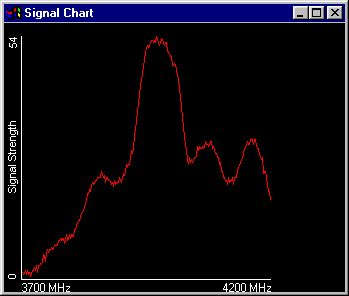
NEWS
Foxtel plan hit by record opposition
From AUSTRALIAN FINANCIAL REVIEW
The Australian Competition and Consumer Commission has received a record number of submissions opposing Foxtel's proposed pay-TV alliance with Optus.
ACCC chairman Allan Fels told The Australian Financial Review yesterday that the regulator had received more submissions than for any deal it had previously considered.
He declined to comment specifically on how many submissions were against the deal but it is understood that most oppose it.
The deadline for submissions is today.
"We've seen more submissions in relation to it, and they are not all from supporters," Professor Fels said.
"There is a very high level of interest, and quite a few parts of concern. There are quite a few businesses concerned."
Objections have come from Kerry Stokes' Seven Network, the Ten Network and newspaper publishers like John Fairfax.
They argue Foxtel's proposal to share movie and sports channels with Optus, allowing both to offer subscribers improved offerings of pay-TV, telephony and internet services, threatens to give Foxtel a monopoly position over pay-TV programming in Australia.
They also claim the deal gives Telstra and its Foxtel partners, Publishing and Broadcasting Ltd and News Corporation, monopoly control over access to Telstra's cable network - the "gateway" into homes for digital and interactive services.
There has also been speculation that international media giant AOL Time Warner is opposed to the deal, but a spokeswoman said earlier this week that the company was still to formulate a position. It is believed that AOL has approached the ACCC to discuss the deal.
Local content providers and broadband groups are also against the deal because many believe it will shut them out of using Foxtel content to bundle services in the future.
Telecommunications carriers including Telecom New Zealand, Hutchison, Primus, Macquarie Corporate and PowerTel have united against the deal amid concerns about enhancing Telstra's market position.
Professor Fels declined to be drawn on the commission's thinking on the deal. However, he reiterated previous comments that its implications were far reaching.
"It's not just about pay-television, it would seem to have implications for telephony, broadband services all around Australia, for some years ahead," he said.
Foxtel and Optus are believed to have set a 10-week time-frame on ACCC's approval as a condition precedent of the transaction.
However, Professor Fels said: "We are a public body, with public responsibilities. We carry them out properly. It's not up to parties to put time-frames on a public matter like that."
Murdoch company 'leaked rival's TV codes'
From http://news.ft.com
A News Corporation whistleblower has claimed that NDS, a software subsidiary of Rupert Murdoch's pay-television empire, directed an employee to leak secret codes belonging to its closest rival to internet pirates.
Oliver Kommerling, a software security consultant, on Thursday said in a written deposition to a California court that Chris Tarnovsky, an NDS employee on the West Coast, arranged for Canal Plus Technologies' codes - enabling smart cards in pay-TV boxes - to be published on the internet.
The allegations, submitted as evidence in a $1bn (E1.1bn) lawsuit brought by Canal Plus, the pay-TV arm of Vivendi Universal would, if true, blow apart NDS's defence that it was not party to the hacking suffered by the French company. NDS maintains it was not a party to the hacking suffered by the French company.
They will also exacerbate tensions between Mr Murdoch and Jean-Marie Messier, Vivendi's chief executive, fierce payTV rivals. NDS technology is used by News Corp's British Sky Broadcasting, while Canal Plus's smart cards are used by Vivendi and ITV Digital.
Both Canal Plus and ITV Digital are claiming hundreds of millions of pounds in lost revenues from the piracy, which allowed hackers to access films, sports and other content free. Canal Plus says it is concerned its next generation of smart cards, out next week, will also be hacked.
Mr Kommerling, whose company ADSR is 60 per cent-owned by NDS, claims to have been told by NDS employees that the Canal Plus code - cracked by NDS technicians in an Israeli laboratory - was sent to Chris Tarnovsky, who had connections with the internet piracy community.
"The same NDS employees told me that it was agreed that Mr Tarnovsky should arrange for Canal Plus code to be published on the internet," he said in his deposition.
Canal Plus is seeking the disclosure of certain documents by NDS, whose directors include James and Lachlan Murdoch. It says it wants to avoid the destruction of potential evidence.
A California judge will next week hear motions by both parties. NDS denies all charges.
NDS on Thursday night refused to comment on the fresh evidence presented by Canal Plus.
But in its motion, obtained by the Financial Times, it said: "It is an attempt by an inept competitor to shift the blame for its incompetence, to damage its skilled competitor behind the shield of the litigation privilege and to extract an unfair price in merger negotiations."
E! channel tweaked for NZ viewers
From http://www.stuff.co.nz/inl/index/0,1008,1164249a1869,FF.html
Sky Digital's new entertainment channel, E!, soon will add a daily half-hour news bulletin to its lineup. Senior E! executives in Auckland last week for the channel's launch acknowledged the ESPN of entertainment was only 70 percent up to speed in New Zealand. Philip Wakefield takes a look.
It's the first E! channel to be launched in the Southern Hemisphere and programming is still being tweaked as the final satellite delivery logistics are worked out - such as marrying the different ad-break structures in NZ and the United States.
E! New Zealand also has more fashion segments than the United States flagship, a stipulation Sky made because it wants the channel to maximise female viewership. E! News Live is slated to start in June and will screen twice a day, Monday to Friday.
E! executives also promise New Zealand viewers will see live break-outs for breaking stories and with next month's release of Spiderman, more live coverage of blockbuster movie premieres.
Just about all of the shows screening on E! in the US will be seen here. The only exceptions will be programmes for which E! doesn't have the international rights, such as Howard Stern's show and Saturday Night Live classics, and specials about series that have never aired in New Zealand.
(Craigs comment, I watched some of this channel, its total trash tabloid american garbage in my opinion)
11/04/02
Insat 2B at 111.5E This sat is now in position here, can anyone receive it, beacons should be on 4187.5, 4191, 4194 and 4197.5 a mystery as to why its there and I am not sure as to what happens to the coverage footprint when a satellite moves
Not much in the news section today, just the regular items about the Indian Scene the FTA/Cable/PAY scene over there is a huge market. That mostly revolves around who has the rights to whatever cricket.
Scatindia site updated
From my Emails & ICQ
From Bill Richards
JCSAT 8 somewhere between 139-140E
Get quite a strong peak on my satfinder
Vert Pol and a bandscan using dvbedit shows a
strong signal around 3970V.
Nothing watchable either dig or analogue
Regards
Bill
(Craigs comment anyone else?, start looking!!)
From Victor Holubecki 3.20pm Syd
Asiasat 2 3640 H 27850 3/4 is currently FTA.
From mssk_hitman
hi,
i'm sohail.kindly mail me the description(frequency,audio,videosettings) for the new sports channel taj started by mr.b ukhatir.
(Craigs comment, I can give you the details but its a bit late as the TAJ Sports signal has already encrypted, the details are Panamsat 10 at 68.5E 3808 V "TAJ Sports" (also called Ten sports) SR 12857 , Fec 7/8 Vpid 32 Apid 33 IRDETO ENCRYPTED)
From Bob Cooper
This announcement which has no relevancy in NZ but may be of interest to
Australian fans:
HOT ON the heels of last week's news of the new television series A Little
Bit Of Country comes the announcement that there will be a brand new country
music channel on Australian Pay TV from next month.
CMC - Country Music Channel will replace MusicCountry on Austar from
Wednesday, May 1, telecasting to around 450,000 homes in regional Australia
(including the Gold Coast but excluding Western Australia).
CMC Program Director Tim Daley said the channel would be full-on country
music... "No 'city folk think it sounds like country' stuff. No Green Day or
Lenny Kravitz".
In its early days, the channel will be "pretty much pure clips," Tim said.
"We hope to play a few concerts and the like down the track and there will
be no hosts in the beginning."
With an on air date of just three weeks away, CMC is urgently seeking
videos, especially of Australian country music artists.
Artists and record companies with videos they want considered for the
program can call Tim on 0410 495 411 or send broadcast quality tapes
(digital betacam, not betacam sp...and include a VHS copy if possible),
together with contact detail, to CMC, Level 2, 7 West Street North Sydney
2060
From the Dish
Sorry nothing to report for today for our region!
NEWS
ABC wants to book a room on pay TV
From http://www.smh.com.au/articles/2002/04/10/1018333373138.html
The ABC would fall into a "death spiral" unless the Federal Government introduced a "must carry" provision guaranteeing the national broadcaster a platform for its channels on commercial pay TV, the acting managing director Russell Balding warned yesterday.
Weighing into the debate over the proposed pay TV alliance of Foxtel and Optus, Mr Balding said he had written to the Australian Competition and Consumer Commission, which is considering whether to approve the deal, about the public broadcaster's fears of being locked out of cable in the future without a regulated access guarantee.
His comments came as new Ten executive chairman Nick Falloon took another swipe at the Foxtel deal, claiming that it was designed to defend Telstra's position in the telephony industry. Telstra owns 50 per cent of Foxtel.
"This new deal is not about pay TV. It's about buying a monopoly to take control of the gateway into people's homes," said Mr Falloon.
Mr Balding said he did not want to comment on the actual commercial arrangements of the Foxtel-Optus deal, under which Foxtel, which is half-owned by News Corp and PBL, would take control of Optus programming, and Telstra would be able to bundle its pay TV and telephone services.
But he grabbed the chance to raise the ABC's concerns over what developments in the pay TV market could hold for the ABC. Mr Balding said that with only a "gentleman's agreement" with pay TV operators keeping the ABC's main channels and its two digital channels, ABCkids and Fly, on cable, he feared the ABC would become marginalised as the pay TV market matured, if it did not acquire any certainty of access.
Pay TV penetration in Australia stands at around 22 per cent of all television watching homes, while in the US it is 80 per cent and the UK 55 per cent.
"We're very much concerned about our access to multi-channel through the pay platform but what I've also got to not lose sight of is our main channel," he said.
"The crucial part from our point of view is certainly access to our main channel, otherwise you will be marginalised, and you will go into a death spin. Because you're marginalised you become less relevant, because you've become less relevant with a declining audience governments tend to fund you less, and because you've got less funding you become less relevant and therefore your audience goes down again. You end up in a death spiral."
But a spokesman for Foxtel said he was "perplexed" at Mr Balding's claims.
Foxtel's director of corporate affairs Mark Furness said the ABC had forgotten Foxtel had a long-standing, binding legal agreement signed in 1999 under which it had agreed to carry five ABC digital channels.
"Foxtel has guaranteed the ABC a generous position on any digital service we may launch. And we have always carried, and will continue to carry, their core existing channel on cable as a service to the ABC and its viewers," said Mr Furness.
ABC's main channel and digital multi-channels are available on Optus, Austar and Transact, while Foxtel only carries the ABC's main channel.
$450m broadcast deal on line as Alston heeds anger of fans
From http://www.smh.com.au/articles/2002/04/10/1018333374252.html
The AFL's $450million five-year TV deal is in disarray with the Federal Government yesterday threatening to intervene and the Seven Network poised to legally attack the broadcast contract.
Communications Minister Richard Alston warned the Government would rewrite broadcasting laws to ensure adequate AFL coverage in regional areas deprived of prime-time games.
Talks between the AFL and News Ltd consortium bosses dragged on yesterday but are expected to conclude today with Channel9 indicating it would make an announcement to appease disgruntled fans in Queensland, NSW and Canberra.
The news comes amid disappointment in Sydney that Saturday night's grand final re-match between Essendon and Brisbane - the biggest home-and-away game of the year - will not be shown live or telecast at a reasonable hour in the city.
The match, the domain of Channel10, will be shown live in Melbourne and on slight delay in Brisbane, but not until 11.25pm on Saturday in Sydney.
The station is instead broadcasting The Crocodile Hunter: Wildest Home Videos at 7.30pm followed by the 1973 James Bond film Live And Let Die at 8.30pm and a news bulletin at 10.55pm.
Alston warned that if the AFL and its broadcasters failed to fix the situation, the Government would step in.
"If [they] don't, then we will have to look seriously at what we do with the anti-siphoning list, because I don't think it's being used in the way that it was intended to if people are simply hoarding events to protect their own commercial interest," he told John Laws on 2UE radio.
Alston warned the broadcasters had "breached the spirit" of anti-siphoning rules that ensure popular sporting events remain on free-to-air TV and do not migrate to pay TV. He attacked the decision to delay broadcasts by several hours in Canberra and parts of NSW and Queensland on Friday nights and said the AFL should have cut a deal with Ten or the pay-TV providers to fill the programming gaps.
Possible changes include amending broadcasting legislation to allow pay-TV operators to screen sports matches ahead of their free-to-air rivals if they failed to schedule them within a reasonable time.
In other developments, the ABC confirmed yesterday it rejected the Nine Network's offer for limited broadcast rights in parts of rural NSW because of technical and programming difficulties.
The AFL also faces a potential legal challenge by Seven if it attempts to sweeten the broadcast deal to ensure adequate regional coverage. Seven paid $20million for the first and last rights agreement in 1997 which dictates that the AFL provides details of competing bids.
If the AFL decides to subsidise regional operators such as Southern Cross, which owns Channel10's regional affiliates, this would breach the first and last deal, in place until 2011, by altering the original broadcast rights contract.
AFL chief executive Wayne Jackson yesterday remained confident a compromise could be reached.
Although Channel7 rarely broadcasted live games on Saturday night in Sydney, the lack of live telecasts here has enraged fans this season.
"It's frustrating from both an Essendon point of view and, I would imagine, an AFL point of view," Bombers chief executive officer Peter Jackson said yesterday. "From Essendon's point of view, it's a matter of public record that we've gone up there two years ago to affiliate with a local club in North Shore Football Club and part of that is to try to build our own brand up there and it's very hard to do that when you've probably got the biggest home-and-away game of the year not being telecast into that city."
A Channel10 spokesman said the game was being shown in four out of five capital cities, and the station would monitor the ratings of its Sydney Swans prime-time broadcasts this year before looking to expand its coverage into Sydney beyond Swans games.
"We are heavily committed to AFL football in Sydney and Brisbane, with 10 Swans games in prime-time on Saturday nights, which hasn't been done since 1997, and 11 [games] in Brisbane," he said.
"We're doing things that Seven has never ever done by a long way in Sydney."
Jackson said there had been an "enormous backlash" from supporters about the scheduling.
"It has, in one sense, surprised us about the depth of feeling up there and I think that's a good thing that there is such a depth of feeling," he said.
Taj Sports aim to secure PCB's television rights contract
From http://www.jang.com.pk/thenews/apr2002-daily/05-04-2002/sports/s10.htm
KARACHI: A senior official of the Taj Sports Ten sports channel made it clear on Thursday that his company had started making efforts to secure the television rights contract of the Pakistan Cricket Board (PCB). Mark Denton, the representative of Taj Sports Ten sports channel in Pakistan told a news conference that his company would try to get the contract for television rights of Pakistan cricket and hope to meet with success in this regard.
"We are preparing for rights negotiations and we hope we are successful in our endeavours," said Denton. Trans World International (TWI) have held the exclusive rights to Pakistan cricket television signals since 1994 but their contract expires next year and Taj Sports, a company of Abdul Rehman Bukhatir group of investment, based in Dubai, is seen as a serious bidder for the rights.
The conference was arranged at a local hotel to officially announce the launching of Ten Sports which is an exclusive sports channel of Taj Sports which would be available in Pakistan through a private cable operator company.
"We have good relations with the PCB and we feel Pakistan cricket rights are very important after we have successfully secured rights of Sri Lankan cricket," said Denton. He stated Taj Sports also saw a lot of potential for its channel in Pakistan and efforts would be made to project and promote Pakistan sports on the channel.
"Cricket would be our main feature but we will also highlight WWF wrestling, Women's Tennis Association (WTA) events, Major Golf tournaments and football matches on our channel." He said initially the sports channel might be available for every one to view as it would be relayed through cable operation via the Pan Am Sat 10 from Dubai.
Denton said Taj Sports and the Ten Sports channel was a dream of Abdul Rehman Bukhatir which had become a reality and efforts would be made to make it a successful venture. "We know we will face tough competition from ESPN and Star Sports channels in Pakistan, but we are confident we can establish ourselves," added Denton.
He said the channel would be telecasting all matches of the Sharjah Cup live this month and also the triangular one-day tournament planned in Tangiers, Morocco in August. "We will also have exclusive cricket talk shows and features as it is a popular sports in Pakistan." Chris Macdonald is the chief executive of Taj Sports and Zahid Noorani a member of its Board of Directors.
RiTV To Shed 30 PC Stake, Plans 2 New Channels
From http://www.financialexpress.com/fe_full_story.php?content_id=6496
Mumbai: Reminiscent India Television Ltd (RiTV), which operates the Lashkara and the Gurjari regional language channels, has decided to dilute 30 per cent stake, for which it has given the mandate to consulting firm Ernst & Young.
Ernst & Young has valued the company at Rs 54.3 crore. RiTV’s future free cash flow method derives a valuation of Rs 48.3 crore. The company also has non-operational assets of Rs 6 crore, according to the Ernst & Young valuation.
RiTV plans to privately place equity at Rs 73 per share, based on this valuation. The company has given the mandate to Ernst & Young to raise around Rs 20 crore to fund its proposed expansion plans in launching two television channels, getting into regional language film production for TV audiences and upgrading the software for its two existing channels. “We are looking for strategic investors. We should be able to complete the exercise in the next three to four months,” said Ernst & Young partner (corporate finance) Sanjiv Agrawal.
RiTV managing director Subhas Menon confirmed that the company was planning to raise Rs 20 crore. “The investor will be issued fresh shares. We will utilise the funds to launch a Marathi and a Metro channel. We plan to produce 12 movies in Punjabi and six each in Gujarati and Marathi for television viewers annually also,” he said.
The estimated cost of the proposed Metro channel is Rs 4.4 crore and for the Marathi language channel it is Rs 2.2 crore. “The Metro channel will initially have content from the cities of Mumbai, Delhi and Bangalore as these are advertising-heavy cities,” said Mr Menon.
RiTV has an estimated 3,500 hours of content, already produced and commissioned by the company. The Punjabi library has 1958.5 hours of content acquired at a cost of Rs 7.5 crore. It has 1,542 hours of Gujarati content, with the acquisition cost at Rs 1.2 crore, the Ernst & Young report said.
Cricket Rights Sale Strains ESPN Ties With Star Sports
From http://www.financialexpress.com/fe_full_story.php?content_id=6497
Kolkata: Star Sports’ 18-month-old association with Entertainment & Sports Production Network (ESPN) in India is in danger of breaking up, going by the buzz in the cable television and satellite channel industry.
Although the spokesperson for ESPN denied that the association was breaking up, industry sources said the two premier sports channels were looking at the option of separation after ICC World Cup cricket rights were sold to Sony Entertainment Television (SET).
ESPN Star Sports is a 50:50 joint venture formed in November 1996 between Walt Disney’s ESPN and Mr Rupert Murdoch’s STAR. In India the alliance was formed in October 2000.
A top executive of a leading pay channel distributor here pointed out that ESPN was unhappy because it did not figure in the prime band in many parts of the country, apart from the fact that Global Cricket Corp - in which Mr Murdoch has a stake - sold the cricket rights to SET.
.SPN is certainly not happy with the alliance. Though the World Cup cricket rights is one of the contentious issues, non-availability of ESPN in the prime band in many parts of the country is another factor behind ESPN’s discomfort. Our information suggests that the alliance will last till August this year,” he said.
The ESPN spokesperson denied there was any plan to end the alliance.
?There is no basis for this kind of conjecture. We are a comprehensive sports channel with interests in various sporting events. Regarding the bidding for the World Cup rights, our objective was not to outbid others, but to ensure that we are able to make sound business decisions regarding our investments,” ESPN Software India’s spokesperson said.
But industry analysts believe that the losing the World Cup rights to SET will certainly hurt ESPN’s business in the subcontinent as it is one of the main moneyspinners for the sports channel.
.SPN has realised that businesswise the channel will be hit more than Star Sports as Rupert Murdoch has made his money from the sale,” an analyst said.
In 2000, GCC won the rights to market ICC events for six years. It was presumed by the industry that ESPN-Star Sports would automatically get the Indian rights. SET’s successful bid upset all these conjectures.
Initially, six players were in the fray when the bids opened in November last year. ESPN Star Sports, SET and the government-owned Prasar Bharati were considered the three serious contenders, based on their financial strength and record in cricket.
By putting in the highest bid, SET has acquired the TV coverage rights for all international cricket matches organised by the ICC as well as two World Cups till 2007 for $375 million.
The acquisition puts SET in a comfortable situation in the highly lucrative arena of sports broadcasting.
Our understanding is that ESPN has failed to derive the benefits it expected from the alliance in India. One of the areas of discontent is the non-availabilty of the channel in the prime band in many parts of the country in contrast to the Star Sports,” an industry watcher said.
But the ESPN spokesperson said it will remain the best channel for cricket lovers even without the World Cup cricket rights.
The network has exclusive rights to telecast cricket played in eight out of 10 test playing nations. We have also acquired the rights to Bangaladesh cricket till mid-2006. We will continue to bring the best sports events to the Indian fans in the coming years,” ESPN’s official spokesperson said.
10/04/02
Well some were talking about Jcsat8/2a in the chatroom lastnight and I mentioned it on the site yesterday. Its up at somewhere around 139E-140E testing. Then it will move to 154E. So who will be the first to scan and discover a beacon on it? or better still the first to log a testcard or other video. There should be at least something of interest in the News section today.
Great news in the News Section about the Dubai TV mux via Asiasat 2 they have signed up for a transponder lease, and will hopefully add more services at a later date!
From my Emails & ICQ
From Steve McClark
Hi Craig,
I have already sent emails to the following people in
Dubai Sports regarding their new signal on Asiasat2 .
I can receive it ok on a 2.3m in Melbourne, but
difnitely weaker then the old signal.
The email addresses are:
[email protected] and [email protected]
I suggest emailing these guys with your concerns.
Regards
Steve
From the Dish
PAS 8 166E 12646 H The test cards have left .
JCSAT 8 JCSAT 8 is now geostationary, at 139-140 East. Reception reports are very welcome.! Come on you guys be the first to detect this new sat!
Palapa C2 113E 11132 V A test card has started on , Fta, SID 11, PIDs 72/73.
NEWS
UAERTV of Dubai Signs a Long-term Lease on AsiaSat 2
From Press Release
Hong Kong, 9th April, 2002 - Asia Satellite Telecommunications Company Limited (AsiaSat) and UAE Radio & Television, Dubai (UAERTV-Dubai) announced today the signing of a long-term agreement for the use of a 36MHz C-band transponder on AsiaSat 2. The services commenced in March when UAERTV-Dubai began broadcasting from its new uplink earth station.
The new capacity is currently used to transmit three Arabic television channels named Dubai EDTV, Dubai Business Channel and Dubai Sports Channel, as well as two radio channels in digital free to air format to viewers and listeners across AsiaSat 2's huge C-band footprint. It is expected that more UAERTV-Dubai television and radio services will be added in the near future.
UAERTV-Dubai started broadcasting its television and radio services on AsiaSat 2 in August 2001 as part of the AsiaSat Arabic bouquet. Under the new agreement, UAERTV-Dubai will use a full C-band transponder on AsiaSat 2 for its digital broadcast services and its own uplink facilities in Dubai.
Speaking about the lease agreement, Mr. Ahmad S. Al-Gaoud, Director General of UAE Radio & Television, Dubai, said "we are very satisfied with our initial broadcast on AsiaSat 2 that commenced last year. With AsiaSat 2, we successfully expanded our geographic coverage to include Asia and Australasia. Acquiring a full transponder on AsiaSat 2 will give us greater flexibility in our future expansion of services to better serve the Arabic speaking community across the region."
"This is a significant deal for AsiaSat and we are very pleased to conclude this long-term agreement with UAERTV-Dubai. We are excited to further expand the variety of programming available on AsiaSat 2 by bringing in more new local culture and language television and radio services. AsiaSat 2 now carries over 50 television channels and a large number of radio channels, and has become Asia's most popular multilingual and multicultural satellite platform," said Peter Jackson, Chief Executive Officer of AsiaSat.
UAERTV-Dubai is the leading Arab broadcaster, commanding a vast Arab-speaking audience and viewership of tens of millions across the globe. The achievements of Emirates Dubai Radio and Television in becoming a broadcaster of such pre-eminent world stature are all the more remarkable in that its first radio transmission was made as recently as 1971 and its first television output in 1974.
Since the infancy of satellite broadcasting, UAERTV-Dubai has been a leading exponent of technology - taking pioneering initiatives to break the barriers imposed by time zones. Now with a network of five satellites, UAERTV-Dubai reaches most remote parts of the globe, bringing together the world's rich diversity - 24 hours a day.
AsiaSat 2, launched in November 1995, has a 13-year operational life. The satellite is a Lockheed Martin Series 7000 model and carries twenty 36 MHz and four 72 MHz C-band, as well as nine 54 MHz Ku-band linearised transponders. Its C-band footprint covers 53 countries embracing Asia, the Middle East, Eastern Europe, Australasia and the C.I.S. AsiaSat 2 also has a high-power Ku beam serving the Greater China region, Korea and Japan.
AsiaSat is Asia's leading provider of high-quality satellite services to both the broadcast and telecommunications markets. AsiaSat serves telecommunications customers for public telephone networks, private VSAT networks and high speed Internet and multimedia services. AsiaSat plans to launch a further satellite, AsiaSat 4 to be positioned at 122 degrees East in mid 2002. AsiaSat is a wholly owned subsidiary of Asia Satellite Telecommunications Holdings Limited, listed on both the Hong Kong (SEHK: 1135HK) and New York (NYSE: SAT) stock exchanges.
For further details, please contact:
Sabrina Cubbon
General Manager Marketing
AsiaSat
Tel: (852) 2805 6650
Fax: (852) 2504 3875
Mobile: (852) 9097 1210
email: [email protected]
Ahmed S. Al Gaoud
Director General
UAE Radio & Television, Dubai
Tel: (971 4) 337 3206
Fax: (971 4) 337 4111
Email: [email protected]
Winnie Pang
Corporate Affair Manager
AsiaSat
Tel: (852) 2805 6657
Fax: (852) 2504 3875
Email: [email protected]
(Craigs comment, Great news for FTA viewers at least Tarbs hasn't taken this one)
Satellite dish maker bought by California firm
From http://www.bizjournals.com/milwaukee/stories/2002/04/08/daily16.html
California Amplifier Inc. has acquired the satellite antenna business of Richland Center-based Kaul-Tronics Inc. and two affiliated companies in a stock and cash transaction valued at approximately $22 million, California Amplifier said Monday.
The transaction consists of the acquisition of substantially all of the assets, including inventory, equipment, real estate and intellectual property, and the assumption of certain liabilities of Kaul-Tronics, a manufacturer of satellite dishes and large offset antennas.
In 2001, Kaul-Tronics had revenues of approximately $36 million, pretax income of approximately $4.8 million, and earnings before taxes, depreciation and amortization of approximately $5.8 million. The company's 2001 revenues included approximately $12 million in satellite products of the type produced by California Amplifier.
Under the terms of the purchase agreement, California Amplifier paid approximately $5 million in common stock (929,086 shares based on the 30-day average closing price through April 3, 2002) and $17 million in cash. Of the cash portion, $12 million has been provided under an interim increase in the company's revolving line of credit.
California Amplifier will continue to operate Kaul-Tronics manufacturing and office facilities in Wisconsin and will assume management control of all operations effective immediately.
California Amplifier estimates fiscal 2003 first-quarter revenues in the range of $20 to $25 million and earnings in the range of 4 cents per share to 7 cents per share after the acquisition.
Pay tv `must carry’ ABC
From Media Release at http://www.aapmedianet.com.au/scripts/DisplayRelease.dll?id=299415
Pay TV must carry ABC -- Australian Broadcasting Corporation
The Acting Managing Director of the ABC, Russell Balding, has written to the Australian Competition and Consumer Commission (ACCC) urging that consideration be given to a `must carry’ provision for all ABC broadcasting services on commercial pay television services.
Mr Balding was responding to an invitation by the ACCC to comment on proposed resale agreements between Optus and Foxtel, and between Foxtel and Telstra.
*lthough the ABC does not wish to offer any comment specifically on these proposed commercial arrangements, we are concerned about certainty of access to delivery platforms. What is at stake is the continued viability of Australia’s main public broadcaster in an environment of market concentration and increasing content availability across a myriad of delivery platforms,” Mr Balding said.
?It is vital that the ABC continues to be available to all Australians via all platforms, including pay television. The proposed arrangements involving Optus, Foxtel and Telstra, make this issue even more important.
,urrently ABC television is not available on all pay television platforms. Its main channel and digital multichannels, ABCKids and Fly, are available on Optus, Austar and Transact. Foxtel only carries the ABC’s main channel on cable.
?It is critical that all ABC services be supported by a `must carry’ provision as there is no binding obligation on pay television companies to carry the ABC.
“The ABC could become seriously marginalised within a growing pay television market should it disappear from this platform. Billions of dollars of investment by the Australian public into the ABC over many years is at stake.
?Just as important is the position that ABC has on those platforms. The ABC’s television channels should not be `buried’ within a multiple channel setting. It is essential that our main television service always be assigned channel number 2.
?The ABC delivers an important dividend of diversity to the Australian media landscape. We cannot allow this to be put at risk in a changing media environment, hence the need for a `must carry’ provision,” Mr Balding said.
In his letter to the ACCC, Mr Balding also drew attention to the need to preserve competition in the broadband provider market as well as the program sales market, particularly in respect of Australian content.
Pay-TV restructure plan has a bundle of objectors
From http://afr.com/companies/2002/04/10/FFXUVDENSZC.html
Telecommunications carriers opposed to the proposed restructure of the Australian pay-TV industry are to collectively lobby the Australian Competition and Consumer Commission to have the deal modified.
The carriers - including Telecom New Zealand, Hutchison, Primus, Macquarie Corporate and Powertel - met yesterday to form a united strategy against the proposed deal between Optus, Foxtel and Telstra.
While each of the carriers will lodge individual submissions with the ACCC by the deadline at the end of this week, they plan to highlight common themes in their concerns about the deal.
These are believed to include the heightened monopoly power they see Telstra gaining, based on its ability to bundle services, including pay-TV.
A spokeswoman for Telecom NZ's AAPT confirmed yesterday that the talks were taking place but said it was too early to discuss the nature of the joint strategy.
"Clearly we have common grounds with other providers on Telstra's bundling arrangements and we are in discussions about that," she said. "We think this is a major concern for the industry and it is raising new concerns on competition."
Already, free-to-air broadcasters Ten and Seven and newspaper publisher Fairfax have opposed the deal.
Hutchison chief executive Kevin Russell said yesterday the ACCC should closely monitor Telstra for any anti-competitive product bundling resulting from the deal. Speaking at an industry conference, he said the mobile marketplace was increasingly challenging and was one where regulators should take a larger role.
"I think the prospective Foxtel Telstra deal raises significant questions and the prospect of anti-competitive product bundling in this marketplace," he said.
"My experience is through Hong Kong, the UK and Israel. Product bundling was very strictly regulated against in those markets."
Meanwhile, Kerry Stokes' Seven Network is continuing negotiations with Foxtel over carriage of Seven's C7 pay-TV channel.
Foxtel has proposed carriage of the channel as a tiered service on its analogue network, and on a digital service once Telstra's broadband cable is digitised.
Access to the cable is one of the key issues the ACCC is considering
Seven is believed to have had informal talks with the ACCC this week about the deal, prior to lodging a formal submission with the regulator before the end of the week.
Though Optus dropped C7 from its pay-TV offering before Easter, the telco has agreed to provide coverage of Australian soccer matches and the Six Nations rugby tournament on a separate channel. Both were previously carried by C7.
Satnews releases 2002 international satellite directory
From Media Release
Satnews, the comprehensive resource centre covering the satellite, broadband and broadcasting industries, has released its 2002 international satellite directory.
The directory, used by satellite professionals, has over 1,200 pages of information including names and addresses of all industry companies and organizations. It also comes with details on over 450 satellite systems worldwide with a CD-ROM of maps called SatMaps.
It includes satellite operator profiles, operational GEO & LEO systems, planned GEO & LEO systems, international & regional networks and internet via satellite. The directory also contains information about transponder brokers and resellers, transmission/business TV and videoconferencing services, equipment providers - both satellites and ground equipment and business and support services as well as information about regulators, government agencies and trade associations. A glossary of satellite terms and a calendar of satellite events is also included in the directory.
The Directory comes with a 21 day money back guarantee. For more information or to order the Directory, visit http://www.satnews.com/free/pubs/isd.html.
9/04/02
Live satellite chat in the chatroom tonight 9pm NZ and 8.30pm Syd time onwards I am in there as usual from 9pm NZ.
Not much news from our region today, The story about Intelsat is interesting. I guess it means we lose more FTA feeds.
Satfacts update, with some very interesting stuff about Canal+ and NDS piracy. You will notice a much better layout on the Satfacts page. The files now being supplied in a more friendly file format. Rather than just a cutnpaste of what Bob Emails.
From my Emails & ICQ
From Jacko
RE: Pas 8 Ku ABC
Hi .I found the ABC mux on Pas 8 KU the other night with the hp Spectrum
(toy).I have about 5 different Sat Boxs & I looked at the wrong one when I
wrote down the FEC & Symbol rates.The guys are right --
Correct SR and FEC for the ABC Asia Pacific mux on 12301 H: 5858 and 5/6.
For any one interested the Moto Gp was on Pas 2 at the weekend 3803 H 10850 3/4
From Jamal H
Hi Craig how are you today? Craig do you receive Dubai Channel on Asiasat2 ? Lyngsat report that it moved to 4020 but on this frequency I don't have any signal.
tnx for your help
jamal
(Craigs comment, The 4020 Asiasat 2 signal transmits a much lower signal level, I can't check it might of even left (lets hope not)
From Bill Richards
0545 UTC 09-04-02
Thaicom3 3672 H, Sr 11500, Fec 3/4
Vpid 49 Apid 52 SID 3 MRTV OCCASIONAL
Vpid 33 Apid 36 SID 2 MRTV3
Vpid 3601 Apid 3604 SID 1 MRTV
RE : ABC KU PAS 8
Note the S/R and FEC reported on lyngsat page is incorrect and have checked
with a Nokia9500 and Prosat P3500 below is correct..
ABC Asia Pacific and Radio Australia have started on 12301 H, clear,
SR 5858, FEC 5/6, PIDs 522/650 and 651-652, Australian beam.
Regards
Bill

Travel Thailand Television, Screenshot from Thaicom 3 Supplied by Bill
From the Dish
Pas 8 166E 12301 H Correct SR and FEC for the ABC Asia Pacific mux Sr 5858 and Fec 5/6.
Asiasat 2 100.5E 3907 H "Occasional SatLink" feeds, Sr 5632, Fec 3/4.
Thaicom 3 78.5E 3574 H "Travel Thailand TV" has started, Fta, Sr 6310, Fec 1/2, PIDs 512/640, global beam. (look at the Fec they want this signal to go a long way)
PAS 10 68.5E 12722 V "A Vivid mosaic" has started , fta, SID 104, PIDs 280/281. (Yes I know its KU, but I think this transponder was one of the Ku signals that could be detected in W.A worth a look if you have the gear 3.7M+ KU dish?)
NEWS
Intelsat selects SKYSTREAM'S Networking solution for TV video multicast trial
From http://www.skystream.com/press/2002/040802-intelsat.stm
With SkyStream's Content Delivery Solution, Intelsat Will Begin Multicast Delivery Trial of Popular U.S. Television Content to Several Asian Countries
LAS VEGAS, NAB 2002 - April 8, 2002 - SkyStream Networks, the leading developer of solutions for digital media services delivery, today announced that Intelsat, a leading satellite communications services provider, selected SkyStream's end-to-end broadcast content delivery solution for its global multicast trial, delivering U.S. and European television content to broadcast companies in the Asia-Pacific region. The trial is significant because it demonstrates an efficient and cost-effective way to deliver TV-quality video content over a multicast-enabled backbone network comprised of satellites. Intelsat selected SkyStream's Source and Edge Media Routers (SMRs and EMRs) and zBand™ Content Delivery Platform for the trial because of their easy integration with existing satellite-based networks and ability to scale for diverse service delivery needs. The trial is scheduled to begin in April and is expected to last for three months.
ABOUT THE INTELSAT MULTICAST TRIAL
For the purposes of the trial, Intelsat will provide space segment on the Intelsat 701 satellite, located at 180ºE, and the customer premise equipment for file storage at Asian broadcast receive stations. BT Broadcast Services is responsible for provisioning and operating the head-end hub and the uplink teleport from its Media Center in Los Angeles.
ABOUT SKYSTREAM'S NETWORKING SOLUTION
SkyStream offers a comprehensive content delivery solution for satellite providers and broadcasters that includes hardware and software elements. Together these products offer capabilities for data and video delivery over satellite-based backbones. Products that comprise this solution include:
The Source Media Router (SMR) is an intelligent network device that enables satellite operators and television broadcasters to deliver Internet content to multiple locations or viewers simultaneously, ensuring maximum scalability and accessibility to high-bandwidth content. The SMR platform was recently named the industry leader, with 40 percent market share, based on units sold worldwide (Source: Northern Sky Research)
The Edge Media Router (EMR) resides at the edge of enterprise networks or in service provider POPs and extracts IP content from incoming DVB MPEG-2 transport streams routing it via 10/100 Fast Ethernet onto corporate LAN or last-mile broadband networks for multi-point delivery. The EMR is an integral part of SkyStream's end-to-end solution for delivering Internet content via broadcast networks.
The zBand Content Delivery Platform provides tools for aggregation, content delivery, management, targeting and presentation, in a single open platform that is secure, scalable, and reliable. zBand is the ideal content delivery platform for network operators, service providers and large enterprises.
ABOUT INTELSAT
Intelsat, Ltd. offers telephony, corporate network, Internet and broadcast solutions around the globe via capacity on 22 geosynchronous satellites in prime orbital locations. Customers in more than 200 countries and territories rely on Intelsat satellites and staff for quality connections, global reach and reliability. For further information, please contact us at [email protected] or at +1 202-944-7500.
ABOUT SKYSTREAM NETWORKS
SkyStream Networks is the leading developer of networking solutions for service providers to deliver digital media services to consumers and businesses all over the world. With SkyStream's patented bandwidth optimization technology, service providers can offer new services to increase revenue such as managed enterprise, data over satellite and digital entertainment services with a consistently high level of performance to millions of people or locations. SkyStream's customers include Clear Channel, DotCast, EchoStar Communications Corporation, Gilat, Granite Broadcasting, iBlast, New Skies Satellites, Pacific Convergence Corporation, SpeedCast and Telefonica. SkyStream Networks' Website can be found on the Internet at www.skystream.com.
News Corporation's Asian Star begins to shine
From http://news.ft.com/
Star, News Corporation's pan-Asian television group, is expected to announce on Tuesday that it will post an operating profit for the first time since Rupert Murdoch acquired an interest in the group in 1993.
Star is expected to post a third-quarter operating profit of $2.4m compared with a loss of $10.7m a year earlier.
Earnings before interest, taxes, depreciation and amortisation (ebitda) are expected to total $7.2m, up from a loss of $5.8m a year earlier.
Star's core broadcasting business is expected to have reached $11.3m in ebitda in the period, up from a $700,000 loss.
James Murdoch, Star's chairman and chief executive, has been cutting costs to stave off the effects of the advertising slump.
The poor advertising market has been exacerbated by uncertainty caused by regional conflicts in Pakistan and India, observers say.
At the same time, Star, which broadcasts in 53 countries across Asia, India and the Middle East, is thought to be gaining market share in India and seeing increases in Southeast Asian subscription revenues.
In late March Star launched Xing Kong Wei Shi, a 24-hour Chinese general entertainment channel, on Guangdong Cable TV Network in Southern China.
The Mandarin entertainment channel was the first new channel to be granted landing rights in China.
Mr Murdoch had said publicly that he had hoped to reach profitability some time this year, putting an end to years of losses.
News Corp bought a 64 per cent interest in Star TV in 1993, and took over the remaining interest two years later.
The group has about 70m daily viewers and controls about 25,000 hours of original programming.
It gained widespread attention in India after having a runaway hit with Kaun Banega Crorepati? - the Indian version of the quiz show Who wants to be a Millionaire?
(Craigs comment, They must be doing something right pity it will all go on Lawyers fees in the Canal+ vs NDS case!)
Commission diktat sets off battle for TV set-top box
From http://timesofindia.indiatimes.com/articleshow.asp?art_id=6207260
NEW DELHI: The decision to switch over to the ku-band has triggered a battle for the set-top box, which the television viewer would need to catch the digital signals without the intervention of the cable operator.
It all began with a Planning Commission diktat that to avail the desired funds for the Tenth Plan, the I&B ministry would have to ensure total television coverage of the population. According to an estimate by the ministry officials, a staggering Rs 4,000 crore would be needed to reach out to the remote North-East and such far-flung areas by the existing terrestrial network. Satellite television is no answer since cable coverage in rural areas is not more than six per cent.
The answer to the challenge, experts believe, is in the digital-to-analogue conversion by switching over to the ku-band. Since majority of the television sets are in the analogue mode, it needs a set-top-box for the conversion.
Smelling opportunity, major players in the field have got active. James Murdoch of STAR TV made a representation to the ministry last week that his company was willing to make the boxes available cheap. Unlike Europe where transmission is often both in digital and analogue, in India the box is a must.
Considering the initial high price of the box — estimated at Rs 7,000 — the government has decided to subsidise the instrument by 50 per cent. Already experiments are on with the ku-band in the metro cities.
Both the Planning Commission and the finance ministry have been informed about the conversion in the offing.
However, there is an apprehension of resistance from TV viewers. The proponents of the box claim that mass production will bring down the prices apart from doing away with the monthly payment to the cable-operator.
Besides, on the ku-band, a large number of channels will be available. Even this exercise will not be able to provide 100 per cent television coverage. In heavy rainfall areas, the reception of signals will remain bad.
The government has identified 160 such villages in the North-East where cable links are going to be provided through the panchayat bodies at a low rate.
(Craigs comment, Murdoch wanting to have the defacto standard set-top sat box in the Indian markt ? anyone surprised??)
New Malayalam TV channel from April 15
From http://timesofindia.indiatimes.com/articleshow.asp?art_id=6197271
The newest Malayalam satellite channel appears set for a test run on April 15.
India Vision Channel's key promoter M.K. Muneer, a Muslim League legislator and Kerala's Public Works minister, said work is on at a frenetic pace at the uplinking centre and studio at Kochi to see the dry run goes off without a hitch.
"This is not the official launch. We have invited a select audience on that day and we would have a test run," Muneer told IANS. "After that we would invite suggestions from the audience and fine tune the shortfalls before we finally launch the channel."
The date of the launch has not yet been decided.
India Vision's promoters are slightly apprehensive given the poor performance of Kairali TV, which reported a loss of Rs.70 million when it completed a year on air in August.
Another setback for India Vision, which initially planned to go on air in August, came when the Sony TV network backed out of a marketing and distribution arrangement. That is primarily why Muneer -- son of former Kerala chief minister C.H. Mohammed Koya -- and his associates are in no hurry to launch the channel.
"We are now talking with STAR TV for technical and backup support," said Muneer, who dismissed fears that India Vision might end up as a Muslim channel. "We have promoters from all religions," he pointed out.
India Vision would be free to air in India and the Middle East while viewers would have to pay to watch it in the US.
When it goes on air, India Vision would be the fifth Malayalam TV channel. Already beaming down are Asianet, Surya, Kairali and Doordarshan.
A sixth channel, Jeevan TV, is also expected to begin broadcast soon. The channel, which has already begun recruiting, has the backing of a premier church.
There is also talk of a TV channel being launched by the spiritual leader Mata Amrithananda Mayi.
(Craigs comment, not sure where this will startup possibly a zone beam on one of the Insats might be one for our readers in India and parts of Asia)
For Sony, game matters not ads
From http://economictimes.indiatimes.com/articleshow.asp?art_id=6243459
NEW DELHI: Sony Entertainment TV may have paid a bomb to win the telecast rights for World Cup Cricket, but it is playing conservative as far as charging advertisers for the games is concerned.
According to Sony insiders, the company is planning to roughly maintain its advertising rates for the World Cup games in 2003 at the level Doordarshan charged during the last World Cup in 1999.
During the last World Cup cricket games in 1999, Doordarshan charged an average of Rs 1 lakh per 10 second spot, Sony is planning to charge the same kind of advertising rates for the 2003 Games.
*part from some minor changes here and there, roughly the rates wouldn’t be dramatically different from those in 1999,” says a Sony insider.
But Sony is still planning the whole nine yards for promoting the games. Says SET Max executive VP Rajat Jain, “The marketing of World Cup is not just about selling ad space for the matches. It will involve a whole lot of promotional activities and countdown shows revolving around the event on the Sony network.”
But there is a whole lot of curiosity in media circles about how Sony is going to generate enough revenues to justify the amount it spent on buying the Cup rights. Says the CEO of a prominent non-sports channel, “Sony has paid a lot of money for getting the rights, but the real clincher is not getting the rights, but marketing it in these tough times to generate enough revenues.”
According to industry sources what compounds Sony’s problems is Doordarshan bagging the terrestrial braodcast rights for a number of crucial games. Doordarshan’s National network (DD1) will show all the Indian matches and the semi-finals and final match live.
All these matches are expected to be high viewership events, and simulcast of these events on two channels will definitely affect viewership for Sony.
DD incidentally paid a much, much lower amount for the terrestrial rights, since it hardly had any competition for these rights.
According to a top media executive, in 1999, ESPN-Star Sports could make decent money on World Cup cricket, despite simulcast of key matches on DD since the national broadcaster was in the analog mode in those days.
?”The picture quality was so pathetic you couldn’t even make out the ball, but now with DD going digital, the scenario has changed dramatically,” says an industry source. Sony is, however, confident of its win-win recipe for the World Cup cricket.
Says Sony’s Jain, “For the crucial matches which will be simulcast on DD and Sony, we would be devising attractive packaging to get in the viewers and advertisers.”
8/04/02
Pretty quiet today, strange because Mondays normally pretty busy for new news. Hey start looking to 154E for Jcsat 8/2a Cband tests. You guys with scanning gear and spectrum analysers should at least be able to find some kind of beacon. Actually I just thought of that. What is the beacon freq on Jcsat 8/2a. Hmm off to check their site. It isn't listed so have emailed them asking for more info and details of when they will test cband at 154E. Another interesting thing for today ABC Asia Pacific appearing on PAS 8 KU band Australia beam not sure why they would be there, anyone have some ideas?
There should be a very interesting Satfacts update tommorow about Piracy NDS/Canal + it would of gone up today but just waiting on fixing a problem with converting the file that Bob has sent.
TRT Turkey has the World Cup soccer rights but I doubt TRT International will show any of it.
From my Emails & ICQ
From Peter Eade 7/04/02
NRL Feed B1 12430V SR 6980 3/4 A256 V308 "NRL, Panthers vs Tigers"
Peter Eade
From Spencer 7/04/02
9 Network B1 12328H 6980 3/4
Color Bars B1 12422V 6110 3/4
7 Talking Head B1 12339 7200 3/4
Watch out for Big Brother B1 12431 6980 3/4
From Me 7/04/02
5.15pm Syd time
B1, 12420 V Sr 6110 Fec 3/4 Vpid 1160 Apid 1120 "Mediasat, horse racing"
(Craigs comment, last few weeks, 12320V-12367V appears not to be in use, many services now using 12420, 12430V)
From the Dish
PAS 8 166E 3940 H "E! Entertainment TV" is here , PowerVu, SID 18, PIDs 2360/2320.
PAS 8 166E 12301 H "ABC Asia Pacific and Radio Australia" have started on , Fta, Sr 6002, Fec 3/4, PIDs 522/650 and 651-652, Australian beam.UNCONFIRMED (not to sure about why this ones here as I didn't think Australia was the target market for this channel! Could it be a test signal or here courtesy of the kind folks at Tarbs)
Optus B1 160E 12578 H "Mix 106.3" has moved here from 12546 H, Fta Radio, Sr 1740, Fec 3/4, Apid 4195.
Optus B3 156E 12336 V "Tamil Radio" has started, Fta, APID 1322.
Palapa C2 113E 4000 H "Radio Singapore International" has started Fta, Apid 1122.
Koreasat 2 113E 12571 H "KFR TV and KFR Radio" have started , Fta, Sr 2894, Fec3/4, PIDs 65/52 and 53.
Asiasat 3 105.5E 3940 V New SID and PIDs for National Geographic Channel Taiwan 1737 and 517/660.
Asiasat 2 100.5E 3705 V "Occasional Satlink feeds", Sr 5632, Fec3/4.
Asiasat 2 100.5E 3799 H "APTN Asia" is encrypted again.
Thaicom 3 78.5E 3671 H "MRTV 3 and the occasional feeds have left" New PIDs for MRTV: 308/256.
PAS 10 68.5E 3808 V "Ten Sports" is now encrypted in Irdeto. (Irdeto C.A was known, but have they also encrypted the service they were supposed to by the 9th)
NEWS
T S I C H A N N E L N E W S - Number 14/2002 7 April 2002 -
A weekly roundup of global TV news sponsored by TELE-satellite International
Editor: Branislav Pekic
Edited Apsattv.com Edition
A S I A
AUSTRALIA
SEVEN NETWORK COULD SUE SINGTEL OPTUS
Seven Network is considering legal action against telco Singtel Optus. Seven Network spokesman Simon Francis said the company was in legal dispute with Optus over the discontinuation of transmission of Seven's C7 sports service. Optus terminated the service on 31 March 2002 and has replaced it with Foxtel's Fox Sports channels. An Optus spokesman said Optus was not legally bound to broadcast C7 because the contract stipulated Optus had a legal right to terminate if Seven lost the rights to Australian Football League matches. Francis said Seven believed the termination process was not valid, and as a result the company was considering legal action.
TEN NETWORK ALSO TO SUE SINGTEL OPTUS
Ten Network, says it will lodge a protest vote against the Foxtel/Singtel Optus pay-TV alliance. Ten alleges that the deal will see Foxtel "kill off" its only competitor. Ten will lodge its protest vote with the Australian Competition & Consumer Commission (ACCC), which is currently assessing the implications of the deal announced in early March 2002. In its submission, Ten will tell the ACCC that if the deal is approved, it would create a pay-TV monopoly for Foxtel's shareholders - Telstra, Publishing & Broadcasting and News Corporation. Ten will also argue that the deal would slow down digitisation and possibly restrict access to third party content providers. Under the deal, Telstra will be able to bundle its telephony and Internet services with the Foxtel service.
CHINA HONG KONG
NEW STAR TV CHANNEL STARTS BROADCASTING
The Asian satellite TV unit of Rupert Murdoch's News Corp, Star TV, has begun transmitting a new channel made for China in the affluent southern province of Guangdong. The channel, called Xingkong Weishi, began transmission on March 28, and is available via cable to about a million homes. It is one of three foreign-owned channels that won permission late last year to be aired in ordinary Chinese homes. Star and two other foreign channels will be able to tap potentially lucrative advertising revenues. AOL Time Warner Inc's Hong Kong-based CETV channel and Hong Kong's Phoenix Satellite TV - 38 per cent owned by News Corp - also won airing rights in Guangdong last year, making the province a test-bed for foreign programming.
INDIA
SET BUYS CRICKET RIGHTS
Sony Entertainment Television has secured exclusive cable and satellite TV rights for the live airing of the International Cricket Council tournaments on the subcontinent for six years, including the 2003 and 2007 World Cups. SET India CEO Kunal Dasgupta noted that the agreement was the "biggest deal in Indian television history and the single biggest broadcast licensing deal in cricket history." SET beat other channels, including ESPN-STAR Sports, for the telecast rights.
SOUTH KOREA
SPICE IN TROUBLE
Playboy TV's adult channel Spice has landed in hot water with Korean authorities for broadcasting content deemed too explicit. Spice has been ordered cut 29 movies from its offering, broadcast on the country's newly launched digital DTH network. Fellow adult operator the Midnight Channel was also ordered to tone down its content.
SRI LANKA
TV LANKA CHOSES SEACHANGE TECHNOLOGY
TV Lanka, a 24-hour digital satellite network, has launched multiple TV channels with its Broadcast MediaServer digital video server system from SeaChange International, Inc. Reaching audiences in Asia, Europe and the Middle East, TV Lanka is Sri Lanka’s first international television station, broadcasting two video channels and six audio/music channels. “We’re embarking on a global television service that will enable our programming to reach millions of people,” said Mr. Abeywardana, CEO of Electroteks Global Networks Ltd., the Sri Lankan company that operates TV Lanka. “We reviewed numerous video server platforms in the market and chose the most cost-effective solution to reliably support our multichannel delivery.” TV Lanka is delivered over the LMI-1 satellite, in which Electroteks has leased a full transponder with the capacity for 20 television channels. The digital television channels are primarily focused on family, cultural and entertainment programming and news.
7/04/02
Sunday and as you know I like to have a day off updating on Sundays...
6/04/02
Very quiet once again, good to see a few feeds reported today.
Global vision Mux on Palapa C2. Is this going to be a new pay tv service??? Anyone know?
Ten Sports on Pas 10 C.A access system, according to a Nokia user is Irdeto1/2 Currently this channel running around the clock WWF programing almost full time including PPV events. They plan to have a lot of cricket coverage as well.
Is the Dr Overflow DVB site down? I can't get to it the last few days.
From my Emails & ICQ
From Chris Pickstock
Just reloaded Mediasat at 12336 V and found Tamil Radio now loads, Apid 1322
Also loading but nothing there at present: Another "Mediasat Occasional", Vpid 1360, Apid 1320 and "OP" Vpid 2945, Apid 2944
I think "OP" was present awhile ago showing Maharishi but can not remember for sure.
Also for those desperate for more football, at the moment on B1, 12355 H is VFL football. (Not AFL)
There is also something scambled on B1 at 12326 H
Chris
From Chris Pickstock 5/4/02
Although no signal is there now, a short while ago on B1, 12430 V, sr 6980, a channel loaded labelled "Big Brother". No picture or sound came through, but did not come up as "scrambled".
Now, 3.40 pm SA time, colour bars are on 12420 V, sr 6110. Could be for sport this evening. Have to check later.
Chris
From Me
5.45pm NZ
B1 12420 V Sr 6110 fec3/4 V308 A 256 "Astralinks colourbars" up at 5.45 pm Nz
This was W.A highlights from the Australian Rally Championship
From the Dish
Asiasat 2 100.5E 3799 H New PIDs for APTN Asia 200/280.
PAS 10 68.5E 4154 H "MTV India" has started Fta, PIDs 1860/1820.
NEWS
TV Lanka launches multiple digital channels;targets Asia, Europe, M East
From indiantelevision.com
TV Lanka, a 24-hour digital satellite network, has launched multiple television channels with its Broadcast MediaServer digital video server system from SeaChange International.
The service will reach audiences in Asia, Europe and the Middle East, claims TV Lanka, purported to be Sri Lanka's first international television station, broadcasting two video channels and six audio/music channels. Electroteks Global Networks, which operates TV Lanka has said that the broadcaster reviewed numerous video server platforms in the market and chose the most cost-effective solution to reliably support its multichannel delivery.
TV Lanka is delivered over the LMI-1 satellite, in which Electroteks has leased a full transponder with capacity for 20 television channels. The digital television channels are focused on family, cultural and entertainment programming and news.
SeaChange, the digital video systems company that has been roped in by TV Lanka to deliver its global digital satellite TV network, enables television operators to provide new on-demand services and to gain greater efficiencies in advertising and content delivery. Using MediaCluster technology, SeaChange systems help broadband, broadcast and satellite television companies to streamline operations, expand services and increase revenues, claims the company.
(Craigs comment TV Lanka is on LMI at 75E, and can be received in Australia on a good setup even though the beam suggest otherwise. Send me an email if you can get it and your location and dish size)
Makers slash FOB quotes for digital satellite receivers
From Tboy
In addition to lower prices, buyers can look forward to advanced models with more interactive features.
Digital satellite receivers are forecast to explode this year, an upshot of the shift from analog to digital that has been sweeping the world these past few years. In preparation for the market upswing, makers in Asia are emphasizing production and R&D, and reducing prices to boot.
Buyers can expect FOB quotes to continue to drop. Prices in Hong Kong have gone down by almost 30 percent, and will likely fall by another 10 percent in the coming months.
From crowding the market with a plethora of analog, digital and even combination analog/digital satellite receivers between 1999 and 2000, makers in Hong Kong have switched to concentrating on low-cost and high-end digital units. Products support free-to-air and common interface features. Upcoming releases will include hard disk recording, more channels and more languages. R&D is also pointing toward the adoption of DiSEqC 1.1 and 1.2, as well as RS-232C interface for PC downloading.
In Taiwan, suppliers are likewise focusing on digital satellite receivers, albeit with hopes to cater to OEM and ODM businesses. They are looking to add more interactive features like online banking, VoD and scheduled video recording. The no-frill, stand-alone receiver that currently dominates the market is expected to step down, as companies roll out interactive prototypes and conducts pilot runs of new products.
John Pierce, communications satellite pioneer, dead at 92
From /www.nj.com
SAN JOSE, Calif. (AP) -- John Robinson Pierce, an electrical engineer who pioneered satellite communications and coined the word "transistor," has died. He was 92.
Pierce, who died Tuesday in Sunnyvale, also was a musician and science fiction writer. He recorded some of the first synthesized music and wrote under the pen name J.J. Coupling.
But he once said his greatest contribution took place in 1948 while he worked at Bell Laboratories, then the research arm of AT&T. Colleagues had invented a solid state device that amplified electrical signals.
One of the inventors, Walter Brattain, knew of Pierce's ability with words and asked for advice for a name. He suggested it be called a transistor.
"It was supposed to be the dual of the vacuum tube," he said in a PBS interview for the program "Transitorized!" "The vacuum tube had transconductance, so the transistor would have 'transresistance.'
"And the name should fit in with the names of other devices, such as varistor and thermistor," he said. "And ... I suggested the name 'transistor."'
The name stuck and transistors would be used to develop everything from small radios to computers, ushering in the digital age.
In 1954, Pierce said satellite communication would be possible by bouncing signals off an orbiting object, an idea first proposed by science fiction author Arthur C. Clarke in 1945.
Pierce's ideas were proven in 1960 with the launch of Echo, a giant balloon that bounced phone calls across the country from the Bell Labs facility in Crawford Hill, N.J.
In 1962, he played a key role in the development and launch of Telstar, the first active communications satellite. In addition to carrying phone traffic, it relayed the first live television images between the United States and Europe.
Pierce won one of engineering's top awards, the Draper Prize, with fellow satellite pioneer Harold Rosen in 1995.
Pierce retired from Bell Labs in 1971 as director of research in communications. He returned to his alma mater, the California Institute of Technology and its Jet Propulsion Laboratory, as an engineering professor.
Later, he was a music professor at Stanford University and wrote books on theories of music and sound.
He is survived by his wife, Brenda Woodard Pierce, as well as a son and daughter from a previous marriage.
5/04/02
I am pissed off with SKY NZ today. They will not screen the Sharjah Cricket tournament which NZ is competing in next week. Possibly there would be 5 matches if NZ makes the final but Sky has said it won't pay the money for the rights as its to much money. Yet another example of Sky not having any competition in the NZ market so the viewer misses out again.
From my Emails & ICQ
From mohammad_joned
I have watched several times FA Cup games live feed via Palapa Satellite 113 east through frequency 3935 H Sr 5632 (managed by OCTAGON, UK) simultaneously as shown on SCTV.
Happy watching!
From Ng Wee Meng
hi Craig,
good days. wmeng here, just to inform that
"Era News channel " at Pas 2 4026 v,22000 is the sole license in Taiwan for the World Cup matches 2002 Japan-Korea.
(Craigs comment, thanks for that So RCTI, CCTV5, ITV (Thailand) and ERA News channel, Anyone else know of more?)
From the Dish
PAS 2 169E 3836 V "Al-Jazeera Satellite Channel" is still here , Fta, PIDs 512/650. (report of Antenna was incorrect)
Optus B1 160E 12608 V "E! Entertainment TV" has started, Videoguard, SID 1021, PIDs 515/653.
Optus B1 160E 12733 V The test card has left
Measat 2 148E 11602 H "SBN - Shanghai Broadcasting Network" is on , Fta, PIDs 368/369.
Palapa C2 113E 3760 H New PIDs for the ten test cards .
(H Takashima)
Asiasat 2 100.5E 4020 V "Dubai EDTV Channel Europe, Dubai Sports Channel Europe, Dubai Business
Channel and UAE Radio Dubai" have moved here from 3660 V.
Asiasat 2 100.5E 3799 H "APTN Asia" is mostly Fta again.
NEWS
Monopoly danger in Foxtel deal, claims Ten
From http://www.smh.com.au/articles/2002/04/04/1017206242107.html
The Ten Network is to lodge a protest vote against the Foxtel/Optus pay TV deal with the competition watchdog, alleging the alliance would see Foxtel kill off its only competitor and become "the pay TV industry".
Ten will tell the Australian Competition and Consumer Commission, which is assessing the implications of the deal announced a month ago and is due to report in mid-May, that if the alliance goes ahead it would create a pay TV monopoly controlled by Kerry Packer, Rupert Murdoch and Telstra, as well as entrenching Telstra as a "monopolist telco".
"This is actually about ensuring that five years plus down the track content providers and consumers are not captive to a monopoly digital platform controlled by Packer, Murdoch and Telstra," said the executive chairman of the Ten Network, Nick Falloon.
Ten is also arguing that the deal would slow down digitisation because there is nothing in the terms of the agreement which would require the Foxtel partners to digitise, nor on what terms third parties would be given access to the digital platform.
Under the deal Foxtel - which is half-owned by Telstra, with the other half owned by News Corp and PBL - would take control of Optus programming, and Telstra would be able to bundle its pay TV and telephone services. Foxtel would then take over Optus's programming liabilities.
Telstra and Optus are the owners of the only two cable networks in Australia.
Ten will tell the ACCC the deal is not about making pay TV profitable - which is the rationale the players involved have given for the deal - as profits from Fox Sports already more than offset their losses from Foxtel.
But a spokesman for Foxtel yesterday described Ten as a "highly protected media company" which would do anything "to cripple competition from subscription TV".
"Foxtel's programming realignment with Optus is about making the subscription TV sector sustainable and more competitive," he said.
"Ten's agenda is to stop new entrants into commercial broadcasting, lock public spectrum away from others, stop competition for viewers and advertising dollars, and retain anti-pay-TV, sports anti-siphoning rules."
4/04/02